
Nicaragua
The largest country in Central America, Nicaragua is a land of lakes and volcanoes, including an enormous freshwater lake so big it grows its own island made of two volcanoes.
WHAT THE FLAG MEANS ◢
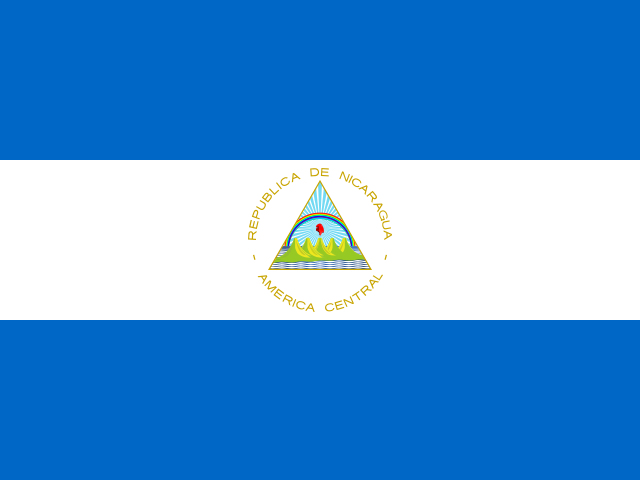
A blue-white-blue horizontal triband with the national coat of arms centred on the white band. Article 2 of the Ley sobre Características y Uso de los Símbolos Patrios assigns the colours their meanings, and they are not geographic: blue signifies justice and loyalty, white symbolises purity and integrity, and the blue is specified as cobalt. The arms set a chain of five dormant volcanoes of equal height on an isthmus between two seas inside an equilateral triangle, beneath a seven-coloured rainbow and the rays of a liberty cap. The law describes every element of them in construction detail without saying the volcanoes stand for the old Central American union. A constitutional reform published in February 2025 added a second national flag beside this one, the red and black of Sandino and of the Sandinista revolution.
Nicaragua FACTS ◢
| Capital | Managua |
|---|---|
| Continent | North America |
| Population | 7,007,502 (2025) |
| Area | 130,374 km² |
| Population density | 54/km² |
| Currency | Nicaraguan córdoba (NIO) |
| Official language | Spanish |
| Calling code | +505 |
| Internet TLD | .ni |
| Time zone | UTC-06:00 |
| Drives on the | Right |
| ISO codes | NI / NIC |
DID YOU KNOW? ◢
- It's the largest country in Central America by land area.
- Lake Nicaragua is the biggest lake in Central America and contains Ometepe, an island formed by two volcanoes.
- It sits on a chain of active volcanoes, some of which draw visitors for volcano boarding down their ash slopes.
- The city of León is home to the largest cathedral in Central America.
Nicaragua QUICK ANSWERS ◢
What is the capital of Nicaragua?
The capital of Nicaragua is Managua.
What is the population of Nicaragua?
Nicaragua had a population of 7,007,502 in 2025.
What currency does Nicaragua use?
Nicaragua uses the Nicaraguan córdoba (NIO).
What languages are spoken in Nicaragua?
The official language of Nicaragua is Spanish.
Think you know your flags? Play Flag Daily → · Browse all countries →
MORE ON THE FLAG ◢
Ask what the Nicaraguan flag means and the reading in circulation is that the two blue bands are the Pacific and the Caribbean and the white between them is the land. It is tidy. It is also not what Nicaragua's flag law says, and it is possible to name who published it.
The National Assembly did. On the "Historia de la Bandera Nacional" page the legislature ran on its own website at the turn of the century, under a heading offering the meaning of the flag and the coat of arms, it set out a gloss with no instrument behind it: the two blue bands, it said, stand for a national territory washed by two great oceans. The statute in force says something narrower and does not mention the sea at all.
That is one of two things about this flag that a summary usually misses. The other is more recent. Since February 2025 Nicaragua's constitution has not had a national flag. It has had two.
Key Takeaways
- Article 2 of the Ley sobre Características y Uso de los Símbolos Patrios, Decreto Legislativo 1908 of 1971, gives each of the two colours a meaning in the statute book and gives neither a geographic reading.
- The two-ocean reading was published by the National Assembly on its own "Historia de la Bandera Nacional" page, archived in 2000, alongside a longer list of colour meanings than the law contains.
- Since the constitutional reform published on 18 February 2025, the national symbols are the anthem, the coat of arms and two flags: the blue and white, and the red and black of Sandino and the Sandinista revolution.
- Ley 1249, given on 4 May 2025, repealed the 14 July Flag Day and replaced it with a 4 May "Día de las Banderas Nacionales", in the plural.
- Article 44 of the same symbols law specifies the coat of arms as a construction drawing, down to a rainbow struck at 90 and 104 millimetre radii and 45 rays of light three degrees wide.
| Instrument | Date | What it fixes | What it says the flag means |
|---|---|---|---|
| Decree of the Constituent Assembly of the Provincias Unidas del Centro de América | 21 August 1823 | The blue, white, blue bands and the triangular arms: five volcanoes, a rainbow, a liberty cap | Nothing |
| Decreto Legislativo of 21 April 1854 | 21 April 1854 | A yellow, white and nacre flag, with a single volcano in the arms | Nothing |
| Executive decree under José Santos Zelaya | 25 May 1897 | Sets the flag for ports and state vessels to the one described in article 22 of a Dieta regulation not obtained here | Nothing |
| Decreto Legislativo of 5 September 1908, where 1908 is the date | 5 September 1908 | Named by the current law as the instrument that created the coat of arms | Not established here; the decree could not be found |
| Ley sobre Características y Uso de los Símbolos Patrios, Decreto Legislativo N°. 1908, where 1908 is the decree number | La Gaceta 194, 27 August 1971 | The flag, its 3:5 proportions, cobalt blue, and the arms in construction detail, across 79 articles | Blue signifies justice and loyalty; white symbolises purity and integrity |
| Ley 432 | La Gaceta 135, 18 July 2002 | Re-enacts articles 34, 36, 42(b), 42(d), 46, 47, 48 and 73 of the symbols law | Nothing |
| Constitutional reform, Ley 1234, and the consolidated text | La Gaceta 32, 18 February 2025 | Names the red and black flag a national symbol beside the blue and white | Nothing beyond naming both |
| Ley 1249 | La Gaceta 79, 6 May 2025 | Moves Flag Day to 4 May and makes it plural | Nothing about the colours |
The two-ocean reading of the Nicaraguan flag is the National Assembly's, not the law's
The history page survives in the Internet Archive's capture of 16 August 2000, and its companion Símbolos Patrios page in a capture of 16 November 2001. The history page's list is longer than the statute's on every line. The white band, it says, stands for the nation's territory and the purity of the fatherland, and the colour white for purity, integrity and goodness. The law gives two of those three words and not the third.
On the blue: "Las dos franjas azules, simbolizan que el territorio nacional está bañado por dos grandes océanos: Atlántico y Pacífico", the two blue bands symbolising a national territory washed by two great oceans, the Atlantic and the Pacific. Then, separately, "El color azul indica: Valor, justicia, lealtad y fortaleza; también representa el color de nuestros mares y lagos" - courage, justice, loyalty and strength, and also the colour of the country's seas and lakes. Two of those four words are the law's. The other two are not, and neither is either half of the geography.
The page's "Atlántico" is worth defending rather than scoring a point off, because the constitution of the day used the same word for the same coast: it called the region the Costa Atlántica until article 47 of Ley 854 replaced the term in February 2014. The current text uses the newer one throughout, and its article 17 sets the national territory between the Mar Caribe, the Pacific and the republics of Honduras and Costa Rica.
The Assembly's companion "Símbolos Patrios" page reads the arms element by element, again with nothing cited: the triangle for equality, the rainbow for peace, the phrygian cap for liberty, and "Los Cinco volcanes expresan la UNIÓN y la FRATERNIDAD de los países de Centroamérica". The history page had given the volcanoes a different reading again, brotherhood and harmony rather than union and fraternity. So the state's gloss is real, and it is the state's. It is also not stable between two pages of one website, and none of it is in an instrument.
What Nicaragua's symbols law actually assigns the colours
The law is Decreto Legislativo 1908, the Ley sobre Características y Uso de los Símbolos Patrios, published in La Gaceta No. 194 of 27 August 1971 and carried in consolidated form by the Asamblea Nacional's Digesto Jurídico. Article 2 runs to four short paragraphs. The design: "El Pabellón de la República o Bandera Nacional es el Emblema Nacional y consta de tres franjas iguales horizontales: blanca la del centro y azules la superior e inferior, con el Escudo de Armas al centro de la franja blanca" - three equal horizontal bands, white in the centre, blue above and below, with the coat of arms at the centre of the white one. The shape is a rectangle of three by five, at any size that holds the proportion.
Then the only colour specification in the statute: "El color azul corresponde al comúnmente conocido como azul cobalto", the blue being the one commonly known as cobalt blue. No numbered colour value appears anywhere in the law, so it fixes no measurable shade against which a flag could be tested.
That is not the same as saying any blue will do, though the conformity provisions are narrower than they look. Article 54 requires faithful reproduction of the coat of arms; the limb that reaches flags is its second, which requires a manufacturer of national flags or arms to have the model approved by the ministry before the insignia reach the public. Article 55 is a one-off conversion duty rather than a standing one, obliging those already displaying the symbols in colours, dimensions or design other than those described to replace them, and exempting anything of historical value. Its companion window, the two years article 73 gave institutions to bring the arms into line, is recorded in the consolidated text as expired. So the mechanism is manufacturer approval plus a one-off conversion duty aimed at what was already on display in 1971, whose companion window for the arms expired in 1973. What it has never had is a number to run against.
The fourth paragraph is the meaning, one sentence long: "El color azul significa justicia y lealtad. El color blanco simboliza pureza e integridad". Blue signifies justice and loyalty, and white symbolises purity and integrity. That is the whole of it, with no ocean, no isthmus and no land between two seas.
The two seas are in the law, but in the coat of arms rather than the bands. Article 42(b) puts on the field "un terreno horizontal, un istmo, que toca ampliamente ambos lados oblicuos del triángulo, bañado por ambos mares", a horizontal stretch of ground, an isthmus, washed by both seas. That is one route by which the geographic reading could migrate outward, from the small device in the middle of the flag to the large bands around it.
Nicaragua now has two national flags, and the constitution says so
Article 13 of the consolidated constitution published in La Gaceta No. 32 of 18 February 2014 read: "Los símbolos patrios son: el Himno Nacional, la Bandera y el Escudo establecidos por la ley que determina sus características y usos". The anthem, the flag and the coat of arms, as established by the law that determines their characteristics and uses. One flag, with the substance handed to the symbols law.
The partial reform enacted by Ley 1234, published in La Gaceta No. 32 of 18 February 2025, replaced that sentence with this one: "Los símbolos patrios son: el Himno Nacional, las Banderas Azul y Blanco y la rojinegra de la lucha antiimperialista del General Augusto C. Sandino y de la Revolución Popular Sandinista, y el Escudo Nacional". The flags, plural: the blue and white, and the red and black of General Augusto C. Sandino's anti-imperialist struggle and of the Sandinista Popular Revolution. The deferral clause went with it, so the constitution no longer says the symbols are the ones the law establishes. It names them itself.
The article number depends on which of the two texts published that day you read. Ley 1234 sets the sentence out as article 13; the consolidated Texto Íntegro in the same gazette issue numbers it article 20. The offset is a constant seven, and it is the reform's own doing: Ley 1234 inserted seven articles into Title I as 5 bis through 5 octies, which the consolidated text absorbs as articles 6 to 12. The territory article moves from 10 to 17 on the same arithmetic.
The red and black had been approaching that status for four years: Ley 1066, published on 26 February 2021, declared the flag, seal and documents of Sandino's Ejército Defensor de la Soberanía Nacional material cultural heritage of the nation, and its anthem and songs intangible heritage.
The law that made Flag Day plural
Ley 1249 was given at Tipitapa on 4 May 2025 and published in La Gaceta No. 79 two days later. Its title declares 4 May to be both the Día de la Dignidad Nacional and the Día de las Banderas Nacionales; its article 1 adds the flags day to a dignity day it treats as already established. Its article 2 removes what was there before: "se deroga el Artículo 35 del Decreto Nº 1908, Ley sobre características y uso de los Símbolos Patrios, que establecía el 14 de julio como Día de la Bandera".
The reason given is unusually direct for a statute. The recitals reject the association of the old date with the abrogation of the Chamorro-Bryan Treaty of 1914, calling that abrogation a diplomatic farce.
Nicaragua's Ministry of Education has since put the plural in front of its own staff. A September 2025 notice on its site reports a talk to ministry administrative staff on the two flags as national symbols, framed as updating the historical knowledge of the teaching profession so the subject can be passed on in the classroom, and quotes the presidential culture adviser on the red and black: "Es una bandera roja y negra que está dentro de la Ley 1249", a red and black flag that sits inside Ley 1249.
The Nicaraguan coat of arms is written as a construction drawing
Article 44 of the symbols law gives the arms for a flag of 1.50 by 2.50 metres, and specifies them the way a draughtsman would rather than the way a herald would.
The rainbow is struck from the midpoint of the horizon, at a radius of 90 millimetres for its inner edge and 104 for its outer, the space between divided into seven equal bands for the seven colours. The liberty cap sits two centimetres below it, three centimetres tall. And the light it gives off is counted: "Se trazarán 45 rayos de 3 grados de anchura y quedarán entre ellos sectores de cielo de 5 grados", forty-five rays three degrees wide with five-degree gaps of sky between them, one dropping perpendicular to the horizon.
Article 43 handles colour with the same flatness. The volcanoes are yellowish green, lit with yellow on the side facing the cap. The liberty cap is vermilion red. The seas are a different blue from the bands around them, ultramarine rather than the cobalt of article 2. Not one of those lines says why.
Nicaragua's flag has not always been blue and white
The Assembly's history page counts three flags and three coats of arms across the country's independent life, and the middle one is easy to miss.
The first is the federation's. Article 1 of the decree of the Constituent Assembly of the Provincias Unidas del Centro de América, given at Guatemala on 21 August 1823, put on the triangle "la cordillera de cinco volcanes colocados sobre un terreno que se figure bañado por ambos mares", five volcanoes on ground shown as washed by both seas. Its article 4 set the blue, white and blue bands, with merchant vessels flying no arms but the words "Dios, Union, Libertad" in silver letters.
The Decreto Legislativo of 21 April 1854 replaced all of that. Its article 4 set outer bands of yellow above and nacre below, around the same white centre. Its article 1 swapped the triangle for a laurel-wreathed circle and cut the range to a single volcano with its base washed by both seas, beneath a civic crown reading "Libertad, Orden, Trabajo".
The move away came under José Santos Zelaya. A decree of 25 May 1897 set the flag for ports and state vessels to the one described in article 22 of the Reglamento of the Dieta of the República Mayor de Centro América, identifying it by cross-reference as the one "descrito en el artículo 22 del citado Reglamento". That Reglamento was not obtained for this article, so the decree leaves a cross-reference on the record rather than a picture. Eleven years later the legislature fixed the flag and arms in the form Nicaragua flies today, and the Assembly quotes that 1908 law still counting the volcanoes, as "una cordillera de cinco volcanes: bañados por dos mares".
The current text does not count them. Article 42(b), as re-enacted by Ley 432 in 2002, gives only "una cadena de volcanes en reposo, equidistantes entre sí, de igual altura", a chain of dormant volcanoes, equidistant and of equal height, with no number attached.
Five is still right, but now only by arithmetic. Article 44(e) places the two outer volcanoes, the nearer raising its truncated summit 2.5 centimetres above the horizon and the farther a single centimetre, then interposes the remaining three between them. The same clause is why equal height is a matter of appearance rather than measurement: all five are to look equidistant and the same height "de acuerdo a las leyes de la perspectiva".
What no Nicaraguan instrument opened for this article says is that the five stand for the five states of the old Central American federation. That reading is the National Assembly's website, and the union it names there is a fraternity between countries rather than a count of them.
The instrument that created the arms is not in Nicaragua's legal database
Article 42 of the symbols law opens by naming its own source: the coat of arms is "el Emblema creado por Decreto Legislativo de 5 de septiembre de 1908".
The same law also keeps it alive: article 78 keeps in force the laws on this subject promulgated on six dates, the first of them 5 September 1908, while article 77 immediately above it repeals the laws of eight others.
That decree is not in the Digesto Jurídico Nicaragüense. A search of every norm the Digesto records as approved in September 1908 returns thirteen results, and the only one dated 5 September is an authorisation for the executive to raise a loan. The Digesto does hold the 1823 federation decree, recorded as spent, the 1854 decree, recorded as tacitly repealed by the 1971 law, and the 1897 decree. It does not hold the one the statute in force points at.
The 1908 text is not lost, since the National Assembly quoted it on its own website and the 1971 law reproduces its substance at far greater length. But the primary instrument could not be opened for this article, which is worth saying plainly rather than leaving as an implied citation.
Nicaragua's flag law gives meaning one sentence and protocol most of its seventy-nine articles
The flag goes up at six in the morning and down at six in the evening. It salutes nobody: article 3 states that as emblem and representation of the fatherland, the national flag "no saluda ni rinde honores". Article 19 obliges every Nicaraguan citizen to fly it at the front of the house on the days commemorating Central American independence, and on any other day the legislature or the executive names.
Article 28 gives the duty to schoolchildren by name. Every Monday before lessons, "los cinco alumnos que se hubiesen distinguido por su aplicación y conducta en la semana anterior", the five pupils who distinguished themselves the previous week for application and conduct, raise the flag while the school sings the anthem, and lower it with the same honours on the last day of the week. A flag too worn to be shown with dignity is burned in private, unless it is judged to be of historical value, in which case it is kept instead, with its documentation.
One thing about the law is easy to miss. It was passed by the Chamber of Deputies on 18 August 1971, by the Senate on 23 August, and executed at the presidential house on 25 August over the signature of A. Somoza as President of the Republic. Ley 1249 repealed one of its seventy-nine articles in 2025 and did not touch the rest.
If you would rather test flags than read about them, Flag Daily shows one flag a day and gives you three guesses at the country.
Frequently asked questions
What does the Nicaraguan flag mean?
Article 2 of Nicaragua's Ley sobre Características y Uso de los Símbolos Patrios says the blue signifies justice and loyalty and the white symbolises purity and integrity. That is the only statement of meaning in the statute, and it says nothing about oceans, land or geography.
The widely repeated reading of the two blue bands as the Pacific and the Caribbean was published by the National Assembly on its own history page, archived in 2000, rather than enacted in any instrument.
Do the blue stripes on the Nicaraguan flag represent two oceans?
Not according to the law. Nicaragua's symbols law assigns the blue justice and loyalty and stops there. The two seas do appear in the statute, but in the coat of arms rather than in the bands: article 42(b) places an isthmus on the triangle washed by both seas.
The National Assembly's own website did give the two blue bands the two-ocean reading, together with a longer list of colour meanings than the statute contains.
How many national flags does Nicaragua have?
Two, since the constitutional reform published on 18 February 2025. The constitution now names as national symbols the anthem, the coat of arms and both the blue and white flag and the red and black flag of Sandino's anti-imperialist struggle and the Sandinista Popular Revolution.
Before that reform the constitution named a single flag and left its characteristics to the symbols law.
What are the five volcanoes on the Nicaraguan coat of arms?
Nicaragua's symbols law does not count them or say what they stand for. Article 42(b) describes only a chain of dormant volcanoes, equidistant and of equal height; five follows from the construction rules in article 44(e), which places the two outermost and interposes the remaining three.
The 1823 decree of the Central American federation did specify five, and the National Assembly's website reads them as the union and fraternity of the countries of Central America. That reading is the Assembly's own, not the statute's.
What shade of blue is the Nicaraguan flag?
The only specification in Nicaragua's symbols law is a name. Article 2 says the blue corresponds to the one commonly known as cobalt blue, and gives no numeric value, no ink reference and no tolerance.
The law does have conformity provisions, but narrow ones: article 54 requires a manufacturer of national flags or arms to have its model approved by the ministry beforehand, and article 55 put a one-off duty on those already displaying non-conforming symbols in 1971 to replace them. Neither supplies a measurable value for a shade to be tested against.
Sources
- Ley sobre Características y Uso de los Símbolos Patrios, Decreto Legislativo N°. 1908, Digesto Jurídico Nicaragüense, Asamblea Nacional. Consolidated text of the law published in La Gaceta, Diario Oficial No. 194 of 27 August 1971 and republished consolidated in La Gaceta No. 72 of 21 April 2022. Articles 2, 3, 5, 19, 28, 33, 35, 42, 43, 44, 54 and 55 are the ones this article uses. Retrieved 21 August 2026.
- Texto Íntegro de la Constitución Política de la República de Nicaragua, Digesto Jurídico Nicaragüense. Published in La Gaceta, Diario Oficial No. 32 of 18 February 2025. Article 20 holds the two-flag list and article 17 the territory. Retrieved 21 August 2026.
- Ley N°. 1234, Ley de Reforma Parcial a la Constitución Política de la República de Nicaragua, Digesto Jurídico Nicaragüense. Published in the same gazette issue of 18 February 2025. It sets the same sentence out as article 13, and inserts the seven articles 5 bis to 5 octies that shift the consolidated numbering. Retrieved 21 August 2026.
- Constitución Política de la República de Nicaragua, consolidated text, Digesto Jurídico Nicaragüense. Published in La Gaceta, Diario Oficial No. 32 of 18 February 2014. Its article 13 is the single-flag text the 2025 reform replaced. Retrieved 21 August 2026.
- Ley N°. 854, Ley de Reforma Parcial a la Constitución Política de la República de Nicaragua, Digesto Jurídico Nicaragüense. Published in La Gaceta, Diario Oficial No. 26 of 10 February 2014. Its article 47 directs that where "Costa Atlántica" is read in the constitution and in the legislation, "Costa Caribe" is to be read instead. Retrieved 21 August 2026.
- Ley N°. 1249, Ley que Declara el 4 de Mayo "Día de la Dignidad Nacional" y "Día de las Banderas Nacionales", Digesto Jurídico Nicaragüense. Published in La Gaceta, Diario Oficial No. 79 of 6 May 2025. Its article 2 repeals article 35 of the symbols law. Retrieved 21 August 2026.
- Ley N°. 432, Ley de Reforma Parcial a la Ley sobre Características y Uso de los Símbolos Patrios, Digesto Jurídico Nicaragüense. Published in La Gaceta, Diario Oficial No. 135 of 18 July 2002. It re-enacts article 42(b) and (d) and does not touch article 2. Retrieved 21 August 2026.
- Ley N°. 1066, declaring the flag, seal, documents, anthem and songs of the Ejército Defensor de la Soberanía Nacional cultural heritage, Digesto Jurídico Nicaragüense. Published in La Gaceta, Diario Oficial No. 40 of 26 February 2021. Retrieved 21 August 2026.
- Decreto de la Asamblea Nacional Constituyente, de 21 de agosto de 1823, sobre escudo de armas i pabellón, Digesto Jurídico Nicaragüense, from the Código de la Legislación de la República de Nicaragua. The federation instrument behind the design, recorded as spent. Retrieved 21 August 2026.
- Decreto Lejislativo de 21 de abril de 1854, designando las armas i el pabellón de la República, Digesto Jurídico Nicaragüense. The yellow, white and nacre flag with a single volcano, recorded as tacitly repealed by the 1971 symbols law. Retrieved 21 August 2026.
- Decreto of 25 May 1897 on the national flag in ports and state vessels, Digesto Jurídico Nicaragüense, published in Diario Oficial No. 245 of 1 June 1897, signed by J. S. Zelaya. Retrieved 21 August 2026.
- Historia de la Bandera Nacional, Asamblea Nacional de la República de Nicaragua. The legislature's own history and meaning page, carrying the two-ocean reading and the 1908 text of the arms. The live page at www.asamblea.gob.ni/Bandera.htm answers a security challenge to every client tried here, so the link goes to the Internet Archive capture of 16 August 2000. Retrieved 21 August 2026.
- Símbolos Patrios, Asamblea Nacional de la República de Nicaragua. The companion page reading the triangle, rainbow, cap and volcanoes, linked to the Internet Archive capture of 16 November 2001 for the same reason. Retrieved 21 August 2026.
- Servidores Públicos del MINED consolidan conocimientos históricos sobre: El Nacimiento de la Gritería Nicaragüense y las dos Banderas Símbolos Nacionales, Ministerio de Educación de Nicaragua, September 2025. Retrieved 21 August 2026.
PLAY ANOTHER →
One thing that happened today in history. Every day, a new one.
TODAY IN HISTORYDAILYDaily CodeA short message, hidden in a different cipher every day.
ONE CIPHER A DAYDAILYGuess the CountryThree clues, three guesses. Work out where in the world it is.
THREE CLUESDAILYDaily TriviaFive questions a day. Everyone gets the same five.
FIVE QUESTIONS