
Honduras
A Central American country of pine-covered mountains and Caribbean reef, Honduras guards the ancient Maya city of Copan and a stretch of the world's second-largest barrier reef just off its northern shore.
WHAT THE FLAG MEANS ◢
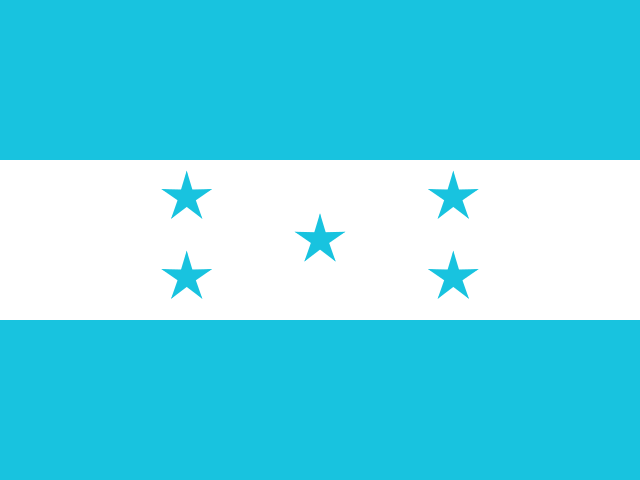
Two blue horizontal bands framing a white one, with five blue five-pointed stars in the centre, four of them set as a rectangle parallel to the bands and the fifth at its centre. Article 7 of the constitution names the flag as a national symbol and leaves its characteristics to ordinary law, assigning it no meaning itself, and the decree that fixes the design assigns none either. The five stars are conventionally read as the five states of the former United Provinces of Central America and the ideal of Central American union, the blue as the sky and the white as peace.
Honduras FACTS ◢
| Capital | Tegucigalpa |
|---|---|
| Continent | North America |
| Population | 11,005,850 (2025) |
| Area | 112,492 km² |
| Population density | 98/km² |
| Currency | Honduran lempira (HNL) |
| Official language | Spanish |
| Calling code | +504 |
| Internet TLD | .hn |
| Time zone | UTC-06:00 |
| Drives on the | Right |
| ISO codes | HN / HND |
DID YOU KNOW? ◢
- The ancient Maya city of Copan is famous for its intricately carved stone monuments and hieroglyphic stairway.
- Its Bay Islands sit on the Mesoamerican Reef, the second-largest barrier reef system in the world.
- The Rio Platano Biosphere Reserve protects one of Central America's largest remaining rainforests.
- Honduras was one of the first places Christopher Columbus reached on the American mainland, in 1502.
Honduras QUICK ANSWERS ◢
What is the capital of Honduras?
The capital of Honduras is Tegucigalpa.
What is the population of Honduras?
Honduras had a population of 11,005,850 in 2025.
What currency does Honduras use?
Honduras uses the Honduran lempira (HNL).
What languages are spoken in Honduras?
The official language of Honduras is Spanish.
Think you know your flags? Play Flag Daily → · Browse all countries →
MORE ON THE FLAG ◢
The Honduran flag is three horizontal bands, blue over white over blue, with five blue five-pointed stars in the middle band. The meanings usually given for it, the five stars as Central American union, the white as peace and the blue as the sky, are real and they are taught by the state, but they are not in the decrees that make the flag.
What the law does say about the colour is one word. The article Decree 29 of 1949 substituted into the 1866 flag law calls the outer bands "azul turquesa", turquoise blue, and that is the whole of it: no shade, no code, no reference to a standard.
So the same flag can be flown in two visibly different colours by a presidency and then by a Congress, without either of them breaking the law. It has been, twice, in the last four years.
Key Takeaways
- Decree 7 of 16 February 1866 created the flag and called the bands only "azules", blue, with no tone and no meaning.
- Decree 29 of 1949 rewrote that decree and added one word, turquesa, because the flags then in use did not match each other.
- The Honduran writer Rafael Heliodoro Valle suggested turquesa had been written for turquí, a much darker blue, which is close to the opposite of what turquoise means.
- The colours' meanings come from the education ministry's civics books, not from either decree or from the constitution.
- The fourth article Decree 29 substituted empowered the Executive to regulate the flag's use; the university reported in September 2023 that a presidency had asked for a separate regulation to set the colour; and no regulation of either kind was found in force.
| Instrument | Date | What it fixes | What meaning it assigns |
|---|---|---|---|
| Decree 7 | 16 February 1866 | Two blue bands and a white one, horizontal, with five blue five-pointed stars in the centre; each band nine inches wide and three to four varas long | None |
| Decree 29 | January 1949 | Rewrites Decree 7: three equal bands, the outer two azul turquesa, four stars set as a rectangle with the fifth at its centre, and a width half the length | None |
| Constitution, article 7 | 1982 | Names the flag a national symbol and refers its characteristics to ordinary law | None |
The 1866 decree says blue, and says nothing else about the colour
The instrument that created the flag is Decree 7 of 16 February 1866, passed under José María Medina and published in the Boletín Legislativo at Comayagua. Honduras's Secretaría de Educación reproduces it in its 2023 civics guide as two provisions, taken from a 1945 compilation.
The first sets the design: "El pabellón de la República de Honduras llevará como el de la antigua federación centroamericana, dos franjas azules y una blanca en medio, colocadas horizontalmente; además de un grupo de cinco estrellas azules de cinco ángulos salientes en el centro de la franja blanca." The flag of the Republic of Honduras will carry, like that of the old Central American federation, two blue bands and a white one in the middle, placed horizontally, plus a group of five blue stars of five projecting angles in the centre of the white band.
The second sets the size: "Las franjas del pabellón serán de tres a cuatro varas de longitud y de nueve pulgadas de latitud." Three to four varas long and nine inches wide.
Neither a shade nor a meaning appears anywhere in it. The stars are put on the flag without a word about what they stand for, and the colours are inherited from the federation's flag without a word about why that flag had them. The inheritance is shared, and Honduras's education ministry says what its own share of it was: the federation's flag survives in all five Central American flags, in the colours and in the arrangement of the bands, and in Honduras's case the ideal of Central American unity was kept with the five stars. El Salvador and Nicaragua took the same three bands and mark the white one differently.
The 1949 decree exists because the blues in use did not match
Decree 29 is not a new flag. Its article 1 says it is reforming the 1866 decree, "el cual se leerá así", which shall read as follows, and then sets out the four articles it substitutes.
Its recitals say why. The first complains about size: under the 1866 measurements the flag comes out "del todo desproporcionado e inconveniente", altogether disproportionate and inconvenient, and adds that not one flag is known that meets the legal requirements.
The second is the colour one. It recites that the tones of the colours vary "por ser diversas las tonalidades de los colores" among the flags then in use, that the arrangement of the stars is nowhere set down precisely, and that the result is "falta de uniformidad", a lack of uniformity.
So the 1949 Congress had the right diagnosis. Eighty-three years of a flag law that named no tone had produced a country full of flags that did not match. Its fix was to write one more word into the sentence.
The day it did so is not settled. The only photograph of the decree available here stops at its last article, before the date and the signatures, and the accounts disagree: El Heraldo gives 18 January 1949 and the national university gives 20 January. Neither the gazette issue nor its date could be reached for this piece.
They agree on the year, and the two that reproduce the substituted article agree on all of it but one clause. The printed page has "la superior y la inferior de color azul turquesa"; the university's version has "la superior e inferior de azul turquesa", dropping the word "color". Once Noticias reproduces only the opening of that article, and where it reaches, it matches the print.
The substituted article 1 fixes the stars, the proportion and one word
The substituted article 1 is the operative text today. It gives three equal horizontal bands, the upper and lower "de color azul turquesa" and the middle white, with five stars of five projecting angles in the middle "del mismo color azul", of the same blue.
It is precise about the stars. Four of them form "un cuadrilongo paralelo a las franjas", an oblong parallel to the bands, with the fifth placed at the centre of that quadrilateral. That is a quincunx, the five on a die.
It is precise about proportion too: the width of the three bands together must be contained twice in the length, so the flag is exactly twice as long as it is wide.
The other three substituted articles deal with the rest of the family. The war flag takes the same dimensions, with its remaining conditions referred to an article of the military ordinance then in force, whose number is not legible in the page image available here. The merchant flag carries no inscriptions of any kind. And the fourth is the one worth keeping in mind: "Facultar al Poder Ejecutivo para que reglamente el uso de la Bandera que se instituye", giving the Executive the power to regulate the use of the flag it institutes.
What the substituted text does not do, anywhere in those four articles, is say what any of it means.
A Honduran writer suggested turquesa was written for turquí, its near-opposite
The word the decree chose has a problem. Turquesa is the colour of turquoise, a pale green-blue. Turquí is a different Spanish word for a different blue, and on the account the national university reproduces it is the darkest blue there is.
The Universidad Nacional Autónoma de Honduras quotes the writer Rafael Heliodoro Valle raising exactly that. It is possible, Valle says, that in speaking of azul turquesa what was meant was azul turquí, and he treats the second as the exact term: "Un término preciso, que corresponde al azul de los ejemplares de bandera que distribuye la Secretaría de Relaciones Exteriores." A precise term, corresponding to the blue of the flag samples the foreign ministry distributes.
He then quotes the heraldist Luis D. Gardel on the two words. Of turquesa, Gardel says the dictionary of the Real Academia records it as an old adjective meaning Turkish. The adjective that denotes a colour is turquí, and "es el azul más obscuro. Es el sexto color del espectro solar", the darkest blue, the sixth colour of the solar spectrum, as against celeste, which "es el más claro", the lightest.
If that is right, then one syllable of a 1949 statute is the difference between a pale flag and a dark one, and everyone arguing about it since has been reading the same word.
The national archive shows sky blue being bought for a garrison's flags in 1853
Ingris Lagos Soriano, Julio José Méndez and Denis Eduardo Ramírez, historians at the national university, were asked by the presidency to work out what the flag's blue had actually been. Their commission set out to reconstruct the tones used between 1866 and 2021 and to recommend one, and the university published the result in April 2023.
The oldest document they report is an order from President José Trinidad Cabañas dated 10 December 1853, held in the national archive. It instructs the customs house at Omoa to buy, in that port or from Belize or Havana, "veinte varas de tafetán azul celeste y diez blanco", twenty varas of sky-blue taffeta and ten of white, for the flags of the plaza.
That is thirteen years before the flag existed as such, and the word is celeste, the lightest blue, not turquesa and not turquí. The April account adds that light tones prevailed through the nineteenth century, though dark-blue representations were found as well, and that one of the sources consulted was a nineteenth-century Central American federation flag held at the Royal Museums Greenwich. The September account, which is the one that describes the method, lists a corpus of images together with written sources; neither says how that flag was examined.
The commission's recommendation was a hexadecimal code, #3f888f, which it describes as a shade of cyan and gives as 24.71% red, 53.33% green and 56.08% blue. Those percentages do check out against that code. What matters more is where it came from: the September account describes the method as sampling colours with a picker tool from a corpus of a hundred images dating between 1937 and 2023, rather than measuring a dyed cloth. It is a recommendation rather than a rule, and no instrument found here enacts it.
The university does record an attempt to turn it into one. The September account says the findings went to the dean, then to the rector, then to President Castro, who asked the social-development secretary, the education secretary and the commission itself for "la creación de un reglamento que será presentado al Poder Legislativo con la finalidad de normar de manera oficial el color de la Bandera Nacional", the making of a regulation to be put to Congress so as to set the flag's colour officially. Seventy-four years after Congress gave the Executive the power to regulate the flag's use, a presidency was asking for a separate regulation to set its colour, and for that one to go to Congress. Nothing found here shows either in force.
The anthem calls the stars pale blue, and the anthem is an official text
There is one instrument that does describe the flag's colour, and it is not the flag law. Honduras's national anthem, made official by Decree 42 of 13 November 1915, opens its chorus on the flag: "Tu bandera es un lampo de cielo por un bloque de nieve cruzado; y se ven en su fondo sagrado cinco estrellas de pálido azul". Your flag is a gleam of sky, crossed by a block of snow, and against its sacred field five stars of pale blue.
Pale blue is a third answer, sitting beside turquesa and turquí, and it reached an official text thirty-four years before turquesa did.
The university's researchers list the anthem among their sources for exactly that reason. The education ministry's own book about the anthem relays that finding, crediting the same three researchers, and what it puts the line behind is worth following: the 1853 Cabañas order and the anthem's pálido azul are cited in support of its conclusion that the colour officially used is azul turquí, which on Gardel's account is the darkest blue there is. A sky-blue purchase order and a line about pale stars are made to carry the darkest reading available.
None of this is a legal specification. An anthem is a poem that a decree made official, and a poem is not a colour standard. But when the flag statute gives one contested word and the anthem gives a different one, a reader is entitled to notice that the state has been telling itself two things.
The education ministry's two civics books disagree about when turquesa entered the law
The Secretaría de Educación published both of its current civics books in October 2023, through the same imprint. They do not agree.
The Cátedra del Himno Nacional de Honduras gets it right: "En el Decreto 29, la bandera sufrió modificaciones con el establecimiento del color azul turquesa en 1949". Under Decree 29 the flag was modified with the establishment of the colour azul turquesa in 1949.
The Guía de símbolos, próceres, heroínas y héroes patrios de Honduras contradicts itself inside a single sentence. Having just printed the 1866 decree, it observes, correctly, that no specific tone of blue is mentioned in it, and then says: "por ello, en el Decreto Legislativo N° 7, del 16 de febrero de 1866, se estableció que el color era el azul turquesa." For that reason, in Legislative Decree 7 of 16 February 1866, it was established that the colour was azul turquesa.
The decree it has quoted as silent about the tone is the decree it then credits with fixing it. That claim also travels: it is the same one the verification desks of El Heraldo and La Prensa ruled false in January 2026, after Angélica Álvarez, a former human-rights secretary, made it on X.
The Cátedra has its own version of the tangle. In one paragraph it gives the flag's colour as azul turquesa with the code the university had recommended, and then, two sentences later and without leaving that paragraph, concludes that "el color utilizado oficialmente en la representación de la bandera es el azul turquí", the colour officially used is azul turquí. Turquesa and turquí are the two readings the whole argument is between, and one paragraph asserts both.
The meanings come from the ministry, not from a decree
Set the tone question aside and the meanings are easier, because there is nothing to reconcile. Neither 1866 nor 1949 assigns one, and article 7 of the constitution of 1982 is a referral rather than a description: "Son símbolos nacionales: La Bandera, el Escudo y el Himno. La Ley establecerá sus características y regulará su uso." The flag, the arms and the anthem are national symbols, and the law will establish their characteristics and regulate their use.
The readings people quote are the education ministry's. Its symbols guide says the five stars stand for the union and fraternity of the Central American nations, and then, in one sentence, that "el color blanco simboliza la paz y el azul turquesa el cielo nacional", white symbolises peace and azul turquesa the national sky. Its anthem book says the two blue bands "representan el cielo patrio", and gives white peace, serenity and purity.
Note what is not there. A widespread English-language gloss gives the two blue bands the Pacific and the Caribbean, with Honduras between them. Those seas are a real Honduran symbol, but the same ministry puts them on the coat of arms, whose two seas it reads as the Atlantic and the Pacific. No source opened here attaches them to the flag.
If you want to test how much of a flag you can actually place, Flag Daily shows one flag a day and gives you three guesses at the country.
The flag has been flown in two blues in four years and the law has not changed at all
In January 2022, on taking office, Xiomara Castro instructed that the flag be represented in azul turquesa in place of the dark tone that had traditionally been used. The commission at the national university reported the following year, and one of its three researchers told the university's own magazine that a scientifically validated representation of the flag would head off changes tied to political interests.
Four years later the opposite happened, and quietly. El Heraldo reported on 23 January 2026 that the darker flag had appeared at the installation of the new legislature, and Once Noticias reported on 25 January that the National Congress had adopted navy bands in its official acts and spaces, days before the new administration took office. Once Noticias is careful about the scope, saying the measure is limited to the tone used by the legislature. Days earlier the verification desks of El Heraldo and its sister paper La Prensa had run the same check on a claim circulating that the incoming president had announced the change, and both ruled it false. There was no such announcement.
There did not need to be one. Nothing in the law had changed. The substituted article still says azul turquesa, article 7 of the constitution still refers the flag's characteristics to ordinary law, and no regulation of the flag's use was found in force. A flag whose colour is fixed by one contested word is a flag that can be repainted by whoever is currently raising it.
Frequently asked questions
What does the Honduran flag mean?
No decree opened here assigns the flag a meaning. The instrument that created it, Decree 7 of 1866, describes the design and stops, and Decree 29 of 1949, which rewrote it, does the same. The meanings in general use are the education ministry's: the five stars for the union and fraternity of the Central American nations, white for peace, and the blue for the national sky. Article 7 of the constitution names the flag a national symbol and leaves its characteristics to ordinary law without describing it.
Why does the Honduran flag have five stars?
Because Honduras kept the flag of the Central American federation and added them. Decree 7 of 1866 says the flag will carry, like that of the old federation, two blue bands and a white one, plus a group of five blue stars of five projecting angles in the centre. The decree gives no reason for the number. The reading taught in Honduras is that the five stand for the Central American nations and the ideal of their union; the country's anthem book ties the same idea to Francisco Morazán.
What shade of blue is the Honduran flag?
The law does not say beyond one word. The article Decree 29 of 1949 substituted into the 1866 flag law calls the outer bands azul turquesa, turquoise blue, and gives no shade, code or standard. A university commission recommended the hexadecimal code #3f888f in 2023, but a recommendation is not a statute, and no instrument found here enacts it. The Honduran writer Rafael Heliodoro Valle also raised the possibility that turquesa was written for turquí, a much darker blue, in which case the statute's one word points the other way.
Why is the Honduran flag navy again in some official settings?
Because nothing in the law prevents it. Xiomara Castro instructed in January 2022 that the flag be represented in azul turquesa in place of the dark tone traditionally used. Once Noticias then reported on 25 January 2026 that the National Congress had adopted navy bands in its official acts and spaces, days before the new administration took office. The week before, the verification desks of El Heraldo and La Prensa had already ruled false a claim that the incoming president had announced one, and no instrument was found altering the 1949 text either way. Both flags answer to the same one-word description.
Do the two blue bands stand for the Pacific and the Caribbean?
Not according to any source opened here. The 1866 decree assigns the colours nothing, the 1949 decree assigns them nothing, and Honduras's education ministry reads the blue as the sky and the white as peace. The oceans are a real Honduran symbol, but the ministry puts them on the coat of arms, whose two seas it reads as the Atlantic and the Pacific, rather than on the flag's bands.
Sources
- Congreso Nacional de Honduras, Decreto Número 29 of 1949, reforming Decree 7 of 1866 - read from a photograph of the Boletín Legislativo page carrying it, published by El Heraldo on 26 January 2022 with the credit "Cortesía analista Miguel Cálix Martínez". The image has no text layer and a watermark across the centre of the page, so every quotation here was transcribed from magnified crops of that photograph. The crops do not resolve accents, so the Spanish from this decree is given in modern accentuation, and the article number it cites from the military ordinance does not resolve at all, which is why it is not stated. Retrieved 21 August 2026.
- Secretaría de Educación de Honduras, Gabriela Eunice Ardón and José David Guerra, Guía de símbolos, próceres, heroínas y héroes patrios de Honduras (Editorial Sabio Valle, October 2023) - source for the text of Decree 7 of 1866 as it reproduces it from Valladares Valeriano (1945), for the ministry's readings of the colours and the stars, and for the sentence crediting the 1866 decree with fixing the tone. Retrieved 21 August 2026.
- Secretaría de Educación de Honduras, Orlin Manuel Duarte, Gabriela Eunice Ardón and José David Guerra, Cátedra del Himno Nacional de Honduras (Editorial Sabio Valle, October 2023) - source for the chorus of the national anthem, for the ministry's account of Decree 42 of 1915, and for the paragraph that gives the flag's colour as both azul turquesa and azul turquí. Retrieved 21 August 2026.
- Elin J. Rodríguez, "Investigadores de la UNAH identifican color original de la Bandera Nacional", Presencia Universitaria, Universidad Nacional Autónoma de Honduras, 13 April 2023 - source for the Cabañas order of 1853, for Rafael Heliodoro Valle and Luis D. Gardel on turquesa and turquí, and for the recommended colour code. The page now returns a 404, so it was read from the Internet Archive capture of 21 April 2026. Retrieved 21 August 2026.
- Hugo Espinal, "Investigadores de la UNAH describen proceso para identificar los colores de la Bandera de Nacional de Honduras", Presencia Universitaria, Universidad Nacional Autónoma de Honduras, 5 September 2023 - source for the commission's remit, its membership, the image-sampling method behind the colour code, and the request for a regulation of the colour. Also read from the Internet Archive, capture of 22 April 2026. Retrieved 21 August 2026.
- Constitución de la República de Honduras, Decreto Número 131 of 1982 with subsequent reforms, article 7, text published by the Tribunal Superior de Cuentas - searched in full for any provision describing the flag or assigning it a meaning. Retrieved 21 August 2026.
- José Quezada, "El azul turquesa de la Bandera Nacional se oficializó en 1949, no en 1866", El Heraldo (Tegucigalpa), 28 January 2026 - the verdict on the claim that the 1866 decree fixed the tone. Retrieved 21 August 2026.
- Paola Ávila, "Es falso que Nasry Asfura haya anunciado cambio en los colores de la Bandera Nacional", El Heraldo (Tegucigalpa), 21 January 2026 - source for the absence of any announcement behind the 2026 change, and for the Boletín Legislativo de Comayagua as the place of publication of the 1866 decree. Retrieved 21 August 2026.
- Paola Ávila, "Es falso que Nasry Asfura haya anunciado cambio en los colores de la Bandera Nacional", La Prensa (San Pedro Sula), 21 January 2026 - the same verification, published the same day by El Heraldo's sister paper in the OPSA group under its own byline and dateline. Both are cited because both are named in the text; they are one check, not two independent ones. Retrieved 21 August 2026.
- José Quezada, "El azul turquesa de la Bandera Nacional se oficializó en 1949, no en 1866", La Prensa (San Pedro Sula), 28 January 2026 - the La Prensa printing of the same 1949 verdict, under its own byline and dateline. Retrieved 21 August 2026.
- Julio Cruz, "Cambian color de la Bandera y volverá al azul tradicional", El Heraldo (Tegucigalpa), 23 January 2026 - source for the darker flag appearing at the installation of the new legislature, and the only source consulted here that dates Decree 29 to 18 January 1949, against the 20 January the university gives. Retrieved 21 August 2026.
- "¿Cambiarán de nuevo el color de la Bandera de Honduras? Congreso Nacional retoma color azul marino en primera legislatura", Once Noticias (Tegucigalpa), 25 January 2026 - source for the return to navy in the Congress's official acts, and a second reproduction of article 1 of each decree. Retrieved 21 August 2026.
- Dalma Acosta, "El error histórico que no debe repetirse al implementar la Bandera azul turquesa", El Heraldo (Tegucigalpa), 26 January 2022 - source for the 2022 adoption of turquoise, and the article that carries the photograph of the 1949 decree. Retrieved 21 August 2026.
- Empresa Nacional de Artes Gráficas, La Gaceta digital archive - checked for the gazette issue carrying Decree 29. Its digital archive begins at 2015, so the 1949 issue could not be read, and no source consulted here reproduces it. That is why this article dates the decree only to January 1949 and says nothing about its publication. Retrieved 21 August 2026.
PLAY ANOTHER →
A short message, hidden in a different cipher every day.
ONE CIPHER A DAYDAILYGuess the CountryThree clues, three guesses. Work out where in the world it is.
THREE CLUESDAILYDaily TriviaFive questions a day. Everyone gets the same five.
FIVE QUESTIONSDAILYDaily CryptogramOne quote, one scrambled alphabet. Crack it before tomorrow.
CRACK THE QUOTE