
El Salvador
The smallest and most densely packed country in Central America, strung with volcanoes and a Pacific coastline that surfers quietly adore. El Salvador does a lot in a small footprint.
WHAT THE FLAG MEANS ◢
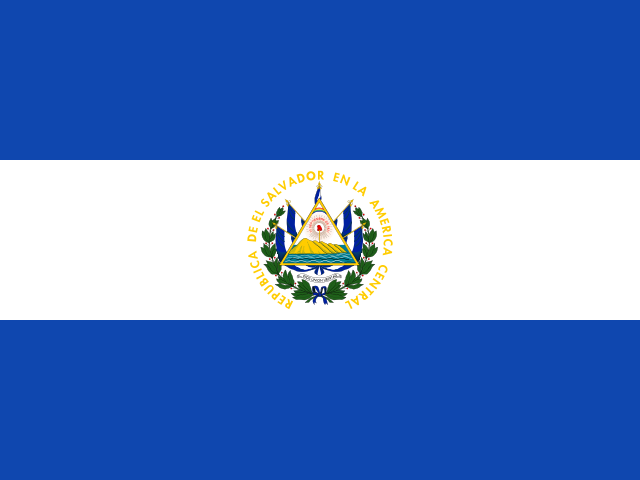
Three horizontal bands of blue, white and blue, all of the same size. The Ley de Simbolos Patrios (Decreto Legislativo 115 of 1972) describes the flag in exactly those terms and assigns the colours no meaning at all; the familiar reading of blue as the two oceans of Central America and white as peace comes from the Presidency's national symbols page, not from the statute. The white band carries either the coat of arms, a triangle with five volcanoes, a rainbow and a liberty cap, or, on the flags flown over public buildings and carried in parades, the motto 'Dios, Union, Libertad' in its place.
Source: asamblea.gob.sv
El Salvador FACTS ◢
| Capital | San Salvador |
|---|---|
| Continent | North America |
| Population | 6,365,503 (2025) |
| Area | 21,041 km² |
| Population density | 303/km² |
| Legal tender | United States dollar (USD) and Salvadoran colón (SVC) |
| Official language | Spanish |
| Calling code | +503 |
| Internet TLD | .sv |
| Time zone | UTC-06:00 |
| Drives on the | Right |
| ISO codes | SV / SLV |
DID YOU KNOW? ◢
- It's the smallest country in mainland Central America.
- It's nicknamed 'the Land of Volcanoes' for the chain of peaks running through it.
- It has no Caribbean coast, facing only the Pacific Ocean.
- Its Pacific breaks, like those at El Tunco, draw surfers from around the world.
El Salvador QUICK ANSWERS ◢
What is the capital of El Salvador?
The capital of El Salvador is San Salvador.
What is the population of El Salvador?
El Salvador had a population of 6,365,503 in 2025.
What currency does El Salvador use?
El Salvador uses the United States dollar (USD) and Salvadoran colón (SVC).
What languages are spoken in El Salvador?
The official language of El Salvador is Spanish.
Think you know your flags? Play Flag Daily → · Browse all countries →
MORE ON THE FLAG ◢
The El Salvador flag is three equal horizontal bands, blue over white over blue. One article of the statute defines it, and that article gives the colours nothing.
Article 5 of the Ley de Símbolos Patrios, passed as Legislative Decree 115 on 14 September 1972, runs to two short sentences. No shade of blue. No ocean, no sky, no peace.
The reading everybody repeats comes from somewhere other than the law.
Key Takeaways
- The Constitution names the flag as a national symbol in Article 64 and leaves the design to the Ley de Símbolos Patrios, whose one descriptive article assigns the colours nothing.
- The Presidency's symbols page supplies the familiar reading, blue for the two oceans of Central America and white for peace, and credits the emblem's meanings to writers and poets, not to the state.
- Three official national flags exist, not one, and two of the three carry the motto DIOS UNION LIBERTAD in place of the coat of arms.
- The design is the 1823 flag of the United Provinces of Central America, brought back in 1912 after 47 years of stars and stripes.
| Flag and use | Size set by the statute | What the white band carries | Where it is used |
|---|---|---|---|
| Bandera magna (Articles 7, 8) | 3.35 m by 1.89 m | The coat of arms, with all its blazons | State ceremonies and national commemorations |
| Buildings and offices (Articles 9, 10) | 1 m by 0.60 m | The legend DIOS UNION LIBERTAD, God, Union, Liberty | Every state building |
| Parade flag (Article 11) | 1.45 m by 0.90 m | DIOS UNION LIBERTAD in gold letters | Civic and school parades |
| Delegations abroad (Article 12, the buildings flag with the arms) | 1 m by 0.60 m | The coat of arms, with all its blazons | Official missions representing the country abroad |
One figure needs care: the Presidency's symbols page gives the flag as 3.25 m long by 1.89 m wide, where Article 7 makes the bandera magna 3.35 m by that same width. The statute controls.
What do the colours on the El Salvador flag mean?
Legally, nothing. Article 5 reads: "La Bandera nacional se compone de dos franjas horizontales color azul, e interpuesta entre ellas una franja blanca, en un rectángulo de tela. Las tres franjas tendrán las mismas dimensiones." Two horizontal blue bands, a white one set between them, on a rectangle of cloth, the three of the same dimensions. That is the entire definition, and no later article returns to the subject. The consolidated text published by the Legislative Assembly carries reforms to 2008, and the reform of 20 July 2021 adds Article 28-A, which allows the Assembly to use the phrase PUESTA NUESTRA FE EN DIOS in the Salón Azul and its other official premises, leaving Articles 2 and 5 untouched.
The Constitution refers the matter out rather than describing the flag. Article 64 names the national symbols and says a law shall regulate the matter; Article 131 leaves the decreeing of them to the Legislative Assembly. Neither text mentions an ocean.
In a looser sense the familiar reading is official. The Presidency's national symbols page says the two blue bands symbolise the two oceans that wash Central America, the Pacific and the Atlantic, while white symbolises peace. That is the government of the day speaking, not the statute, and it describes Central America rather than El Salvador, which has no Atlantic coastline at all.
The same page is unusually careful about the emblem. It notes that writers and poets have read the emblem differently over the years, and credits each reading to them: the triangle for liberty, equality and fraternity, the five volcanoes for the scattered parcels of the greater homeland.
Why does the El Salvador flag sometimes carry words instead of an emblem?
Because Article 6 creates three official national flags, and the arms belong to only one of them.
Articles 9 and 11 put the legend DIOS UNION LIBERTAD across the white band of the buildings flag and the parade flag instead of the arms. Article 12 is the exception: delegations abroad carry the buildings flag with the arms restored.
The split is older than the statute. The 1823 federal decree that created the design put the arms on the national flag and ordered merchant vessels to fly the same three bands with no arms and the words Dios, Unión, Libertad along the white band in silver letters. Article 11 makes them gold, and Flags of the World carries contributor reports, which it records rather than settles, that the change came after the Second World War.
What is on the Salvadoran coat of arms?
Article 2 of the 1972 law is entirely descriptive, and what it describes is the 1823 federal blazon that Nicaragua kept too. An equilateral triangle in gold lines. Along its base five green volcanoes, decreasing in size from left to right, on ground shown as bathed by two seas. Above them a rainbow, and beneath the arch the cap of Liberty scattering light, with 15 DE SEPTIEMBRE DE 1821 read among its rays. Around the triangle, in gold, REPUBLICA DE EL SALVADOR EN LA AMERICA CENTRAL. Five Salvadoran flags emerge from it, two per side and one over the apex.
The laurel is the detail worth knowing. Two branches are tied in a circle with a blue and white ribbon, and the statute fixes no number of sprigs, only a formula: the number shall equal the number of administrative departments of the Republic. Article 200 of the Constitution leaves that number to ordinary law rather than setting it. The Presidency's symbols page puts the sprigs at 14, one for each department.
Why do Guatemala, Honduras and Nicaragua share these colours?
One decree, in 1823.
On 21 August that year the Constituent Assembly of the United Provinces of Central America, sitting in Guatemala, decreed the arms and the flag together. That flag was to be the same three bands, with the arms on the white one. The arms it described are the ones El Salvador still carries, element for element.
The union collapsed. Its flag survived four times over. Guatemala turned the bands upright, Honduras added five stars, Nicaragua kept the triangle and rainbow inside its own emblem, and Costa Rica pushed a red band through the middle. The federation had five member states and its arms had five volcanoes, the obvious root of the five-states reading, but the decree never draws the link. Four more flags out of one decree. The survivors turn up together in Flag Daily.
When did El Salvador adopt the flag it flies now?
Twice, with a long American-looking gap in between.
From 1865 the country flew nothing of the sort. The Presidency's account describes five blue stripes and four white ones, with a red canton of white five-pointed stars, adopted by decree on 28 April 1865 under President Francisco Dueñas. Its stars tracked the departments, rising from nine to 14 by 1875.
Blue and white returned by legislative decree of 17 May 1912. The 1972 law's own recitals describe that decree as adopting the arms and flag of the Central American Federation. The Presidency's account has President Manuel Enrique Araujo raising the new flag on 15 September 1912 at the Campo de Marte in San Salvador.
Frequently asked questions
Does Salvadoran law say what the blue and white stand for?
No. Article 5 of the Ley de Símbolos Patrios describes two blue bands with a white band between them and assigns neither colour any meaning. Article 64 of the Constitution refers the question to that statute.
What do the words DIOS UNION LIBERTAD mean?
God, Union, Liberty. Articles 9 and 11 of the Ley de Símbolos Patrios write the motto across the white band of the flag flown over public buildings and the flag carried in parades, in place of the coat of arms. The statute prints the phrase and, as with the colours, never explains it.
What are the official proportions of the Salvadoran flag?
The statute fixes no ratio. It gives each of the three flags measurements of its own and they do not agree: 3.35 m by 1.89 m for the bandera magna, about 1.77 to 1; 1 m by 0.60 m for the buildings flag, or 5 to 3; 1.45 m by 0.90 m for the parade flag, about 1.61 to 1. Articles 7 and 9 let the first two be enlarged where the setting warrants, so those figures can be exceeded.
Does El Salvador have a separate flag for ships?
No. The 1972 statute creates no separate ensign for merchant or civil use: Article 14 sends national and Salvadoran-registered vessels to the treaties, conventions and special provisions that apply to them, rather than giving them a design of their own. Flags of the World catalogues the arms-less version under the heading civil ensign, but that is a vexillological label for the flag the statute assigns to public buildings and parades, not a design the law creates for ships.
Can anyone fly the Salvadoran flag, or is it restricted?
Yes, within limits. Article 13 allows the flag in reduced dimensions, with the arms, with the legend, or as the bare colours, on state property that warrants it, and extends the same permission to private people for civic celebrations. Article 10 pulls the other way for the state: the buildings flag is compulsory in every state building all year, in a place of honour, and on national holidays it is raised at 6am and lowered at 6pm.
Sources
- Asamblea Legislativa de la República de El Salvador, Ley de Símbolos Patrios, Decreto Legislativo N° 115 of 14 September 1972, consolidated text carrying reforms to 2008 - retrieved 12 August 2026.
- Presidencia de la República de El Salvador, Símbolos Patrios - retrieved 12 August 2026.
- Asamblea Legislativa de la República de El Salvador, Constitución de la República, consolidated text, Articles 64, 131 and 200 - retrieved 12 August 2026.
- Asamblea Nacional de la República de Nicaragua, Decreto de la Asamblea Nacional Constituyente, de 21 de Agosto de 1823, sobre Escudo de Armas i Pabellón - retrieved 12 August 2026.
- Asamblea Legislativa de la República de El Salvador, Decreto Legislativo N° 101 of 20 July 2021, Reforma a la Ley de Símbolos Patrios, published in Diario Oficial N° 142, Tomo 432, of 26 July 2021 - retrieved 12 August 2026.
- Flags of the World, El Salvador, Civil Ensign and Alternative State Flag - retrieved 12 August 2026.
PLAY ANOTHER →
A short message, hidden in a different cipher every day.
ONE CIPHER A DAYDAILYOn This DayOne thing that happened today in history. Every day, a new one.
TODAY IN HISTORYDAILYGuess the CountryThree clues, three guesses. Work out where in the world it is.
THREE CLUESDAILYDaily TriviaFive questions a day. Everyone gets the same five.
FIVE QUESTIONS