
Guatemala
The heart of the ancient Maya world, Guatemala stacks volcanoes, cloud forest and colonial towns into Central America's most populous country, with the temples of Tikal rising straight out of the jungle canopy.
WHAT THE FLAG MEANS ◢
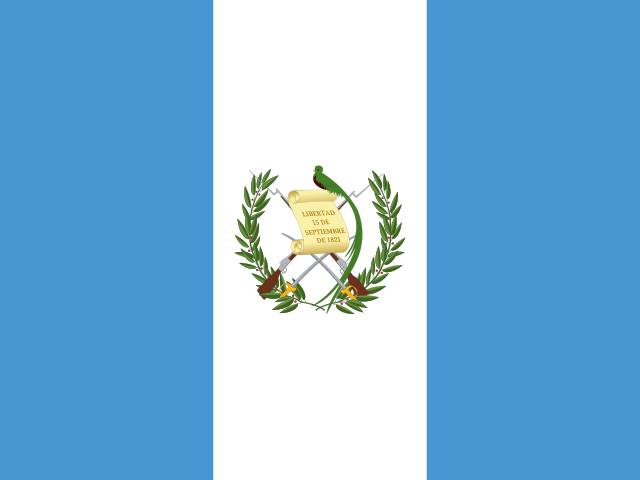
Two blue vertical bands flanking a white one, with the national coat of arms at the centre, carrying a quetzal, a scroll, two Remington rifles crossed at right angles, two swords and laurel branches. Article 3 of Decree 104-97 assigns the colours their meanings, and they are not geographic: white represents purity, peace, integrity, firmness and light, and blue expresses strength, justice, truth and loyalty. The same article reads the arms, giving the sword as justice and sovereignty, the laurel branches as victory, the scroll as the immortality of the date of the nation's birth, and the quetzal as the supreme symbol of liberty. The reading of the two blue bands as the Pacific and the Caribbean is not the law's.
Guatemala FACTS ◢
| Capital | Guatemala City |
|---|---|
| Continent | North America |
| Population | 18,687,881 (2025) |
| Area | 108,889 km² |
| Population density | 172/km² |
| Currency | Quetzal (GTQ) |
| Official language | Spanish |
| Calling code | +502 |
| Internet TLD | .gt |
| Time zone | UTC-06:00 |
| Drives on the | Right |
| ISO codes | GT / GTM |
DID YOU KNOW? ◢
- The ancient Maya city of Tikal has towering stone temples that rise above the rainforest canopy.
- It has more than 30 volcanoes, several of which are still active.
- Lake Atitlan, ringed by volcanoes, is often called one of the most beautiful lakes in the world.
- The quetzal, its national bird, is so prized that the currency is named after it.
- More than 20 distinct Mayan languages are still spoken across the country today.
Guatemala QUICK ANSWERS ◢
What is the capital of Guatemala?
The capital of Guatemala is Guatemala City.
What is the population of Guatemala?
Guatemala had a population of 18,687,881 in 2025.
What currency does Guatemala use?
Guatemala uses the Quetzal (GTQ).
What languages are spoken in Guatemala?
The official language of Guatemala is Spanish.
Think you know your flags? Play Flag Daily → · Browse all countries →
MORE ON THE FLAG ◢
Guatemala has a statute that says what its flag's colours stand for. Article 3 of Decree 104-97 is the source of every official meaning attached to the blue and the white, and of the readings given to the sword, the laurel, the scroll and the quetzal inside the coat of arms.
That article was passed on 28 October 1997. The flag it describes was fixed in its present form by two decrees of 1871.
The two decrees of 1871 that set the flag and the arms assign the flag and the arms almost no meaning. Whether anything in the 126 years between them and 1997 did is not a question this article can settle, because the only instruments opened here are those three and the 1985 constitution, which turns out to mention no national symbol at all. What the 1871 flag decree does explain is the choice of blue and white, and its explanation is a date rather than a landscape; the single element either decree read symbolically is now read differently by the law in force.
Key Takeaways
- Decree 12 of 17 August 1871 set the flag out in four short articles and gave its colours no meaning at all.
- The reason it gives for blue and white is that they restore the colours fixed by a constituent assembly on 21 August 1823.
- Decree 33 of 18 November 1871 replaced the coat of arms and read only one element of the new design, the quetzal, as a symbol of independence and autonomy.
- Decree 104-97 of 1997 assigned meanings to both colours and to four elements of the arms, and reads the quetzal as the supreme symbol of liberty rather than as a symbol of independence and autonomy.
- Guatemala's constitution does not mention the flag, the arms or any national symbol.
| Instrument | Date | What it fixes | What meaning it assigns |
|---|---|---|---|
| Decree 12 | 17 August 1871 | Blue and white in three vertical bands with white in the centre; the arms on the white band; a merchant flag without the arms; the cockade | None |
| Decree 33 | 18 November 1871 | Two rifles and two swords in gold, laurel branches, a light sky-blue field, the scroll legend, the quetzal above it | The quetzal only |
| Decree 104-97 | 28 October 1997, published 26 November | A five by eight rectangle, two colour codes, the arms occupying two thirds of the white band, Remington rifles, the scroll in four lines, the quetzal facing dexter | White, blue, the sword, the laurel, the scroll and the quetzal |
Guatemala's 1871 flag decree runs to four short articles
Decree number 12, issued at Guatemala City on 17 August 1871 under the government of Miguel García Granados, is the instrument. The 1874 compilation prints no signature beneath it; that part of the volume signs some decrees and not others, and it does print his beneath Decree 33 three months later. It runs to two recitals and four numbered articles, and the whole of the flag is in the first two of them.
Article 1 of Decree 12 sets the colours and the layout: "Los colores nacionales serán el azul y el blanco dispuestos en tres fajas verticales, quedando la blanca en el centro." The national colours will be blue and white in three vertical bands, with the white one in the centre. Article 2 of the same decree puts the arms of the republic on the white band.
What is not there is as telling as what is. The decree fixes no proportions, no shade of blue, and no meaning for either colour. It does not even specify which colour goes at the edges, beyond placing the white band in the middle, which settles the question by elimination rather than by instruction.
Two further articles deal with the rest of the family. Article 3 of Decree 12 provides a merchant flag: "El pabellon mercante será el mismo, pero sin escudo." The same flag, but without the arms. Article 4 of the same decree gives the cockade the same colours in the same arrangement.
Those vertical bands are what tell the flag apart from El Salvador and Honduras, which use the same two colours in horizontal bands.
The 1871 decree explains blue and white with a date, not a landscape
The recitals are where Decree 12 comes closest to a reason, and it is a legal one. The first recital says the revolution that has taken place imposes the duty of adopting a new flag, one in better harmony with the fundamental laws establishing the absolute independence of the republic.
The second says how that duty is discharged: "restableciendo los colores fijados en el decreto de la Asamblea nacional constituyente de 21 de agosto de 1823". By restoring the colours fixed in the decree of the national constituent assembly of 21 August 1823.
So the decree does answer the question people actually ask, and the answer has nothing to do with sea, sky or geography. Blue and white are on the flag because a constituent assembly had fixed them on an earlier one, and the decree presents restoring them as the way of meeting its own stated requirement. The decree of 21 August 1823 itself is not something this article was able to open, so what is quoted here is the 1871 decree's own description of it. The body it names can be identified from its own printing: broadsides issued at Guatemala in the same month carry the decrees of the Asamblea nacional constituyente de las provincias unidas del centro de América, the constituent assembly of the United Provinces.
Guatemala's Ministry of Culture and Sports tells the same story in its own words and reaches a slightly different conclusion from it. Writing on flag day in 2009, the ministry said the national flag was created by the decree of 21 August 1823 and modified by decrees 12 and 33 of 1871. The law in force says the opposite: article 17 of Decree 104-97 sets flag day at 17 August "por ser la fecha en que se creó la misma, en el año 1871", because that is the date on which the flag was created, in the year 1871. Whether the flag is a creation of 1871 or a restoration of 1823 is a question the state answers both ways.
The arms were replaced three months later, and one element got a meaning
The arms that Decree 12 put on the white band were not the ones there now. Its article 2 sends the reader to "el escudo de armas de la República", a definite article with no blazon behind it, so something already existed to be referred to. Three months later Decree number 33, of 18 November 1871, replaced it, opening on the ground that the arms of the republic ought to be in harmony with the political principles the nation had proclaimed and then providing that the arms of the republic "serán", shall be, a design it goes on to set out.
Its single article is a blazon: "un escudo con dos rifles y dos espadas de oro enlazadas con ramas de laurel, en campo celeste claro." A shield with two rifles and two swords in gold, bound with laurel branches, on a light sky-blue field. A scroll covers the centre, carrying in gold letters the legend "Libertad, 15 de Setiembre de 1821", and above it stands a quetzal.
Only the bird is explained. The decree calls it a "símbolo de la independencia y autonomía" of the nation, a symbol of independence and autonomy. The rifles, the swords, the laurel and the scroll are described and left unread.
Two details of that blazon are not what a Guatemalan flag shows today. Decree 33 sets the charges on a light sky-blue field, where the 1997 law puts the arms on the flag's white band and provides in its article 7 that wherever the arms appear away from the flag the cloth behind them is always white. And the scroll's legend is spelled in the orthography of the period, with "Setiembre", where article 5 of the 1997 law sets the same month as SEPTIEMBRE.
Guatemala's colour meanings come from a law passed in 1997
Decree 104-97, the Ley Normativa de la Bandera Nacional y del Escudo de Armas, was passed by Congress on 28 October 1997, promulgated on 19 November and published in the state gazette, the Diario de Centro América, on 26 November. Under its article 19 it took effect thirty days after that publication.
It carries three recitals. The first says Guatemala must establish definitively the characteristics of its national symbols, as elements of identity and of patriotic strengthening among its inhabitants. The second makes it a priority to establish the official colour of the flag and the arms, their dimensions and design characteristics, so that anyone making one does so only in the established form. The third calls for a legal provision fixing those characteristics exhaustively, together with the protocol to be observed in the symbols' presence and the penalties for non-compliance.
Assigning the colours a meaning is in none of the three.
Article 3 of Decree 104-97 supplies it anyway, in two sentences. "El color blanco representa pureza, paz, integridad, firmeza y luz; el azul expresa fortaleza, justicia, verdad y lealtad." White represents purity, peace, integrity, firmness and light; blue expresses strength, justice, truth and loyalty. The article then reads the arms: "la espada simboliza justicia y soberanía; las ramas de laurel, victoria; el pergamino, inmortalidad de la fecha del nacimiento de la Patria y el Quetzal es símbolo supremo de libertad."
The sword symbolises justice and sovereignty, the laurel branches victory, the scroll the immortality of the date of the nation's birth, and the quetzal is the supreme symbol of liberty. Note that article 3 of the 1997 law reads "la espada", the sword, in the singular, while articles 4 and 5 of the same law describe the design with swords in the plural.
The rest of the law is drawing instructions. The flag is a rectangle whose vertical and horizontal dimensions are "de 5 a 8 a la regla de oro de la proporción estética", five to eight by the golden rule of aesthetic proportion. The arms occupy two thirds of the white band. The rifles are Remingtons "de la época de su creación (1871)". The Spanish leaves open whose creation is meant, and 1871 is the year of the arms rather than of the rifle, so the phrase is read here as the period of the arms' creation. They are crossed at right angles at the centre of the shield, with triangular pierced bayonets shown in profile and their trigger guards downwards. The scroll's legend runs in four lines, gold capitals, reading LIBERTAD, then 15 DE, then SEPTIEMBRE, then DE 1821. The quetzal is to be shown "diestrado", facing the dexter side.
The quetzal does not mean the same thing in the two decrees
Put the two glosses side by side and the change is plain. In 1871 the quetzal is a symbol of independence and autonomy. In 1997 it is the supreme symbol of liberty.
Those are not the same claim. Independence and autonomy are properties of a state, and they are the language the 1871 recital had already used about the absolute independence of the republic. Liberty is the word written on the scroll below the bird, which the 1997 law also glosses separately, giving the scroll the immortality of the date of the nation's birth.
Neither instrument explains the shift, and Decree 104-97 nowhere acknowledges that a reading existed before it. Article 18 of Decree 104-97 repeals every legal and regulatory provision that conflicts with it, which is the only route by which the older gloss could have ceased to be official. The law never mentions it.
That earlier reading is the only symbolic statement in either 1871 decree, and it was made about a bird the same decree had just put on the arms.
The blue is fixed by a code that names a range of blues
Article 2 of the 1997 law does something unusual for a flag statute. Rather than naming a shade or citing a printing standard, it gives two catalogue numbers: "Al tono de azul que deberá utilizarse en su confección le corresponde el código ISCC-NBS177, y al blanco el código ISCC-NBS263 según la Sociedad Internacional del Color."
Those codes are real and they are checkable. They belong to the ISCC-NBS method of designating colours, as set out in the United States National Bureau of Standards' Special Publication 440. In that system, designation 177 is brilliant blue and designation 263 is white.
The catch is what a designation is. The method divides the colour solid into 267 blocks and assigns each block a name, with the boundaries of each block set so that its range matches ordinary use of that name. A block is a region, not a point. Citing block 177 tells a flag maker which family of blues to stay inside; it does not fix a single value the way a Pantone or CIE coordinate would.
The attribution is also off. The method is named for the two bodies behind it: it was outlined by the Inter-Society Color Council and developed at the National Bureau of Standards. The decree credits neither, giving the codes instead to the Sociedad Internacional del Color, an international colour society. The codes are the ISCC-NBS ones whatever the decree calls their author.
Neither 1871 decree nor the 1997 law reads the bands as oceans
A common English-language explanation of this flag is that its two blue bands stand for the Pacific and the Caribbean, with the country between them. It is a tidy reading, and Guatemala does have coasts on both.
It appears in neither 1871 decree nor in the law in force. Decree 12 assigns the colours nothing. Decree 33 concerns the arms. Article 3 of Decree 104-97 gives blue four abstract qualities, strength, justice, truth and loyalty, and no geography at all. The Ministry of Culture's summary of the law describes the three bands without a geographic gloss, and so does its database entry for the decree.
An explanation being available is not the same as a state adopting it, and here the state adopted a different one and wrote it into a statute.
If you want to see how much of a flag you could actually place from memory, Flag Daily shows one flag a day and gives you three guesses at the country.
The constitution does not mention the flag at all
Guatemala's Political Constitution, given at Guatemala on 31 May 1985 and carrying the reforms its own transitional article 23 dates to 17 November 1993, has no article on national symbols. Searched from end to end, the text carries no bandera, no pabellón, no escudo, no himno, no emblema and no símbolo, and the string quetzal appears only inside Quetzaltenango, the department named beside four of the deputies who signed it.
That is a real absence rather than a delegation. Some constitutions name the flag and hand the details to ordinary law; this one does not raise the subject, and Decree 104-97 rests instead on the general legislative power of Congress under article 171(a) of the constitution.
It also explains why the 1997 law had to be as detailed as it is. With no constitutional provision over it, and with the 1871 decrees supplying no proportions, no shade and no gloss, the 1997 law is where the proportions, the colour codes and the meanings are all fixed.
The law puts its own meanings into the school system
Decree 104-97 does not leave article 3 as an abstract statement. Article 15 of Decree 104-97 obliges the Ministry of Education to promote the law's content and to ensure that educational establishments, public or private, make known "los significados aquí contenidos", the meanings contained here.
Article 17 gives that teaching a date, setting flag day at 17 August each year and making the same ministry responsible for seeing it marked in every educational establishment, public or private, at any level. Between them the two articles make passing on the 1997 readings a legal duty rather than a custom.
The law also polices the object itself. Flags that have lost their original colours or are in visibly poor condition may not be flown, and those withdrawn from use are to be burned with full honours, each institution free to decide what becomes of the ashes. Manufacture is licensed by the Ministry of Culture and Sports, which issues a single approved model.
That ministry's own database entry for the decree shows how easily a compressed summary drifts. It records the law's publication and entry into force as 28 October 1997, which is the date Congress passed it rather than either the 26 November publication or the commencement thirty days after it, and it compresses article 3 into justice and sovereignty, victory, and the immortality of liberty, fusing the scroll's meaning with the quetzal's.
Frequently asked questions
What does the Guatemalan flag mean?
Article 3 of Decree 104-97 assigns the meanings, and the two 1871 decrees that set the flag and the arms assign the colours nothing. White represents purity, peace, integrity, firmness and light; blue expresses strength, justice, truth and loyalty. The same article reads four elements of the coat of arms: the sword as justice and sovereignty, the laurel branches as victory, the scroll as the immortality of the date of the nation's birth, and the quetzal as the supreme symbol of liberty. Those readings date from 1997.
Why is the Guatemalan flag blue and white?
Because the 1871 decree restores colours an earlier assembly had already fixed. The recital of Decree 12 of 17 August 1871 says the requirement of a new flag is met by restoring the colours fixed in the decree of the national constituent assembly of 21 August 1823. That is the whole of the stated reason, and it is a claim about legal continuity rather than about anything visible in Guatemala.
Do the two blue stripes of Guatemala's flag represent the Pacific and the Caribbean?
Not according to either 1871 decree or the law in force. Decree 12 gives the colours no meaning, and article 3 of Decree 104-97 gives blue strength, justice, truth and loyalty, with nothing geographic anywhere in the law. The ocean reading is widely repeated in English-language accounts, and Guatemala does have both coasts, but no decree, law or government page consulted here attaches it to the flag.
What is on the Guatemalan coat of arms?
Two crossed rifles and two swords, bound with laurel branches, with a scroll across the centre and a quetzal perched above it. Decree 33 of 18 November 1871 created that design with the rifles and swords in gold on a light sky-blue field. Decree 104-97 tightened it: the rifles are Remingtons of the 1871 period, crossed at right angles at the centre of the shield, with triangular pierced bayonets shown in profile and their trigger guards downwards, and the scroll carries LIBERTAD, 15 DE, SEPTIEMBRE, DE 1821 across four lines in gold capitals.
Why is Guatemala's flag day 17 August?
Because the law names the date the flag was made. Article 17 of Decree 104-97 fixes flag day at 17 August each year, on the ground that this is the date on which the flag was created, in 1871, which is the date Decree 12 carries. The same article makes the Ministry of Education responsible for seeing the day marked in every school, public or private, at any level. Guatemala's Ministry of Culture and Sports has published a different account of the flag's origin, treating the 1823 decree as the creation and the 1871 decrees as modifications of it.
Sources
- Congreso de la República de Guatemala, Decreto Número 104-97, Ley Normativa de la Bandera Nacional y del Escudo de Armas, articles 1 to 19, as published in the Diario de Centro América, Tomo CCLVII, Número 84, 26 November 1997, pages 2733 and 2734, from the two-page gazette scan hosted by the Ministerio de Cultura y Deportes - the scan carries no usable text layer, so every quotation here was transcribed from the page images. The ministry's site now answers a security block, so the file was taken from the Internet Archive capture and checked byte for byte against the copy already held. Retrieved 19 August 2026.
- Miguel García Granados, Decreto Núm. 12 of 17 August 1871, creating the flag, printed at page 9 of Recopilación de las leyes emitidas por el gobierno democrático de la República de Guatemala, desde el 3 de junio de 1871 (Guatemala, 1874), digitised by the Internet Archive as
recopilaciondelas1874guat- read from the page image itself, because the volume's automatic transcription is unreliable. Quotations follow the orthography of the 1874 printing, which leaves revolucion, pabellon and armonia unaccented. Retrieved 19 August 2026. - Miguel García Granados, Decreto Núm. 33 of 18 November 1871, creating the coat of arms, printed at page 43 of the same volume - read from the page image itself. Retrieved 19 August 2026.
- Supremo Poder Executivo de las Provincias Unidas del Centro de América, decree promulgated at Guatemala on 23 August 1823, broadside digitised by the Internet Archive - cited only to identify the body Decree 12 refers to, which its opening names as the Asamblea nacional constituyente de las provincias unidas del centro de América. Its subject is unrelated to the flag. Retrieved 19 August 2026.
- Ministerio de Cultura y Deportes de Guatemala, "17 DE AGOSTO DÍA DE NUESTRA BANDERA", 17 August 2009 - the ministry's site now answers a security block, so this was read from the Internet Archive capture of 23 August 2009. Retrieved 19 August 2026.
- Ministerio de Cultura y Deportes de Guatemala, "El Ministerio de Cultura y Deportes promueve Ley Normativa de la Bandera Nacional y del Escudo de Armas", 10 September 2009 - the ministry's summary of the decree, quoting its design articles. Read from the Internet Archive capture of 13 September 2009. Retrieved 19 August 2026.
- Ministerio de Cultura y Deportes de Guatemala, Sistema de Información Cultural, database entry for Decreto Número 104-97 - source for the state's own summary of the law and for the publication date it records. Read from the Internet Archive capture of 30 May 2023, the live site being unreachable. Retrieved 19 August 2026.
- Constitución Política de la República de Guatemala, 1985, with the reforms of 1993, text published by the Corte de Constitucionalidad - searched in full for any reference to the flag, the arms or the national symbols. Read from the Internet Archive capture of 20 July 2014, the court's site being unreachable. Retrieved 19 August 2026.
- Kenneth L. Kelly and Deane B. Judd, Color: Universal Language and Dictionary of Names, National Bureau of Standards Special Publication 440 (Washington, 1976) - source for the ISCC-NBS designations cited by article 2, for the naming of designations 177 and 263, and for the description of the 267 colour-name blocks. Retrieved 19 August 2026.
PLAY ANOTHER →
Five questions a day. Everyone gets the same five.
FIVE QUESTIONSDAILYOn This DayOne thing that happened today in history. Every day, a new one.
TODAY IN HISTORYDAILYGuess the CountryThree clues, three guesses. Work out where in the world it is.
THREE CLUESDAILYDaily CodeA short message, hidden in a different cipher every day.
ONE CIPHER A DAY