
Haiti
The first nation founded by people who freed themselves from slavery, Haiti won independence in 1804 after the only successful large-scale slave revolt in history, sharing the island of Hispaniola with the Dominican Republic.
WHAT THE FLAG MEANS ◢
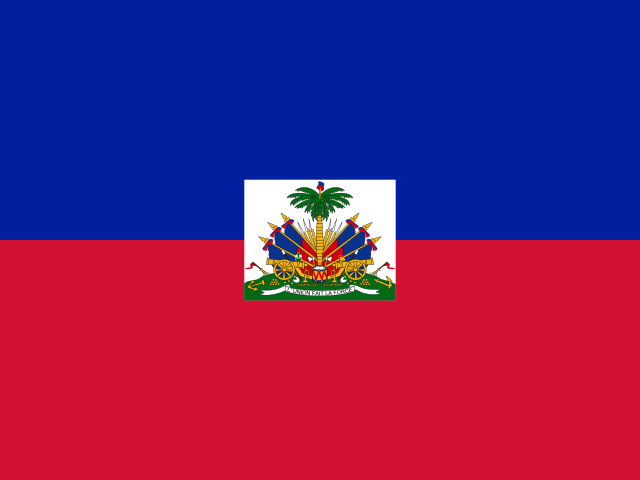
Two horizontal bands of blue over red bearing the national coat of arms on a central white square: a royal palm crowned with the liberty cap, shading a trophy of arms, and the motto 'L'Union Fait La Force'. Article 3 of the constitution describes the flag and the arms in those terms and assigns them no meaning, though the 1986 decree that restored the bicolour calls it the true symbol of national unity. The flag is traditionally said to have been made by taking the white out of the French tricolour, and the blue and red read as the union of the nation's Black and mixed-race citizens.
Haiti FACTS ◢
| Capital | Port-au-Prince |
|---|---|
| Continent | North America |
| Population | 11,906,095 (2025) |
| Area | 27,750 km² |
| Population density | 429/km² |
| Currency | Gourde (HTG) |
| Official languages | French, Haitian Creole |
| Calling code | +509 |
| Internet TLD | .ht |
| Time zone | UTC-05:00 |
| Drives on the | Right |
| ISO codes | HT / HTI |
DID YOU KNOW? ◢
- In 1804 it became the world's first independent nation founded by formerly enslaved people.
- It was the second country in the Americas, after the United States, to declare independence.
- It shares the island of Hispaniola with the Dominican Republic.
- The mountaintop Citadelle Laferriere is one of the largest fortresses in the Americas.
- Its name comes from an Indigenous Taino word meaning 'land of high mountains'.
Haiti QUICK ANSWERS ◢
What is the capital of Haiti?
The capital of Haiti is Port-au-Prince.
What is the population of Haiti?
Haiti had a population of 11,906,095 in 2025.
What currency does Haiti use?
Haiti uses the Gourde (HTG).
What languages are spoken in Haiti?
The official languages of Haiti are French and Haitian Creole.
Think you know your flags? Play Flag Daily → · Browse all countries →
MORE ON THE FLAG ◢
Ask who made Haiti's flag and you get a date, a place and two names. On 18 May 1803, at Arcahaie, Jean-Jacques Dessalines tore the white band out of the French tricolour, and Catherine Flon sewed what was left back together. It is Haiti's founding image, the date is a national holiday, and since 1986 the story has been written into Haitian law.
Two Haitian histories of the revolution, published within fifty years of it, contain almost none of that. Thomas Madiou's came out in 1847 and Beaubrun Ardouin's in 1853. They agree on one point: the white came out of the French tricolour. On who ordered it and what prompted it they do not agree; on when it happened and which way the stripes ran, only Ardouin speaks at all. Neither of them mentions Arcahaie, 18 May or Catherine Flon in connection with the flag.
The constitution, meanwhile, describes the flag down to the shape of the white square at its centre, and tells you nothing about what it means.
Key Takeaways
- Article 3 of the 1987 constitution specifies the bands, the white square, the palm, the liberty cap, the trophy of arms and the legend, and assigns none of it a meaning.
- Madiou's 1847 account gives the tearing of the tricolour one sentence, with no date, no place and no ceremony.
- Ardouin's 1853 account says Pétion pressed for the change after reading a printed sheet from Port-au-Prince, and that the new bicolour ran vertically, not horizontally.
- Catherine Flon is named in neither Madiou's third volume nor Ardouin's fifth and sixth, on a search of the archive's corrupted text of them. The earliest Haitian instrument consulted here that does is the decree of 11 February 1986, which restored the blue and red.
- Three Haitian constitutions have made the national colours black and red: Dessalines's of 1805, and then Duvalier's of 1964 and its successor of 1983, which also removed the liberty cap from the coat of arms.
| Instrument | The national colours, as written | Meaning assigned |
|---|---|---|
| Imperial Constitution, 20 May 1805, Dispositions générales art. 20 | black and red | none |
| Constitution of 30 December 1843, art. 192 | blue and red, placed horizontally | none |
| Constitution of 15 July 1932, art. 122 | blue and red, placed horizontally | none |
| Constitution of 25 May 1964, art. 191 | black and red, placed vertically | none, but the article names Arcahaie, 18 May 1803 and Dessalines as the origin |
| Constitution of 27 August 1983, art. 61 | black and red, placed vertically | none, and it cites the 1805 constitution |
| Decree of 11 February 1986, art. 1 | blue and red, placed horizontally | its recitals call the bicolour the true symbol of national unity |
| Constitution of 29 March 1987, arts. 2 and 3 | blue and red, blue above red, horizontal, arms on a central white square | none |
What article 3 of Haiti's constitution actually describes
Haiti's current constitution is more specific about the flag than any of its predecessors, and just as silent about why it looks that way.
Article 2 is one line, naming blue and red as the national colours and stopping there. Article 3 then says the emblem of the Haitian nation "est le Drapeau qui répond à la description suivante", the flag answering to the following description, and gives three lettered paragraphs.
Paragraph (a) sets out two bands of cloth of equal size, "l'une bleue en haut, l'autre rouge en bas, placées horizontalement". Paragraph (b) places the arms of the Republic on a square of white cloth at the centre: "Au centre, sur un carré d'étoffe blanche, sont disposées les Armes de la République". Paragraph (c) describes the arms themselves as "Le Palmiste surmonté du Bonnet de la Liberté", the royal palm crowned with the cap of liberty, shading with its fronds a trophy of arms that bears the legend "L'Union fait la Force".
The phrase governing that last image is printed "ombrageant des ses Palmes", where "de ses" is meant. Both of the transcriptions consulted here reproduce the slip, which makes it more likely to sit in the text than in either transcription, and no scan of Le Moniteur, the official gazette, could be opened to settle the point.
That is the whole of it. There is no clause saying what blue stands for, or red, or the palm, or the cap. Article 4 gives the national motto and article 4.1 the anthem, and the text moves on to the languages and the currency.
The silence is not an accident of drafting, because every Haitian constitution since 1843 has been written the same way. Each one states the colours and interprets nothing, and the Second Empire's constitution of 1849 does not even describe the arms, leaving the seal and the arms of the Empire to a law it never names.
Madiou's account: one sentence, no date, no place
Thomas Madiou's Histoire d'Haiti was published in Port-au-Prince in 1847, forty-four years after the events it describes. His third volume opens in 1803, the year the flag was made, and on a search of the archive's own text of it the tearing of the tricolour appears exactly once. That text is corrupted enough that this is strong evidence rather than proof.
It is not in his narrative of 1803. It is on page 328, printed under the year 1806, inside a summing-up of Dessalines written after the assassination. Madiou says Providence had charged him with founding Haiti by binding the black and the mixed-race population into one sheaf, and then: "Il arracha du drapeau tricolore la couleur blanche", he tore the white colour out of the tricolour flag, "et en rapprochant le rouge et le bleu, il symbolisa, à nos yeux, l'alliance de l'africain avec ses descendans", and by bringing the red and the blue together he symbolised, in our eyes, the alliance of the African with his descendants.
There is no date in it, no town, no ceremony and no seamstress.
Madiou does describe a meeting at Arcahaie in the same volume, on page 31, and it is worth reading against the story. He writes that it was agreed a "réunion solennelle des chefs indépendans de Léogane et du Petit-Goâve" would be held there, that the commanders "s'embarquèrent pour l'Arcahaie vers le milieu de Mai", embarked for Arcahaie around the middle of May, and that "Les chefs indigènes de l'Ouest rencontrèrent Dessalines à l'Arcahaie", where they recognised his authority and agreed a plan to invade the Cul-de-Sac plain.
The date is around the middle of May, not the eighteenth. The business is command and strategy. Nothing on that page or the next mentions a flag.
Madiou does put the flag in Dessalines's own mouth, but somewhere else entirely. At Camp Gérard in the plain of Les Cayes, towards the end of June 1803, Dessalines assembled the Army of the South and spoke to them, Madiou says, in Creole, in words "demeurées gravées dans l'esprit des témoins de cette scène solennelle", remaining engraved in the minds of the witnesses of that solemn scene. Among them: "notre drapeau rouge et bleu est le symbole de l'union du noir et du jaune", our red and blue flag is the symbol of the union of the black and the yellow.
That is the earliest source consulted here for the reading the flag is usually given. It is remembered speech, translated out of Creole, printed forty-four years later. It also puts red first and blue second.
Ardouin's account: a printed sheet from Port-au-Prince, and stripes that ran vertically
Beaubrun Ardouin published his Études sur l'histoire d'Haïti six years after Madiou, and his version of the same event is longer, more circumstantial and different in almost every particular.
Ardouin says the trigger was a printed sheet published at Port-au-Prince, which reached Alexandre Pétion in February 1803. Reporting a clash in the Cul-de-Sac plain in which the French had taken a colour of the 13th demi-brigade, it observed that the insurgents "avaient conservé le drapeau tricolore de la France", had kept France's tricolour, which showed that they meant to stay French and were fighting only for a liberty they believed threatened.
Ardouin's explanation of why that reading was available at all is the most useful sentence in the passage. Since 1791, he writes, the tricolour had been understood by black Haitians only as "le symbole de l'union entre les blancs, les mulâtres et les noirs", the symbol of the union between whites, mulattoes and blacks. On that reading, removing the white is not a gesture about a colour. It is the removal of a party.
Then the mechanism. "Pétion sentit la nécessité urgente de l'adoption d'un drapeau qui fût un signe de ralliement pour les indigènes, et distinct de celui des Français", Pétion felt the urgent necessity of adopting a flag that would be a rallying sign for the insurgents and distinct from the French one. The choice, Ardouin notes, was the commander in chief's to make and to order to his generals, so Pétion sent him the printed sheet with his reflections. "Dessalines prescrivit alors de retrancher la couleur blanche du drapeau dont on se servait", Dessalines then ordered the white colour cut out of the flag in use, and "le drapeau indigène devint bicolore, bleu et rouge".
And then the detail that no popular telling keeps. Those colours, Ardouin writes, "restèrent placées verticalement comme dans le drapeau français", remained placed vertically as in the French flag.
Ardouin also offers the nearest thing to a contemporary document. He says he has seen a procès-verbal drawn up on 29 floréal an XI, which he glosses as 19 May, in the roads of Port-au-Prince by Admiral Latouche Tréville, concerning a captured insurgent barge that had left Arcahaie for Léogane. On board was found a flag bearing the device "Liberté ou la mort". The admiral drew the act up with some solemnity and sent a copy to Rochambeau.
That puts a rebel flag out of Arcahaie into a French naval record dated the day after the traditional date. The record, as Ardouin describes it, says nothing about its colours.
So where do 18 May, Arcahaie and Catherine Flon come from?
Not from either historian. On a search of the archive's own text of both works, Catherine Flon's name appears in neither Madiou's third volume nor Ardouin's fifth and sixth, and neither writer connects 18 May to the flag. That text is corrupted enough to make this strong evidence rather than proof. Madiou does name a Flon in that volume twice in the narrative, and once more in an appendix list, but he appears to be Jacques Flon, a clerk in the government land office, named at the second mention and identifiable at the first only from the shared context, and both narrative mentions are about audits.
The date arrives through the constitution, and later than you would expect. The constitution of 19 June 1918 and its 1928 revision list exactly two national holidays at article 122: independence on 1 January and agriculture on 1 May. The constitution of 15 July 1932, which states the colours at article 122, adds a third holiday at article 124, "celle du Drapeau, le 18 mai". Every constitution since has kept it, and the current text lists "La Fête du Drapeau et de l'Université" on 18 May at article 275.1.
So Flag Day is a twentieth-century institution in Haitian constitutional law, whatever its life in custom before that.
Catherine Flon arrives later still, and in the least likely instrument. The decree of 11 February 1986 that restored the blue and red carries a recital saying that through the traditions of a free and independent people, the city of Arcahaie has remained the historic high place where the blue and red bicolour was born, "grâce à l'action de la valeureuse Catherine Flon", thanks to the action of the valiant Catherine Flon.
A recital in a 1986 decree is the first appearance of her name in any Haitian instrument consulted for this article. The decree itself frames the account as tradition, in its own words.
Three times, a Haitian constitution has made the national colours black and red
Blue and red is not continuous in the constitutions, and the interruption is not obscure. Three Haitian constitutions have made the national colours black and red, and they fall into two episodes: Dessalines's of 1805, and then Duvalier's of 1964 and its successor of 1983, which together ran from 1964 until 1986. What was flown between 1806 and 1843, when no constitution described a flag at all, is a separate question these texts cannot answer.
The first is Dessalines's own. Article 20 of the Dispositions générales of the Imperial Constitution of 20 May 1805 reads, in full: "Les couleurs nationales sont noires et rouges." The instrument numbers its articles twice, and its other article 20 is the one proclaiming Dessalines emperor. The founder who is said to have made the bicolour has black and red in his own constitution, promulgated less than eighteen months after independence, and the text gives no reason for it.
The second is François Duvalier's. Article 191 of the constitution of 25 May 1964 makes the colours black and red placed vertically, and then does something no other Haitian colours clause does. It explains where the flag came from: an "emblème créé le 18 Mai 1803 à l'Arcahaie, par Jean-Jacques DESSALINES Le Grand", an emblem created on 18 May 1803 at Arcahaie by Jean-Jacques Dessalines the Great, and in conformity with the provisions of the Imperial Constitution of 1805.
Read it closely and it is doing two incompatible things at once. It claims the Arcahaie founding for a black and red vertical flag, which is not the flag the Arcahaie tradition describes. And it invokes the 1805 constitution for an arrangement that document never specifies, since the 1805 colours clause gives two colours and no orientation.
The constitution of 27 August 1983 kept the black and red at article 61 and dropped the Arcahaie sentence, retaining only the words "comme l'avait prévu la Constitution de 1805", as the Constitution of 1805 had provided. The same objection applies.
The 1986 decree names that article directly. In the fuller of the two transcriptions consulted here, that of Haïtianaute, a recital states that article 61 of the amended 1983 constitution had fixed entirely different colours, and that the 1983 constitution had been set aside.
What the 1986 decree says that the constitution does not
The constitution assigns nothing. The decree that restored the flag does.
The same recital that credits Catherine Flon calls the bicolour "vrai symbole de l'Unité Nationale", the true symbol of national unity. A further recital, carried only by the Haïtianaute transcription, says that a flag is, for a nation, the most significant symbol of its existence in the national and international community. A third says the restoration of the blue and red across the whole territory expresses the will of the Haitian people.
So what Haiti's flag means depends on which instrument you accept. The constitution in force describes it and stops. The decree that put it back reads it as national unity, and traces it to Arcahaie and to Flon.
The narrower reading, that blue and red stand for the union of Haiti's black and mixed-race citizens, is in neither. It rests on Madiou's report of what Dessalines said at Camp Gérard, on Ardouin's explanation of what the white in the tricolour had stood for, and on a century and a half of repetition. It is a reading with real nineteenth-century evidence behind it, and it has never been the law.
It has, though, survived as state-published tradition. The Haitian embassy in France, describing the national symbols, sets the arms out charge by charge, down to the drum at the foot of the palm, the anchor, and the white ribbon the legend is written on, and it interprets none of those. But in the same page's entry on Catherine Flon it writes that the couturière sewed the blue and red bands, and that "Cet acte symbolise l'union sacrée des noirs et des mulâtres dans la guerre contre le système esclavagiste et colonialiste", this act symbolises the sacred union of blacks and mulattoes in the war against the slave and colonial system.
So a Haitian state organ does publish the reading. It attaches it to the making of the flag and to the sewing, never to the two colours as such, and it sits in the same page's gallery of national heroines rather than in any instrument. The union reading is official enough to be published by an embassy, and it has still never been written into a constitution.
The liberty cap that went missing, and the arms that no constitution put on the flag until 1987
The coat of arms hides two things that are easy to miss, and both are checkable in the texts.
The first is that the liberty cap is a casualty of the same politics as the colours. Every republican constitution from 1843 to 1957 gives the arms as the palm "surmonté du bonnet de la liberté", crowned with the cap of liberty, with the constitution of 16 December 1888 calling it a Phrygian cap instead. The constitutions of 1964, its 1971 revision, and 1983 all describe the arms as the palm merely "orné d'un trophée", adorned with a trophy. The cap is gone from all three. The decree of 11 February 1986 puts it back in the same article that restores the colours, and the 1987 constitution keeps it.
The second is that the arms are a recent arrival on the flag itself. From 1843 onward the constitutions state the colours in one sentence and the arms of the Republic in the next, as two separate national emblems. The Digithèque MJP at the Université de Perpignan collects twenty-three Haitian constitutions; five of them, those of 1801, 1806, 1807, 1811 and 1816, do not describe the flag at all, and none of the rest puts the arms on it before 1987. Article 3(b) of the current constitution, with its white square at the centre, is the first constitutional text to do so.
Alexandre Pétion's republican constitution of 27 December 1806 is in that silent group, which is worth pausing on: the government that made blue and red the colours of the Haitian republic again, after Dessalines had made them black and red, wrote nothing about the flag into its constitution.
The 1987 constitutional change matters for anyone trying to identify a Haitian flag in a photograph, and it is the sort of detail that decides a round of Flag Daily, which shows one flag a day and gives you three guesses at the country. The plain bicolour without the arms is not a mistake or an unofficial variant. No Haitian constitution before the current one put the arms on the flag, and every earlier text that describes a flag at all describes bands and nothing else.
The last thing worth saying is the point the sources keep insisting on themselves. Both nineteenth-century historians agree that the flag was made by subtraction from the French tricolour, and both were writing decades after the fact, from testimony. Across all twenty-three of its constitutions, the Haitian state has never written a meaning for the colours into the article that describes them.
Frequently asked questions
Who created the Haitian flag?
Both nineteenth-century histories credit Dessalines with the removal of the white from the French tricolour, but they differ on how it came about. Madiou, writing in 1847, attributes the act to Dessalines alone and does not give a date or a place. Ardouin, writing in 1853, says Pétion pressed for a distinct flag after reading a printed sheet published at Port-au-Prince and sent it to Dessalines, who then ordered the change.
What do the colours of the Haitian flag mean?
No Haitian constitution assigns the blue and red a meaning, including the one in force. The popular reading, that they stand for the union of the country's black and mixed-race citizens, comes from Madiou's report of a speech Dessalines gave to the Army of the South in June 1803. The decree of 11 February 1986 that restored the flag calls the bicolour the true symbol of national unity, which is the closest thing to an official gloss.
Why is Haitian Flag Day on 18 May?
By tradition it marks the making of the bicolour at Arcahaie in 1803. In law the date is newer than that. The constitutions of 1918 and 1928 list only two national holidays, and 18 May first appears as one in the constitution of 15 July 1932. The current constitution keeps it as the Fête du Drapeau et de l'Université.
Why was Haiti's flag black and red?
Three Haitian constitutions have made the national colours black and red, and none of them gives a reason. Article 20 of the Dispositions générales of Dessalines's Imperial Constitution of 1805 made them black and red without explanation. François Duvalier's constitution of 1964 did the same, adding a claim that this was the emblem created at Arcahaie in 1803 and provided for by the 1805 constitution, and the constitution of 1983 kept them, dropping the Arcahaie sentence and citing only the 1805 constitution. The blue and red were restored by decree on 11 February 1986.
What is written on the Haitian flag?
The flag bears the legend "L'Union fait la Force", strength through unity, which article 3 of the constitution places with the trophy of arms at the centre of the flag. Those words have been in the constitutional description of the arms in every text that describes them since 1843. The national motto is a separate thing, and article 4 of the current constitution gives it as Liberté, Égalité, Fraternité.
Sources
- Digithèque MJP, Université de Perpignan, Haïti, Constitution du 29 mars 1987, version de 2011 - retrieved 26 August 2026.
- Political Database of the Americas, Georgetown University, Constitution de la République d'Haïti 1987 - retrieved 26 August 2026. Used as an independent transcription against which the wording of articles 2 and 3 was checked word by word.
- Digithèque MJP, Haïti, Constitution impériale du 20 mai 1805 - retrieved 26 August 2026.
- Digithèque MJP, Haïti, Constitution du 30 décembre 1843, and the index of all twenty-three Haitian constitutions - retrieved 26 August 2026. The 1801, 1806, 1807, 1811, 1816, 1846, 1849, 1867, 1874, 1879, 1888, 1889, 1918, 1928, 1932, 1935, 1939, 1944, 1946, 1950, 1957 and 1971 texts were read from the same collection.
- Digithèque MJP, Haïti, Constitution du 25 mai 1964 and Constitution du 27 août 1983 - retrieved 26 August 2026.
- Thomas Madiou, Histoire d'Haiti, tome III (Port-au-Prince, 1847), Internet Archive - retrieved 26 August 2026. Pages 31, 48 and 328 were read as page images, because the archive's optical character recognition of this volume is badly corrupted, and transcribed by hand.
- Beaubrun Ardouin, Études sur l'histoire d'Haïti, tome V (Paris, 1853), Internet Archive - retrieved 26 August 2026. Chapter XI, pages 386 to 388, read as page images and transcribed for the same reason. Tome VI was searched for Catherine Flon and for 18 May and contains neither.
- Haïti-Référence, Décret rétablissant le drapeau bleu et rouge - retrieved 26 August 2026. A transcription of the decree of 11 February 1986, which it cites to Le Moniteur, Journal Officiel de la République d'Haïti, 141st year, no. 13, 11 February 1986, pages 147 to 148. No scan of that gazette issue could be reached.
- Haïtianaute, Décret de 1986 rétablissant le drapeau Bleu et Rouge - retrieved 26 August 2026. A second, independent and fuller transcription of the same decree, carrying three further clauses the Haïti-Référence text does not, two of them recitals and one a visa. The recital on article 61 of the 1983 constitution and the one calling a flag a nation's most significant symbol are taken from this text.
- Ambassade de la République d'Haïti en France, Les Symboles de la République - retrieved 26 August 2026.
PLAY ANOTHER →
One thing that happened today in history. Every day, a new one.
TODAY IN HISTORYDAILYDaily CodeA short message, hidden in a different cipher every day.
ONE CIPHER A DAYDAILYGuess the CountryThree clues, three guesses. Work out where in the world it is.
THREE CLUESDAILYDaily TriviaFive questions a day. Everyone gets the same five.
FIVE QUESTIONS