
Iran
One of the world's oldest continuous civilisations, ruled from Tehran and rooted in the ancient Persian empires. Iran gave the world poetry, the qanat and some seriously old carpets.
WHAT THE FLAG MEANS ◢
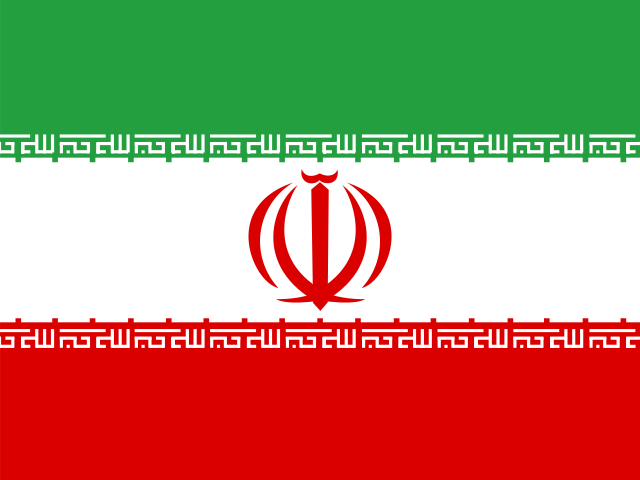
Three horizontal bands of green, white and red, with a stylised red emblem at the centre in the form of the word 'Allah' and the phrase 'Allahu Akbar' repeated 22 times in squared Kufic script along the inner edges of the green and red bands, eleven times on each. The 22 repetitions stand for the 22nd of Bahman, the day the 1979 revolution succeeded. Article 18 of the constitution names only the colours, the emblem and the motto and gives none of them a meaning; the design was fixed by a Revolutionary Council decision of 1980, with the geometry left to the national flag standard. The readings of green as Islam and growth, white as peace and red as courage and martyrdom are conventional rather than constitutional.
Iran FACTS ◢
| Capital | Tehran |
|---|---|
| Continent | Asia |
| Population | 92,417,681 (2025) |
| Area | 1,648,195 km² |
| Population density | 56/km² |
| Currency | Iranian rial (IRR) |
| Official language | Persian |
| Calling code | +98 |
| Internet TLD | .ir |
| Time zone | UTC+03:30 |
| Drives on the | Right |
| ISO codes | IR / IRN |
DID YOU KNOW? ◢
- The Persian empire founded by Cyrus the Great was once the largest the world had ever seen.
- Persian carpet weaving is an art thousands of years old and a UNESCO-recognised heritage.
- Ancient Persians engineered qanats, underground channels that carried water across deserts.
- Persepolis, the ceremonial capital of the Achaemenid empire, still stands as a vast ruined complex.
- The Persian New Year, Nowruz, marks the spring equinox and is celebrated across the region.
Iran QUICK ANSWERS ◢
What is the capital of Iran?
The capital of Iran is Tehran.
What is the population of Iran?
Iran had a population of 92,417,681 in 2025.
What currency does Iran use?
Iran uses the Iranian rial (IRR).
What languages are spoken in Iran?
The official language of Iran is Persian.
Think you know your flags? Play Flag Daily → · Browse all countries →
MORE ON THE FLAG ◢
Iran's flag is governed by four instruments. The summary above names three of them: article 18 of the constitution, which is the shortest and gives nothing a meaning; the 1980 Revolutionary Council decision, which designed the flag; and the national standard, where that decision sends the geometry. The fourth is a cabinet regulation issued in June 2026.
Read all four together and something unusual falls out. Between them they fix the emblem, the script, the stripe order, the cloth, the stitching and twelve customary sizes. Exactly one feature is given a purpose: the phrase Allahu Akbar appears 22 times because the revolution succeeded on the 22nd of the month of Bahman.
Not the green. Not the white. Not the red. A number.
One clause pulls the other way, and it is worth naming at the top rather than burying it. Clause 4-8 of the standard calls the central emblem an embodiment of the word of tawhid, and then names the word in brackets. That is the strongest thing anyone arguing with this article has. It is also identification rather than symbolism: it tells you which word the shape is a drawing of, which is a different act from telling you what an element stands for. On symbolism the instruments say one thing and one thing only, and it is a date.
Key Takeaways
- Article 18 of the constitution is one sentence. It names three colours, an emblem and a motto, and assigns nothing a meaning.
- The design was fixed by Revolutionary Council decision no. 6930 of 15 Tir 1359, the first text to say where the emblem sits and how the writing is set.
- Three binding texts explain the same single element: the takbir repeats 22 times as a sign of 22 Bahman, the day the revolution succeeded.
- Iranian national standard No. 1 sets a 4 to 7 ratio and twelve sizes, then points to an annex for the emblem's geometry that its 1383 revision does not contain.
- Until a cabinet regulation of 17 Khordad 1405, no instrument stated the order of the bands as a rule; it had to be read off a clause about ink and a printed colour plate.
| Instrument | Date | What it fixes | Does it explain anything? |
|---|---|---|---|
| Constitution, article 18 | 1358, revised 1368 | Three colours, the emblem, the motto | No |
| Revolutionary Council decision no. 6930 | 15 Tir 1359 | Emblem red and central, takbir white in banna'i script, 22 repetitions, 11 and 11 | Yes, the 22 only |
| National standard No. 1 | first drawn up 1359, revised 1383 (the edition read), current edition 1395 | Ratio 4 to 7, twelve sizes, cloth, colour fastness, stitching | Yes, the 22, in binding clause 4-1-3; the colour readings only in its informative annex |
| Cabinet regulation, resolution no. 23171 | 17 Khordad 1405 | The order of the bands as a rule, the rectangle, protocol for use | Yes, the 22 again, in the same formula; adds nothing new |
The twenty-two is a date, and three instruments say so
Count the small angular inscriptions along the edges of the green and the red band and you get eleven on each, twenty-two in total. Every one reads Allahu Akbar, God is greater.
The Revolutionary Council's decision spells out why. The motto is repeated as a sign of "بیست و دوم بهمن", the twenty-second of Bahman, which the same clause calls "روز پیروزی انقلاب", the day of the revolution's victory. That is 22 Bahman 1357, or 11 February 1979.
The national standard restates it in clause 4-1-3, in the normative body of the document rather than in the essay annexed to it, and adds the arithmetic that makes the choice work. Bahman is "یازدهمین ماه سال", the eleventh month of the year, so eleven repetitions in the green and eleven in the red give the day and the month at once.
The cabinet regulation of 2026 makes it three. Item 3 of its first article carries the reason over in the same formula, naming the twenty-second of Bahman and, in brackets, the day of the victory of the Islamic revolution. Three of the four instruments explain this one feature, and none of them explains any other.
The designer tells it as providence. Interviewed in 2008, Hamid Nadimi said he had taken repetition from the nature of a slogan and drawn eleven above and eleven below, and then invited the interviewer to look at what the total came to: 22/11/57, the date of the revolution's victory, written in the slogan itself.
What article 18 of Iran's constitution leaves out
Article 18 sits in chapter two and runs to one sentence. The official flag of Iran is of the colours "سبز و سفید و سرخ", green and white and red, with the "علامت مخصوص جمهوری اسلامی", the special emblem of the Islamic Republic, and the motto "الله اكبر".
That is the whole provision. It does not say which colour goes on top. It does not describe the emblem, or say how many times the motto appears, or in what script, or what colour the writing is. It says nothing about what any of it stands for.
Nor has it ever been read to say more. The Guardian Council is the body that interprets the constitution, and its own published edition of the text sets those interpretive opinions out article by article, beneath the articles they concern. Article 18 has none.
The 1980 decision that actually designed the flag
The instrument that turned that sentence into a flag is Revolutionary Council decision no. 6930, adopted at the session of 15 Tir 1359 and recorded in the Islamic Parliament Research Center's law database under the Ministry of the Interior. It is four bullet points long.
The emblem goes in red at the centre. The motto is white and set in "خط کوفی بنایی", squared Kufic, which the decision helpfully defines as the same script that carries Allahu Akbar on the minarets of mosques. The motto repeats 22 times as a border at the colour boundaries, eleven in the green and eleven in the red. And the precise geometric and technical specifications are to follow the standards approved by the Institute of Standards and Industrial Research of Iran.
So the shape of the emblem, the size of the flag and the proportions of the writing were never fixed by the constitution or by any decree. They were delegated to a standards body.
Ettela'at carried the announcement on its front page on 8 Mordad 1359, under the headline that the design of the official flag had been communicated to the Ministry of the Interior. Its report gives the same specifications with one addition, and adds that the president's covering letter stressed the referral to the standards institute. The decision names those two boundaries; what the paper adds is that green and white sit above and white and red below, and which side is which the decision's own text never says. The newspaper describes the notification as happening that day; the parliamentary record dates it four days earlier, on 4 Mordad.
Iran's flag is specified by a textile standard
Iranian national standard No. 1 is called The flag of the Islamic Republic of Iran - Specifications, and it is a textile specification in the ordinary sense. The edition available for inspection is the first revision, approved at the 147th session of the national committee for clothing and textile products on 14 Bahman 1383, and published by the body that was then the Institute of Standards and Industrial Research of Iran and is now the Iranian National Standards Organization. Its record for the standard shows a further edition of 1395, still listed as valid.
Clause 4-6 gives the proportions. The flag has twelve customary sizes at a ratio of 4 to 7, listed in millimetres from 262 by 150 up to 3500 by 2000, with a tolerance of plus or minus 2 per cent on length and width. Work through the table and every size but the first is exactly 7 to 4. Only the smallest is not: 150 millimetres of width wants 262.5 millimetres of length, and the table rounds it to 262.
The rest is what you would expect of a cloth standard and would never guess about a national flag. The flag may be made of several fibres but never of pure viscose. Colour fastness to light, washing, water, seawater and rubbing is graded, each grade tested to a numbered Iranian standard. Sewing thread is normally orange. Nine visual defects are listed, the last of them the emblem printed over a seam or drifting off centre.
Clause 4-8 is the one that describes the emblem, and it takes one sentence to do it: it is an embodiment of the word of tawhid "در قالب کلمه الله", in the form of the word Allah, printed in red in the middle of the flag's white. Then the clause points the reader to annex B for the geometry and the method of drawing it.
There is no annex B. The published revision runs to annex A and stops, on a page numbered 14. So the only official account of how to construct the emblem is a cross-reference to a document that is not there.
The colour readings come from outside the law, and they disagree
Nowhere in the four instruments does any colour get a reading. The glosses everyone repeats are real, and they are published by the state, but they come from documents that are not doing legal work, and they do not agree with each other.
Annex A of the standard is labelled "اطلاعاتی", informative, which in a standard means explanatory rather than binding. It is a short essay, and its treatment of the colours is hedged from the first word: if white is taken as a sign of tawhid, being the combination and unification of all colours, then it joins the red field of the flag, which is a sign of blood and jihad, to the green, which can be a symbol of the lofty ideals of Islam.
The office of the Supreme Leader published a longer reading in 2025. There green is growth, flourishing and spiritual life; the red of the emblem is epic, the blood of the martyrs and strength in the way of truth; the white ground is peace, purity and oneness. Note the scope: that account glosses the red of the emblem, and leaves the red band unexplained.
The Institute for Iranian Contemporary Historical Studies gives a third version, in which green stands for belief in Islam, white for Iranians' love of peace and calm, and red for the blood shed in defence of independence, freedom and the Islamic Republic.
Three state or state-adjacent publications, three different sets of words. That is what a popular reading looks like when it has no instrument behind it. The short summary at the top of this page is a fourth compression, green for Islam and growth, white for peace, red for courage and martyrdom, and it matches none of the three exactly. That is the honest state of it, which is why the summary calls the readings conventional rather than constitutional.
The man who designed the emblem, and what he says it is
The emblem is the work of Hamid Nadimi, an architect who teaches at Shahid Beheshti University in Tehran. By his own count he had spoken about it three times in the twenty-eight years to 2008, and he refuses to be photographed, on the ground that a flag should not be pinned to a mortal person.
His account, given to the magazine Sepideh-ye Danaei in 1386, undercuts several things that get said about the design. He entered the government's public competition and lost it. The design chosen instead was a clenched fist with several stars, and it went on to the flag and on to banknotes. A state historical institute names its author as the painter and calligrapher Sadegh Tabrizi, counts twenty-two stars and eight clenched fists in it, and says it stayed in use in government offices for more than a year. Several well-known designers were commissioned after that, and their work was rejected too. Nadimi found out that his own design had been adopted when Hashemi Rafsanjani telephoned to tell him the Revolutionary Council had approved it and Khomeini had ratified it, on 19 Ordibehesht 1359.
Asked what the shape means, he described five parts standing for five principles of the religion, with tawhid as the central column; the word Allah in the overall composition, with the phrase la ilaha illa Allah concealed inside it; the crescents deriving from a mark the Prophet is said to have drawn on the sand with his sword, as a signature; and the central upright, combined with the shape of a shadda, evoking a sword, which he read through the Quranic word hadid, iron. The symmetry he read as mizan, the balance. He traced the whole idea back to sessions with Ali Shariati before the revolution, and to a formula he took from them: book, balance, iron.
Two things he did not say are worth as much as what he did. He never mentions a tulip, and he offers no meaning at all for the flag's three colours.
The tulip is worth pausing on, because it is the reading most often attached to the emblem and it is not an invention of foreign writers. The Institute for Iranian Contemporary Historical Studies states it flatly, calling the emblem outwardly similar to a tulip, itself a figure for the martyrs. The standard's informative annex closes on the same idea as a pun: it says the tulip, laleh, has grown in the earth and under the sky of Allahu Akbar, and laleh is one letter away from la ilaha. So the tulip sits exactly where the colour readings sit. It is published by the state, in an essay and in a history institute's prose, and it is in no binding clause. Nadimi, asked directly what the shape means, does not reach for it.
The five parts are the weakest link even inside the official texts. The standard's own annex hedges them, saying the five components have tawhid as their central stem if they are traced back to the five base principles of the religion. The Institute for Iranian Contemporary Historical Studies names those five as tawhid, prophethood, resurrection, justice and the imamate. The Supreme Leader's office names a different five: tawhid, prayer, fasting, zakat and hajj. Both are printed as fact.
The takbir on the flag today is the second version of it
Nadimi's first version used the form seen on mosque domes and minarets, and he pointed to the Goharshad Mosque in Mashhad as an example of it.
Then, he said, somebody claimed the letters could be read as the Latin string USA. He was asked to draw a different one, and did. In the same breath he said he preferred the first.
The episode is a reminder of how squared Kufic works. The script fits letterforms to a grid of squares, so the same phrase can be laid out in many ways and each layout reads differently at a distance. Iraq's flag carries the same phrase in the same script, and its exact letterforms have been argued over just as hard.
Green, white and red are older than the Islamic Republic
The three colours did not arrive in 1979. They were already the constitutional colours of Iran in 1907, when the Supplementary Constitutional Law was signed. Its article 5 gives the "الوان رسمی بیرق ایران", the official colours of Iran's banner, as green, white and red, with the emblem of the lion and sun.
Read that beside article 18 and the pattern is hard to miss. Two constitutions, seventy-two years apart, both name the same three colours, both name the emblem that sits between them, and neither says what any of it stands for. The thing that changed was the emblem.
Khomeini demanded that change on 10 Esfand 1357, in a speech that says the banner of Iran must not be an imperial banner and the lion and sun must go from every ministry and every office. It took another fourteen months, one interim emblem and a lost competition to reach the emblem Khomeini ratified on 19 Ordibehesht 1359.
In 2026 the cabinet made the order of the bands a rule
On 4 Khordad 1405 the Council of Ministers approved a new regulation on the use of the official flag and the national anthem, issued as resolution no. 23171 on 17 Khordad and made under articles 18 and 138 of the constitution and pursuant to decision no. 6930.
Its article 1 restates the flag, and one item in it does something no instrument had done before. Item 1 sets the order of the colours as a rule of its own, under a heading that means the arrangement of the colours: green at the top, white in the middle, red at the bottom.
The order was not in doubt. It was simply never stated as a rule. The constitution lists the colours in that sequence without presenting the list as an arrangement, and the 1980 decision fixes where the emblem and the writing go without ever saying which band is uppermost. Everyone knew the answer because the standard had settled it sideways: clause 4-8 fills the spaces between the letters with green in the upper band and red in the lower, and the standard prints the flag as a colour plate. So from the 1383 revision until 2026, the order of Iran's national flag rested on a clause about where the ink stops, and on a picture.
Item 3 of the same article is the one that changes nothing: it carries the 22 and its reason over in the same formula. Item 4 adds the shape, a horizontal rectangle of three rows of equal size.
The regulation keeps the delegation to the standards body and tightens it: a note requires the national standards organisation to publish the flag standards within three months, through its own portal, the national laws database and the Official Gazette. Another note attaches the approved image of the flag as annex 1, stamped by the cabinet office.
The most telling clause is in article 8. Schools are to teach what the flag contains, its history and "مبانی رنگ های پرچم رسمی", the basis of the official flag's colours. Forty-six years after the flag was adopted, the state is instructing its teachers to explain a symbolism that none of its own instruments has ever set down.
If you want to test how much of a flag you actually know rather than assume, Flag Daily shows one a day and gives you three guesses.
Frequently asked questions
What does the Iranian flag mean?
Officially, almost nothing is stated. Article 18 of the constitution names green, white and red, the emblem of the Islamic Republic and the motto Allahu Akbar, and assigns no meaning to any of them. The only element any state instrument gives a reason for is the number of times the motto appears: 22, as a sign of 22 Bahman, the day the 1979 revolution succeeded. The colour readings in wide circulation come from government publications rather than from law, and those publications disagree with one another.
Why is Allahu Akbar written 22 times on the Iranian flag?
Because the revolution won on 22 Bahman 1357, which is 11 February 1979. Three instruments say so. Revolutionary Council decision no. 6930 of 15 Tir 1359 states the reason directly and splits the count eleven and eleven; Iranian national standard No. 1 adds that Bahman is the eleventh month, so eleven repetitions in the green band and eleven in the red encode the day and the month together; and the cabinet regulation of 2026 repeats the reason in the same formula.
What is the symbol in the middle of the Iranian flag?
Clause 4-8 of Iranian national standard No. 1 describes it as an embodiment of the word of tawhid in the form of the word Allah, printed in red on the white band. Its designer, Hamid Nadimi, describes five components standing for five principles of the religion, the phrase la ilaha illa Allah concealed in the composition, crescents taken from a mark the Prophet is said to have drawn with his sword, and a central upright combining with a shadda to suggest a sword. The tulip reading, which the standard's own annex and a state historical institute both carry, does not appear in his account.
What do the colours of the Iranian flag mean?
No instrument says. The 1907 Supplementary Constitutional Law and the 1979 constitution both name green, white and red without glossing them. The explanations you will find are published by the state in non-binding documents and do not agree: the standard's informative annex offers white as tawhid, red as blood and jihad, green as the ideals of Islam, all conditionally. The office of the Supreme Leader gives green as growth and spiritual life, white as peace and purity, and the emblem's red as the blood of the martyrs. A state historical institute gives a third version.
What are the proportions of the Iranian flag?
Four to seven. The 1383 revision of Iranian national standard No. 1 sets that ratio and lists twelve customary sizes in millimetres, from 262 by 150 to 3500 by 2000, with a tolerance of plus or minus 2 per cent. Flags made to other dimensions must still keep the 4 to 7 ratio and the stitching requirements. The constitution and the 1980 Revolutionary Council decision say nothing about proportions at all. Both leave the geometry to the standards body.
Sources
- Guardian Council of the Constitution, Full text of the Constitution of the Islamic Republic of Iran with the Council's interpretive opinions - retrieved 22 August 2026. Article 18 is quoted from this edition, which sets the Council's interpretive opinions out article by article and carries none under article 18.
- Islamic Parliament Research Center, Revolutionary Council decision no. 6930, adopted 15 Tir 1359, notified 4 Mordad 1359 - read 22 August 2026 from Internet Archive captures of 1 February 2013, 25 February 2017 and 18 August 2019, the three being identical. The live site answers a security challenge and then a gateway error from outside Iran.
- Institute of Standards and Industrial Research of Iran, Iranian national standard No. 1, The flag of the Islamic Republic of Iran - Specifications, first revision, approved 14 Bahman 1383 - read 22 August 2026 from the Internet Archive capture of 1 November 2013.
- Iranian National Standards Organization, record for standard No. 1, The flag of the Islamic Republic of Iran - specifications and test methods, 1395, status valid - read 22 August 2026 from the Internet Archive capture of 26 June 2018. The 1395 text itself could not be obtained. The standards organisation's own site refuses connections from outside Iran.
- Ettela'at, no. 16203, 8 Mordad 1359, page 1, front-page item on the communication of the official flag design to the Ministry of the Interior - scan of the issue, retrieved 22 August 2026.
- Sepideh-ye Danaei magazine, Esfand 1386, interview with Dr Hamid Nadimi on the story of the flag - read 22 August 2026 from the Internet Archive capture of 15 March 2018 of Rang magazine's reprint.
- Office of the Supreme Leader, The sign of Allah, a report marking the anniversary of the approval of the emblem of the Islamic Republic of Iran, 20 Ordibehesht 1404 - retrieved 22 August 2026.
- Institute for Iranian Contemporary Historical Studies, On what date and how was the emblem of the flag of the Islamic Republic of Iran approved? - retrieved 22 August 2026.
- Supplementary Constitutional Law, article 5, text at the Tehran laws portal. The portal heads the law 1285/07/14 and prints the royal endorsement of 29 Sha'ban 1325 at its foot, which is 7 October 1907 - read 22 August 2026 from the Internet Archive capture of 6 May 2022.
- Council of Ministers, regulation on the use of the official flag and the national anthem of the Islamic Republic of Iran, approved 4 Khordad 1405 and issued as resolution no. 23171 of 17 Khordad 1405 - text reproduced by Ekhtebar, retrieved 22 August 2026. The national laws database and the Official Gazette both refuse connections from outside Iran. The resolution's number and date are separately confirmed by a report of its notification to provincial governors.
PLAY ANOTHER →
A short message, hidden in a different cipher every day.
ONE CIPHER A DAYDAILYGuess the CountryThree clues, three guesses. Work out where in the world it is.
THREE CLUESDAILYOn This DayOne thing that happened today in history. Every day, a new one.
TODAY IN HISTORYDAILYDaily CryptogramOne quote, one scrambled alphabet. Crack it before tomorrow.
CRACK THE QUOTE