
Iraq
Cradled between the Tigris and Euphrates, Iraq sits on the ancient land of Mesopotamia, where writing, the wheel and the first cities were arguably invented.
WHAT THE FLAG MEANS ◢
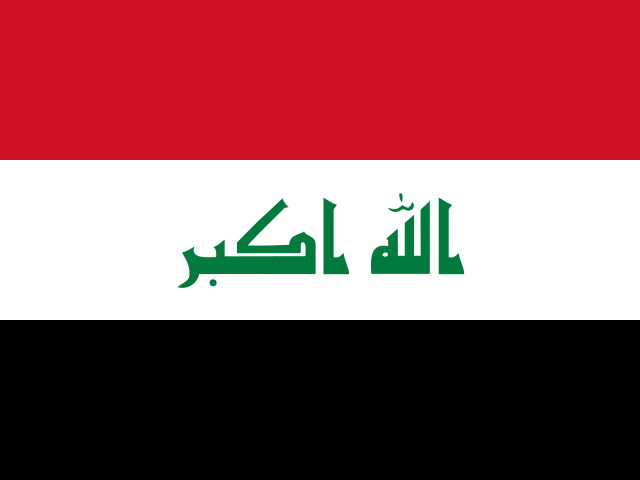
Three horizontal bands of red, white and black, with the green Takbir, 'Allahu Akbar' ('God is great'), written across the centre of the white band in Kufic script. The flag law reads the colours as those of the Islamic banners. That wording replaced a reading of them as the colours of the Arab banners in 2008, in the same clause that deleted the three green stars.
Iraq FACTS ◢
| Capital | Baghdad |
|---|---|
| Continent | Asia |
| Population | 47,020,774 (2025) |
| Area | 437,072 km² |
| Population density | 108/km² |
| Currency | Iraqi dinar (IQD) |
| Official languages | Arabic, Kurdish |
| Calling code | +964 |
| Internet TLD | .iq |
| Time zone | UTC+03:00 |
| Drives on the | Right |
| ISO codes | IQ / IRQ |
DID YOU KNOW? ◢
- Mesopotamia, largely within modern Iraq, is often called the birthplace of civilisation.
- The earliest known writing system, cuneiform, was developed here by the Sumerians.
- The ancient city of Babylon, with its legendary hanging gardens, stood near modern Baghdad.
- The Code of Hammurabi, one of the oldest written legal codes, originated in this region.
- Baghdad was a leading centre of learning and science during the medieval Islamic Golden Age.
Iraq QUICK ANSWERS ◢
What is the capital of Iraq?
The capital of Iraq is Baghdad.
What is the population of Iraq?
Iraq had a population of 47,020,774 in 2025.
What currency does Iraq use?
Iraq uses the Iraqi dinar (IQD).
What languages are spoken in Iraq?
The official languages of Iraq are Arabic and Kurdish.
Think you know your flags? Play Flag Daily → · Browse all countries →
MORE ON THE FLAG ◢
Ask what the colours of the Iraqi flag mean and there is, unusually for this subject, a statutory answer. One sentence of Iraqi law says the colours of the Iraqi flag represent the colours of the Islamic banners. It is the whole of what the flag law says about them.
That sentence is younger than it looks. It was written in 2008, and it replaced an older sentence in the same slot of the same statute, which had said the colours were those of the Arab banners and had read the flag's three green stars as unity, freedom and socialism. The 2008 law dropped the word Arab and the qualifier that followed it, deleted the stars, and deleted their meanings with them.
What is stranger is the statute that carries it. Its own text said it would run only until a new Iraqi flag law was issued, and in any case for no longer than one year. The year ran out in January 2009 with no new flag law. Rather than let the flag lose its legal footing, parliament passed another law that struck out the deadline and backdated itself to the day the deadline had passed. Eighteen years on, no successor flag law has been traced, and the amendment chain still describes one as yet to be issued.
Key Takeaways
- The only statement of meaning in force is one clause of Law No. 9 of 2008: the colours of the Iraqi flag represent the colours of the Islamic banners. None of the instruments read for this article assigns red, white or black an individual meaning.
- The clause it replaced, from Law No. 33 of 1986, read the colours as those of the Arab banners used in Arab history since the dawn of Islam, and read the three stars as unity, freedom and socialism.
- Law No. 28 of 1963, which created the red, white and black triband with three green stars and whose bands Iraq still flies, assigns nothing any meaning at all.
- The takbir was put on the flag by Law No. 6 of 1991, which specified that it be in the handwriting of Saddam Hussein. The 2008 law deleted that phrase and required Kufic script instead.
- Law No. 9 of 2008 was to expire within a year. Law No. 32 of 2009 removed the time limit and took effect retroactively from 29 January 2009.
| Instrument | Date | What it did | What it said the colours mean |
|---|---|---|---|
| Law No. 28 of 1963 | 30 April 1963 | Created the red, white and black triband with three green five-pointed stars; repealed the 1959 flag law | Nothing |
| Law No. 33 of 1986 | 8 March 1986 | Replaced the 1963 law, added ceremonial rules, kept the design | Colours of the Arab banners; stars for unity, freedom and socialism |
| Amending law of 1987 | 4 June 1987 | Rewrote the design clause, adding the stars' circumscribed circle and the visible-light provision | Unchanged |
| Law No. 6 of 1991 | 22 January 1991 | Added the takbir in green, in Saddam Hussein's handwriting, split around the stars | Unchanged |
| Law No. 9 of 2008 | issued 29 January, published 5 February 2008 | Deleted the stars and the handwriting clause; required Kufic script | Colours of the Islamic banners |
| Law No. 32 of 2009 | issued 20 December 2009, published 25 January 2010 | Deleted the one-year limit on the 2008 law | Unchanged |
The one clause of Iraqi law that says what the colours mean
Article 1 of Law No. 9 of 2008 does not describe a flag. It amends a paragraph. It directs that paragraph two of article two of the 1986 flag law be replaced, and then gives the replacement in full. The colours of the Iraqi flag represent ألوان الرايات الإسلامية, the colours of the Islamic banners. Then a second clause, وتحذف النجوم الثلاث, deletes the three stars, and it deletes their significations with them.
Read that against what was there before and the edit is very small. The 1986 paragraph had said the flag's colours were those of the Arab banners, and specified the ones used in Arab history from the dawn of Islam to the present. The 2008 version keeps the banners and swaps Arab for Islamic, dropping the historical qualifier with it.
It also drops something larger. The rest of the 1986 paragraph read the three stars as the principles of unity, freedom and socialism, and then added a paragraph of its own about the flag having been carried by the Iraqi people in what it called the glorious Qadisiyyah of Saddam, the state's name for the war with Iran. That passage is unnumbered in the transcription, so whether it sat inside the paragraph the 2008 law replaced is a question about the gazette's typesetting rather than its wording. On the natural reading it went with the rest.
So the flag has a statutory meaning, and the statutory meaning is a family resemblance rather than a colour code. No Iraqi instrument opened for this article assigns red, white or black a reading of its own.
Iraq's 1963 flag law explained nothing at all
One caveat belongs here rather than in a footnote. The Ministry of Justice's online run of the gazette starts at issue 4014, so the 1963, 1986, 1987 and 1991 instruments could not be read from the official scans; they are quoted here from a transcription archive of Iraqi legislation, whose orthography has been normalised. Nothing in this article quotes their Arabic wording as verbatim gazette text. The 2008 and 2009 laws are a different matter: those were read from the gazette's own page images.
The design Iraq flies is older than either gloss. Law No. 28 of 1963, signed at Baghdad on 30 April 1963, runs to seven short articles, five of them operative, and it is entirely silent about meaning.
Its article 1 composes the flag of three colours, black and white and red, with three green five-pointed stars, then sets the rectangle at two thirds as wide as it is long, divides it into three equal horizontal bands, and puts red at the top, white in the middle and black at the bottom. The colours are listed in the reverse of the order they are then flown in, which is a drafting quirk rather than a claim.
Article 2 permits the flag's use for decoration and public celebrations. Article 3 makes it an offence to lower, destroy or insult the flag in public out of hatred or contempt for the authority of the government, punishable by up to six months or fifty dinars or both. Article 4 allows regulations to be issued under the law. Article 5 repeals the flag law of the Iraqi Republic, No. 102 of 1959, whose text is not in the archive used here. Not one of the seven explains a colour or a star.
The three stars are the part everyone thinks they know, and the popular reading has them standing for a hoped-for union of Iraq with two neighbours. That reading appears in no Iraqi instrument read for this article. The only statutory gloss the stars ever had was the 1986 one, and it is a party platform: unity, freedom, socialism. When Iraq's parliament removed them in 2008 the speaker of the house, Mahmud al-Mashhadani, gave that as the reason, telling members the stars symbolised those principles and adding, "So we do not need them."
The colours themselves are the ones Egypt flies in the same arrangement, and the ones Syria flew in it until December 2024, which is why an Iraqi flag with the writing removed is hard to place. That family is what the 1986 and 2008 clauses are both gesturing at, and what they disagree about is whose family it is.
The takbir arrived by statute, in a named man's handwriting
The green writing on the white band is not decoration and it is not old. Law No. 6 of 1991, dated 22 January 1991, rewrote the design paragraph to put the phrase on both faces of the flag, with one word after the first star and the other after the second, in green, and mandated the handwriting of a specific person. The 2008 law quotes the words it is about to delete, naming الرئيس القائد صدام حسين, the President the Leader Saddam Hussein, and requiring the flag to carry his hand.
It is worth being precise about what that means. Iraqi law did not merely permit a president's handwriting on the national flag. It prescribed it, in the operative clause of the instrument that defines the flag's appearance, for seventeen years.
The 2008 law removes exactly that. Its article 2 deletes from the 1991 article both the reference to the three stars and the parenthesis naming the handwriting, and puts in their place the takbir, الله أكبر, which it requires بالخط الكوفي, in Kufic script, occupying the middle third of the white rectangle along its length and the middle two quarters across its width. With the stars gone the two words, one of which had followed the first star and the other the second, close up into the centre.
By then the flag being flown had already looked like that for four years. Reporting at the time of the vote noted that the script had been changed to Kufic unofficially in 2004, with no legal basis, while the handwriting clause stayed on the books. Contributors to the vexillological archive Flags of the World reached the same suspicion a week before the vote, reading a report from the Information Service of the Iraqi Parliament and noting that it might indicate the flag then in use had never been regulated by law. On this reading the 2008 statute was not a redesign so much as the law catching up with the cloth.
Why January 2008, and what the vote was actually about
The 2008 law's own explanatory memorandum is one sentence, and it is candid without being specific. It cites the political and social transformations that had taken place in Iraq, which required that the reference to the flag's signification be brought into harmony with العراق الجديد, the new Iraq.
The reporting supplies the part the memorandum leaves out. Kurdish officials had refused to fly the flag, which they associated with the Baath and with the Anfal campaign, and a pan-Arab meeting of politicians was scheduled for Erbil on 10 March 2008. Kurdish authorities said they would fly the new banner there. One proposal on the table would have made the writing yellow, a Kurdish national colour; it was dropped on the ground that yellow is hard to read against white.
The vote itself was not unanimous and not close. Of 165 members present, 110 voted for the change. The thirty members loyal to Muqtada al-Sadr voted against, on the ground that the existing flag should stand until a permanent one was settled rather than be replaced by something temporary.
That objection turned out to be the accurate prediction in the room.
The deadline in Iraq's 2008 flag law was real, and then it was deleted
Article 3 of Law No. 9 of 2008 is where the strangeness sits. Having amended the regulations to match, it provides that the law is to be worked with until العلم العراقي الجديد, the new Iraqi flag, has a law of its own, and within a period لا تتجاوز سنة واحدة, not exceeding one year. The presidency council resolved to issue it at its session of 29 January 2008, and it was published in the official gazette on 5 February.
One year later there was no new flag law. What happened next is recorded in the gazette of 25 January 2010, which carries Law No. 32 of 2009, the first amendment to Law No. 9 of 2008. Its article 1 repeals article 3 and substitutes the same sentence with the time limit cut off after the words about the new flag law. Its article 2 repeals article 4 and replaces it with a provision that the law be published in the official gazette and deemed in force as of 29 January 2009: the day the year expired, eleven months before the amendment was issued.
The reasons given are unusually frank for a legislature. The memorandum records that Law No. 9 of 2008 had set a period not exceeding one year for issuing a new flag law, that the period had passed, that no new law had been issued, and that the amendment was enacted to provide سند قانوني للعلم الحالي, a legal basis for the current flag, after the expiry of that period.
Whether the successor was ever enacted is not something this article can settle from the gazette. The Ministry of Justice's online archive of الوقائع العراقية begins at issue 4014 and runs to the present, but its files are page scans without a searchable text layer, so no full-text check of eighteen years of legislation was possible. Iraq's own legislation database at the Higher Judicial Council, and the Council of Representatives site, both refuse every request from this machine behind a security challenge. What can be said is narrower and still worth saying: the operative text of Iraqi flag law today is the 1986 statute as rewritten in 1987, 1991 and 2008, with the 2008 amendment itself amended in 2009, and that chain still describes its own successor as a law yet to be issued.
Iraqi law names no shade of red, white or black
There is one more thing in the design clause, and it is the reason no Iraqi statute can tell you which red the flag is.
The design clause as it stood after 1987, and as the 1991 law carried it forward, sets out the star geometry in detail: outer angles of 108 degrees and equal spacing, both already in the 1986 text, and a circumscribed circle 20 per cent of the flag's width, which 1987 added. Then it turns to colour, and the wording is odd enough to be worth giving carefully. What the clause puts inside a range is the rate of fixing and recording the spectral reflections of the flag's colours. The range it gives is the range of human vision in daylight, a wavelength of 400 to 700 nanometres, which it then glosses as the limits of visible light.
Read strictly, the subject of that sentence is a measurement or a dye-fixing rate rather than the colours themselves, so a colour-fastness reading is available. The conclusion does not depend on which reading wins. The only range Iraqi law puts round the flag's colours is the whole of the visible spectrum, so any red, any white and any black a person can see falls inside it, and the shades on Iraqi flags are settled by manufacture and custom rather than by statute.
The stars the clause measures so carefully were deleted in 2008. The sentence about visible light was not, because the 2008 amendment reached into that paragraph only for the reference to the stars and the phrase naming the handwriting, and took nothing else out of it.
The constitution asked for something the flag law does not deliver
Above all of these instruments sits article 12 of the 2005 constitution, and it is one line. The flag, the emblem and the national anthem are to be regulated by law in a way that symbolises مكونات الشعب العراقي, the components of the Iraqi people.
That is a substantive instruction, not a formality. It asks the legislature for a flag that represents who is in the country. The law that answers it is an amendment to a Baath-era statute that reads the colours as a religious banner family and says nothing about anyone in Iraq, and the amendment was drafted as a placeholder for a law that would do the job properly.
The gap is not hidden. It is the reason the 2008 text names its own replacement, and the reason the 2009 amendment had to find the current flag a legal basis rather than give it a permanent one. If you want to know what the Iraqi flag means, the honest answer is that Iraqi law gives you one clause of family resemblance, written as a stopgap, over a design whose creating statute explained nothing at all.
If you want to test how many of these you can tell apart, Flag Daily shows one flag a day and gives you three guesses at the country.
Frequently asked questions
What does the Iraqi flag mean?
Iraqi law gives one answer and it is a single clause. As amended by Law No. 9 of 2008, paragraph two of article two of the flag law says the colours of the Iraqi flag represent the colours of the Islamic banners, and that is the entirety of the statutory meaning. None of the instruments read for this article assigns red, white or black a meaning of its own, and the green writing across the white band is the takbir, the phrase "Allahu Akbar", which the law requires in Kufic script and green. Before 2008 the same paragraph read the colours as those of the Arab banners and read the three green stars as the principles of unity, freedom and socialism; the 2008 amendment deleted the stars and their meanings in the same sentence.
Why were the three stars removed from the Iraqi flag?
Because parliament voted to remove them in January 2008, as a break with the Baath period. The stars had a statutory meaning that made the point for them: the 1986 flag law read them as the principles of unity, freedom and socialism, and the speaker of the Council of Representatives cited exactly that in the chamber. The change was pressed hardest by Kurdish politicians, who associated the flag with the Baath and with the Anfal campaign, and it was timed ahead of a pan-Arab parliamentary meeting scheduled for Erbil in March 2008. The measure passed with 110 votes of 165 members present.
Is the writing on the Iraqi flag still in Saddam Hussein's handwriting?
No, and it has not been since 2008 in law or since 2004 in practice. Law No. 6 of 1991 added the takbir to the flag and specified in its operative clause that it be written in the hand of Saddam Hussein. Law No. 9 of 2008 deleted that phrase and required the words in Kufic script instead, occupying the middle third of the white band lengthwise. Reporting at the time of the 2008 vote records that the switch to Kufic had already been made unofficially in 2004, so for four years the flag being flown did not match the flag on the statute book.
Is Iraq's current flag temporary?
It was designed to be, and the deadline no longer exists. Article 3 of Law No. 9 of 2008 provided that the law apply until a new Iraqi flag law was issued and for no longer than one year. That year ran out in January 2009 without a successor, and Law No. 32 of 2009, published on 25 January 2010, repealed article 3 and reissued it without the time limit, taking effect retroactively from 29 January 2009 so that the flag would not have flown without a legal basis in the interval. Its stated reason was to find a legal basis for the current flag. The statute still refers to a new flag law as something to be issued.
What script is the Arabic on the Iraqi flag?
Kufic, and the law says so in as many words. Article 2 of Law No. 9 of 2008 requires the phrase in Kufic script, a prestigious early form of Arabic calligraphy that reporting on the 2008 change describes as having originated in Iraq. The same article fixes where it goes rather than how it looks: the middle third of the white rectangle along the flag's length, and the middle two quarters across its width. It does not name a typeface, a stroke weight or a shade of green beyond the green already carried over from the 1991 text.
Sources
- Republic of Iraq, Law No. (9) of 2008 amending the Iraq Flag Law No. (33) of 1986 and its amendment Law No. (6) of 1991, in Al-Waqai Al-Iraqiya (the official gazette) No. 4059, 5 February 2008 - the issue is a page scan with no text layer, so the articles quoted here were read from the rendered page images and transcribed beside this draft. Retrieved 19 August 2026.
- Republic of Iraq, Law No. (32) of 2009, the First Amendment to Law No. (9) of 2008, in Al-Waqai Al-Iraqiya No. 4142, 25 January 2010, pages 33 to 34 - the law is inside the issue and not listed on its cover; the embedded text layer is unreadable, so these articles were also read from page images and transcribed. Retrieved 19 August 2026.
- Iraq Flag Law No. (33) of 1986 of 8 March 1986, transcribed in the Iraqi laws and legislation archive at Durar al-Iraq - a transcription, not a gazette scan: the Ministry of Justice's online gazette archive begins at issue 4014 and does not reach 1986. The paragraph quoted from it is the one the 2008 gazette scan replaces, and the scan confirms its location in the statute. Retrieved 19 August 2026.
- Law amending the Iraq Flag Law, No. (6) of 1991, of 22 January 1991, same archive - transcription, same caveat. The phrase naming the handwriting is independently confirmed by the 2008 gazette scan, which quotes it in order to delete it. Retrieved 19 August 2026.
- Law amending the Iraq Flag Law, No. (53) of 1987, of 4 June 1987, same archive - transcription; source of the star geometry and the visible-light clause, which the 1991 text repeats. This file is visibly corrupt at that clause, running the wavelength figure into the wrong words, so the clean reading was taken from the 1991 text above. Its title as filed reads "No. (23) of 1986" where the body and the record both give the 1986 law as No. 33. Retrieved 19 August 2026.
- National Flag Law No. (28) of 1963 of 30 April 1963, same archive - transcription; the instrument that created the three-star triband and assigns nothing a meaning. Retrieved 19 August 2026.
- Constitution of Iraq, 2005, articles 4 and 12, Arabic and English texts at the Constitute Project - the constitution was published in Al-Waqai Al-Iraqiya No. 4012, which predates the ministry's online archive. Retrieved 19 August 2026.
- "Iraq: Parliament Approves New Flag, But Only Temporarily", Radio Free Europe/Radio Liberty, 23 January 2008 - source for the speaker's remark, the 110 of 165 vote, the Sadrist bloc's objection, the Erbil meeting of 10 March and the rejected yellow lettering. Retrieved 19 August 2026.
- Peter Smith, "Iraq's flag redesign erases one of the last public symbols of the Hussein regime", The Christian Science Monitor, 23 January 2008 - a round-up quoting Al Jazeera for the unofficial 2004 switch to Kufic, Agence France-Presse for Masoud Barzani's September 2007 statement, and the New York Times for the association between the flag and the Anfal campaign, which is where that detail in this article comes from. Retrieved 19 August 2026.
- "2008 Flag Change (Iraq)", Flags of the World, last modified 31 July 2020 - contributors reading a report from the Information Service of the Iraqi Parliament in January 2008, including the observation that the flag then in use appeared never to have been regulated by law. A hobbyist archive, used here for what its contributors observed at the time. Retrieved 19 August 2026.
- "Iraqi Parliament Fails to Pass 2008 Budget, Adopts New Flag", VOA News, 22 January 2008 - same-day wire summary of the vote, read as republished by GlobalSecurity.org rather than on VOA itself. Retrieved 19 August 2026.
PLAY ANOTHER →
Five questions a day. Everyone gets the same five.
FIVE QUESTIONSDAILYGuess the CountryThree clues, three guesses. Work out where in the world it is.
THREE CLUESDAILYDaily CryptogramOne quote, one scrambled alphabet. Crack it before tomorrow.
CRACK THE QUOTEDAILYDaily CodeA short message, hidden in a different cipher every day.
ONE CIPHER A DAY