
Egypt
The gift of the Nile, where a thin green ribbon of farmland threads through the desert and 5,000 years of pharaohs, pyramids and hieroglyphs still loom over modern Cairo. Egypt basically invented the tourist landmark.
WHAT THE FLAG MEANS ◢
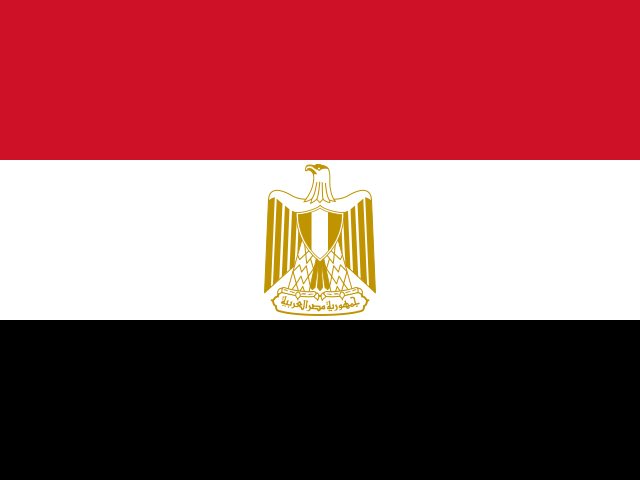
Three horizontal bands of red, white and black with the golden Eagle of Saladin centred on the white. Article 223 of Egypt's constitution describes the flag in almost exactly those terms, naming the three colours and the eagle, and assigns the colours no meaning at all. The readings usually quoted come from Egypt's State Information Service, which gave red as the era of struggle against the British occupation before 1952, white as the arrival of a revolution that ended the monarchy without bloodshed, and black as the end of oppression under both the monarchy and British colonialism. The service's current page gives only the description.
Source: constituteproject.org
Egypt FACTS ◢
| Capital | Cairo |
|---|---|
| Continent | Africa |
| Population | 118,365,995 (2025) |
| Area | 1,010,408 km² |
| Population density | 117/km² |
| Currency | Egyptian pound (EGP) |
| Official language | Arabic |
| Calling code | +20 |
| Internet TLD | .eg |
| Time zone | UTC+02:00 |
| Drives on the | Right |
| ISO codes | EG / EGY |
DID YOU KNOW? ◢
- The Great Pyramid of Giza is the only one of the Seven Wonders of the Ancient World still standing.
- The Nile is generally considered the longest river on Earth.
- Ancient Egyptians were among the first to develop a form of picture-writing, hieroglyphs, thousands of years ago.
- The vast majority of Egyptians live crowded along the banks of the Nile, since most of the country is desert.
Egypt QUICK ANSWERS ◢
What is the capital of Egypt?
The capital of Egypt is Cairo.
What is the population of Egypt?
Egypt had a population of 118,365,995 in 2025.
What currency does Egypt use?
Egypt uses the Egyptian pound (EGP).
What languages are spoken in Egypt?
The official language of Egypt is Arabic.
Think you know your flags? Play Flag Daily → · Browse all countries →
MORE ON THE FLAG ◢
Egypt's constitution describes the Egyptian flag in a single sentence, and that sentence gives the colours no meaning at all.
Article 223 of the 2014 constitution, as amended in 2019, reads: "The national flag of the Arab Republic of Egypt consists of three colors black, white, and red with the eagle of Saladin in golden yellow." It then hands the emblem, decorations, insignia, seal and anthem to ordinary legislation, and makes desecrating the flag a crime. That is the entire provision.
Read it again for what is missing. No ratio. No stripe order, so the text never actually says red goes on top. And not one idea attached to any of the three colours. The order the article does give, black then white then red, is the exact reverse of the order Egypt flies them.
The famous meanings do exist, and Egypt's government published its own version of them. They come from somewhere more specific than "the constitution".
Key Takeaways
- Article 223 of Egypt's constitution describes the flag in one sentence and assigns the three colours nothing at all. It fixes no ratio and no stripe order.
- The colour readings Egypt's government published come from its State Information Service: red for the era of struggle before 1952, white for a revolution that ended the monarchy without bloodshed, black for the end of oppression under the monarchy and British colonialism. Flag documentation carries a looser reading alongside them.
- The page carrying them no longer resolves. It was read for this article in the Internet Archive's capture of 11 August 2020, and the service's live Basic Information page describes the flag and stops.
- The bird changed. From the first day of 1972 Egypt flew the gold hawk of Quraish, the emblem of a three-country federation, and replaced it with the Eagle of Saladin in 1984.
- Yemen's constitution fixes the order Egypt actually flies and assigns it no meaning; Iraq's 2005 constitution and Sudan's 2005 interim constitution describe no design at all and leave the flag to a statute.
What do the colours on the Egyptian flag mean?
Egypt's State Information Service answered that on a page headed "Egypt Flag", dated 20 July 2009 on the copy read for this article. Its wording was precise and political.
Red, it said, refers to the period before the 1952 revolution that brought a group of army officers to power after deposing King Farouk, a period characterised by the struggle against the British occupation. White symbolises the advent of that revolution, which ended the monarchy without bloodshed. Black symbolises the end of the oppression of the people of Egypt at the hands of the monarchy and British colonialism. The bird got a line of its own: the Eagle of Saladin represents power and strength.
Notice how narrow those readings are. Red is not a general idea of sacrifice, it is a named era, and black is not a generic dark past but the ending of two named things, the monarchy being the half that is easiest to drop.
That page no longer resolves. Checked on 13 August 2026, the address returns a 404 rather than a redirect, and the wording above was read in the Internet Archive's capture of 11 August 2020. What the service publishes about the flag instead, on the Basic Information page updated in October 2025, is description and nothing else: three equal horizontal rectangles, the upper red, the middle white, the lower black, with the golden eagle emblem in the middle. No symbolism at all.
Egypt's is not the only reading in circulation, either. The Flags of the World page on Egypt sets out what it heads alternative explanations of the flag symbolism: it records Whitney Smith (1975, 1980) giving red as revolution, white as a bright future and black as a dark past, which is a looser scheme than the State Information Service's dated one, without the named era or the named oppressors.
One official Egyptian source could not be checked for this article. The presidency's website refused this connection on both its English and its Arabic path, and the same flag archive records that the presidency's site carries a page with illustration and symbolism, so a second official reading probably exists and could not be read here. The supportable statement is that these meanings are traceable to the State Information Service and are absent from the constitution, not that no Egyptian institution has ever published anything else.
Is that eagle Saladin's, or the Hawk of Quraish?
Both birds are real, both are gold, and Egypt has flown each.
The State Information Service's own history is blunt about the sequence. In 1972 the law was amended, the stars were removed from the flag, and a golden hawk took their place. In 1984 the hawk was replaced by a golden eagle, the eagle of Saladin, named for the Ayyubid sultan who ruled Egypt in the twelfth century.
The hawk was never Egypt's alone, which is the part that is easy to miss. Flags of the World, which collects flag documentation rather than issuing it, records that Egypt, Libya and Syria signed an agreement in April 1971 calling for a confederation, that the Federation of Arab Republics came into existence that September after referendums in all three countries, and that the federation's constitution called for a single flag for the federation and its three member states. That flag was hoisted on the first day of 1972: a red, white and black tricolour with the gold hawk of Quraish on the white stripe, holding a scroll reading "Federation of Arab Republics" in Arabic, with each member state adding its own name beneath. The account there is sourced to Whitney Smith (1975) and to E M C Barraclough (1978).
So the bird Egypt flew for the next twelve years had been adopted as the emblem of a three-country union rather than of Egypt, and Egypt outlasted the union. The same record has Libya withdrawing in protest after Anwar Sadat's visit to Israel in November 1977, and the federation ceasing to exist; Egypt kept the hawk until 1984.
The bird flying since 1984 is settled in law rather than in argument, because Article 223 names it outright. On where it comes from, Flags of the World records Whitney Smith's account that the emblem is based on an eagle carved on a wall in Cairo, notes that Saladin was the first Ayyubid sultan and ruled Egypt, Hejaz, Syria and Mesopotamia, and adds that the use of the Saladin eagle on Arab flags is modern.
Why does the Egyptian flag look like Yemen's and Iraq's?
Because they share a palette, the one Flags of the World calls the Arab liberation flag. That archive describes the flag the Federation of Arab Republics hoisted as a tricolour "in the colours of the Arab liberation flag", and it quotes Whitney Smith describing the red, white and black flag Egypt flew alongside the green one after 1952 as the Liberation Flag of the revolution.
That family is worth separating from the four colours of the 1918 Great Arab Revolt flag it often gets folded into. The Revolt flag carried red, white, black and green, as the Christian Science Monitor set out in April 2025 while tracing the origins of Syria's flag.
One contributor to Flags of the World argues against the design spreading outward from Cairo. Josh Fruhlinger, posting there in January 1999, sets out the case that most of the post-war Arab nationalist leaders used a red, white and black banner derived from the Arab Revolt, and that Egypt's adoption coincided with similar adoptions by Syria and Iraq, and on his own hedged reckoning by Yemen and Libya, which "seems to prove false the idea that said colors are inherently Egyptian". On that reading the resemblance is a shared inheritance rather than a copy, and he draws the moral this article keeps running into: that official descriptions of flags should not be taken at face value.
One country flying that palette has since changed its flag. Syria flew the red, white and black design with two green stars until December 2024. Bashar al-Assad was overthrown on 8 December 2024, and the opposition flag was adopted in his place: the 1932 independence flag, green, white and black with three red stars, as the Christian Science Monitor reported from Damascus in April 2025. The table below sets out what each of the five constitutions says, Syria's 2012 text among them, which is the text behind the flag it flew until then.
| Country | What the flag article says | Colour meanings |
|---|---|---|
| Egypt | Article 223: black, white and red, with the eagle of Saladin in golden yellow | None |
| Yemen | Article 156: three colours, starting from the top, red, white, black | None |
| Syria, 2012 text, for the flag flown until December 2024 | Article 6: red, white and black plus two green stars, red highest, width two thirds of the length | None |
| Iraq | Article 12: set by law, in a way that symbolises the components of the Iraqi people | None |
| Sudan | Section 9 of the 2005 interim constitution: the law specifies the flag | None |
The five texts differ only in how much they pin down: Egypt's names the colours and the eagle but neither an order nor a ratio, Yemen's article fixes the stripe order and nothing else, Syria's fixed the stars and the proportions too, and Iraq and Sudan wrote no design at all.
What does Egyptian law actually fix about the flag?
The constitution supplies the colours, the eagle and the penalty, and leaves the rest to legislation.
Describing the flag at all is a change of approach rather than an oversight. Egypt's December 2012 constitution said only that the flag, emblem, decorations, insignia, seal and anthem "are defined by law", with no description at all. The 2014 text put the design into the constitution for the first time.
The implementing statute is harder to pin down than the constitution, and the flag documentation does not agree with itself. On the Flags of the World Egypt page one contributor names "Law No. 144 of 1984" as the only flag legislation he could find, while another on the same page cites "Section 3 of Law No. 144 and Section 1 of Law No. 145 dated 4/5 October 1985" as the instruments that established the eagle and the flag.
Daily News Egypt reported on 1 June 2014 that the interim president, Adly Mansour, had issued a decree regulating use of the flag and the anthem, and that it eliminated Law 7/1941 and Law 144/1984. The report does not mention Law 145, so if the 1985 pairing is the right one, nothing read for this article says what became of that half. Citing the state-owned Al-Ahram, the paper said the new law specified the colours and dimensions of the flag and the places it must be flown, from presidential and cabinet headquarters to courts, embassies, consulates and the country's borders. The report adds, in its own voice, that the law forbade adding slogans, pictures and designs to the flag, and set a maximum penalty of one year in prison and a fine of EGP 30,000.
The decree's own text was not reachable for this article. Egypt's legal-document database serves individual documents but refused its search endpoint from this connection, so the specification that actually fixes the flag's dimensions is described here through a newspaper report of it rather than read directly.
To test how much of a flag you can redraw from memory, try the daily flag round.
Which flags did Egypt fly before this one?
The State Information Service's own history starts in 1923, when a royal decree established the first national flag of modern Egypt, a year after the country gained conditional independence from Great Britain. It was green, with a white crescent and three white stars. Nothing red, white or black about it.
The next entry jumps to 1958, when a presidential decree established a flag for the United Arab Republic, the union of Egypt and Syria: three colours, red, white with two green stars, and black, in a rectangle whose width was one third of its length. Then 1972, then 1984.
There is a gap in that list, and it is the interesting one. The years between the 1952 revolution and the 1958 union are missing, and the editor of the flag archive that reproduces the passage marks the same absence, calling the flag of the period 1952 to 1958 strangely omitted.
Its own page for those years carries two accounts that agree on the shape of it. Roy Stilling records that the republic initially kept the green flag with the crescent and stars, and only later replaced it with a red, white and black tricolour carrying a different eagle emblem, bearing a shield of the crescent and stars. Whitney Smith, quoted on the same page, approaches it from the other side: the 1923 design "was not replaced by a modern tricolor until some years after the 1952 revolution", while the red, white and black Liberation Flag of the revolution was flown alongside the national flag, often with the state arms added in gold.
Read together, those explain the hole. For some years after 1952 Egypt had two flags in use and only one of them was the national flag, which is an awkward thing for an official history to summarise in a line.
The union's flag outlasted the union. Syria left in 1961, and Flags of the World records Egypt keeping the United Arab Republic name and flag until the first day of 1972, when the federation flag with the hawk replaced it.
Frequently asked questions
What do the red, white and black stripes on the Egyptian flag stand for?
Egypt's constitution assigns them nothing. The meanings Egypt's own government published come from Egypt's State Information Service, which gave red as the era of struggle against the British occupation before 1952, white as the advent of a revolution that ended the monarchy without bloodshed, and black as the end of oppression under both the monarchy and British colonialism. Flag documentation carries a looser reading alongside it, Whitney Smith's red for revolution, white for a bright future and black for a dark past. The government page carrying the first reading no longer resolves, and it was read for this article in the Internet Archive's capture of 11 August 2020.
Is the bird on the Egyptian flag an eagle or a hawk?
An eagle, and it has been one since 1984. Article 223 of the constitution calls it "the eagle of Saladin in golden yellow". The confusion is well founded, though: from the first day of 1972 Egypt flew a gold hawk of Quraish in the same position, the emblem of the Federation of Arab Republics it had formed with Libya and Syria, and the eagle replaced it in 1984.
Does Egypt's constitution say which stripe goes on top?
No. Article 223 lists the colours as black, white and red, which is the reverse of the order Egypt flies them, and it fixes neither an order nor a ratio. The order comes from practice and from the government's own description of the flag: the State Information Service describes the upper rectangle as red, the middle as white and the lower as black.
Which law fixes the Egyptian flag's dimensions?
A decree issued by the interim president, Adly Mansour, in 2014. Daily News Egypt reported that it repealed both Law 7/1941 and Law 144/1984, the 1984 law a contributor to the flag archive names, and, citing the state-owned Al-Ahram, that it specified the colours and dimensions of the flag. No text of the decree itself was reachable for this article, so the detail here rests on that report rather than on the gazette.
Did Egypt and Syria ever fly the same flag?
Yes, twice. They flew one flag as the United Arab Republic from 1958, and Egypt kept both the name and the flag after Syria left in 1961, until the start of 1972. From 1 January 1972 both flew the Federation of Arab Republics flag, identical but for each country's name beneath the hawk. Syria later returned to the two-star design on its own, and flew it until December 2024, when the 1932 independence flag was adopted after Bashar al-Assad was overthrown.
Sources
- Constitute Project, Egypt 2014 (rev. 2019) Constitution, Article 223 - retrieved 12 August 2026.
- Constitute Project, Egypt 2012 Constitution, Article 221 - retrieved 12 August 2026.
- Arab Republic of Egypt State Information Service, Basic Information - retrieved 12 August 2026.
- Arab Republic of Egypt State Information Service, Egypt Flag, archived by the Internet Archive on 11 August 2020 - retrieved 12 August 2026.
- Constitute Project, Yemen 1991 (rev. 2001) Constitution, Article 156 - retrieved 12 August 2026.
- Constitute Project, Syrian Arab Republic 2012 Constitution, Article 6 - retrieved 12 August 2026.
- Constitute Project, Iraq 2005 Constitution, Article 12 - retrieved 12 August 2026.
- Constitute Project, Sudan 2005 Interim National Constitution, Section 9 - retrieved 12 August 2026.
- Flags of the World, Egypt - retrieved 12 August 2026.
- Flags of the World, Republic of Egypt (1952-1958) - retrieved 13 August 2026.
- Flags of the World, Republic of Egypt (1972-1984) - retrieved 13 August 2026.
- Flags of the World, United Arab Republic (Egypt and Syria, 1958-1961) - retrieved 13 August 2026.
- Flags of the World, Libya, 1972-1977 - retrieved 13 August 2026.
- Daily News Egypt, Presidential decree issued to regulate flag, anthem usage - retrieved 13 August 2026.
- The Christian Science Monitor, Syria's flag is everywhere: 'Everyone wants to touch freedom' - retrieved 12 August 2026.
PLAY ANOTHER →
One thing that happened today in history. Every day, a new one.
TODAY IN HISTORYDAILYDaily TriviaFive questions a day. Everyone gets the same five.
FIVE QUESTIONSDAILYDaily CryptogramOne quote, one scrambled alphabet. Crack it before tomorrow.
CRACK THE QUOTEDAILYDaily CodeA short message, hidden in a different cipher every day.
ONE CIPHER A DAY