
Sudan
Straddling the Nile in northeast Africa, Sudan quietly holds more ancient pyramids than Egypt, clustered around the ruins of the once-mighty Kingdom of Kush.
WHAT THE FLAG MEANS ◢
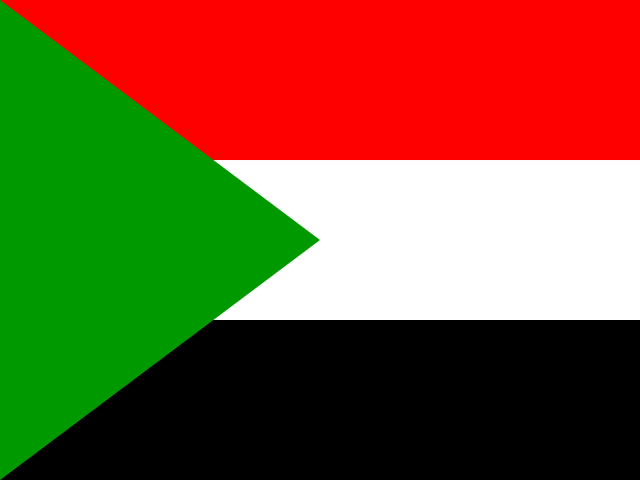
Three horizontal bands of red, white and black with a green triangle at the hoist. The National Flag Act 1993 fixes the shape, the proportions and the geometry of the triangle and assigns the colours no meaning at all. The state's published reading gives the red for the martyrs and the struggle, the white for peace, optimism and light and for the White Flag revolt of 1924, the green for prosperity and goodness, and the black for Sudan's African belonging and for the origin of the country's name.
Sudan FACTS ◢
| Capital | Khartoum |
|---|---|
| Continent | Africa |
| Population | 51,662,147 (2025) |
| Area | 1,886,068 km² |
| Population density | 27/km² |
| Currency | Sudanese pound (SDG) |
| Official languages | Arabic, English |
| Calling code | +249 |
| Internet TLD | .sd |
| Time zone | UTC+02:00 |
| Drives on the | Right |
| ISO codes | SD / SDN |
DID YOU KNOW? ◢
- Sudan has more pyramids than Egypt, with over 200 built by the ancient Kingdom of Kush.
- The Blue Nile and White Nile meet at Khartoum to form the main Nile River.
- The Nubian pyramids at Meroë are a UNESCO World Heritage Site.
- For decades it was the largest country in Africa by area, until South Sudan split away in 2011.
Sudan QUICK ANSWERS ◢
What is the capital of Sudan?
The capital of Sudan is Khartoum.
What is the population of Sudan?
Sudan had a population of 51,662,147 in 2025.
What currency does Sudan use?
Sudan uses the Sudanese pound (SDG).
What languages are spoken in Sudan?
The official languages of Sudan are Arabic and English.
Think you know your flags? Play Flag Daily → · Browse all countries →
MORE ON THE FLAG ◢
There is a law in Sudan that describes the national flag down to the inch. It fixes the shape, the proportions, the order of the bands, the geometry of the green triangle, eight permitted sizes in feet and inches, the manner in which the flag is raised and lowered, and a prison term for insulting it.
It is the National Flag Act 1993, it runs to twenty sections and a schedule, and in the whole of it there is not one word about what any colour stands for.
The meanings do exist in a Sudanese state source. They were published by the Presidency of the Republic, on its own website, and they are not quite the meanings that circulate in English. Three of the four colours are read differently, and one of them differs in a direction that matters: the Presidency gives the black an African referent, where the English gloss traces the whole palette to the Arab Revolt.
Key Takeaways
- Sudan's flag statute is the National Flag Act 1993. It specifies the design in detail and interprets none of it.
- The Presidency of the Republic published the colour meanings instead, reading white for peace, optimism and light and for the White Flag revolt of 1924.
- The Presidency reads black for Sudan's African belonging and for the origin of the country's name, and green for prosperity and goodness, with no mention of Islam.
- Sudan's first flag, flown from independence in 1956, was blue, yellow and green, adopted on a motion put to the House of Representatives on 31 December 1955.
- Sudan's 1973, 1998 and 2005 constitutions each said the flag would be fixed by law. The constitutional document in force since 2019 does not mention the flag at all.
| Colour | National Flag Act 1993 | Presidency of the Republic | CIA World Factbook (retired 2026) |
|---|---|---|---|
| Red | Named as a band colour, no meaning given | The martyrs and the struggle | The struggle for freedom |
| White | Named as a band colour, no meaning given | Peace, optimism and light; the White Flag revolt of 1924 | Peace, light and love |
| Black | Named as a band colour, no meaning given | Sudan's African geographic belonging; the origin of the name Sudan | The people of Sudan, because the name means black |
| Green | The colour of the hoist triangle, no meaning given | Prosperity and goodness | Islam, agriculture and prosperity |
What Sudan's flag law actually specifies
The Act was made on 15 December 1993, and its second section repeals its predecessor by name, the National Flag and Foreign States Flags Act 1976. Section 4 then sets out the design.
The flag is rectangular, with its width half its length. It is made of three equal horizontal rectangles. On the side alongside the mast it ends in a green isosceles triangle. The triangle's base is the width of the flag, and its vertical height reaches one third of the flag's length, ثلث طول العلم in the Act's words. The colours of the rectangles run from top to bottom red, white and black.
Those four requirements are lettered (a), (b), (c) and (e). There is no (d).
In the text WIPO Lex publishes, which is the copy this article quotes from, all four sit together on one page, so no question of a missing sheet arises. The copy the Presidency of the Republic published is typeset differently and set over seven pages, and its section numbering runs from 1 to 20 without a gap; there the lettering breaks across a page, ending at (c) and resuming at (e). It still looks like a slip in the drafting rather than a missing rule, but the gazette original could not be opened to say so.
Section 4 also answers the thing people get wrong when they hang a flag on a wall. Laid flat on a fixed object the green triangle goes to the viewer's left, and hung vertically the triangle goes at the top, so that the red ends up on the viewer's right.
There is a presidential version. Section 4(3) puts the emblem of the Republic in gold, شعار الجمهورية باللون الذهبى in the original, in the middle of the white band.
Section 5 lists eight sizes for eight purposes, in imperial units, running from the flag used at Republican Palace ceremonies down to a nine inch by four and a half inch flag for talks with foreign delegations. Seven of the eight keep the two to one ratio section 4 requires. The largest, given as fourteen feet by four and a half feet, does not. Both digitised copies read the same way, and the gazette original could not be opened to check whether the odd figure is the Act's or the typist's.
Nowhere in any of that does the Act interpret a colour. The Arabic verbs for symbolise do not occur in the statute at all, and neither does its noun for a signification.
So who assigns the colours their meanings?
The Presidency of the Republic does, on the page it published about the flag. That page links out to the 1993 Act as the flag law, so the statute and the gloss sat one click apart on the same state site.
Past tense, because presidency.gov.sd no longer serves it. Everything this article quotes from that page is read from Internet Archive captures made between March 2024 and March 2025, which is also why the Sources block links the archive rather than the live host.
It gives four readings, one per colour. The red symbolises the martyrs and the struggle, يرمز للشهداء والكفاح as the page words it, and red is also described there as one of the three primary colours. The green symbolises prosperity and goodness, يرمز للرخاء والخير in the same list.
The white gets two referents. It stands for peace, optimism and light, and it also stands for the White Flag revolt of 1924, ثورة اللواء الأبيض 1924م in the original. That is the only referent on the page that points at a dated event in Sudanese history, the page does not explain it any further, and it is missing from almost every English account of the flag.
The black is the interesting one. The Presidency puts Sudan's African geographic belonging first, انتماء السودان الجغرافي الأفريقي on the page, and then ties the name's own derivation to it in the same clause, الاشتقاق اللغوي لأسم السودان joined by a connective that makes the two one thought rather than two readings. The same site's country introduction supplies that derivation: the name بلاد السودان was applied to the belt lying south of the Sahara.
The Presidency's design paragraph is worth reading beside section 4 too, because it adds a shade the statute does not. It calls the triangle dark green, الأخضر الغامق rather than the plain green of the Act.
The same state site says nothing about the colours in English
The Presidency ran three language editions of that page, and their contents diverge.
The English edition lists the four colours as a bare enumeration, gives the 1955 origin of the first flag in a single sentence, prints a transliteration of the national anthem, and stops. There is no significations section in it at all. Nothing on it tells an English-speaking reader what the red, the white, the black or the green is for.
The French edition behaves differently again. Its navigation and furniture are in French, and the flag page itself serves the Arabic text unchanged, colour meanings included.
So the Sudanese state published these meanings in exactly one language, which is a large part of why the version that travels in English came from somewhere else entirely.
Where the English version comes from
The phrasing that circulates in English is traceable. The CIA World Factbook's Sudan entry, in the wording it used until the publication was retired, said the colours and design were based on the Arab Revolt flag of the First World War, then glossed red as the struggle for freedom, white as the colour of peace, light and love, black as the people of Sudan, and green as the colour of Islam, agriculture and prosperity.
Set that against the Presidency and three of the four colours come out differently. The fourth, the red, nearly agrees. Over the whole palette there is one more difference, of framing rather than of colour.
The green is the cleanest split. The Factbook gives it to Islam; the Presidency gives it to prosperity and goodness and mentions no religion. The white is the widest gap: the Factbook has peace, light and love, the Presidency has peace, optimism and light, and the 1924 revolt that the Presidency names has no counterpart in the Factbook at all. The black is the subtler one, since both explain it by the meaning of the country's name, but Sudan's African belonging is a referent the Factbook does not carry and the Presidency puts first.
The red is where the two nearly agree, on the struggle, and even there the Presidency's martyrs and the Factbook's freedom are not the same word. The framing difference is the fourth. The Factbook casts the whole palette as Arab Revolt colours, and the Presidency does not use that frame anywhere on a page that reads one of the four colours as African.
None of that makes the Factbook's design point wrong as design history, since its sentence is about where the colours came from. It does mean that quoting its colour meanings as what Sudan says its flag means is quoting the wrong body.
Sudan's first flag was blue, yellow and green
Since independence Sudan has had two national flags, and the first one looked nothing like the current one.
The Presidency dates its adoption precisely: the colours, meanings, arrangement and design of the first flag were approved at sitting number 53 of the third session of the House of Representatives, on 31 December 1955, on a motion by Mubarak Zarrouq, the leader of the House. Independence followed the next morning, on 1 January 1956.
Zarrouq's motion is quoted on the page. Blue symbolises the Nile, يرمز إلى النيل in the motion's own words. Yellow stands for the desert and green for agriculture. Blue on top, yellow in the middle, green at the bottom, the three bands equal, the flag's width half its length.
That last proportion survived the change of design. It is the same two to one ratio the 1993 Act now states in section 4.
The 1955 flag is the one Sudan flew at independence and for the next fourteen years. It is also the reason the red, white, black and green design is younger than the country, and younger than the separation debate that eventually produced South Sudan in 2011.
How the current flag was chosen
The change came under Jaafar Nimeiri. The Presidency records that the Council of Ministers decided at its sitting of 13 September 1969 to change both the flag and the emblem of the Republic.
What followed was a public competition, open to every member of the Sudanese people. The Presidency names the winner as a citizen, Abdel Rahman Ahmed al-Jaali, عبد الرحمن أحمد الجعلي in the Arabic, and gives no further detail about him.
An official ceremony was held in the gardens of the Republican Palace, the new flag was raised, and it was decided that it would come into use on the morning of 20 May 1970.
There is a gap between those two dates. The flag went up in May 1970, and the statute the 1993 Act repeals is dated 1976. On the face of the two instruments, the design flew for six years before the flag law that the current Act replaced was on the books, which would mean a competition entry became the national flag by executive act rather than by legislation. That last step is an inference, not a finding: the 1993 Act names only its immediate predecessor, so it cannot rule out an earlier instrument that the 1976 Act had already replaced.
Notice which part of the design the statute takes trouble over. The three bands get a shape and an order: three equal rectangles, red over white over black. The green triangle gets a base, a height and a fraction. That is also the part a person actually uses to recognise the flag, which is the whole test in Flag Daily, where you get one flag a day and three attempts at the country.
Three constitutions pointed at a flag law. The current one does not
The 1973 Permanent Constitution of the Democratic Republic of the Sudan, in the text transcribed at Arabic Wikisource because no state copy could be opened, gives article 12 as a bare delegation: the law shall regulate the flag of the state and its emblem, علم الدولة وشعارها in the Arabic, together with the anthem, the seal and the decorations.
The 1998 Constitution keeps the same shape. Its article 5, headed The Flag, the Emblem, the Decorations and the Feasts, is one sentence saying the law shall determine the flag of the state and its emblem, علم الدولة وشعارها again, along with its decorations and its feasts.
The 2005 Interim National Constitution, on the Ministry of Justice's own website, is wider still. Article 9, headed National Emblems, says the law shall determine the national flag, يحدد القانون العلم الوطني in the Arabic, along with the national emblem, the national anthem, the general seal, the decorations and the state's national days.
Then it stops. The Constitutional Document for the Transitional Period 2019, published in the Republic of Sudan Gazette number 1895 on 3 October 2019, opens with a general provisions chapter running from article 1 to article 6, and there is no symbols article anywhere in it. Its article 2 repeals the 2005 Interim Constitution and the state constitutions by name, while saving the laws issued under them. The word flag does not appear once in the Charter's English text.
Two amendments have followed and neither restored it. The 2020 amendment, gazette number 1908 of 2 November 2020, is about the composition of the Sovereignty Council and the Juba peace agreement. The 2025 amendment, gazette number 1960 of 15 March 2025, is far larger, and it inserted two entirely new articles immediately after article 6, one on the sources of legislation and one on language. The drafters were editing the exact part of the document where the earlier constitutions had each put their symbols clause, and did not put one back.
Did the 1993 Act survive all of that? Nothing opened here settles it as a matter of law. The Act predates the 2005 constitution, so the saving clause in article 2 of the 2019 Charter is not obviously what keeps it alive, and no Sudanese court decision on the point was read for this article.
What can be shown is that the state was still treating it as the flag law. The Presidency's own flag page, captured in March 2025, sent the reader to it as the flag law, قانون العلم in its own words.
So the position on the face of the instruments is that Sudan's flag is fixed by a statute from 1993 that says nothing about meaning, under a constitutional document that says nothing about the flag.
What the 1993 Act orders
Reading the Act right through is a reminder of when it was written.
Section 14 forbids flying the flag continuously, flying it if its colours are faded, اذا كانت ألوانه باهته in the Act, using it as a trademark or in commercial advertising, using it as a decoration outside the listed occasions, and covering a coffin with it without the approval of the President or, abroad, of the head of the Sudanese diplomatic mission.
Section 17 handles disposal. A body designated by the Secretary-General of the Presidency may order a flag destroyed for age, for disfigurement, or for any reason the President decides, and the destruction is carried out after separating the flag's colours from one another, بعد فصل ألوان العلم in the Act's words.
Section 20 sets the penalty. Destroying or insulting the flag, or any other emblem of the Republic, in a public place with intent to display or incite hatred against the authority of the State, carries up to a year's imprisonment, a fine, or both.
And then there is the schedule. Section 15(1) says the flag may be flown only on the occasions the schedule lists, and section 15(2) lets the President amend that schedule by order. The schedule's fifth entry, among eleven official feasts, is the feast of the National Salvation Revolution, عيد ثورة الانقاذ الوطنى as the Act has it.
Al-Inqadh was what the government of the day called its own foundation. The constitution it promulgated five years after this Act opens by placing itself under the impetus of the renewed National Salvation Revolution, وبدفع ثورة الإنقاذ الوطني المتجددة in its preamble.
The 2019 Constitutional Document reaches for the same period from the other side. Its preamble draws inspiration from the Sudanese people's struggles during the years of the former dictatorial regime, dating that regime from the moment it undermined the constitutional order on 30 June 1989.
Neither instrument closes the loop by itself. The 2019 document never uses the name al-Inqadh, and the 1998 preamble never gives a date, so joining them takes one step that neither text supplies: that the National Salvation government and the government that took power on 30 June 1989 are the same government. That step is not in the sources gathered here.
Take it, and the flag law orders the flag flown for a feast named after the movement that the constitutional document now in force calls a defunct dictatorship. The Act does not date the feast, and nothing opened for this article fixes the day it falls on, so the point is about the name rather than about a calendar clash.
That reading needs one further caution. Section 15(2) puts the schedule within reach of a presidential order rather than of a statute, and presidential orders appear in none of the sources used here, so no search of the statute book could show that the entry has survived untouched. What can be said is narrower and still worth saying: the entry stands in the Act as published, and nothing opened for this article removes it.
Frequently asked questions
What do the colours of the Sudan flag mean?
Sudan's flag statute, the National Flag Act 1993, assigns the colours no meaning at all. The meanings come from the Presidency of the Republic, which published a reading for each colour: red for the martyrs and the struggle, white for peace, optimism and light and for the White Flag revolt of 1924, green for prosperity and goodness, and black for Sudan's African belonging and for the origin of the country's name.
Widely circulated English versions differ, most often by giving the green to Islam and describing the palette as Arab Revolt colours. Neither of those readings appears on the Presidency's page.
Does Sudan's constitution describe the flag?
No. The Constitutional Document for the Transitional Period 2019, which is the instrument in force as amended in 2020 and 2025, contains no provision about the flag, the emblem or the anthem. The word flag does not appear anywhere in its English text.
That is a break with what came before. The 1973, 1998 and 2005 constitutions each carried a clause saying the flag would be determined by law, and the 2019 document repealed the 2005 constitution without replacing that clause.
Who designed the flag of Sudan?
Abdel Rahman Ahmed al-Jaali, whom the Presidency of the Republic named simply as a citizen. His entry won a public competition open to every Sudanese citizen, run after the Council of Ministers decided on 13 September 1969 to change the flag and the national emblem.
When did Sudan change its flag?
The Presidency of the Republic records that the new flag came into use on the morning of 20 May 1970, a date fixed at a ceremony in the gardens of the Republican Palace where the flag was first raised. Before that Sudan flew a blue, yellow and green horizontal tricolour, adopted on a motion approved by the House of Representatives on 31 December 1955, the day before independence.
Is it illegal to misuse the Sudanese flag?
Under the National Flag Act 1993 it can be. Section 20 makes it an offence, punishable by up to a year in prison, a fine or both, to destroy or insult the flag in a public place with intent to display or incite hatred against the authority of the State.
Lesser breaches of the Act, such as using the flag as a trademark or flying it when its colours have faded, carry a fine set by the court.
Sources
- Republic of Sudan, National Flag Act 1993, Arabic text, WIPO Lex - retrieved 27 August 2026. The Presidency of the Republic published the same text at
www.presidency.gov.sd/uploads/, read from the Internet Archive capture of 12 April 2019. - Presidency of the Republic of the Sudan, Sudan Flag, Arabic edition,
www.presidency.gov.sd/ara/page/Sudan-Flag- read from the Internet Archive capture of 16 March 2025, the live host no longer serving the page. The English edition,www.presidency.gov.sd/eng/page/Sudan-Flag, was read from the capture of 8 February 2025, and the French edition from the capture of 3 March 2024. - Republic of Sudan Gazette number 1895, 3 October 2019, Constitutional Document for the Transitional Period 2019, Ministry of Justice - retrieved 27 August 2026.
- Republic of Sudan Gazette number 1960, 15 March 2025, Constitutional Document for the Transitional Period (Amendment) 2025, Ministry of Justice - retrieved 27 August 2026.
- Republic of Sudan Gazette number 1908, 2 November 2020, Constitutional Document for the Transitional Period (Amendment) 2020, Ministry of Justice - retrieved 27 August 2026.
- Ministry of Justice of the Republic of Sudan, Interim National Constitution of the Republic of the Sudan 2005, article 9 - retrieved 27 August 2026.
- Constitution of the Republic of the Sudan 1998, article 5, Arabic text held by ConstitutionNet - retrieved 27 August 2026.
- Permanent Constitution of the Democratic Republic of the Sudan 1973, article 12, Arabic Wikisource transcription - retrieved 27 August 2026. Cited as a transcription: no state copy of the 1973 text could be opened.
- Comparative Constitutions Project, Sudan 2019 Constitutional Charter, English text - retrieved 27 August 2026, used to search the whole document for the word flag.
- Central Intelligence Agency, The World Factbook, Sudan, Internet Archive capture of 11 January 2021 - cited only as the origin of the English gloss. The publication was retired on 4 February 2026 and its live pages redirect to a notice.
PLAY ANOTHER →
A short message, hidden in a different cipher every day.
ONE CIPHER A DAYDAILYGuess the CountryThree clues, three guesses. Work out where in the world it is.
THREE CLUESDAILYDaily CryptogramOne quote, one scrambled alphabet. Crack it before tomorrow.
CRACK THE QUOTEDAILYDaily TriviaFive questions a day. Everyone gets the same five.
FIVE QUESTIONS