
South Sudan
The world's youngest country, South Sudan only became independent in 2011. It sits along the White Nile, where vast wetlands host one of Earth's largest wildlife migrations.
WHAT THE FLAG MEANS ◢
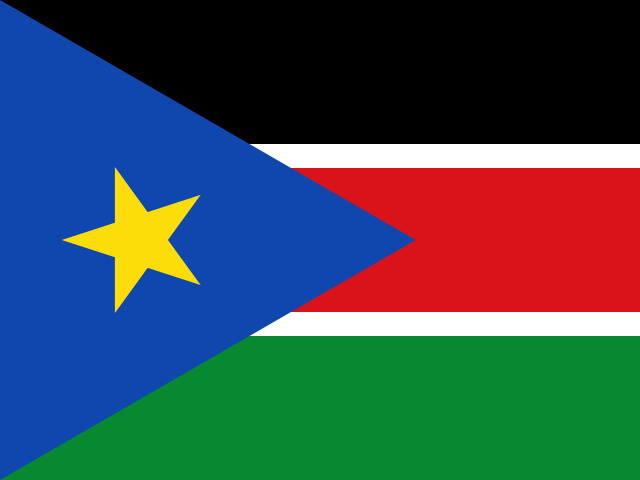
Three horizontal bands of black, red and green separated by thin white stripes, with a sky-blue triangle at the hoist bearing a yellow star. Article 7 of the Transitional Constitution leaves the flag to be prescribed by law and assigns it no meaning. The Office of the President publishes a reading it credits to the National Flag Act 2011: black for the people, white for peace, red for the blood of the martyrs shed during the struggle for liberation, green for the land, agriculture and natural resources, blue for the waters and skies of South Sudan, and the star's yellow for the nucleus formation of the country and its resilience.
Source: mojca.gov.ss · op.gov.ss · goss-online.org · crwflags.com · checked 2026-08-27
South Sudan FACTS ◢
| Capital | Juba |
|---|---|
| Continent | Africa |
| Population | 12,188,788 (2025) |
| Area | 644,329 km² |
| Population density | 19/km² |
| Currency | South Sudanese pound (SSP) |
| Official language | English |
| Calling code | +211 |
| Internet TLD | .ss |
| Time zone | UTC+02:00 |
| Drives on the | Right |
| ISO codes | SS / SSD |
DID YOU KNOW? ◢
- It became the world's newest internationally recognised nation when it gained independence in 2011.
- The Sudd, a giant swamp fed by the White Nile, is one of the largest wetlands on the planet.
- Its Boma-Jonglei landscape hosts a mass antelope migration rivalling the more famous Serengeti one.
- English is its official language, chosen at independence.
South Sudan QUICK ANSWERS ◢
What is the capital of South Sudan?
The capital of South Sudan is Juba.
What is the population of South Sudan?
South Sudan had a population of 12,188,788 in 2025.
What currency does South Sudan use?
South Sudan uses the South Sudanese pound (SSP).
What languages are spoken in South Sudan?
The official language of South Sudan is English.
Think you know your flags? Play Flag Daily → · Browse all countries →
MORE ON THE FLAG ◢
The six meanings that circulate for South Sudan's flag are not invented. Black for the people, red for the blood shed for freedom, green for the land, white for peace, blue for the waters of the Nile, and the star for the unity of the states: a South Sudanese government published that list.
The complication is that a South Sudanese government has published a different one since. The Office of the President reads the blue as the waters and skies of the country rather than the Nile, and gives the star's yellow something it calls the nucleus formation of South Sudan.
Neither the constitution of 2005 nor the constitution of 2011 says a word about what any of it means. Both hand the whole question to a statute, and that statute is where the trail stops.
Key Takeaways
- Article 7 of the Transitional Constitution of 2011 gives the flag no description and no meaning. It says only that the symbols of the State "shall be prescribed by law".
- The 2005 interim constitution said the same thing in the same article number, six years earlier, so no constitutional text of South Sudan or of Southern Sudan has ever described the flag.
- The Office of the President credits the colour meanings to a National Flag Act, 2011. That Act does not appear in the Ministry of Justice's own index of 76 published laws, and no copy of it could be opened for this article.
- The two published state readings disagree: the blue is the River Nile in the older one and the waters and skies of South Sudan in the current one.
- The flag is older than the country. It was the liberation movement's flag, used by the Government of Southern Sudan from 2005, and it was kept rather than replaced in 2011.
Set the two accounts side by side and the disagreement is not where you would expect it. On black, red and green the two governments say much the same thing in different words. The white shifts from a specific historical claim to a single abstract noun. The blue and the star are where they part company.
| Element | Government of Southern Sudan, page dated 2009 | Office of the President, current page |
|---|---|---|
| Black | "the black African people of Southern Sudan" | "the people of South Sudan" |
| White | "Sudan peace for which many lives have been lost" | "peace" |
| Red | "the blood of the gallant freedom and justice fighters who have been lost in the many years of conflict" | "the blood of the martyrs shed during the struggle for liberation" |
| Green | "agricultural potential exemplified by the fertile soil and rich equatorial vegetation" | "the land, agriculture, and natural resources" |
| Blue | "the River Nile" | "the waters and skies of South Sudan, symbolising unity" |
| Star | "unity of the states of Southern Sudan" | its yellow is "the nucleus formation of South Sudan and its resilience" |
Where South Sudan's flag came from, and why 2005 is the date that matters
The flag was not designed for the Republic of South Sudan. It was already in service when the Republic arrived.
The Comprehensive Peace Agreement of 9 January 2005 ended the second civil war and created a self-governing Government of Southern Sudan inside Sudan. That government flew the flag of the Sudan People's Liberation Movement, the movement that had fought the war.
Contemporary reporting is unusually direct about the arrangement. Reporting the Council of Ministers meeting of 22 March 2011, Sudan Tribune described the flag then flying over the Government of Southern Sudan as one "which was borrowed from the ruling Sudan People’s Liberation Movement (SPLM) since 2005", and said it "was also approved by the cabinet to remain the flag for the independent country".
Five weeks earlier the SPLM secretary general Pagan Amum had put the same thing to a press conference in Juba. The same paper reported that "the party preferred the SPLM flag, which has already been serving as an interim flag for the Government of Southern Sudan, to remain as the national flag of the new independent state".
So the adoption question has two answers. The design has been in state use since 2005. It became the flag of a sovereign country on 9 July 2011, without being redrawn.
Who drew it is a third question, and this article cannot answer it. The movement was using the design before any government did, and no source reachable here names its designer or the date the movement adopted it. Names circulate; none that could be traced for this article is attached to a document anyone can open.
A design magazine that interviewed the officials who built the rest of the new country's symbols recorded the decision to keep the flag from the other side. Anne Quito, writing in Works That Work, reported that new flag designs were considered and that keeping the movement's flag "was a sentimental and strategic decision".
The coat of arms was the opposite case, and the contrast is the point. It had to be made from nothing in the same six months, by a nine-member technical committee "handpicked by the Minister of Culture". That committee worked from 26 submitted entries with "all 28 cabinet ministers" commenting on every round, and the National Legislative Assembly ratified the result "barely four weeks before Independence Day".
South Sudan's constitution does not describe the flag, and neither did the last one
Here is the whole of what South Sudan's current constitution says about its flag, under a heading that reads simply "Symbols":
The flag, emblem, national anthem, coat of arms, public seal, medals, festivals, and commemorations of the State shall be prescribed by law.
That is Article 7 of the Transitional Constitution of the Republic of South Sudan, 2011, in the copy the Ministry of Justice and Constitutional Affairs publishes itself. There is no second flag clause. The word appears exactly twice more in the whole document, both times in a schedule of powers rather than in a description: Schedule (A) reserves "National flag, emblem, anthem, coat of arms and medals" to the national government, and Schedule (B) gives each state a "Flag and emblem of the state".
The deferral is older than the country, and it sits at the same article number. The Interim Constitution of Southern Sudan, 2005, also headed its Article 7 "Symbols", and said that the flag and the other emblems of Southern Sudan "shall be specified by law". The printed page sets a stray space inside that last word, which is a defect in the official publication rather than a transcription slip.
That continuity is not a coincidence. The 2011 constitution is legally an amendment of the 2005 one. Its preamble says the people of South Sudan "amend the Interim Constitution of Southern Sudan, 2005", which is then renamed. The 2011 drafters added the national anthem and the coat of arms to the 2011 list, changed the verb from specified to prescribed, and left the mechanism itself alone.
Two constitutions, then, across the whole life of the entity that became South Sudan, and neither tells you that the flag has three bands, or a triangle, or a star, let alone what any of it stands for.
The National Flag Act, 2011, and the trail that stops there
The 2011 constitution's Article 7 promises a law. The state says the law exists and says what is in it.
The Office of the President's National Symbols page states that "the law governs its design, display, and protection" and then gives its authority in one sentence: "The colours and symbols of the flag shall have the following meanings in accordance with the National Flag Act, 2011." Six lines follow. Black is "the people of South Sudan", white is "peace", red is "the blood of the martyrs shed during the struggle for liberation", green is "the land, agriculture, and natural resources", blue is "the waters and skies of South Sudan, symbolising unity", and the star's yellow is "the nucleus formation of South Sudan and its resilience". The same page says the Presidential Flag is used "as prescribed under the National Flag Act, 2011".
This is a stronger claim than the one most flag articles have to assess. It is not a popular reading presented as official. It is the head of state's office naming a statute and saying the meanings are in it.
The statute is where the trail stops. The Ministry of Justice and Constitutional Affairs publishes a consolidated index of the laws of the Republic of South Sudan, 76 documents deep, running from 2001 to 2017 and including both constitutions. There is no National Flag Act in it. Searching that index for the word flag returns nothing at all.
The Act is not a rumour, though. The Flags of the World archive records that the Chief of State Protocol at the Office of the President issued a document on 22 October 2012 headed "Restrictions on the use of the Seal of the Republic, the National Coat of Arms, the Presidential Flag & the National Flag", and that the document names both a National Flag Act (2011) and a National Coat of Arms Act (2012) without reproducing either text. No copy of that document could be opened for this article. The Internet Archive holds exactly one capture of the file that carries its name, made in December 2025, and what that returns is a domain-sale placeholder rather than a document.
What follows from that is worth stating precisely. The meanings the Presidency publishes may well be exactly what the Act says, and nothing here contradicts them. But they cannot be checked against the instrument they are attributed to, and the two elements where the state's own account has moved are the two you would most want to check.
The blue triangle: the Nile, or the waters and skies?
If you have read anywhere that the blue triangle stands for the Nile, you have read something a South Sudanese government said in as many words.
The Government of Southern Sudan's State Symbols page, dated November 2009 and captured before independence, put it like this: "Blue represents the River Nile, which is the main source of life not only in the Southern Sudan but also in the North and all the way to Egypt."
Read that back and notice how much of a pre-independence sentence it is. It is a claim about a river shared with a country the region was still part of, and it makes a point of saying the sharing runs north.
The current page does not say it. The Office of the President's blue "represents the waters and skies of South Sudan, symbolising unity". The river is gone, the northward reach is gone, and something the older page never attached to the blue has arrived: unity.
The Nile reading has not gone away outside the government. Britannica's flag entry, by a former director of the Flag Research Center, says the blue triangle "represents the everlasting Nile River system, which flows through the land and provides sustenance". Anne Quito's account in Works That Work says the blue "symbolises the waters of the Nile".
Geography is not the point here, and it is worth saying so plainly, because the country does lie on the White Nile. What has moved is authorship. The Nile reading is a real reading published by a real government, and it is not the reading the state publishes now.
Is South Sudan's star gold or yellow, and what is a nucleus formation?
The star is often called gold in English-language descriptions of the flag. The word matters, because gold and yellow are different words when a flag statute is doing the fixing, and here there is no reachable statute to check.
Every South Sudanese source reachable for this article says yellow. The Office of the President's page attaches the meaning to the star's yellow colour rather than to the star as a shape. The Media Authority's 2023 printing advisory is reported in both accounts of it as calling it a yellow star. The flag image the Presidency serves on its own page uses one flat yellow, measured as #FFE51A.
No South Sudanese source reachable for this article says gold. The word travels with the reference works. One of them was the CIA World Factbook, which described "a gold, five-pointed star" in a sentence the Flags of the World archive preserves in full. The CIA's own notice, dated 4 February 2026, says the Factbook "has sunset", and its South Sudan page now redirects to that notice, so the description survives only where archives kept it.
The meaning has moved further than the colour word. The older government page gave the star to "unity of the states of Southern Sudan", which is the version that circulates. The Presidency gives the star's yellow for "the nucleus formation of South Sudan and its resilience", which is a different idea and an unusual phrase in English.
Britannica offers a third reading: "Yellow is a symbol of hope and determination for all the people." Works That Work offers a fourth, "a guiding light". Four sources, four stars.
It took until 2023 to settle which blue was right
For its first twelve years the flag circulated in more than one version. The triangle appeared both navy and light blue, and flag archives record both an upright star and one tilted towards the upper hoist. The proportion is not in dispute in any source read for this article: Britannica gives it as "1 to 2", and the Presidency's own image is exactly twice as wide as it is tall.
On 25 August 2023 the Media Authority, South Sudan's media regulator, intervened. Radio Tamazuj quotes the managing director Elijah Alier telling printers that "Printing, publication and circulation of the wrong version of the South Sudan national flag is prohibited", and that companies "are hereby cautioned to immediately cease any printing of wrong versions of the national flag". Eye Radio does not quote him on those two points, but both reports name the fault the memo was aimed at, and Eye Radio puts it plainly: "A deep-blue color has occasionally been wrongly printed instead of the correct light blue color." Both also report that the regulator had observed the wrong versions inside the country and at some diplomatic missions abroad.
The memo regulates printing. It rules one of two circulating versions right without publishing a colour value for either. No South Sudanese instrument giving Pantone, CMYK or hexadecimal figures could be reached for this article, and the Flags of the World archive, which collects flag colour standards from national sources as a matter of routine, records that it has not found one either. What it lists instead is five different sets of approximate values drawn from four reference works, two of the five being successive editions of the same one.
What exists in place of a standard is a curiosity. The flag image the Office of the President serves on its own National Symbols page resolves to exactly six values, #000000, #E22028, #00914C, #FFFFFF, #00B6F2 and #FFE51A, at a ratio of 1:2 with the star upright. Those are the same six values the Flags of the World page lists as Wikipedia's figures for this flag. That is a coincidence worth recording rather than a derivation: it is not evidence that either was taken from the other, only that the state's published image and the encyclopaedia's numbers agree, and that no published specification supports either of them.
Where the familiar readings come from
Trace the version with the Nile and the unity of the states and you arrive at two places. One is the Government of Southern Sudan's own page, last updated in November 2009. The other is the CIA World Factbook, which carried a near-identical sentence and has now been sunset.
The Government of Southern Sudan page repays a second look, because it says something about how much care went into it. Under its flag paragraph it prints a coat of arms with a secretary bird and an Arabic scroll reading "The Republic of Sudan", and a national anthem beginning "We are the army of God and of our land" that ends "May this Our land, Sudan, live long". Those are Sudan's arms and Sudan's anthem, sitting under the heading "State Symbols" of the government that was preparing to leave Sudan.
The flag gloss on that page may still be perfectly accurate. But it is the earliest state text anyone quotes, it went unrevised for years, and the page around it was plainly not being checked.
None of that makes the popular reading wrong. It makes it attributable, which is a more useful thing. If you want to know what South Sudan says its flag means, the answer today is the Presidency's six lines, credited to an Act no source outside government appears to have reproduced. If you want to know why so many pages say the blue is the Nile, the answer is a government web page from 2009.
The flag also belongs to a family. It shares its black, white, red and green and its hoist triangle with the flag of the country it left, and it shares the black over red over green band order with the flag of Kenya. Six colours is a lot to hold in your head at once, which is roughly the difficulty Flag Daily is built around: it shows you a flag and gives you three guesses at the country.
Frequently asked questions
What do the colours of the South Sudan flag mean?
The Office of the President gives black for the people of South Sudan, white for peace, red for the blood of the martyrs shed during the struggle for liberation, green for the land, agriculture and natural resources, blue for the waters and skies of South Sudan symbolising unity, and the star's yellow for the nucleus formation of South Sudan and its resilience. It credits those meanings to a National Flag Act of 2011 whose text is not publicly available, so they cannot be checked against the statute.
An older Government of Southern Sudan page gave a different version of the last two, reading the blue as the River Nile and the star as the unity of the states.
Is the blue triangle on South Sudan's flag the Nile?
Not according to the Office of the President, which reads the blue as the waters and skies of South Sudan and connects it to unity rather than to any river. The Nile reading comes from the Government of Southern Sudan's own symbols page, dated November 2009, and is repeated by reference works including Britannica.
South Sudan does sit on the White Nile, so the reading is geographically unremarkable. It is simply no longer the one the state publishes.
When was the South Sudan flag adopted?
There are two dates, and no published instrument behind either. The design has been in state use since 2005, when the Comprehensive Peace Agreement created the Government of Southern Sudan, which flew the flag of the Sudan People's Liberation Movement. It became the flag of a sovereign country on 9 July 2011 without being redrawn, after the Council of Ministers approved keeping it on 22 March 2011.
Article 7 of both the 2005 and the 2011 constitutions says only that the flag shall be prescribed by law, and no adoption instrument for either step could be opened for this article.
Why does South Sudan's flag look like Kenya's and Sudan's?
No South Sudanese state source reachable for this article explains the resemblance or names a model for the design, so what follows is a description rather than a derivation. The flag has the same black, white, red and green as the flag of Sudan and a triangle at the hoist where Sudan has one. Its band order of black over red over green with white fimbriations is the arrangement Kenya's flag uses.
The design was the Sudan People's Liberation Movement's own banner before any state adopted it, and it was carried into independence unchanged in 2011.
Is the star on the South Sudan flag gold or yellow?
Yellow, on the evidence available. Every South Sudanese source reachable for this article calls it yellow, including the Office of the President's page and the image that page serves, which uses one flat yellow measured as #FFE51A. Gold travels with the reference works rather than with South Sudanese sources.
No South Sudanese instrument specifying colour values could be reached, so this is a description of consistent usage rather than a citation of a standard.
Sources
- Ministry of Justice and Constitutional Affairs, Republic of South Sudan, The Transitional Constitution of the Republic of South Sudan, 2011 (PDF) - retrieved 27 August 2026. Article 7, Schedules (A) and (B), and the preamble.
- Ministry of Justice and Constitutional Affairs, Republic of South Sudan, The Interim Constitution of Southern Sudan, 2005 (PDF) - retrieved 27 August 2026. Article 7 and the schedules of powers.
- Ministry of Justice and Constitutional Affairs, Republic of South Sudan, Laws of the Republic of South Sudan - retrieved 27 August 2026. The consolidated index of 76 published laws, which contains no flag act.
- Office of the President, Republic of South Sudan, National Symbols - retrieved 27 August 2026. The colour meanings and their attribution to the National Flag Act, 2011.
- Government of Southern Sudan, State Symbols - page dated 23 November 2009, read from the Internet Archive capture of 29 May 2011, retrieved 27 August 2026.
- Sudan Tribune, South Sudan cabinet approves 'Sovereignty Symbols' for emerging nation, 22 March 2011 - read from the Internet Archive capture of 13 November 2020, retrieved 27 August 2026.
- Sudan Tribune, South Sudan political parties to discuss flag and currency Thursday, 16 February 2011 - read from the Internet Archive capture of 21 February 2011, retrieved 27 August 2026.
- Radio Tamazuj, Media Authority warns against printing of wrong national flag, 25 August 2023 - retrieved 27 August 2026.
- Eye Radio, Media Authority warns against use of wrong national flag, 25 August 2023 - retrieved 27 August 2026.
- Whitney Smith, Flag of South Sudan, Encyclopaedia Britannica - read from the Internet Archive capture of 25 July 2026, retrieved 27 August 2026.
- Anne Quito, Branding the World's Newest Country, Works That Work - retrieved 27 August 2026.
- Central Intelligence Agency, Spotlighting The World Factbook as We Bid a Fond Farewell, 4 February 2026 - retrieved 27 August 2026. The Factbook's own South Sudan URL,
cia.gov/the-world-factbook/countries/south-sudan/, now redirects here. - Flags of the World, South Sudan, last modified 2 May 2026 - retrieved 27 August 2026. A volunteer-compiled archive, used here for five things and nothing else: its record of the 2012 Chief of State Protocol document, its preservation of the retired CIA World Factbook description, its tables of colour values from five reference sources, its statement that it has found no legislation on the colour specification of the flag, and its record of the flag's variants, both the upright and the tilted star and the navy and the light blue triangle.
PLAY ANOTHER →
One quote, one scrambled alphabet. Crack it before tomorrow.
CRACK THE QUOTEDAILYDaily CodeA short message, hidden in a different cipher every day.
ONE CIPHER A DAYDAILYDaily TriviaFive questions a day. Everyone gets the same five.
FIVE QUESTIONSDAILYOn This DayOne thing that happened today in history. Every day, a new one.
TODAY IN HISTORY