
Kenya
An East African crossroads where the Great Rift Valley splits the land and the savannah stages one of nature's greatest shows, the wildebeest migration across the Maasai Mara.
WHAT THE FLAG MEANS ◢
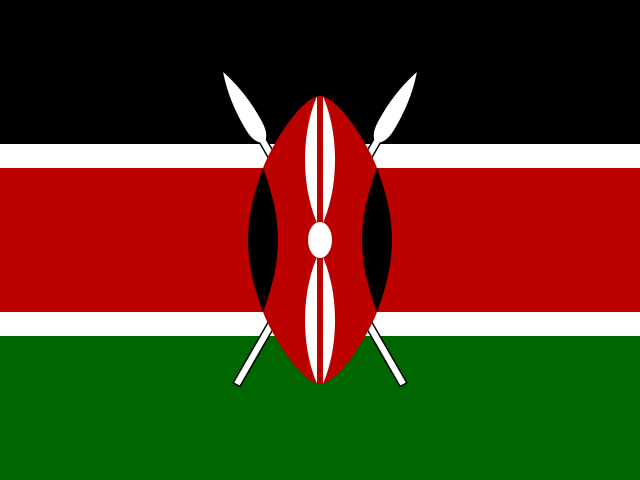
Black, red and green horizontal bands separated by thin white stripes, with a Maasai shield and two crossed spears at the centre, conventionally described as black, red and white. The National Flag, Emblems and Names Act declares the flag by a design and a description: the drawing carries the 2:3 ratio and the band widths, the thirty-word description gives neither, and neither assigns a meaning. The black is conventionally read for the people, the red for the blood shed for freedom, the green for the land and the white for peace, with the shield and spears for the defence of all of them.
Kenya FACTS ◢
| Capital | Nairobi |
|---|---|
| Continent | Africa |
| Population | 57,532,493 (2025) |
| Area | 581,309 km² |
| Population density | 99/km² |
| Currency | Kenyan shilling (KES) |
| Official languages | English, Kiswahili |
| Calling code | +254 |
| Internet TLD | .ke |
| Time zone | UTC+03:00 |
| Drives on the | Left |
| ISO codes | KE / KEN |
DID YOU KNOW? ◢
- The Maasai Mara hosts the Great Migration, when millions of wildebeest and zebra thunder across the plains.
- The Great Rift Valley, visible from space, runs right through the country.
- Kenyan runners are among the greatest distance athletes in the world.
- Some of the oldest human fossils ever found were unearthed near Kenya's Lake Turkana.
- The equator runs directly through the country, yet Nairobi stays mild thanks to its high altitude.
Kenya QUICK ANSWERS ◢
What is the capital of Kenya?
The capital of Kenya is Nairobi.
What is the population of Kenya?
Kenya had a population of 57,532,493 in 2025.
What currency does Kenya use?
Kenya uses the Kenyan shilling (KES).
What languages are spoken in Kenya?
The official languages of Kenya are English and Kiswahili.
Think you know your flags? Play Flag Daily → · Browse all countries →
MORE ON THE FLAG ◢
Kenyan law specifies its flag twice over in the same schedule, once as a drawing and once as a sentence, and almost everything you would want to know is in the drawing.
The figure carries dimension lines: thirty across the top, twenty down the side. That is the 2:3 ratio, and neither the 1964 gazette text nor the 2012 consolidation states it in words anywhere. The three coloured bands are bracketed at six units each, which leaves the two white strips at one unit apiece.
The sentence printed underneath runs to thirty words. It does not give the ratio, the band widths, the colour of the shield, or where the spears cross. It gives the order of the colours and very little else.
What neither the drawing nor the sentence gives is a meaning. The readings you know are real and they are published by Kenyan state bodies, but they are not in the law, and two of those bodies do not word them the same way.
Key Takeaways
- The Second Schedule to the National Flag, Emblems and Names Act declares the flag by its "design and description". The design is a dimensioned figure; the description is one sentence.
- The figure is marked 30 by 20, so Kenya's flag is 2:3 - drawn, never written.
- The red is British Standard shade reference 0-006 in all three texts; the green is 0-010 in the 1964 gazette and 0.010 in both modern ones. The black, the white and the shield carry no colour reference.
- The flag flew on 12 December 1963. The law describing it was assented on 11 December 1964 and deemed to have come into operation on 12 December 1963.
- No instrument assigns a meaning. The Kenya High Commission and the Kenya Yearbook Editorial Board both gloss the colours, and they differ on two of the four.
The drawing is the law, and the sentence is the caption
The declaring provision is worth reading closely, because it names two things and not one: "The flag of which the design and description are set out in Part I of the Second Schedule to this Act is hereby declared to be the National Flag of Kenya".
Design and description. Both are enacted, and they do different jobs.
The design is a technical figure of the flag with dimension lines running round it. Along the top it is marked 30. Down the right-hand side it is marked 20. Twenty by thirty is two to three, which is the ratio usually quoted for the Kenyan flag, and this figure is where it comes from.
The same right-hand margin brackets the three coloured bands at six units each. Six and six and six is eighteen, inside the twenty, so the two white strips between them are one unit each: a coloured band is six times the width of the white strip beside it.
The figure carries far more than the outline. The consolidated Act reprints it as a clean redraw, in vector type rather than a 1964 line block, and against the 30, the 20 and the three sixes it also marks 15 and 15 along the black band and a vertical 12 for the shield. Down the right of the shield runs 3 1/4, 1/2 and 5 1/4; across its upper interior, 1/2, 1/3, 1/2. A 6 spans the shield foot, and the spears cross at 60 degrees.
It carries written instructions as well, and neither appears in the description: "central lines of spears cross of mid point of flag" in the redraw, "cross at" in the 1964 block, and, of the shield, "internal curvature same as external curvature" in both.
That second one is a drafting instruction to whoever renders the flag, constraining the two sides of the shield to the same curve. What shape that produces is a matter of the figure rather than of the instruction.
What the thirty words leave out
Here is the description in full, from Part I of the Second Schedule:
"Three major strips of equal width coloured from top to bottom black, red and green and separated by narrow white strips, with a symmetrical shield and white spears superimposed centrally."
Thirty words. Set against the figure above it, what is missing is striking.
No ratio. No width for the white strips beyond "narrow". No colour for the shield: the spears are given one, white, and the shield beside them is only "symmetrical", so the black, red and white the state's own descriptions give it are nowhere in the enacted words. No spear geometry. No curvature rule.
The word "symmetrical" is doing the work that "internal curvature same as external curvature" does in the figure, and doing it far less precisely.
This is why the description alone cannot answer most questions about the Kenyan flag, and why answering them from the description alone produces confident wrong answers. The Act declares the design and the description together, and the specification lives in the half that is a picture.
The note that gets misread
Underneath the colour key, the schedule prints a note: "All dimensions given do not necessarily represent any particular measurements and are merely proportional." The schedule introduces it with the word "Note".
Read quickly, that looks like a disclaimer of the figure's numbers. It is not, and reading it that way removes a ratio the law plainly fixes.
What it says is that the numbers are not units. The 30 and the 20 are not inches, centimetres or feet, and a Kenyan flag is not required to be thirty of anything wide. They are proportions, which is exactly what a ratio is. The note frees the size and preserves the shape.
So the correct statement is narrow: Kenyan law fixes the flag's proportions and deliberately fixes no absolute dimension. Nothing in the schedule turns on how large the flag is, and a great deal turns on the proportions inside it.
Two colours are pinned to a British Standard, and two are not
The colour key sits between the figure and the note, and it is where the law is at its most exact. It is three lines:
| Swatch | Line as printed |
|---|---|
| the top band | Black. |
| the middle band | Red. B.S.* shade reference 0-006. |
| the bottom band | Green. B.S.* shade reference 0-010. |
The asterisk on two of those three lines is expanded below the Note as "British Standard Specification". So the red and the green are legislated by reference to a numbered shade in a British standards document, while the black is simply "Black" and the white does not appear in the key at all.
One caution on the green. The 1964 gazette prints its reference as 0-010 with a hyphen, and the consolidated Act published by the National Council for Law Reporting prints 0.010 with a full stop. The red is 0-006 in both. The constitutional schedule's figure block gives 0.010 as well, so the full stop is the modern form and the hyphen the 1964 one. Which of them is the typesetting error is not something the three texts settle between them.
Kenya became independent on 12 December 1963, and the shades of two of its national colours were fixed by reference to a British standards specification in a schedule enacted the year after.
The flag flew for a year before the law described it
The National Flag, Emblems and Names Act was assented on 9 December 1963 and commenced on 10 December 1963, two days before independence. Its long title says what it was for: an Act "to prevent the improper use of the National Flag and of certain emblems, names, words and likenesses for professional and commercial purposes, and to prohibit the display of certain flags".
A misuse statute. It protected the flag without ever saying what the flag was.
The design and the description arrived a year later, in the National Flag, Emblems and Names (Amendment) Act, No. 32 of 1964. Its dates are printed at the head of the gazette supplement that carried it: "Date of Assent: 11th December 1964" and "Date of Commencement: 12th December 1963".
Assented in December 1964, commencing in December 1963. The amendment repeats the point in its own first section, that it "shall be deemed to have come into operation on the 12th December 1963" - Kenya's independence day, and the day the flag was first raised.
That amendment created the Second Schedule, renamed the original Schedule the First Schedule, and inserted the section declaring the National Flag. The drawing that fixes Kenya's flag was enacted after everybody had been looking at the flag for a year, and then dated back to the morning it went up.
The Constitution repeats the sentence rather than replacing it
The 2010 Constitution carries the national symbols in its Second Schedule, which the Constitution reaches through article 9. The schedule is headed National symbols and holds four entries in order, the flag first, then the anthem, the coat of arms and the public seal, as the Kenya Law Reform Commission's publication of it shows. The wording of article 9 itself is not quoted here, because no Kenyan state text of it could be opened for this article.
The constitutional entry has the same shape as the Act's: a figure block carrying the drawing and the colour key, the proportionality note, and then the description, which is the 1964 sentence. Its figure is the redraw rather than the 1964 line block, and its colour key follows the consolidation in giving the green as 0.010 rather than 0-010. The only textual difference either source shows is that the constitutional note reads "any particular measurement" where the Act reads "measurements".
Set the three texts side by side and what is stable and what drifts are both visible at once.
| Element | 1964 gazette | Cap 99, Rev. 2012 | Constitution, 2nd Schedule |
|---|---|---|---|
| Description | "Three major strips of equal width coloured from top to bottom black, red and green and separated by narrow white strips, with a symmetrical shield and white spears superimposed centrally." | same, with a comma after "bottom" | same as 1964 |
| Colour key | Black; Red 0-006; Green 0-010 | Green given as 0.010 | carried in the figure block, green as 0.010 |
| Note | "any particular measurements" | "any particular measurements" | "any particular measurement" |
| Figure | dimensioned line block | redrawn, fully dimensioned | the same redraw, at reading size |
So the description has survived a change of constitution essentially unaltered. What it has never acquired, in sixty years and across two instruments, is a single word about what any of it stands for.
If you want to test how much of a flag you actually retain, Flag Daily gives you one a day and three guesses. Kenya's is one that people are sure they know and then draw with the shield in the wrong colours, which the law would not help them with either.
Where the meanings come from, and where they differ
The reading is not in doubt in Kenya. It is simply not in the statute, and the bodies that publish it are diplomatic and educational rather than legislative.
The Kenya High Commission in Accra, a mission of the Ministry of Foreign Affairs, puts it this way: "The color black represents the people of the Republic of Kenya, red for the blood shed during the fight for independence, green for the country’s landscape and the white fimbriation was added later to symbolize peace and honesty. The black, red, and white traditional Maasai shield and two spears symbolize the defense of all the things mentioned above".
The Kenya Yearbook Editorial Board, a state corporation, words two of the four differently: "green is the colour of the landscape, white denotes peace and honour while black is archetypical of our skin colour".
Set those side by side and the black is either the people or their skin, and the white is either honesty or honour. The sense is the same in both and the wording is not, which is what a gloss looks like when it is genuinely and widely held and has never been reduced to legislative text.
The High Commission also supplies something the schedule cannot, because the schedule draws only the finished flag: the white was "added later". The flag began as the flag of the Kenya African National Union, black, red and green without the white separations.
Tom Mboya, and the flag that was nearly a party flag
That KANU inheritance is the part of the story most worth knowing, and the reason the flag is not simply the party's.
The Kenya Yearbook Editorial Board records that at independence some KANU officials wanted the party's own flag to become the national flag, and that Tom Mboya argued instead for a flag representing interests wider than KANU. Its verdict on the outcome is one sentence: "That is how the flag of Kenya got its distinctive colours and symbols."
The white strips and the Maasai shield are the visible result of that argument. They are what separates a national flag from the banner of the party that won.
South Africa's flag came out of a comparable problem three decades later and solved it the other way round, by taking colours from both sides rather than by adding to one side's.
The offence, and how it reaches the flag
One more thing the Act does, which sits in its misuse half rather than its description half.
Showing disrespect, "in speech, manner or writing", to the National Anthem or to any specified emblem, specified likeness or specified name is an offence, punishable by a fine not exceeding five thousand shillings or imprisonment for up to six months, or both.
The National Flag is not named in that section. It is caught by it through a definition that names flags expressly. "Specified emblem" means "any emblem, seal, flag, pennant, insignia, ensign or coat-of-arms of a kind specified in Part I of the First Schedule", and the first item on that list is "The National Flag, and the Armorial Ensigns of Kenya".
The 1964 version of the provision did name the flag expressly. The section in force is the replacement inserted by Act No. 15 of 1968, which reorganised the offence around the anthem and the schedule of emblems, and reaches the flag through the schedule instead.
So Kenyan law is precise about the penalty for insulting the flag and silent on what the flag means. Not a contradiction, but a fair description of where the drafting effort went.
Frequently asked questions
What do the colours on the Kenyan flag mean?
No Kenyan instrument says. The National Flag, Emblems and Names Act sets out a design and a description and assigns nothing, and the Constitution's Second Schedule repeats them. The reading published by Kenyan state bodies is black for the people, red for the blood shed in the fight for independence, green for the landscape, and white for peace, with the Maasai shield and spears for the defence of all of it.
What is the ratio of the Kenyan flag?
Two to three, fixed by the drawing rather than by any sentence. The figure in Part I of the Second Schedule is marked 30 along the top and 20 down the side. A note adds that the dimensions are not particular measurements and are merely proportional, which frees the absolute size while leaving the proportion fixed.
What colour is the shield on the Kenyan flag?
The description does not say. It gives a colour only for the spears, which are white, and calls the shield "symmetrical". What is settled is the state's own answer, if not the statute's: the Kenya High Commission calls it a "black, red, and white traditional Maasai shield". The Act does not, and its figure gets you two of those three.
Part II of the same schedule is worth reading beside that, provided the two are kept apart. It blazons the Armorial Ensigns: "Arms.-Per fess sable and vert, on a fess gules fimbriated argent a cock grasping in the dexter claw an axe also argent." Divided horizontally black and green, with a red band edged in white across it.
That is the escutcheon of the coat of arms, which restates the flag's bands. It is not the flag's Maasai shield, which is a different device with a different arrangement, and nothing in Part II describes that one.
For the flag's own shield the figure is all there is, and it takes you two thirds of the way. The body carries the stipple the key assigns to red and the spindles are left unhatched, which is how the drawing renders white. In the 1964 block the outer lobes are hatched, and the key there distinguishes black from green by the density of the hatching rather than by its angle, so which of the two they are is a judgement about line spacing. The redraw does not settle it either: it replaces the hatching with flat tone screens, and its key is three greys.
How wide are the white stripes on the Kenyan flag?
One unit each, against six for every coloured band. The schedule's figure brackets the black, red and green bands at six apiece against the twenty marked down the side of the flag, which leaves one unit for each white strip. The description says only that the strips are "narrow".
When was the Kenyan flag adopted?
It was first flown at independence on 12 December 1963, but the law setting out its design and description was assented on 11 December 1964 and deemed to have come into operation on 12 December 1963. For the first year, the flag existed without an enacted specification.
Sources
- National Flag, Emblems and Names (Amendment) Act, No. 32 of 1964, Kenya Gazette Supplement No. 170 of 17 December 1964 - a scan of the printed gazette supplement, hosted on Wikimedia Commons rather than by a Kenyan state body, which is the only copy of the 1964 enacting text that could be opened. Its description and colour key say the same thing as the consolidated Act below, with three small textual differences: the green shade reference is separated by a hyphen here and a full stop there, the consolidation adds a comma after "top to bottom", and the two print the asterisk footnote with and without a closing full stop. Each 1964 form was read off the rendered page rather than off the text layer, which the scan mangles elsewhere, so the differences are between the printed texts rather than artefacts of extraction. It carries the enacting text and, at page 240, the Second Schedule Part I figure with its dimension lines and annotations, the colour key, the proportionality note and the description. Also the declaration of the National Flag, the retrospective commencement, and the 1964 form of the disrespect offence. Retrieved 26 August 2026.
- National Flag, Emblems and Names Act, Chapter 99, Revised Edition 2012, National Council for Law Reporting - the consolidated Act: the same description and colour key, the 1963 assent and commencement dates, the long title, the First Schedule list of emblems, and section 2B as substituted by Act No. 15 of 1968. Its page 9 carries a clean redraw of the Second Schedule figure, in vector type, and that redraw is the source of the numeric callouts given in the body. The redraw also carries a fourth textual difference from the gazette: its spear annotation reads "central lines of spears cross of mid point of flag" where the gazette has "cross at mid point of flag". The constitutional schedule's figure block carries "cross of" too, so the variant belongs to the redraw rather than to any one publisher. Both annotations were read off the rendered figures, since neither text layer carries them. kenyalaw.org refuses direct requests, so this was read from the Internet Archive capture of 26 September 2025. Retrieved 26 August 2026.
- Kenya Law Reform Commission, Constitution of Kenya, Second Schedule, (a) The National Flag - the constitutional Second Schedule entry, carrying the drawing, the note and the description. The site answers a bot challenge, so this was read from the Internet Archive capture of 6 June 2025. Retrieved 26 August 2026.
- Kenya Law Reform Commission, Constitution of Kenya, Second Schedule, National symbols (index) - the schedule's own contents list, showing the four symbols in order with the flag first. The flag entry's figure block was fetched as an image and saved with this article; it carries the redrawn figure and the colour key, with the green given as 0.010. It evidences the schedule's contents, not the wording of article 9, which this article does not quote. Internet Archive capture of 24 June 2025. Retrieved 26 August 2026.
- Kenya High Commission, Accra (Ministry of Foreign Affairs), "Flag & National Anthem" - the state gloss on the colours, the KANU origin and the later addition of the white fimbriation. Read from the Internet Archive capture of 12 June 2024. Retrieved 26 August 2026.
- Kenya Yearbook Editorial Board, "One anthem, one flag; Emblems of a common cause" - a second state gloss, differing on the black and the white, and the account of Tom Mboya and the KANU flag. Read from the Internet Archive capture of 22 January 2026. Retrieved 26 August 2026.
PLAY ANOTHER →
A short message, hidden in a different cipher every day.
ONE CIPHER A DAYDAILYOn This DayOne thing that happened today in history. Every day, a new one.
TODAY IN HISTORYDAILYDaily TriviaFive questions a day. Everyone gets the same five.
FIVE QUESTIONSDAILYGuess the CountryThree clues, three guesses. Work out where in the world it is.
THREE CLUES