
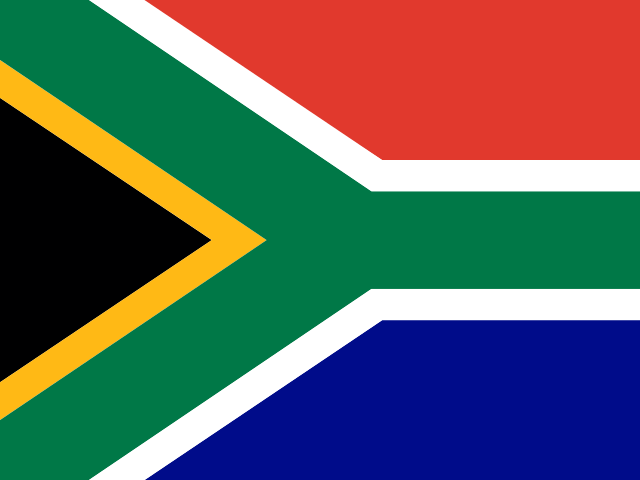
South Africa
A nation with three capitals and twelve official languages, South Africa wraps its neighbour Lesotho entirely inside its borders and hosts some of the planet's most famous safari country.
WHAT THE FLAG MEANS ◢
A green Y-shaped band separating a chilli red upper band and a blue lower band from a black triangle at the hoist, edged in white above and below and in gold where it meets the triangle. Schedule 1 to the constitution describes and sketches that design and gives no element a meaning, and the government's own account of the flag says no universal symbolism should be attached to any of the colours. The one reading that account offers is that the central design can be read as diverse elements within South African society converging and taking the road ahead in unity.
South Africa FACTS ◢
| Capital | Pretoria |
|---|---|
| Continent | Africa |
| Population | 64,747,319 (2025) |
| Area | 1,221,037 km² |
| Population density | 53/km² |
| Currency | South African rand (ZAR) |
| Official languages | Afrikaans, English, Northern Sotho, Sesotho, South African Sign Language, Southern Ndebele, Swazi, Tsonga, Tswana, Venda, Xhosa, Zulu |
| Calling code | +27 |
| Internet TLD | .za |
| Time zone | UTC+02:00 |
| Drives on the | Left |
| ISO codes | ZA / ZAF |
DID YOU KNOW? ◢
- It has three capital cities: Pretoria (executive), Bloemfontein (judicial) and Cape Town (legislative).
- It recognises 12 official languages, one of the highest counts of any country.
- It completely surrounds the independent kingdom of Lesotho.
- The first successful human heart transplant was performed in Cape Town in 1967.
- Table Mountain in Cape Town is one of the oldest mountains on Earth and hosts thousands of plant species found nowhere else.
South Africa QUICK ANSWERS ◢
What is the capital of South Africa?
The capital of South Africa is Pretoria.
What is the population of South Africa?
South Africa had a population of 64,747,319 in 2025.
What currency does South Africa use?
South Africa uses the South African rand (ZAR).
What languages are spoken in South Africa?
The official languages of South Africa are Afrikaans, English, Northern Sotho, Sesotho, South African Sign Language, Southern Ndebele, Swazi, Tsonga, Tswana, Venda, Xhosa and Zulu.
Think you know your flags? Play Flag Daily → · Browse all countries →
MORE ON THE FLAG ◢
South Africa's flag is easy to describe and, officially, almost impossible to explain. That no official meaning attaches to its individual colours is not a gap in the record or an oversight by a drafter in a hurry. It is a decision, taken by the man who drew the flag, and the government page that sets out what the flag means is the same page that names him as its designer and cites his book.
Ask what the green stands for, or the black, or the gold, and the instruments that create the flag answer nothing at all. Section 5 of the constitution names six colours and points at a schedule. Schedule 1 sets out the geometry in six numbered clauses and stops. The 1994 proclamation that first brought the flag into being says the same thing in the vocabulary of heraldry and also stops.
The state offers one reading, and it belongs to the shape rather than to any colour. The central design converges and then runs on as a single band, which can be read as diverse elements coming together. Even that is written in the conditional. The designer confined himself to it on purpose, and said so.
Key Takeaways
- Section 5 of the Constitution of the Republic of South Africa, 1996 says the flag is black, gold, green, white, red and blue, as described and sketched in Schedule 1. Schedule 1 describes the geometry in six clauses and assigns no element a meaning.
- In the official English text the Department of Justice publishes, the sketch that section 5 promises is a line drawing with no colour in it. Its areas have the names of their colours set inside them as printed words instead.
- The government's own page on the flag says that no universal symbolism should be attached to any of the colours, and offers one reading of the central shape, in the conditional.
- The reading traces to the flag's designer. The government's page names Fred Brownell, then state herald, as the designer, and its Sources list carries a book of his. He wrote that his decision to stay clear of colour symbolism was deliberate.
- The palette matches a count. Brownell records that the colours used on flags in South Africa across three and a half centuries were tabulated and the figures given to the symbols commission in September 1993, and the flag's six colours are that count's top six.
| Instrument | Date | What it fixes | What it says the flag means |
|---|---|---|---|
| Constitution Act 200 of 1993, sections 2(1) and 248 | Act in force 27 April 1994; section 248 from 28 January 1994 | That the flag is whatever the President prescribes by proclamation, and that the proclamation counts as part of the constitution | Nothing, and it does not describe a flag at all |
| Proclamation no. 70, 1994, Schedule | Gazetted 20 April 1994 | The design, in heraldic terms, at two in the width to three in the length | Nothing |
| Constitution of the Republic of South Africa, 1996, section 5 and Schedule 1 | Assented to 10 December 1996, in force 4 February 1997 | Six colours, six clauses of geometry, and a sketch | Nothing |
| Government Notice 510 of 2001, The Presidency | 8 June 2001 | How and where the flag is flown, and what may not be done with it | Nothing |
Both the government and the flag's designer put its one meaning in the conditional
The South African government's page on the national flag has three tabs, Symbolism, Flying the flag and Colour specifications, and a Sources list under them. The section headed Symbolism opens by naming Fred Brownell as the designer, says the flag was first used on 27 April 1994, and then says this: "The design and colours are a synopsis of principal elements of the country's flag history. Individual colours, or colour combinations represent different meanings for different people and therefore no universal symbolism should be attached to any of the colours."
Only after that does it offer anything positive, and what it offers is a single sentence about the shape. The central design, beginning at the flagpost in a V form and flowing into a single horizontal band to the outer edge of the fly, "can be interpreted as the convergence of diverse elements within South African society, taking the road ahead in unity". It adds that the theme "ties in with the motto Unity is Strength of the previous South African Coat of Arms".
The page does not present that reading as its own work. Its Symbolism section names Brownell as the designer, and its Sources list opens with a book of his: National Symbols of the Republic of South Africa, published in Johannesburg in 1995.
That list has four entries, and the other three are all ruled out. Two of them are official yearbooks, from 1983 and 1993, published before this flag existed. The remaining one is what the page cites as Government Gazette no 1658 of 1995, which is Government Notice 1658 of 27 October 1995, the notice that the 2001 flying instructions withdrew. That leaves Brownell's book, the entry the list opens with, as the only work on the page's own bibliography that both postdates the flag and has not since been withdrawn.
Brownell set out the same reading at greater length in an article in the journal Historia in 2011. South Africa has a diverse population, he writes there, and "in addition to positive attributes, symbolism also has the potential of erecting barriers and creating divisions". "For this reason I have, personally, confined any allusion to possible symbolic meaning to only one aspect of the design, namely the central element". That element, he goes on, "can be seen as representing the convergence of cultures and other diverse elements in South African society, which then take the road ahead in unison". The word can is italicised in the original.
He was blunter about the colours. "Colours are a natural phenomenon and can have no intrinsic meaning", he wrote, and "No universal symbolism can thus be attached to any of the colours incorporated into the national flag". Then the sentence that accounts for the abstention: "The decision on my part to stay clear of colour symbolism was deliberate."
His reason was practical rather than modest. Human nature being what it is, he writes, people attribute widely differing meanings to individual colours and combinations anyway. "Those who wish to see in the flag colours which they might in some other way hold dear, often do so", he observes. In his view, declining to rule on any of it has contributed to the flag's acceptance across the political and cultural spectrum.
What South Africa's constitution says about the flag, and what its sketch shows
Section 5 of the 1996 constitution reads in full: "The national flag of the Republic is black, gold, green, white, red and blue, as described and sketched in Schedule 1." Both verbs matter. The schedule has to do two things, and it does them in that order.
The description is six numbered clauses. "The national flag is rectangular; it is one and a half times longer than it is wide." "It is black, gold, green, white, chilli red and blue." "It has a green Y-shaped band that is one fifth as wide as the flag", whose centre lines "start in the top and bottom corners next to the flag post, converge in the centre of the flag, and continue horizontally to the middle of the free edge". "The green band is edged, above and below in white, and towards the flag post end, in gold", and "Each edging is one fifteenth as wide as the flag". "The triangle next to the flag post is black." "The upper horizontal band is chilli red and the lower horizontal band is blue. These bands are each one third as wide as the flag."
That is the whole of it. No colour is given a referent, no shape is given a story, and the word symbol does not appear.
The sketch is stranger. In the official English text published by the Department of Justice and Constitutional Development it sits below the clauses on printed page 124, and it is a plain line drawing in black on white. Nothing in it is coloured. The areas instead have the names of their colours set inside them as printed words: Chilli Red in the upper panel, White on the edgings above and below the horizontal arm, Gold running at an angle along the upper diagonal, Black in the triangle at the hoist, Green along the horizontal arm, Blue in the lower panel.
So the sketch the constitution promises turns out to be a diagram in which a six-colour flag has its colours spelled out rather than shown. It works perfectly well as a specification, since the words in the drawing point back to the colour names in clause 2 and to the shade codes the government publishes separately. It is also the plainest possible demonstration of what the schedule is for. The drawing exists to fix where each colour goes, and nothing in the constitution ever undertakes to say why.
The 1994 proclamation says the same thing in heraldry
The flag is older than the constitution that now prescribes it, and the route it took into law is worth following, because the interim constitution never described a flag at all.
Section 2(1) of the Constitution of the Republic of South Africa Act 200 of 1993 said only that "The national flag of the Republic shall be the flag the design of which is determined by the President by proclamation in the Gazette." The design was still unresolved when that Act was passed, so the Act left a hole and named who could fill it.
Section 248 then did something unusual. It let the State President use that power before the Act itself came into force, on the advice of the Transitional Executive Council, and provided that any proclamation so issued "shall for all purposes be deemed to form part of this Constitution". That section came into operation on 28 January 1994, and it gave a gazette notice the standing of a constitutional provision.
The proclamation followed on 20 April 1994, seven days before the flag was flown. Its Schedule is written in blazon rather than plain English. The 1994 gazette could not be retrieved online, so what is quoted here is the reprint The Presidency published in 2001, in the notice that still governs how the flag is flown. On that text the flag is "rectangular in the proportion of two in the width to three in the length; per pall from the hoist, the upper band chilli red and the lower band blue, with a black triangle at the hoist, over the partition lines a green pall one fifth the width of the flag, fimbriated white against the chilli red and blue, and gold against the black triangle at the hoist; the width of the pall and its fimbriations is one third the width of the flag."
Per pall and fimbriated are the heraldic words for the Y-shaped division and for the narrow edging that keeps two colours apart. The 1996 schedule translates them into ordinary English and breaks out the one component the older text left inside its total. The proclamation gives the pall as one fifth of the width, and the pall with its fimbriations as one third, leaving each fimbriation to be worked out. Schedule 1 states it: one fifteenth per edging, which is exactly what makes that third. The two descriptions are the same flag, one written for heralds and one written for everybody.
Red in section 5, chilli red in Schedule 1
Section 5 lists the colours as black, gold, green, white, red and blue. Clause 2 of Schedule 1 lists them as black, gold, green, white, chilli red and blue. The schedule's word is the operative one, and it is also the word the 1994 proclamation used twice.
Chilli red is a specification rather than a flourish. The government's own colour table gives the textile colours as CKS 42 c Spectrum green, CKS 401 c Blue black, CKS 701 c National flag white, CKS 724 c Gold yellow, CKS 750 c Chilli red and CKS 762 c National flag blue, and then lists what it calls "Approximate Pantone equivalents": 3415 c for the green, 1235 c for the gold, 179 c for the red, and reflex blue c for the blue. Black and white are given no Pantone equivalent at all, and the word approximate is the government's.
Brownell explained the choice of that shade in political rather than chromatic terms. Chilli red falls between red and orange, so it "circumvented certain political objections to the use of both orange and red". The flag flown from 1928 to 1994 was based on an orange, white and blue tricolour, with everything that went with it. Plain red had associations of its own. A colour that is exactly neither was the point.
South Africa's six flag colours are the top six of a count going back three and a half centuries
There is arithmetic under the palette. Well before the design was chosen, Brownell records, "The relative popularity of flag colours used in South Africa over the past three and a half centuries was also researched and tabulated." He gives the result as a ranked list: "white (25); green (22); red (20); blue (20); black (16); gold/yellow (15); and orange (6)". He adds that if red and orange were counted together and represented by chilli red, "they together occupied first place". The note on those figures records that they were provided to the Commission on National Symbols in September 1993.
He never says what the unit was, and the note he hangs on the tabulation sentence does not supply it. What that note offers is a place to go and look, in a book published in 2008, and it was written for the reader of 2011 rather than for the counter of 1993. It reads, "For colour illustrations of virtually all the flags which have flown over South Africa, see the plates in A.P. Burgers, The South African Flag Book: The History of South African Flags from Dias to Mandela".
Six colours reached the flag, and they are the top six on that list. Orange is the one that did not reach it in its own right, though on Brownell's account chilli red is the colour standing in its place. The count is provenance rather than a selection procedure. He gives particular reasons for particular colours elsewhere, putting the yellow triangles in at the hoist for the popularity of green and gold in South African sport and in the flags of the South African liberation movements.
He set out where each had come from. The chilli red, white and blue "are derived from the earlier stages of our flag history", while green, black and gold "first came into use in South African national flags during the nineteenth century": green in the Transvaal Vierkleur of 1857, black in the flag of the early Boer republic of Goshen in 1882. Looking outward rather than back, he noted that red, yellow or gold and green are the Pan-African colours, derived from the flag of Ethiopia, and that black, green and gold had been associated since at least 1925 with the flags of the African National Congress and later the Inkatha Freedom Party and the Pan Africanist Congress.
None of that is symbolism in the usual sense. It is a claim about provenance, which is what the government means when it calls the design "a synopsis of principal elements of the country's flag history". A colour is on the flag because it was already on South African flags, not because it stands for a virtue.
Where the design came from, and the objection that produced the Y
The design has a date and a place. Brownell was at the 15th International Congress of Vexillology in Zurich, and on the evening of 25 August 1993, during what he calls "a seemingly interminable meeting" of the International Federation of Vexillological Associations, his attention drifted to the problem waiting for him at home. He asked himself: "Aren't we looking for something depicting convergence and unification?" He turned over the lecture programme in front of him and sketched the answer on the back.
That was not yet the flag. The original had green above and blue below, with the central device in red. Because "an adverse symbolism could well be attached to the idea of red paths converging", the red and the green were swapped. Yellow triangles went in at the hoist. Black triangles superimposed on the yellow were tried and, at that stage, were not a success. Red and orange were both tried as colours for the top band.
The last change was not his. Working on the designs at home, he showed the progression to his family, and his youngest daughter Claire argued that there were people who would "stand the flag design on its head" and see the "ban the bomb peace sign". The green stripe still ran from the V all the way to the hoist at that point. Deleting that extension removed the objection and produced the classic Y-shaped heraldic pall the flag has now, with a chilli red upper band.
His confidence in the geometry came from having done it before. As state herald he had worked on Namibia's national symbols in February and March 1990, which he says provided "invaluable experience in both the technical side of national flag design and also some insight into political factors and social dynamics".
The formal process ran nowhere near as well. Some 7,000 proposals had come in from the public by 14 October 1993, when the commission began evaluating them, and designs were still arriving days after that. The national flag sub-committee and its assessors were expected to work through them between 11h00 and 16h00 on one day. Six designs went forward to the Negotiating Council. None of them caught. Four graphic design studios were briefed next, and a further group of designers days after that. More than thirty-five designs were delivered on 3 and 4 November, and they fared no better. The flag that was adopted came out of a joint technical working committee appointed on 28 February 1994 and required to report by 8 March, eight days later. The committee's designs went to the Transitional Executive Council, which on 15 March 1994 adopted the one that became the flag.
South Africa's flag was supposed to be temporary
The flag was commissioned as a transitional symbol. The Negotiating Council resolution of 10 August 1993 that called for a Commission on National Symbols asked it to recommend flags, coats of arms, a seal and an anthem "for the transition period", and the press of the day treated the country's symbols as a five-year question: Brownell cites a Die Burger article of 29 September 1993 remarking that South Africans seemed rather unconcerned about their symbols for the following five years. Barry Ronge, writing in the Sunday Times Magazine on 3 April 1994, put it more sourly. His notice of the new design, quoted by the vexillologist Bruce Berry, includes the line "They tell us we are stuck with it for the next five years", and ends the passage Berry quotes with this: "All I can say is that if this is an example of what negotiated consensus can produce at the level of flag design, heaven help us when they get down to designing a new society".
It was hoisted for the first time at one minute past midnight on 27 April 1994, at ceremonies in each of the nine new provincial capitals, to the accompaniment of the two new national anthems. The flag it replaced had been in service since 31 May 1928.
The five years never ran. The Constitutional Assembly, drafting the permanent constitution, called for submissions on the national symbols and received 118 recommending that the flag be kept against 35 suggesting changes. On 28 September 1995 it resolved to retain the design, with every political party except the Pan Africanist Congress supporting that outcome. Schedule 1 of the 1996 constitution carries the design unchanged, and the flag became permanent when that constitution came into force on 4 February 1997.
If you want to see how a flag designed in a hurry holds up as a piece of identification, Flag Daily shows one flag a day and gives you three guesses at the country. Brownell's practical test, built on the Finnish heraldic designer Olof Eriksson's advice to learn to think on the size of a postage stamp, is whether a flag design can be reduced to fit an enamelled lapel badge without losing detail.
Flying South Africa's flag, and the four things the flag must not do
The constitution describes the flag and stops there. The rules for using it are somewhere else entirely: a set of instructions issued by The Presidency as Government Notice 510 of 8 June 2001, "published for general information" and withdrawing an earlier notice of 1995. The notice creates no offence and prescribes no penalty for breaching any part of it.
Most of it is protocol: sizes, flag stations, the order of precedence when the flag is flown with others, and the rule that except on ceremonial occasions the flag is hoisted rolled up to break at the truck. Half-masting happens only on instructions from The Presidency. Freedom Day, 27 April, is the one designated ceremonial day.
Paragraph 15 is the one people usually want. "The National Flag must at all times be treated with dignity and respect", it opens, and then lists four things the flag must not do:
- Touch the floor or the ground.
- Be used as a tablecloth, or draped in front of a platform.
- Be used to cover a statue, plaque, cornerstone or the like at an unveiling or similar ceremony.
- Be used to start or finish any competition, race or similar event.
Nothing in the notice, in either the 1993 or the 1996 constitution, or in the proclamation says what the flag means. On the evidence of the man who designed it, that silence was chosen rather than overlooked.
Frequently asked questions
What does the South African flag mean?
Officially, the colours mean nothing. Schedule 1 to the 1996 constitution describes the flag in six clauses of geometry and assigns no element a meaning, and the South African government's own page says that no universal symbolism should be attached to any of the colours. The one reading the state offers concerns the shape: the central design converges and continues as one band to the fly, which the government says "can be interpreted as the convergence of diverse elements within South African society, taking the road ahead in unity".
That reading originates with Fred Brownell, the state herald who designed the flag, who limited himself to it deliberately and expressed it in the conditional.
What do the colours of the South African flag stand for?
No South African instrument that creates or governs the flag assigns them anything: not section 5, not Schedule 1, not the 1994 proclamation, not the 2001 instructions. What the designer records instead is a count. The colours used on flags in South Africa over the previous three and a half centuries were tabulated, and the flag's six are that count's top six, with orange seventh.
Popular readings do circulate, and each of them belongs to whoever is offering it. The government's page says in terms that no universal symbolism should be attached to any of the colours.
Who designed the South African flag?
Fred Brownell, then South Africa's state herald, an office he held from 1982 to 2002. The idea came to him on 25 August 1993 at the International Congress of Vexillology in Zurich, where he sketched it on the back of a lecture programme.
The Transitional Executive Council adopted the final version on 15 March 1994, after a joint technical working committee that Brownell convened was given roughly a week to resolve a question that had defeated a public call for proposals, a national commission and four design studios.
Is the South African flag a Y or a V?
Schedule 1 calls it "a green Y-shaped band", and the 1994 proclamation calls it a pall, which is the heraldic name for the same figure. The government's page describes the central design as beginning at the flagpost in a V form and flowing into a single horizontal band, which is the same shape read as two parts rather than one.
An earlier version of the design carried the green stripe all the way to the hoist. It was removed on the advice of the designer's youngest daughter, who argued that there were people who would turn the design on its head and see the ban-the-bomb peace sign. Deleting it is what produced the Y.
Why is the red on the South African flag called chilli red?
Because that is the shade the instruments specify. Schedule 1 and the 1994 proclamation both use the words chilli red, even though section 5 of the constitution, listing the colours, abbreviates it to red. The government's colour table gives the textile shade as CKS 750 c Chilli red, with Pantone 179 c as an approximate equivalent.
The designer's stated reason for choosing a shade between red and orange was political: it avoided objections attached to both of the colours it sits between, orange having been a colour of the flag in use from 1928 to 1994.
Sources
- Constitution of the Republic of South Africa, 1996, section 5 and Schedule 1, Department of Justice and Constitutional Development. The official English text. Section 5 is on printed page 3, and Schedule 1 with its uncoloured sketch on printed page 124. Retrieved 21 August 2026.
- Constitution of the Republic of South Africa Act 200 of 1993, Parliament of the Republic of South Africa. The interim constitution, whose section 2(1) leaves the flag to proclamation and whose section 248 deems such a proclamation part of the constitution. Retrieved 21 August 2026.
- Instructions regarding the flying of the National Flag of the Republic, Government Notice 510 of 8 June 2001, The Presidency, Government Gazette no. 22356. Paragraph 1 reprints the Schedule to Proclamation no. 70, 1994, first published in Government Gazette no. 15663 of 20 April 1994, and that reprint is the text of the 1994 Schedule quoted in this article. Paragraph 15 carries the four prohibitions, and the notice also withdraws Government Notice 1658 of 27 October 1995. Retrieved 21 August 2026.
- National flag, South African Government. The state's Symbolism, Flying the flag and Colour specifications sections, including the CKS textile colours and the approximate Pantone equivalents. Its Symbolism section names Fred Brownell as the designer, and the first entry in its own Sources list is his National Symbols of the Republic of South Africa (Chris van Rensburg Publications, Johannesburg, 1995). Retrieved 21 August 2026.
- F.G. Brownell, Flagging the "new" South Africa, 1910-2010, Historia volume 56 number 1, May 2011, published at SciELO South Africa. The designer's own peer-reviewed account of the process, the Zurich sketch, the colour tabulation and his decision to avoid colour symbolism. His footnote 49 points the reader to the plates in A.P. Burgers, The South African Flag Book: The History of South African Flags from Dias to Mandela (Protea Book House, Pretoria, 2008) for illustrations of the flags that have flown over South Africa, and footnote 50 records that the tabulated figures went to the Commission on National Symbols in September 1993. The author note identifies him as the designer of the flag and as state herald from 1982 to 2002. Retrieved 21 August 2026.
- Bruce B. Berry, Zero to Hero - the role of the national flag in nation building in post-apartheid South Africa, Southern African Vexillological Association, hosted by the International Federation of Vexillological Associations. Source for the first hoisting at one minute past midnight, the Constitutional Assembly's 1995 decision and the submission counts, and for the contemporary press reaction quoted here. For the 118 against 35 figures it cites a contemporaneous record, the SAVA Newsletter of 31 August 1995, which predates the 28 September resolution and so covers the submissions rather than the decision. Two details in it do not survive a check against the constitution and are not followed here: it gives the flag provision as section 1, where the instrument has it at section 5, and it dates the signing to 16 December 1996, where the official text records assent on 10 December and promulgation on 18 December. Retrieved 21 August 2026.
PLAY ANOTHER →
One quote, one scrambled alphabet. Crack it before tomorrow.
CRACK THE QUOTEDAILYOn This DayOne thing that happened today in history. Every day, a new one.
TODAY IN HISTORYDAILYDaily CodeA short message, hidden in a different cipher every day.
ONE CIPHER A DAYDAILYDaily TriviaFive questions a day. Everyone gets the same five.
FIVE QUESTIONS