
Namibia
One of the emptiest countries on Earth, Namibia hands most of its space to the desert, where the world's tallest dunes glow orange and a ghostly gravel plain meets a foggy Atlantic shore.
WHAT THE FLAG MEANS ◢
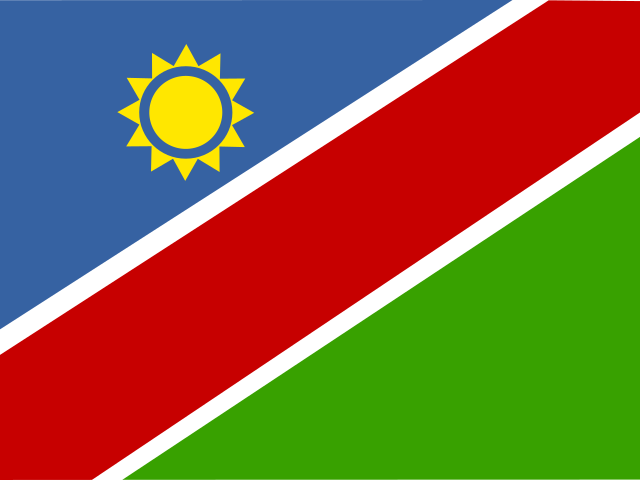
A red diagonal band edged in white runs from lower hoist to upper fly, separating a blue upper triangle from a green lower one, with a gold twelve-rayed sun in the upper hoist. Schedule 6 to the constitution blazons the whole flag in proportions - the white bend a third of the width, the red a quarter, the sun a third of the width in diameter, its rays two fifths of its radius issuing from a blue ring - and assigns none of it a meaning. The government's own reading, published outside the law, gives the blue to the sky, the Atlantic and the importance of rain and water, the red to the Namibian people and their heroism, the green to the country's vegetation and agricultural resources, the white to peace and unity, the sun to life and energy, and the gold of the sun to the warmth and the colour of the plains of the Namib Desert.
Namibia FACTS ◢
| Capital | Windhoek |
|---|---|
| Continent | Africa |
| Population | 3,092,816 (2025) |
| Area | 825,615 km² |
| Population density | 4/km² |
| Legal tender | Namibian dollar (NAD) and South African rand (ZAR) |
| Official language | English |
| Calling code | +264 |
| Internet TLD | .na |
| Time zone | UTC+02:00 |
| Drives on the | Left |
| ISO codes | NA / NAM |
DID YOU KNOW? ◢
- The Namib Desert, which gives the country its name, is considered one of the oldest deserts on Earth.
- It's among the least densely populated countries in the world, with vast stretches of near-empty land.
- The dunes at Sossusvlei are among the tallest in the world, some rising over 300 metres.
- It was the first country in the world to write environmental protection into its constitution.
Namibia QUICK ANSWERS ◢
What is the capital of Namibia?
The capital of Namibia is Windhoek.
What is the population of Namibia?
Namibia had a population of 3,092,816 in 2025.
What currency does Namibia use?
Namibia uses the Namibian dollar (NAD) and South African rand (ZAR).
What languages are spoken in Namibia?
The official language of Namibia is English.
Think you know your flags? Play Flag Daily → · Browse all countries →
MORE ON THE FLAG ◢
Namibia's flag runs a red diagonal band, edged white, from the bottom of the hoist to the top of the fly, with a blue triangle above it, a green one below, and a gold sun in the upper corner nearest the pole. The readings quoted for it are real and they are official: blue for the sky and the Atlantic, red for the Namibian people and their heroism, green for vegetation, white for peace and unity, and the sun for life and energy.
What is unusual about Namibia is where those readings live. The flag itself is written into the Constitution of the Republic of Namibia, in a schedule that fixes the design in the technical language of heraldry, down to the width of every band, and that schedule assigns not one element a meaning.
The meanings come from somewhere else entirely: a page the Namibian government publishes about its national symbols. It has never been enacted, it is not what the Constituent Assembly said when it adopted the flag, and the government's own domestic web portal has quietly stopped carrying it.
Key Takeaways
- Article 2(1) of the Namibian Constitution puts the flag's description in Schedule 6. Schedule 6 gives proportions, positions and colour names, and no symbolism whatsoever.
- The colour meanings are the Namibian government's own, published on its national-symbols pages. The wording has been in circulation since at least 2013 and the High Commission in London still carries it word for word.
- The Constituent Assembly adopted the flag on 2 February 1990, and nothing was said in that sitting about what it stood for. Five weeks later it had the coat of arms explained charge by charge.
- The design came out of a public competition. On 1 February 1990 the subcommittee told the House it had narrowed the field to about four designs out of 700.
- The flag's Pantone colours are fixed by the National Symbols Act of 2018, sideways: they arrive inside the schedule describing the President's personal standard.
Who assigns the Namibian flag its colour meanings?
The Government of Namibia does, on its national-symbols pages, in wording that has barely changed in over a decade.
The government portal's account opens by dating the flag: "Namibia's National Flag was unanimously adopted by the Constituent Assembly on 2 February 1990 as a symbol of the country's struggle for national unity." It then works through the design: "It symbolises peace, unity and common loyalty to Namibia. The National Flag represents the nation in every aspect. The sun symbolises life and energy. The golden colour of the sun represents the warmth and the colour of the plains of the Namib Desert."
The colours follow in a single paragraph: "The blue symbolises the sky, the Atlantic Ocean, Namibia's marine resources and the importance of rain and water. Red represents the Namibian people, their heroism and their determination to build a future of equal opportunity for all. White refers to peace and unity, while the green symbolises the country's vegetation and agricultural resources."
That is the source of nearly every colour gloss written about this flag. It is a government text, so calling the meanings official is fair. It is not law, and it does not claim to be.
Retellings lose two things in it. The sun and its colour are read separately: the sun is life and energy, while the gold is the warmth and the colour of the Namib plains. And the flag as a whole is given a meaning before any of its parts, as a symbol of the struggle for national unity.
The passage is also drifting out of view at home. It was on the government portal's national-symbols page in January 2013 and still there in November 2018, at a different path and with the passage unchanged. The page standing in its place now, headed About National Symbols, is about protection rather than meaning: it lists the five symbols, names the two Acts that guard them, and explains how to apply to the National Symbols Committee for permission to use one. It says nothing about what the colours stand for. The full reading is still published by the High Commission of the Republic of Namibia in London, sentence for sentence.
Blue, red, green, white and the sun, in both documents
| Element | The government's national-symbols text | Schedule 6 of the constitution |
|---|---|---|
| Blue | the sky, the Atlantic Ocean, Namibia's marine resources, the importance of rain and water | one of three tinctures the flag is tierced in |
| White | peace and unity | a bend reversed, one third of the width of the flag |
| Red | the Namibian people, their heroism, their determination to build a future of equal opportunity for all | a bend one quarter of the width of the flag |
| Green | the country's vegetation and agricultural resources | one of three tinctures the flag is tierced in |
| The sun | life and energy | a gold sun with twelve straight rays, one third of the width of the flag across |
| The gold of the sun | the warmth and the colour of the plains of the Namib Desert | the word gold, and nothing more |
What Schedule 6 actually says
Article 2 of the constitution is headed National Symbols, and its first clause is one sentence long: "Namibia shall have a National Flag, the description of which is set out in Schedule 6 hereof."
Schedule 6 is that description, and it is a single paragraph of blazon. It begins by fixing the shape and the field: "The National Flag of Namibia shall be rectangular in the proportion of three in the length to two in the width, tierced per bend reversed, blue, white and green; the white bend reversed, which shall be one third of the width of the flag, is charged with another of red, one quarter of the width of the flag."
Then the sun, in the same register: "In the upper hoist there shall be a gold sun with twelve straight rays, the diameter of which shall be one third of the width of the flag, with its vertical axis one fifth of the distance from the hoist, positioned equidistant from the top edge and from the reversed bend."
And finally the detail almost nobody draws correctly from memory: "The rays, which shall each be two fifths of the radius of the sun, issue from the outer edge of a blue ring, which shall be one tenth of the radius of the sun." The twelve rays do not touch the disc. They stand off it, separated by a blue annulus a tenth of the radius wide.
That is the whole of it. Six fractions, five colour words, a ray count, and no symbolism. Whoever drafted it was answering the question of how to draw the flag, and only that question.
What the Assembly said when it adopted the flag
The Constituent Assembly's own debates record the moment, and it is much less ceremonious than the anniversary retellings suggest.
On 1 February 1990 the flag came up at the end of a housekeeping sitting, after exchanges on the minutes about deputy ministers and on Article 11 of the draft constitution. Hidipo Hamutenya rose "to extend an invitation to members of this House to come here tomorrow at 10h30 to decide on the flag", explaining that "There are designs available and we have to decide now, since the people who have been given the mandate want to proceed with whichever one we choose."
The next morning it was Theo-Ben Gurirab who pushed for an answer, saying that of the transitional arrangements "One item that remains hanging in my mind is about the flag." The Chairman, Hage Geingob, set out the plan the committee had changed that morning: "We said yesterday that the committee will select the flag and then describe it in the Constitution, and then you are going to have a flag with the Constitution. But it was decided at committee-level this morning that the flag will be brought here, the one we have chosen, to be seen by the members and adopted. Do we have it here?"
It was not in the room yet. Hamutenya: "We were waiting for the opportune moment to bring it in."
While the House waited, Ngarikutuke Tjiriange made the complaint that dates the whole episode. The design had already leaked. "We will be the first people in history to have our flag before independence in the newspapers, what it looks like and so on. From my experience the flag is unveiled on that particular day."
The Chairman filled the gap by reading out what the South African State President had announced at the opening of Parliament that morning: that Nelson Mandela would be released within days, and that thirty-three banned parties had been unbanned. Then, in the next breath: "The flag will now be displayed. APPLAUSE. There was a proposal by an honourable member that we should sing Nkosi Sikulele in honour of the flag." And: "We have adopted the flag formally."
Not one word in that sitting about what any of it meant. The Assembly adjourned at noon.
The coat of arms got an explanation the flag did not
Five weeks later, on 9 March 1990, the same subcommittee brought the coat of arms to the same House, and this time somebody asked. Moses Katjiuongua requested that the chairman of the subcommittee "explain these things to the House in more detail", adding that "It might be of public interest". The presiding officer, the Deputy Chairman that morning, put it plainly: "There is a request to explain the meaning of the symbols on the coat of arms to the House."
Hamutenya obliged, prefacing it with a disclaimer that he was "not a specialist in heraldic rules of designing flags, coats of arms, seals and the rest". He then went round the shield. The oryx are "an elegant animal", "a very proud animal", "a very brave animal". The fish eagle "represents far-sightedness", and "So, we want to be a far-sighted nation." The motto at the base is "unity of our nation, liberty and justice".
The one element he did not interpret was the flag itself, which occupies the shield in the middle of the arms. He described it only by position, as "the part containing the flag". So the parliamentary record carries an official gloss on the eagle, the oryx, the welwitschia and the sand. Searching all three volumes of the Assembly's debates for every mention of the flag and of the national symbols turns up none at all on the blue, the red, the white, the green or the sun. That negative is worth stating with its bounds. The debates survive as scans whose machine-readable layer is poor enough to be untrustworthy, so the search itself ran over degraded text. But every sitting at which flag or national-symbols business was actually transacted was read off the page images instead: 29 November, 5 December and 12 December 1989, then 1 and 2 February and 9 March 1990. Degraded text across the volumes, clean text at every point where the flag came before the House.
The competition, and how many entries it drew
The idea of putting the national symbols out to public competition was argued in the chamber, and it belongs to Katjiuongua. On 5 December 1989 he told the Assembly that "we must avoid a situation whereby the symbols of a particular party become the symbols of the nation", and proposed that a committee be "given the right to launch a public competition through the TV and radio media and other forms of publicity, to find the national symbols. Such a competition would enhance the spirit of participation and nation-building."
The machinery had been set up a week earlier by Hans-Erik Staby, whose motion on the Seal of State, the Flag and the National Anthem rested on an unusually candid argument: designing them "is a process that cannot be handled by the honourable members of this House, because quite frankly, none of them qualify as a heraldic expert or even as a graphic artist." On 12 December the Standing Committee reported that "the issue of national symbols, i.e. the Anthem, Flag and Coat of Arms be referred to a subcommittee of the Standing Committee."
Then come the numbers, and three of them circulate. The most quoted is the Namibian government's: a 2018 account written by two chief information officers of the Ministry of Information and Communication Technology states that "A total of 870 entries were received by the National Symbols Sub-Committee for the national flag" and that "Initially six designs were selected and subsequently trimmed to only three designs." The state broadcaster, interviewing one of the designers in 2023, put the field at "from among more than 800 other Namibians".
Those two are not two versions of one figure. One counts drawings and the other counts people, and the same 2018 account shows they cannot be the same count: Don Stevenson, one of the three whose entries were used, took two weeks off work to draw for the competition. "I submitted 13 entries and my designs stood out since I approached them from a professional point of view", he told the paper. One entrant, thirteen entries.
What that leaves genuinely unreconciled is the contemporaneous parliamentary record. Standing in the chamber on 1 February 1990, the day before the vote, Hamutenya told members there would be "basically about four designs which the subcommittee has selected from the 700". Whether 700 was a round number spoken from memory, whether entries were still arriving, or whether he was counting entrants rather than drawings, the debates do not say. Both numbers are on the record. Only one of them was spoken while the choosing was still going on.
Who designed the Namibian flag?
Three people, according to the Namibian government: Theo Jankowski of Rehoboth, Don Stevenson of Windhoek and Ortrud Clay of Lüderitz, whose three shortlisted entries were merged into the flag that was adopted.
The ministry's own phrase for them is "three Namibians", and its own account sits oddly with that earlier in the same piece: it describes Stevenson as an American citizen, born and raised in New York City, who came back to Namibia with his family in 1981 and was still there when it was written. So the phrase is the ministry's shorthand for who entered its competition, not a finding about anybody's nationality.
That attribution is not a piece of folklore. It was published after the ministry went looking, because rival claims were circulating in the Namibian press. The Permanent Secretary of the Ministry of Information and Communication Technology, Mbeuta Ua-Ndjarakana, is quoted in the 2018 account saying that "We perused through our archives and found documents attesting to what the three Namibians claimed", and that "Our investigation into the matter confirmed that the designs of Mr Don Stevenson, Mr Theo Jankowski and Mrs Ortrud Clay were combined to come up with the Namibia flag".
The same piece records that the three were publicly acknowledged at a ceremony on 9 March 1990 chaired by Judge Hans Berker. Berker is the Judge President whom Sam Nujoma greeted from the floor at the Constituent Assembly's opening session in November 1989, which the debates record separately. The 2018 piece also carries the designers' own frustration at rival claims in the media, and names one: Roy Allen, a British citizen who had lived in Namibia between 1978 and 1982, reported in a local daily as the flag's designer.
None of that dispute is settled by the parliamentary record, because the parliamentary record names nobody at all. Read the debates end to end and the Constituent Assembly never credits a designer, never mentions the competition's results, and never states how many entries it received other than in Hamutenya's passing "the 700". If you want a name, you are relying on the ministry's archive search, not on Hansard. That is worth knowing when you see the designers listed anywhere as flat fact.
Where the flag's colour values appear in Namibian law
Namibia does have a national symbols statute, and it is a curious document from a flag's point of view. The National Symbols of the Republic of Namibia Act 17 of 2018 was signed on 21 December 2018 and its long title announces that it is "To determine the national coat of arms, national anthem, national seal and presidential standard for the Republic of Namibia and for the use thereof; to determine the use of the national flag; and to provide for incidental matters."
Read that clause again. The Act determines the arms, the anthem, the seal and the President's standard. Of the flag it determines only the use. It cannot determine the flag itself, because Article 2(1) already has, so the Act simply points at the constitution: National Flag "means the national flag referred to in Article 2(1) and Schedule 6 of the Namibian Constitution".
Which leaves one gap. Schedule 6 names five colours and does not say what shade any of them is, so on the face of the constitution there is no such thing as the correct Namibian blue. Values do exist, in an unexpected place. Schedule 4, which describes the Presidential Standard, states that "The Colours of the Presidential Standard must be the same as that of the National Flag of Namibia, namely:" and then prints a table of Pantone and Coates SP references, blue 294c, green 347c, red 186c, and the sun's colour listed as "Yellow (gold)" at 116c. White is not in the table.
That obligation binds the Standard rather than the flag. It tells the President's flag-maker what to match, by pointing at the national flag, and the Act is careful elsewhere not to determine the flag at all. But that table is the only place those four values appear in either the constitution or the Act, and where the constitution says gold the schedule hedges to yellow with gold in brackets.
Twelve straight rays, or twelve triangular ones?
The sun on the Namibian flag is described twice in Namibian law, by two different instruments, and they do not use the same word for its rays.
Schedule 6 of the constitution says "twelve straight rays". The 2018 Act, blazoning the coat of arms in Schedule 1, describes the same sun sitting on the same shield as "a sun with twelve triangular rays Or, charged with an annulet Azure". Its Schedule 3 repeats the wording for the seal, which carries "Two miniature suns with twelve triangular rays on either side".
Both are official, both are current, and neither repeals the other. Twelve is not in doubt in either. Most people meet this flag as a shape to recognise rather than one to draw, which is all a game like Flag Daily asks, showing a flag and taking three guesses at the country, and at that level the difference is invisible. In the statute book it is not. What differs is the word for the rays' shape, and because neither instrument repeals the other, a rendering that follows either wording is a correct rendering of the Namibian sun.
Changing the flag is harder than changing the coat of arms
Putting the flag in the constitution rather than in a statute had a consequence that outlasted everyone in the room in 1990.
Article 2(2) leaves the other three symbols to legislation: Namibia "shall have a National Coat of Arms, a National Anthem and a National Seal to be determined by Act of Parliament, which shall require a two-thirds majority of all the members of the National Assembly for adoption and amendment." That is a demanding threshold, and it is a single-chamber one. The 2018 Act used it: section 8 repeals the National Coat of Arms Act of 1990 and the National Anthem Act of 1991 outright, and the Act's own schedules blazon the arms, print the anthem and describe the seal and the Presidential Standard in their place.
The flag is in a schedule to the constitution, so redrawing it means amending the constitution. Article 132(2) requires "two-thirds of all the members of the National Assembly" and "two-thirds of all the members of the National Council", with a national referendum as the only route past a failure in the second chamber.
The Seal is the near miss, and it is worth naming before the comparison is pushed too far. Article 2(3)(a) does put something about the Seal in the constitution: it fixes that the Seal must show the Coat of Arms, circumscribed with the country's name and its motto. But the power to determine the Seal stays with Parliament under Article 2(2), and Schedule 3 of the 2018 Act is where that power was used. Constraining what a symbol must show is not the same as putting the symbol itself beyond ordinary legislation.
The Chairman's remark on 2 February 1990 described the mechanism exactly: the committee would "select the flag and then describe it in the Constitution", and Namibia would "have a flag with the Constitution". It got one, and the flag is the only Namibian national symbol whose design is itself fixed in the constitution.
Frequently asked questions
What do the colours of the Namibian flag mean?
The Namibian government's national-symbols text gives blue the sky, the Atlantic Ocean, Namibia's marine resources and the importance of rain and water. Red is the Namibian people, their heroism and their determination to build a future of equal opportunity for all. White is peace and unity, green is the country's vegetation and agricultural resources, and the sun is life and energy. These are readings the government publishes outside the law rather than constitutional definitions.
The same text gives the gold of the sun a reading of its own, as the warmth and the colour of the plains of the Namib Desert.
Does Namibia's constitution say what the flag means?
No. Article 2(1) says only that Namibia shall have a National Flag described in Schedule 6, and Schedule 6 is a single paragraph of heraldic description: proportions, the position and width of each band, the diameter and placement of the sun, the length of its rays and the blue ring they stand off from. It assigns no meaning to any colour or element.
Who designed the Namibian flag?
The Namibian government's position, published in 2018 after the Ministry of Information and Communication Technology searched its archives, is that the flag combines the competition entries of Theo Jankowski of Rehoboth, Don Stevenson of Windhoek and Ortrud Clay of Lüderitz. The ministry calls them three Namibians, though its own account describes Stevenson as an American citizen resident in Namibia since 1981. Rival claims by others have circulated in the Namibian press, and the Constituent Assembly's own debates name no designer at all.
When was the Namibian flag adopted?
The Constituent Assembly adopted it on 2 February 1990, seven weeks before independence, in a sitting recorded in Hansard with the words that the flag would now be displayed and that the Assembly had adopted it formally. Flying it was another matter: on 9 March Hamutenya told the House that "the hoisting of the flag at certain places in town and elsewhere is illegal", and that "It can only be hoisted after midnight on the 21st March".
What are the official colour values of the Namibian flag?
They are set out in Schedule 4 of the National Symbols of the Republic of Namibia Act 17 of 2018, which gives the Presidential Standard the same colours as the national flag and lists them as Pantone 294c blue, 347c green, 186c red and 116c for the sun, described there as yellow with gold in brackets. The constitution itself gives no colour values at all.
Sources
- Government of Namibia, National Symbols - the colour readings quoted here. Read from the Internet Archive capture of 27 January 2013, because gov.na is unreachable from this network. Retrieved 27 August 2026.
- Government of Namibia, National Symbols - the same passage at the later path, read from the Internet Archive capture of 13 November 2018. Retrieved 27 August 2026.
- Government of Namibia, About National Symbols - the page that stands in its place, read from the Internet Archive captures of 28 November 2023 and 1 July 2025. Retrieved 27 August 2026.
- High Commission of the Republic of Namibia, London, Symbols of the State - the same wording, still published by a Namibian diplomatic mission. Retrieved 27 August 2026.
- Constitution of the Republic of Namibia, Article 2, Article 132 and Schedule 6, as published in Government Gazette 2 of 21 March 1990 and consolidated with its three amendment Acts, annotated text published by the Legal Assistance Centre, Windhoek - retrieved 27 August 2026.
- National Symbols of the Republic of Namibia Act 17 of 2018, Government Gazette 6807 of 28 December 2018, annotated text published by the Legal Assistance Centre - retrieved 27 August 2026.
- Constituent Assembly of Namibia, Debates, 21 November 1989 to 31 January 1990, pages 43, 114 and 144 - retrieved 27 August 2026.
- Constituent Assembly of Namibia, Debates, 1 February to 16 March 1990, pages 68, 99, 100, 137, 138 and 139 - retrieved 27 August 2026.
- Parliament of Namibia, Constituent Assembly: 1989 - 1990 - the members' full names, which the Debates give only as initials - retrieved 27 August 2026.
- Herman Kangootui and Elizabeth Amagola, chief information officers in the Ministry of Information and Communication Technology, The Namibian flag: Its origins and spirit that inspire the nation, New Era, 14 June 2018 - retrieved 27 August 2026.
- Namibian Broadcasting Corporation, The Nambian flag still represents heroism, peace and unity - retrieved 27 August 2026.
PLAY ANOTHER →
One quote, one scrambled alphabet. Crack it before tomorrow.
CRACK THE QUOTEDAILYGuess the CountryThree clues, three guesses. Work out where in the world it is.
THREE CLUESDAILYDaily CodeA short message, hidden in a different cipher every day.
ONE CIPHER A DAYDAILYOn This DayOne thing that happened today in history. Every day, a new one.
TODAY IN HISTORY