
Yemen
Perched at the southern tip of the Arabian Peninsula, Yemen is home to Socotra, an island so isolated its dragon's blood trees grow nowhere else in the world.
WHAT THE FLAG MEANS ◢
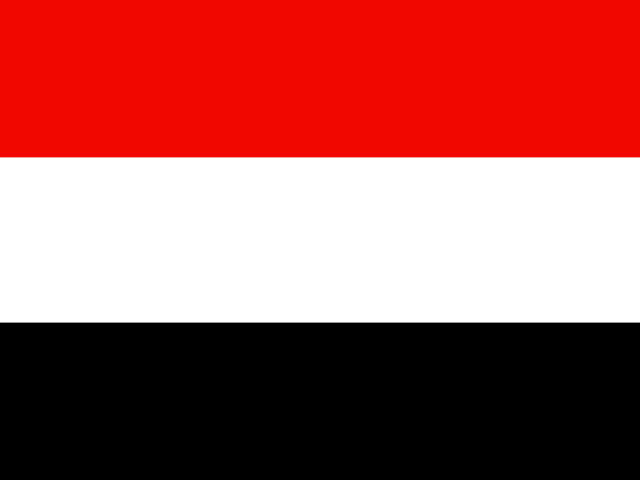
Three equal horizontal bands of red, white and black. Article 156 of the constitution lists those three colours from the top and stops there, and the 1990 decree-law on the national flag adds only the shape, a rectangle two thirds as wide as it is long in three equal bands. Neither assigns a colour a meaning. The state reads the red for the revolution, the white for the revolution's principles and its purity, and the black for the era of darkness and reactionary rule.
Source: constituteproject.org · hrlibrary.umn.edu · yemen-nic.info · agoyemen.net · yemenparliament.gov.ye · checked 2026-08-27
Yemen FACTS ◢
| Capital | Sanaa |
|---|---|
| Continent | Asia |
| Population | 41,773,878 (2025) |
| Area | 527,968 km² |
| Population density | 79/km² |
| Currency | Yemeni Rial (YER) |
| Official language | Arabic |
| Calling code | +967 |
| Internet TLD | .ye |
| Time zone | UTC+03:00 |
| Drives on the | Right |
| ISO codes | YE / YEM |
DID YOU KNOW? ◢
- Its Socotra island hosts the umbrella-shaped dragon's blood tree, found naturally nowhere else.
- The old walled city of Shibam is famed for centuries-old mud-brick tower houses, dubbed the 'Manhattan of the desert'.
- Sanaa, its capital, is one of the oldest continuously inhabited cities in the world.
- Mocha, a Yemeni Red Sea port, lent its name to the coffee-and-chocolate drink.
Yemen QUICK ANSWERS ◢
What is the capital of Yemen?
The capital of Yemen is Sanaa.
What is the population of Yemen?
Yemen had a population of 41,773,878 in 2025.
What currency does Yemen use?
Yemen uses the Yemeni Rial (YER).
What languages are spoken in Yemen?
The official language of Yemen is Arabic.
Think you know your flags? Play Flag Daily → · Browse all countries →
MORE ON THE FLAG ◢
Yemen fixes its flag in two instruments, and you can read both of them in about a minute. Article 156 of the constitution names three colours in order from the top and stops. Decree-Law No. 1 of 1990 adds the shape, the flying rules, and the penalties for insulting it.
Neither one says what a colour is for.
The reading the Yemeni state gives those colours is published rather than enacted, on a government reference page that has been carrying it since at least 2012. And the sentence that puts the flag into the constitution was not drafted for the country that flies it. It reproduces South Yemen's.
Key Takeaways
- Article 156 reproduces South Yemen's 1978 flag article, with the star, the triangle and the proportion cut out of it.
- Article 156 lists red, white and black from the top and assigns nothing. Its Arabic does not contain the word three.
- Decree-Law No. 1 of 1990 fixes the proportion at two thirds, sets the flying rules and the penalties, and still assigns nothing.
- Yemen's National Information Center reads red as the revolution, white as its principles and purity, and black as the era of darkness and reactionary rule.
- The same Presidential Council wrote symbolism into the emblem decree the same day, and left it out of the flag decree.
| Instrument | Date | What it fixes | Assigns a meaning? |
|---|---|---|---|
| Agreement on the Declaration of the Republic of Yemen, art. 7 | 22 April 1990 | Authorises decree-laws on the emblem, the flag and the anthem | No |
| Decree-Law No. 1 of 1990 on the National Flag | 22 May 1990 | Colours and order, rectangle two thirds as wide as long, three equal bands, flying rules, penalties | No |
| Decree-Law No. 2 of 1990 on the emblem and official seal | 22 May 1990 | The eagle, its base, the Marib Dam and coffee tree | Yes, for the eagle |
| Constitution as approved 15 to 16 May 1991, art. 127 | 1991 | Colours and order | No |
| Constitution in force, art. 156 | 1991, rev. 2015 | Colours and order | No |
Yemen's flag article reproduces South Yemen's, minus the star and triangle
This is the part that gets left out, and it is checkable in two documents the Yemeni parliament publishes itself.
The 1978 constitution of the People's Democratic Republic of Yemen, the southern state, has a Part Five on the emblem of the Republic, its flag, its capital and the national anthem. Its article 134 composes the national flag of the colours arranged "ترتيبا أفقيا", horizontally, beginning from the top: red, white, black.
Then it keeps going. There is a triangle in "الأزرق الفاتح", light blue, on the hoist side, at the centre of which sits a "نجمة حمراء مخمسه", a red five-pointed star. And the ratio of the flag's width to its length is "واحد إلى إثنين", one to two.
Now set that beside the unified constitution as the referendum approved it on 15 and 16 May 1991, where the flag is article 127. It composes the national flag of the colours arranged, beginning from its top, as follows: red, white, black, and there the article ends.
The opening clause survives almost word for word. Four things go with the edit: the sentence carrying the triangle and the star, the one-to-two ratio, the word for horizontally, and the southern state's name, which the 1978 article spells out and the 1991 one has no use for.
Two further changes are wording rather than deletion, and they sit in the same short clause. The southern article says the colours begin "من أعلى", from the top; the 1991 article says "من أعلاه", from its top, adding the possessive. And where the southern article writes "كتالي", the word meaning as follows, the 1991 article has the standard spelling, "كالتالي". Neither change is evidence of anything on its own, and the corrected spelling is the weaker of the two, since correct spelling is the default. What carries the inference is the identity of everything around them.
The proportion that replaces the deleted one is not in the constitution at all. It is in the decree-law, and it is two thirds rather than one half.
One qualification belongs here rather than only at the end. Just one of the two predecessor constitutions could be opened. The Yemeni parliament's file of the north's 1970 constitution is truncated, so there is no way to check whether the southern article itself took its formula from a northern one. The southern derivation is the best reading the available texts support, not the only conceivable one.
Article 127 was later renumbered to 156, and the wording did not change. A flag guide quoting article 156 and a 1991 source quoting article 127 are quoting the same sentence.
What the decree-law on the flag actually fixes
More than the constitution, and still nothing about meaning.
Decree-Law No. 1 of 1990 on the National Flag runs to eight articles. Article 1 composes the flag "من ثلاثة ألوان", of three colours, red, white and black, ordered from top to bottom. Article 2 is the one the constitution never supplies: the flag is a rectangle whose width is "ثلثا طوله", two thirds of its length, made of three rectangles of equal dimensions running the length of the flag.
So the two-to-three proportion everybody draws is real, and it is statutory. It simply is not constitutional.
Articles 3 to 5 are protocol. The flag flies on the buildings of the Presidential Council, on government buildings, on Yemeni embassies, legations and consulates abroad, and on ships and aircraft of Yemeni nationality. It must fly on government premises on official holidays and public occasions from sunrise to sunset. It goes to half mast on a declaration of official mourning.
Articles 6 and 7 are penal, and both are narrower than they first look. Under article 6, carrying a flag, displaying one in shops or at public meetings, distributing one or offering one for sale, in breach of the specification in the decree's own article 1, brings up to six months or a fine of up to five thousand rials. So does using the flag as a trademark or for advertising, or flying one that is torn or in an unfit state.
Article 7 reaches taking down, destroying or insulting the national flag or that of a foreign state, but only where it is done out of hatred or contempt for the authority of the government or of that state, and only in public or in a public place. That one reaches up to a year or ten thousand rials. Both articles then close without prejudice to any more severe penalty provided by law, so those ceilings are the decree's own rather than the limit of liability.
Eight articles on what the flag is, where it flies and what happens if you abuse it. Not one on why it is red.
Why Yemen's constitutional flag article is so short
Because the constitution gives the symbols to the legislature, and then keeps only the flag for itself.
Article 155 of the constitution in force reads that the law shall determine the emblem of the Republic, its badges, its decorations and its national anthem. The flag is conspicuously absent from that list. Article 156 then fixes the flag directly, in a single sentence and a list of three words.
The Arabic is worth reading closely, because the usual English rendering adds something. Article 156 composes the flag "من الألوان المرتبة", of the colours arranged, and says they begin "من أعلاه", from its top, as follows: red, white, black. The English text most often quoted turns that opening into "composed of three colors". The Arabic gives no number at all. The number three is in article 1 of the decree-law.
Article 157, immediately after, makes Sanaa the capital. That is the whole of the constitution's part on the emblem, the flag and the anthem.
Where the government's reading of the colours is published
Not in a statute. On a reference page, and one that predates the war.
Yemen's National Information Center, the state body that maintains the government's public information site, carries a standing country profile. Its section headed العلم الوطني describes the flag, giving the same rectangle and the same two-thirds proportion as the decree-law, and then it does something neither instrument does. It gives each band a line of its own.
Red is glossed "ويرمز إلى الثورة", symbolising the revolution. White is "مبادئ الثورة ونقاءها", the principles of the revolution and its purity. Black is "عهد الظلام والحكم الرجعي", the era of darkness and reactionary rule.
That reading is anchored to a specific event rather than to a mood. It does not say blood, and it does not say a bright future. It names a revolution, that revolution's principles, and the order the revolution ended.
Two things make it usable as the state's account rather than as somebody's later edit. The Internet Archive holds a capture of the page from 18 August 2012 carrying the three lines word for word, published under the government of the day and years before the current conflict. And the live copy still gives an average exchange rate for December 2012 in its currency row, which is roughly when it was last revised at all.
What it is not is law. It sits on a profile page beside the time zone and the mains voltage, and nothing in either 1990 decree or in the constitution repeats it.
Who decided, and on what day
The Presidential Council, under an authority written for the purpose a month earlier.
The Agreement on the Declaration of the Republic of Yemen and the organisation of the transitional period was signed at Sanaa on 22 April 1990 by Ali Salim al-Bidh for the south and Ali Abdullah Saleh for the north. Its article 7 authorises the Presidential Council to issue decisions having the force of law on "شعار الجمهورية وعلمها", the emblem of the Republic and its flag, and on the national anthem, at the Council's first meeting.
Both the flag and the emblem decrees cite that agreement in their opening recitals. Both are dated 27 Shawwal 1410, corresponding to 22 May 1990. Both were issued at the Presidency in Sanaa, and both are signed by Saleh as Chairman of the Presidential Council. The flag one is numbered 1.
The date the agreement itself set for the union is the one thing in that chain which could not be settled, and the reason is worth stating plainly. The two transcriptions of its article 1 that could be opened do not agree. The text on the General People's Congress's Yemeni unity site reads 26 May 1990, corresponding to 1 Dhu al-Qi'dah 1410. The Arabic Wikisource transcription reads the twenty-second of May 1990, corresponding to 27 Shawwal, and its transcriber has marked the spot with an asterisk. The Hijri year printed beside it, 1415, cannot correspond to any date in May 1990. The year that does is 1410, and 27 Shawwal 1410 is the date both 1990 decrees carry. No scan or gazette printing of the signed original was found, so neither reading could be checked against the document.
It matters less than it looks, because article 1 is not what governed. The Supreme People's Council ratified the agreement and the draft constitution together, and the second article of its own decision opens "استثناء من أحكام", by way of exception to the provisions, and names articles 1 and 8 of the agreement as the ones excepted. It goes on to delegate the Presidium of the Council to follow up the implementation of the procedures for establishing the Republic in accordance with the agreement, within the twenty-four hours following the decision. The page publishing the decision does not date it, so how much of May 1990 that leaves is not established here. Whichever date article 1 carried, the Council excepted itself from that article and put the establishment on a twenty-four hour clock.
The eagle stands on the flag, and its decree is far more forthcoming
Decree-Law No. 2 of 1990, signed the same day by the same person, is the control experiment.
Its article 1 gives the Republic an emblem consisting of an eagle "يرمز إلى قوة الشعب", symbolising the strength of the people, and its launching into the horizon of liberation, "باسطاً جناحيه" spreading its wings over the national flag, resting on a base inscribed with the name of the Republic, and engraved with a drawing representing the Marib Dam and the coffee tree.
The verb for symbolises is used of the eagle and of nothing else. The dam and the coffee tree are put there for a stated reason rather than given a meaning: the decree includes them as being among Yemen's most prominent characteristics. That is still more than the flag decree does for any of its three colours. The same decree's article 2 then forbids obscuring the emblem's general appearance or the fine detail it is made of, and forbids adding any drawings, lines or ornament to it.
So the same council, in the same sitting, wrote a symbolism into one decree and declined to write one into the other. Whatever the flag's colours are held to mean, the omission was not a drafting habit of the period. The habit was there in the next decree along.
It also means the flag is inside the coat of arms. The eagle's wings are spread over it, so any official seal, Yemeni banknote or embassy frontage carrying the emblem is carrying the tricolour as well.
Egypt flies the same three colours, and publishes its own reading
The readings that travel with this palette belong to the palette rather than to Yemen, and the state that sets them out at length is Egypt.
Egypt's State Information Service dates its own red, white and black flag to a Presidential Decree of 1958, which established a flag for the United Arab Republic, the union of Egypt and Syria, in three colours: red, white bearing two green stars, and black. The stars were removed in 1972 and replaced with a golden hawk, and in 1984 the hawk gave way to the golden eagle the page ties to Saladin.
Under a heading of its own, that page then says what the colours stand for. Red "represents the struggle against the British occupation of Egypt (the period before 1952)". White "symbolizes the advent of the 1952 Revolution which ended the monarchy without bloodshed". Black "stands for the end of the oppression of the people of Egypt at the hands of the Monarchy and British colonialism".
Notice that Egypt's own state account is not the blood-and-bright-future triad either. It is a chronology of one national revolution, which is the same shape as the reading Yemen's National Information Center publishes about a different one.
The generic version, in which red is blood shed in struggle, white a bright future and black a dark past, reads as a summary of the whole family of flags rather than as any one state's account of its own. It does not appear in Yemen's constitution, in either 1990 decree-law, or on the National Information Center's page. That is not proof that no Yemeni official has ever used the phrasing, but it is absent from every Yemeni instrument and state page opened for this article.
What could not be settled
Three things, and they are worth naming rather than filling in.
No shade is fixed anywhere. Neither instrument gives a colour standard, a Pantone reference or any wording beyond the three colour names. There is a specification for the shape and none for the colour, which is an unusual way round.
The northern flag has no reachable text. The Yemeni parliament publishes the 1970 permanent constitution of the former Yemen Arab Republic, but the file it serves is truncated. It stops at article 72, part-way through the chapter on the Consultative Council, and its closing sentence cross-refers to an article 80 the file does not contain. It never reaches any part on state symbols, so no primary description of the north's flag could be opened. The south's could, because the parliament's copy of the 1978 southern constitution is complete.
Nothing found dates the design decision. The decrees record who signed and when. No instrument or state page opened here records who drew the flag, when the two devices were dropped, or whether any other design was considered.
If you want to practise telling the plain tricolours apart, that is a job for Flag Daily, which shows one flag and gives three guesses at the country.
Frequently asked questions
What do the colours of Yemen's flag mean?
Yemen's National Information Center, a government body, publishes a reading in which red stands for the revolution, white for the principles of the revolution and its purity, and black for the era of darkness and reactionary rule. That reading is published rather than enacted: neither article 156 of the constitution nor Decree-Law No. 1 of 1990 on the national flag assigns any colour a meaning.
Does Yemen's constitution describe the flag?
Barely. Article 156 composes the national flag of the colours arranged, beginning from its top, as red, white and black, and says nothing further. It gives no proportion, no shade and no symbolism, and it is followed immediately by the article naming Sanaa as the capital. The Arabic does not use the word three; that comes from the decree-law.
What are the proportions of the Yemeni flag?
Two to three. Article 2 of Decree-Law No. 1 of 1990 makes the flag a rectangle whose width is two thirds of its length, composed of three rectangles of equal dimensions running the length of the flag. The constitution does not mention proportions, so a source quoting only article 156 cannot give you this.
When was Yemen's current flag adopted?
On 22 May 1990. Decree-Law No. 1 of 1990 on the national flag is dated 27 Shawwal 1410, corresponding to 22 May 1990, was issued at the Presidency in Sanaa, and takes effect from the date of its issue. It was made under article 7 of the agreement that joined the Yemen Arab Republic and the People's Democratic Republic of Yemen into the Republic of Yemen, signed the previous month.
How did Yemen's flag differ from South Yemen's?
South Yemen's flag was the same three horizontal bands with a light blue triangle at the hoist carrying a red five-pointed star, in a one-to-two proportion, all of which its 1978 constitution set out in article 134. The unified flag is that description with the triangle, the star and the ratio removed, and a two-thirds proportion supplied separately by the 1990 decree-law.
Sources
- Constitution of the Republic of Yemen, articles 155 to 157, Arabic and English texts published by Constitute, Comparative Constitutions Project. Retrieved 27 August 2026.
- Constitution of the Republic of Yemen, Arabic text published by the University of Minnesota Human Rights Library, used to cross-check articles 155 to 157. Retrieved 27 August 2026.
- Constitution of the Republic of Yemen as approved 15 to 16 May 1991, articles 126 to 128, published by the Yemeni House of Representatives. Retrieved 27 August 2026.
- Constitution of the former People's Democratic Republic of Yemen, 1978, articles 133 to 136, published by the Yemeni House of Representatives. Retrieved 27 August 2026.
- Permanent Constitution of the former Yemen Arab Republic, 1970, published by the Yemeni House of Representatives; the served file stops at article 72 and cross-refers to an article 80 it does not contain. Retrieved 27 August 2026.
- Presidential Council Decree-Law No. 1 of 1990 on the National Flag, published by Yemen's National Information Center and by the Public Prosecution of the Republic of Yemen in Aden. Retrieved 27 August 2026.
- Presidential Council Decree-Law No. 2 of 1990 on the emblem of the Republic of Yemen and its official seal, published by Yemen's National Information Center. Retrieved 27 August 2026.
- Agreement on the Declaration of the Republic of Yemen and the organisation of the transitional period, 22 April 1990. The authorising clause of article 7 is quoted from the transcription on the General People's Congress's Yemeni unity site, almotamar.net, and that clause reads the same in the Arabic Wikisource transcription. The two transcriptions diverge at article 1, as set out above, and their texts of article 7 differ in a later clause this article does not use. Both retrieved 27 August 2026.
- Supreme People's Council decision ratifying the Agreement on the Declaration of the Republic of Yemen and the constitution, published by Yemen's National Information Center. Retrieved 27 August 2026.
- National Information Center of the Republic of Yemen, country profile, the state page carrying the flag description and the colour readings; also read from the Internet Archive capture of 18 August 2012. Retrieved 27 August 2026.
- Egypt State Information Service, Egypt Flag, read from the Internet Archive capture of 22 June 2025 after the live page began returning 404. Retrieved 27 August 2026.
PLAY ANOTHER →
Three clues, three guesses. Work out where in the world it is.
THREE CLUESDAILYDaily CodeA short message, hidden in a different cipher every day.
ONE CIPHER A DAYDAILYDaily CryptogramOne quote, one scrambled alphabet. Crack it before tomorrow.
CRACK THE QUOTEDAILYOn This DayOne thing that happened today in history. Every day, a new one.
TODAY IN HISTORY