
Syria
One of the cradles of civilisation, Syria's capital Damascus ranks among the oldest continuously inhabited cities on Earth, and its markets have anchored trade routes for thousands of years.
WHAT THE FLAG MEANS ◢
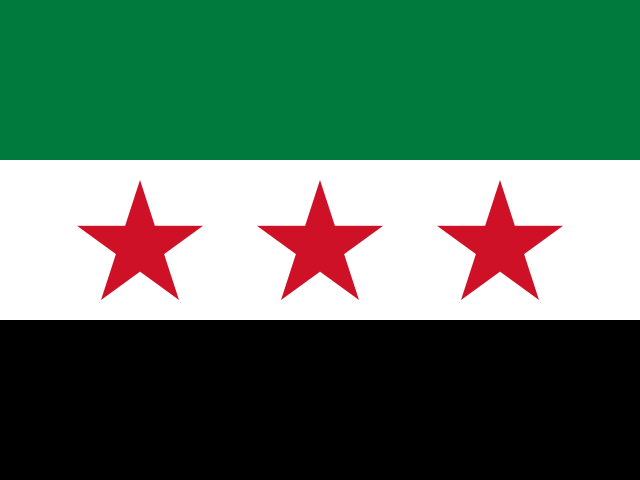
Three horizontal bands of green, white and black with three red five-pointed stars on the central band. Article 6 of the Constitutional Declaration of 13 March 2025 prescribes it after the fall of the Assad government, reviving a design written into the draft constitution of 1928 and first flown in Aleppo in 1932. That article describes the flag and gives no part of it a meaning, and nor do the flag clauses of 1928, 1950 and 2012. One reading takes the three stars for the statelets the mandate had divided the country into.
Syria FACTS ◢
| Capital | Damascus |
|---|---|
| Continent | Asia |
| Population | 25,620,427 (2025) |
| Area | 185,180 km² |
| Population density | 138/km² |
| Currency | Syrian pound (SYP) |
| Official language | Arabic |
| Calling code | +963 |
| Internet TLD | .sy |
| Time zone | UTC+03:00 |
| Drives on the | Right |
| ISO codes | SY / SYR |
DID YOU KNOW? ◢
- Damascus is one of the oldest continuously inhabited cities in the world.
- The ancient city of Palmyra was a wealthy caravan hub linking the Roman world with the East.
- Syria was part of the Fertile Crescent, where some of the earliest farming and cities emerged.
- The city of Aleppo is home to one of the oldest and largest covered markets in the world.
- Ugarit, on the Syrian coast, produced one of the earliest known alphabets.
Syria QUICK ANSWERS ◢
What is the capital of Syria?
The capital of Syria is Damascus.
What is the population of Syria?
Syria had a population of 25,620,427 in 2025.
What currency does Syria use?
Syria uses the Syrian pound (SYP).
What languages are spoken in Syria?
The official language of Syria is Arabic.
Think you know your flags? Play Flag Daily → · Browse all countries →
MORE ON THE FLAG ◢
Syria's flag was readopted in 2025. That is usually all of it, and it leaves out the document.
The document is Article 6 of the Constitutional Declaration of the Syrian Arab Republic, signed on 13 March 2025 and published the same evening by SANA, the Syrian Arab News Agency, as ten page images of the Presidency's own typeset text. Article 6 runs to four short lines. It gives the proportions, the order of the three colours and the number of the stars, and then it stops.
Nothing in it says what the green, the white, the black or the three red stars stand for. That is not an omission peculiar to this text. Of the four Syrian constitutional texts examined for this article, not one interprets the flag it describes.
Key Takeaways
- The instrument is Article 6 of the Constitutional Declaration signed on 13 March 2025. It describes the flag in four lines and assigns no colour and no star a meaning.
- The other three texts examined here, the 1928 draft constitution, the 1950 constitution and the 2012 constitution the declaration replaced, also describe the flag without interpreting it.
- The 2025 article fixes no point count for the stars and does not require them in a line. The 1928 and 1950 articles required both.
- Its proportion clause gives the length as two thirds of the width, where 1950 gave the length as twice the width and 2012 gave the width as two thirds of the length.
- The declaration's preamble names the constitution of 1950 as Syria's constitution of independence. The flag itself is older than that text.
| Instrument | Read for this article from | Flag described | Proportion clause | Meaning assigned |
|---|---|---|---|---|
| Draft constitution of 1928, Article 4 | SANA's verbatim quotation of it, not the instrument | green, white, black, three red stars | length twice the width | none |
| Constitution of 1950, Article 6 | page image of the printed booklet | green, white, black, three red stars | length twice the width | none |
| Constitution of 2012, Article 6 | Constitute Project, Arabic and English | red, white, black, two green stars | width two thirds of the length | none |
| Constitutional Declaration of 13 March 2025, Article 6 | SANA's page images of the signed text | green, white, black, three red stars | length two thirds of the width | none |
Which document brought Syria's flag back, and on what day
The flag was flying long before any of this. The declaration's own preamble fixes the moment: the sun of liberation rose over Damascus on 8 December 2024, announcing the end of the era of the Assad government and its backers.
The paperwork took three more months. On 2 March 2025 the president decided to form a committee of experts to draft a constitutional declaration for the transitional phase, a step SANA reported as resting on the outcomes of the Syrian National Dialogue Conference. On Thursday 13 March the committee handed the draft over and the president signed it.
At the press conference that followed, the committee set out what it had produced: freedom of opinion, expression and the press, a chapter on rights and freedoms, property rights, women's rights to education and to political participation, the independence of judges, the People's Assembly holding full legislative responsibility, executive authority in the hands of the President of the Republic, the President's right to declare a state of emergency, a five-year transitional period. SANA's report of that briefing does not mention the flag once. Whatever was said about Article 6, the agency did not report it.
The signature page is dated in two calendars at once, 13 Ramadan 1446 and 13 March 2025. Article 53 of the declaration is one sentence: it is published in the Official Gazette and takes effect from the date of its publication. Article 52 sets the transitional period at five years from that date, ending when a permanent constitution is approved and elections are held under it.
So the flag has two starting dates that are three months apart, and only the later one has a document behind it. No earlier Syrian instrument prescribing the green, white and black flag could be found for this article, and if a decision of the transitional authorities exists between December 2024 and March 2025, it is not on the state news agency's site.
What Article 6 of the declaration leaves out
Read it and what you have is a specification.
Article 6 opens by providing that the Syrian flag shall be in the following form. The flag then extends as a rectangle whose length equals "ثلثي عرضه", two thirds of its width. It contains three equal rectangles, green uppermost, white in the middle, then black at the bottom. Centred on the flag and within the white area are "ثلاثة نجماتٍ حمراء", three red stars.
That is the article, in full. There is no clause about what any of it represents.
The declaration's Article 6 also drops two details that were in the texts it revives. It does not say how many points the stars have, and it does not say they sit in a line. The 1928 and 1950 articles required both, calling for red stars "خماسية الأشعة", five-rayed, arranged along a straight line inside the white band. The flag as flown still has five-pointed stars in a row, so the description and the object agree. The current instrument simply no longer requires it.
Article 5 makes the silence look deliberate rather than accidental. It names Damascus as the capital and then sends the state's emblem and its national anthem away to be determined by law. The flag is not sent anywhere. It is described on the spot, in the constitutional text, and nothing further is said about it. No such law was found on the state news agency's site at the time of writing, so of the three symbols Articles 5 and 6 deal with, only the flag has an instrument describing it.
The declaration's own pages print an emblem regardless. A gold eagle with a shield on its breast in the flag's colours, three red stars on the white, sits at the head of page one and as a watermark behind every page of the text. An emblem is already on the paper, under the Presidency's own name, though nothing in the text establishes it as the one Article 5 defers.
The proportions and the stars, from 1928 to 2025
Three of the four texts examined for this article open the flag provision with the same formula, that the Syrian flag shall be in the following form. The 2025 declaration's opening words are word for word the 1950 constitution's, and the 1928 text SANA quotes differs from both by one word. The 2012 constitution is the exception: it begins by listing the colours instead.
Then they part company on the very first measurement. The 1950 article says "طوله ضعفا عرضه", its length is twice its width, and the 1928 article SANA quotes says the same in the singular. The 2012 article reverses the two nouns and changes the fraction: "عرضه ثلثا طوله", its width is two thirds of its length, which is the ordinary 2:3 flag. The 2025 article keeps 2012's fraction and puts the nouns back the way round 1950 had them, so its length is "ثلثي عرضه", two thirds of its width.
One premise is already doing work in that last sentence, and it should be stated: take طول as the flag's horizontal dimension and عرض as its vertical, which is the reading on which the 2012 clause gives the ordinary 2:3 flag. On that reading the three earlier clauses describe rectangles wider than they are tall, and the 2025 clause describes one taller than it is wide. The flag flown in Damascus is the ordinary landscape rectangle, so it is Article 6's orientation that is unusual here, not the object it governs.
It is worth being careful about what that does and does not show. It shows that the proportion clause has been written three different ways across these four texts, and that the 2025 wording matches the 2012 one in everything except which noun takes the fraction. It does not show intent. No explanatory note or transmittal document accompanying the declaration was available, so the drafting history behind that sentence is not something this article can settle.
The star clause moved in one direction only, from prescription toward description. The 1928 article requires the white section to carry "ثلاث نجوم حمراء", three red stars. It sets them in "خط مستقيم واحد", one straight line. The 1950 article calls them "ثلاثة كواكب حمر", using an older word that covers stars and planets alike. The 2025 article names them, places them in the middle of the white, and says nothing about their geometry.
Four texts are not the whole set, and the same SANA feature says so. It reports a researcher in parliamentary affairs, whom it names as Mukhtar, as pointing to two further flag clauses: Article 4 of the 1953 constitution, laid down for six months only, which the feature says states the flag in the same three colours with three stars, and Article 6/1 of the 1962 interim constitution, where the same source says the flag returned to its original form. Neither instrument was opened for this article, so neither is in the comparison.
The 1928 design, and the statelets one historian says its stars stood for
The account a Syrian state source gives is not in an instrument at all. It is in a SANA feature of 28 August 2025 on the flag in the constitutional documents, which quotes Article 4 of the 1928 constitution in full and then goes to a historian for the rest.
Abd al-Munim al-Ahmad, professor in the history department of the Faculty of Arts at Damascus University and a specialist in the modern history of the Levant, tells SANA that when France occupied Syria in 1920 it divided the country into several statelets, each with its own flag, and that the Great Syrian Revolt of 1925 to 1927 forced France to accept national elections and the formation of the National Bloc under Hashim al-Atassi, which elected a committee to draft a constitution. Al-Ahmad continues: Ibrahim Hananu chaired it. The constitution the committee produced ran to 115 articles and adopted a national flag whose stars, on his account, stood for the statelets of Damascus, Aleppo and Deir ez-Zor. France did not accept that constitution, and disturbances followed.
Al-Ahmad's next point is the one SANA's feature appears to have been written for. On his account the mandate flags were the ones France created for its statelets after General Gouraud divided the country, and the independence flag was made by the national committee precisely to unite the country under one flag, so it is not "علم الانتداب", the flag of the mandate, as the former government claimed. His test is chronological: had it been the mandate's flag, Shukri al-Quwatli would not have raised it in 1946, and it would not have lasted until 1958.
SANA's own chronology compresses several dates into one sentence, and it is worth separating them. The design appears in the first draft constitution of 1928. SANA dates official approval to 1930. It was raised for the first time in Aleppo in 1932, which is where the common dating of the flag to 1932 comes from. The sentence also ties the 1930 approval to the day Muhammad Ali al-Abid was elected the republic's first president, a fourth date that no instrument opened for this article fixes, so it is left here as the agency reports it rather than resolved.
Quoting Sami Moubayed, the Syrian historian, SANA carries the later run: raised by al-Quwatli on 17 April 1946, raised by Syrian soldiers in 1948, untouched through the coups of 1949 to 1951, and replaced under the union with Egypt in 1958 by a flag SANA describes as inspired by the same colours, with two green stars for the two members, restored by Syrians in 1961, and current until 1 May 1963. Elsewhere in the same feature the flag of the union period is simply the red one.
Where freedom, dignity and justice appear in Syria's declaration
Freedom, dignity and justice are all three in the declaration. None of them is attached to the flag.
The preamble's first paragraph describes hope rekindled in the building of a modern state founded on "العدل والكرامة", justice and dignity, and on true citizenship. A few lines later it has the people rising to demand their freedom and the restoration of their dignity. Every one of the three ideas is there, and every one of them is attached to the state or to the people, in a document whose sixth article describes the flag and interprets nothing.
Syrian officials speaking about the flag do not distribute those ideas across the stars either. When a 600-square-metre flag was raised on a 110-metre mast in Tishreen Park in Damascus on 4 June 2025, the ministers of culture and tourism and the governor of Damascus all spoke. The governor, Maher Marwan, called it a symbol of sacrifice and redemption, of change, freedom, giving and steadfastness, and a symbol of sovereignty and independence. The governor's list runs to six ideas in one sentence, with sovereignty and independence added in the next. None of it is distributed across the stars.
The same event supplies the plainest statement of what changed. The culture minister noted that the mast had flown the red flag under the former government, and that the new Syrian passport now carries this one.
SANA's own framing reaches further back than any instrument. Its feature opens not with law but with the classical line on the four Arab colours: white for our deeds, black for our battles, "خُضرٌ مرابعنا", green for our meadows, and red for our swords. The agency prints it without attaching it to any of the three stars. It is offered as inheritance rather than as legislation.
No article protects the flag, and one criminalises glorifying the old government's symbols
For a symbol of this weight, the striking thing about the Constitutional Declaration is how little it does with it. There is no clause on flying the flag, no clause on its use by private citizens, and no penalty for anything done to it. That is true of all fifty-three articles, read end to end.
One provision does touch a flag, and it is the one Syria stopped flying. Article 49(3), in the declaration's transitional-justice provisions, has the state criminalise glorification of the deposed Assad government and its symbols, and makes denying its crimes, or praising, justifying or playing them down, punishable by law. It does not list what those symbols are. So the instrument that gives the new flag no protection is the same instrument that puts the old government's symbols inside a criminal provision.
Article 51 of the declaration continues the existing laws until they are amended or repealed, so whatever protection the flag has is inherited rather than newly granted. Syrian security officials plainly treat it as protected. After an individual lowered the flag during Newroz celebrations in Ain al-Arab on 21 March 2026, the commander of internal security in Aleppo governorate, Colonel Mohammad Abdul Ghani, told SANA that any infringement on state symbols, the flag foremost among them, is a red line.
It is the ordinary condition of a flag in a transition. The design is settled and written down; the apparatus around it, the emblem, the anthem, the rules of use, is still a set of promises to legislate.
The design itself is easy to recognise once the order of the bands is fixed in the memory, which is the trick a game like Flag Daily trades on, showing one flag and allowing three guesses at the country. The neighbours are the harder part: Iraq's flag and Egypt's are the same three bands with red where Syria's has green, and a device on the white.
Frequently asked questions
Why did Syria change its flag in 2025?
The flag in use changed when the government did, in December 2024, and the law caught up on 13 March 2025, when the President of the Syrian Arab Republic signed the Constitutional Declaration. Article 6 of that declaration prescribes the green, white and black flag with three red stars. No earlier instrument prescribing it was found for this article.
What do the three stars on the Syrian flag mean?
None of the four Syrian constitutional texts examined for this article assigns them a meaning, the 2025 declaration that prescribes them included. The account a Syrian state source gives is the historian Abd al-Munim al-Ahmad's, reported by SANA: the stars of the 1928 design stood for the statelets of Damascus, Aleppo and Deir ez-Zor, which the constitution's drafters set out to unite under one flag.
What colours is the Syrian flag, and in what order?
Green at the top, white in the middle, black at the bottom, with three red stars centred in the white. Article 6 of the Constitutional Declaration gives that order and nothing else about the colours. The flag flown until December 2024 was the reverse family: red, white and black with two green stars, prescribed by Article 6 of the 2012 constitution.
Does Syrian law say how many points the stars have?
Not any more. The 2025 declaration calls them three red stars and stops there. The 1928 and 1950 articles both specified five-rayed stars set in a straight line inside the white band, so the current text is the least prescriptive of the three even though it describes the same flag.
Is the Syrian flag the same as the flag of the French mandate?
Not according to the historian the Syrian state news agency asked. SANA reports Abd al-Munim al-Ahmad of Damascus University saying the mandate flags were the separate flags France created for the statelets it divided Syria into, and that this design was made by a national committee to unite the country under one flag. His argument is that Shukri al-Quwatli would not have raised it at independence in 1946 had it been the mandate's flag.
Sources
- Presidency of the Syrian Arab Republic, Constitutional Declaration of the Syrian Arab Republic, published by SANA on 13 March 2025 as ten page images of the signed text. Articles 5, 6, 49, 51, 52 and 53, the preamble, and the emblem printed at the head of page one and behind every page, are read from those images. The Arabic is transcribed beside this draft. Retrieved 26 August 2026.
- Internet Archive, الدستور السوري, the Constitution of the Syrian Republic, dated 1950, a scan of the 64-page printed booklet, item AAlexandrina-223820. Article 6 was read from the page image of print page 6, not from the item's Arabic OCR, which drops enough letter-pointing to be unusable for quotation. Retrieved 26 August 2026.
- Constitute Project, Syrian Arab Republic 2012 Constitution, Article 6, Arabic and English texts of the superseded flag article. Retrieved 26 August 2026.
- SANA, The Syrian flag in the constitutional documents, 28 August 2025, quoting Article 4 of the 1928 constitution and interviewing Abd al-Munim al-Ahmad of Damascus University and quoting the historian Sami Moubayed. Retrieved 26 August 2026.
- SANA, Presidential decree to form a committee of experts to draft the Constitutional Declaration, 2 March 2025. Retrieved 26 August 2026.
- SANA, President al-Sharaa signs the draft Constitutional Declaration, 13 March 2025, with the drafting committee's press conference. Retrieved 26 August 2026.
- SANA, A Syrian flag of 600 square metres raised on a 110-metre mast in Damascus, 4 June 2025. Retrieved 26 August 2026.
- SANA, Aleppo security chief: desecrating the national flag is a red line for the state, 21 March 2026. Retrieved 26 August 2026.
PLAY ANOTHER →
Five questions a day. Everyone gets the same five.
FIVE QUESTIONSDAILYOn This DayOne thing that happened today in history. Every day, a new one.
TODAY IN HISTORYDAILYDaily CodeA short message, hidden in a different cipher every day.
ONE CIPHER A DAYDAILYGuess the CountryThree clues, three guesses. Work out where in the world it is.
THREE CLUES