
Israel
A small country on the eastern Mediterranean packed with ancient history and modern tech, Israel holds the lowest dry land on Earth and cities sacred to three world religions.
WHAT THE FLAG MEANS ◢
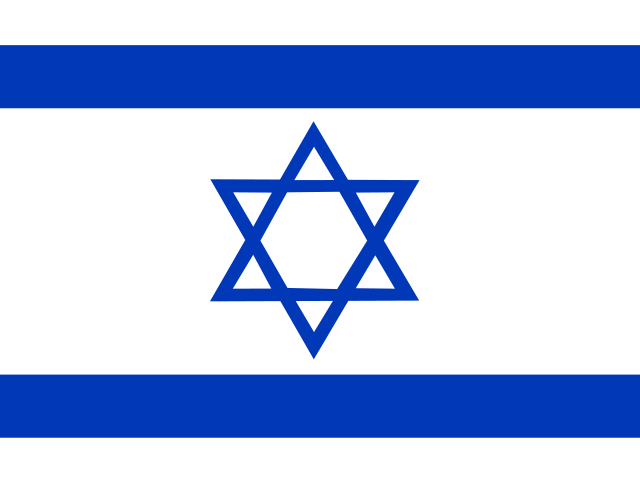
A white field with two horizontal dark sky-blue stripes and a blue Star of David at the centre. The Flag and Emblem Law of 1949 does not describe the flag: it defines it by referring to the proclamation the Provisional Council of State made in 1948, which sets the design out in centimetres and assigns it no meaning. The design is conventionally read as evoking the tallit, the Jewish prayer shawl, and the Star of David is a long-standing Jewish symbol.
Israel FACTS ◢
| Capital | Jerusalem |
|---|---|
| Continent | Asia |
| Population | 10,122,800 (2025) |
| Area | 20,770 km² |
| Population density | 487/km² |
| Currency | New shekel (ILS) |
| Official language | Hebrew |
| Calling code | +972 |
| Internet TLD | .il |
| Time zone | UTC+02:00 |
| Drives on the | Right |
| ISO codes | IL / ISR |
DID YOU KNOW? ◢
- The Dead Sea shore is the lowest point on Earth's land surface, more than 400 metres below sea level.
- The Dead Sea is so salty that swimmers float effortlessly and almost nothing lives in it.
- Jerusalem is a holy city to Judaism, Christianity and Islam.
- Hebrew is the only ancient language to be successfully revived as an everyday spoken tongue.
- The Dead Sea Scrolls, among the oldest biblical manuscripts, were found in caves near the sea.
Israel QUICK ANSWERS ◢
What is the capital of Israel?
The capital of Israel is Jerusalem.
What is the population of Israel?
Israel had a population of 10,122,800 in 2025.
What currency does Israel use?
Israel uses the New shekel (ILS).
What languages are spoken in Israel?
The official language of Israel is Hebrew.
Think you know your flags? Play Flag Daily → · Browse all countries →
MORE ON THE FLAG ◢
Ask what Israel's flag means and you will be told about a prayer shawl. White cloth, blue stripes, and the Magen David set between them. It is an old reading and it is widely held, and it is not in the document that created the flag.
That document is a notice in the official gazette, on a single page, next to a line drawing. The flag is 220 centimetres long and 160 wide. The stripes are 25 centimetres broad and sit 15 centimetres in from the top and bottom edges. The star is built from six stripes 5.5 centimetres wide. Then the notice stops. There is no sentence about the sky, the sea, purity, the shawl or the shield.
Four documents are quoted below, and they are the four opened for this article: the proclamation of 1948, the Flag and Emblem Law of 1949, the regulations made under that law in 1953, and the 2018 Basic Law that names the state's symbols. Where the sections that follow say the documents, those four are what is meant. Not one of them assigns the flag a meaning, and only two of them describe it at all.
Key Takeaways
- The flag was created by a proclamation of the Provisional Council of State on 28 October 1948, printed in the official gazette as a description in centimetres beside a drawing.
- That proclamation gives the colour as a word and never as a value: tekhelet kehah, dark sky-blue, at first mention, and plain tekhelet three times after it. No numeric specification of colour appears in any of the four documents.
- The Flag and Emblem Law of 1949 contains no description of the flag. Its section 1(a) defines the flag by referring to the 1948 proclamation.
- Section 2(b) of the 2018 Basic Law describes the flag in one sentence, and that sentence uses tekhelet for the stripes and tekhol for the star.
- The prayer shawl reading is credited to David Wolffsohn and attaches to the Zionist movement's flag, which Israel adopted. None of the four documents contains it.
| Document | Date | What it does about the flag | Meaning assigned |
|---|---|---|---|
| Proclamation on the Flag of the State of Israel | 28 October 1948 | Describes it in centimetres, beside a drawing | None |
| Flag and Emblem Law 5709-1949, s. 1(a) | 18 May 1949 | Defines it by reference to the proclamation | None |
| Flag and Emblem Regulations (Use of the State Flag) 5713-1953, reg. 1(a)(1) | 9 April 1953 | Requires the proclamation's proportions in other sizes | None |
| Basic Law: Israel as the Nation-State of the Jewish People, s. 2(b) | 19 July 2018 | Describes it in one sentence | None |
The notice that created the flag is a drawing and a list of measurements
It runs to one paragraph. The Provisional Council of State declares that the flag of the State of Israel is "כמצויר וכמתואר להלן", as drawn and as described below, and the drawing is printed beside the text rather than in place of it. Both halves are part of what was proclaimed.
The description then works from the outside in. The flag: 220 centimetres its length, 160 centimetres its width. The background white, and on it two stripes of "תכלת כהה", dark sky-blue, 25 centimetres the width of the stripe, running the whole length of the flag from edge to edge. The upper stripe 15 centimetres from the upper long edge, the lower stripe 15 centimetres from the lower long edge. In the middle of the white background, between the two blue stripes and at equal distance from both, a Magen David made of six stripes of tekhelet, 5.5 centimetres wide each, joining into two equilateral triangles whose bases are parallel to the two tekhelet stripes along the length of the flag.
That is the entire text. It is signed by Yosef Sprinzak as chairman and dated 25 Tishrei 5709, 28 October 1948, and it was printed in the official gazette of 12 November 1948, at page 62 of issue 32.
Read it against a flag law that assigns meanings and the silence is loud. Cuba's national symbols statute works through the star, the triangle, the red and each set of stripes and says what every one of them stands for. Israel's proclamation measures.
Why Israel's Flag and Emblem Law never describes the flag
Because it does not have to. The law that everyone cites for the Israeli flag opens by defining the term, and the definition is a pointer.
Section 1(a) of the Flag and Emblem Law 5709-1949 says that the term it is defining, degel hamedinah, means the flag which the Provisional Council of State proclaimed on 25 Tishrei 5709 as the flag of the State of Israel. Then it widens, and the widening is doing the real work: the term also covers a flag "בכל גודל שהוא", of any size whatsoever, "שדמותו כדמות הדגל האמור", whose form is like the form of the said flag, and anything at all that bears the form of the state flag.
The proclamation had fixed one physical object, 220 centimetres by 160. Taken literally, a flag on a desk or a car bonnet is not the flag it describes. The 1949 definition admits every other size by likeness instead of by dimension, without restating a single measurement.
What follows in the law is administration and enforcement, not description. As enacted it had eight sections: definitions, a licence requirement for commercial use, the same for the state emblem, licence conditions, an offence of dishonouring the flag or the emblem, regulation-making power, delegation, and a provision for flags and emblems similar enough to be mistaken for the real thing. The law was passed by the Knesset on 18 May 1949 and printed at page 37 of Sefer HaChukkim 8.
It has been amended seven times since, renamed to take in the national anthem by its fourth amendment, and given a schedule. The schedule carries the two verses of Hatikvah. The flag still has no description in it, and nothing in the law says what the flag means.
The 1953 regulations turned 220 by 160 into a ratio
The Minister of the Interior made regulations under section 6 in April 1953, and their first rule is the one that quietly solved the centimetres problem.
Regulation 1(a)(1) forbids public use of the flag unless it is made as drawn and described in the proclamation, and in the measurements specified there or in other measurements, "ובלבד שיישמר בהן היחס", provided that the ratio is preserved. The gazette then says which ratio, and its wording is worth quoting rather than paraphrasing: "היחס שבין הדגלים", the ratio between the flags, in the plural, specified in that proclamation. The proclamation specifies one flag, so what a smaller flag has to keep is that flag's own proportions.
The operative rule for every flag that is not exactly 220 by 160 is therefore proportion, which is 11 to 8, plus the internal ratios the proclamation sets out. The regulations go on to require a flagpole about three times the flag's width, to put the state flag on the right, as the hoister faces out from the building, or in the centre of a group, and to have it raised first and lowered last.
They are a code of manners for an object, and like the two documents before them they say nothing about what the object stands for.
The 2018 Basic Law describes Israel's flag in one sentence
Israel has no single codified constitution. It has Basic Laws instead, and one of them names the state's symbols.
Basic Law: Israel as the Nation-State of the Jewish People, passed in 2018, has a section 2 headed simlei hamedinah, the symbols of the state, which gives the state's name, its flag, its emblem and its anthem a subsection each. Subsection (b) is a single line. The state flag is white, with "שני פסי תכלת סמוך לשוליו", two tekhelet stripes near its edges, and "מגן דוד תכול במרכזו", a Magen David at its centre in tekhol, a second Hebrew word for blue.
Two things are worth noticing in that one line. It is a description without dimensions, so it does not replace the proclamation, and subsection (e) says as much: details concerning the state symbols are to be determined by law. And it does not use one colour word. The stripes are tekhelet; the star is tekhol. Neither is the tekhelet kehah of 1948, and no shade is attached to either.
What it does not do is the thing this article is about. Seventy years after the flag was proclaimed, the closest instrument Israel has to a constitutional text described the flag and left the meaning out again.
How dark is Israel's dark sky-blue? The documents do not say
The proclamation names a colour. It does not measure one, and this is the one place where the flag's official description is looser than the rest of it.
Every dimension in the proclamation is given to the half centimetre. Both of its colours are given as words and nothing else: the background lavan, white, and the stripes tekhelet kehah, dark sky-blue. There is no numeric specification of colour anywhere in the proclamation, the law, the regulations or the Basic Law, which is why the question of what shade Israeli blue is has no answer inside the documents that define the flag.
The word itself is not neutral. Tekhelet is the blue of Numbers 15:38, where the Israelites are told to attach what the Jewish Publication Society's gender-sensitive edition renders as "a cord of blue" to the fringe at each corner of their garments. That is the thread on the tzitzit. The Israeli Foreign Ministry's essay on the flag is careful about the step after that: it reports that some say the tallit's stripes are meant to recall that one dyed strand.
The colour word appears four times in that description, and only the first is the full one. The Hebrew names the field stripes tekhelet kehah when it introduces them. Its last sentence then uses the bare word three times: "בין שני פסי התכלת", between the two tekhelet stripes, meaning the dark ones just described, then "ששה פסי תכלת", six tekhelet stripes, for the star, then a second back-reference to the dark stripes running the length of the flag.
So the bare word carries the full one twice over, once on each side of the star. The Foreign Ministry's English translator read it the same way: the first three occurrences come out as "two stripes of dark sky-blue", "between the two blue stripes" and "six dark sky-blue stripes". Nothing in the Hebrew marks the star's blue as a different blue.
What none of the four occurrences does is attach a value to the word.
Shade is also the thing you stop noticing once you know a flag, and start noticing again the moment the picture is all you have and a list of country names is all you are offered, which is the whole exercise in one flag a day and three guesses.
Where the prayer shawl reading comes from
Not from the four documents. It comes with the flag itself, which was the Zionist movement's before the Provisional Council of State adopted it, and which was being explained in those terms half a century before 1948.
The Israeli Foreign Ministry does give the reading. Its essay on the flag, written by the art historian Alec Mishory, says the blue stripes on the Zionist flag were inspired by the stripes on the tallit. That essay is not an instrument and does not claim to be one; it is the ministry setting out where the design came from, and it is the source for most of this section and for the section on the Star of David below.
The story it tells is David Wolffsohn's. In the ministry's telling, Wolffsohn was at Basel facing the question of what to hang in the congress hall. In the wording the World Jewish Congress prints, his own later account runs: "The tallit with which we wrap ourselves when we pray: that is our symbol." He then had a blue and white flag made with the Shield of David on it. The ministry's essay is careful with the scene, calling it what Zionist tradition credits and introducing it with the word legend.
There is a reason for the care. The colours were being called Judah's before Wolffsohn. The Austrian Jewish poet Ludwig August Frankl published "Juda's Farben" in Ahnenbilder in 1864, more than three decades before the first Zionist Congress, and in the ministry's English rendering of it one line runs "Blue and white are the borders of Judah". A blue and white flag flew over Rishon LeZion in 1885, and another over a Boston hall in 1891, with a Star of David carrying the word Maccabee in its centre.
So the shawl reading is genuinely old and genuinely Jewish. The state adopted the flag; what it never adopted was the explanation. If you want the difference in one line: the tallit tells you where the design came from, and none of the four documents tells you what it means.
Herzl proposed a white flag with seven gold stars
The founder of political Zionism did put a flag in writing, with meanings attached, and it is not this one.
Der Judenstaat, published in 1896, has a short section headed "Die Fahne". It opens by stating the problem: "Wir haben keine Fahne. Wir brauchen eine." We have no flag. We need one. Then Herzl proposes his: "Ich denke mir eine weisse Fahne, mit sieben goldenen Sternen."
He explains it immediately, which is what makes the contrast sharp: "Das weisse Feld bedeutet das neue, reine Leben; die Sterne sind die sieben goldenen Stunden unseres Arbeitstages." The white field means the new, pure life; the stars are the seven golden hours of the working day. A flag proposed as a labour symbol, with a seven-hour day written into it.
None of that reading survives on the flag Israel flies. The white field is still there, but nothing carries over the meaning Herzl gave it, and the seven stars never arrived at all. The founding pamphlet of political Zionism set out a design and a meaning together, in print, and both were replaced.
What the Foreign Ministry's essay says about the Star of David
It opens its account of the star by stating, in its own voice, that the Star of David "was never a uniquely Jewish symbol", and then turns for the history to a 1949 article by the scholar Gershom Scholem.
Scholem's account, as the ministry summarises it, traces early Jewish use to printers' colophons on title pages, then to the nineteenth century, when Jews emancipating into European civil life wanted something for a synagogue wall that would answer the cross. The spread was, in his reading, imitation rather than inheritance.
That is also why he thought it suited Zionism. In the ministry's summary of him, the six-pointed star was already in wide circulation among Jewish communities and yet "evoked no clear-cut religious associations", which made it usable by a movement that was not a religious one.
You can hold that alongside the shawl and the thread without contradiction. The stripes carry a religious association that goes back to a commandment. The star in the middle of them is, on Scholem's account, the newer element. Either way, the 1948 proclamation calls it a Magen David made of six stripes and measures the stripes.
A Magen David measured in stripes is the whole of what the four documents commit to paper about it, and rather less than the reader who came here for a meaning was expecting. If you would rather test the recognition than the reading, a country worked out from clues instead of a flag removes the picture altogether.
Frequently asked questions
What does the Israeli flag mean?
None of the four documents that create and govern it assigns it a meaning. The 1948 proclamation that created the flag describes it in centimetres and stops, the Flag and Emblem Law of 1949 defines it by referring to that proclamation, the 1953 regulations govern its use, and section 2(b) of the 2018 Basic Law describes it in one sentence. The widely held reading, that the white field and blue stripes evoke the tallit and its tekhelet thread, is a tradition attached to the Zionist movement's flag, and the Israeli Foreign Ministry sets it out in an essay rather than in any of those four documents.
What do the two blue stripes on the Israeli flag represent?
Nothing that the documents defining the flag say: the 1948 proclamation gives the stripes their width, their colour and their distance from the edges, and assigns them no significance, and neither the 1949 law, the 1953 regulations nor the 2018 Basic Law adds one. By tradition they are read as the stripes of the tallit, the Jewish prayer shawl. The Israeli Foreign Ministry's essay on the flag makes the next link a reported one rather than a stated one: "Some say", it writes, that the stripes are meant to recall the one dyed strand of the ritual fringes, the tzitzit. That strand's blue is the tekhelet of Numbers 15:38. The reading is credited to David Wolffsohn, and blue and white were being called Judah's colours before the Zionist movement existed, in Ludwig August Frankl's poem "Juda's Farben" of 1864.
Does Israeli law say what colour blue the flag is?
None of the four documents that create and govern the flag gives the blue a value; they give it only a word. The 1948 proclamation calls the flag's blue tekhelet kehah, dark sky-blue, and then uses the bare word tekhelet for the same blue three times over, including once for the stripes of the Star of David. Section 2(b) of the 2018 Basic Law uses tekhelet for the stripes and tekhol, a second Hebrew word for blue, for the star. So the proclamation fixes every dimension of the flag to the half centimetre, and no document fixes a shade at all.
Who designed the Israeli flag?
None of the four documents that create and govern the flag names a designer. Israel's Provisional Council of State announced a public competition in June 1948; the design first selected was rejected, a committee of the Council was appointed instead, and the flag adopted in the end was the one the Zionist movement had already been using. Zionist tradition credits that earlier design to David Wolffsohn, at Basel, though the Foreign Ministry's own account calls the scene a legend and blue and white were being described as Judah's colours decades earlier.
When was the Israeli flag adopted?
On 25 Tishrei 5709, 28 October 1948, when the Provisional Council of State proclaimed it, just over five months after the state was declared. The proclamation was published in the official gazette on 12 November 1948, and the Flag and Emblem Law that put the flag on a statutory footing was passed on 18 May 1949.
Sources
- Provisional Council of State, Proclamation on the Flag of the State of Israel, 25 Tishrei 5709 (28 October 1948), official gazette no. 32, 12 November 1948, p. 62 - PDF scan from the Knesset's document server, retrieved 17 August 2026.
- Flag and Emblem Law, 5709-1949, Sefer HaChukkim 8, 24 May 1949, p. 37 - PDF scan of the law as enacted, Knesset document server, retrieved 17 August 2026.
- Knesset, consolidated text of the Flag, Emblem and National Anthem Law - the Sefer HaChukkim HaPatuach proofread transcription, checked against the seven amending PDFs it cites on the Knesset server, retrieved 17 August 2026.
- Minister of the Interior, Flag and Emblem Regulations (Use of the State Flag), 5713-1953, Kovetz HaTakanot 355, 16 April 1953, p. 910 - PDF scan of the complete gazette issue, retrieved 17 August 2026.
- Basic Law: Israel as the Nation-State of the Jewish People, Sefer HaChukkim 2743, 26 July 2018, p. 898 - Knesset document server, retrieved 17 August 2026.
- Theodor Herzl, Der Judenstaat: Versuch einer modernen Lösung der Judenfrage (1896), section "Die Fahne" - Project Gutenberg transcription no. 28865, produced from Austrian Literature Online scans, retrieved 17 August 2026. The same passage in the 1920 Jüdischer Verlag printing carries modernised spelling and punctuation, and was read as a cross-check.
- Alec Mishory, "Israel National Symbols: The Israeli Flag", sourced to the Israeli Foreign Ministry, reproduced by the Jewish Virtual Library - retrieved 17 August 2026. Its footnote cites "G. Sholem" (Gershom Scholem), "The Curious History of the Six Pointed Star; How the 'Magen David' Became the Jewish Symbol", Commentary 8 (1949), and A. L. Frankl, "Juda's Farben", in Ahnenbilder (Leipzig, 1864), p. 127.
- World Jewish Congress, Israeli Provisional Council of State unveils Israeli flag - retrieved 17 August 2026.
- Numbers 15:37-41, Sefaria - Hebrew from the Miqra according to the Masorah, English from The JPS Tanakh: Gender-Sensitive Edition, retrieved 17 August 2026.
PLAY ANOTHER →
One thing that happened today in history. Every day, a new one.
TODAY IN HISTORYDAILYDaily TriviaFive questions a day. Everyone gets the same five.
FIVE QUESTIONSDAILYDaily CryptogramOne quote, one scrambled alphabet. Crack it before tomorrow.
CRACK THE QUOTEDAILYDaily CodeA short message, hidden in a different cipher every day.
ONE CIPHER A DAY