
Kiribati
A scatter of 33 coral atolls flung across the Pacific, Kiribati is so wide it straddles all four hemispheres. It was the first country to greet the new millennium.
WHAT THE FLAG MEANS ◢
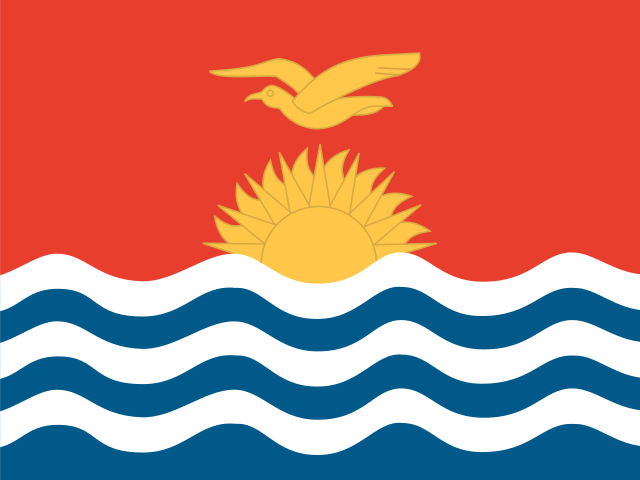
The upper half is red with a golden frigatebird flying over a rising golden sun; the lower half shows three white wavy stripes on blue. The constitution has no flag provision. The design is conventionally read as the sun over the Pacific with the three white waves for the ocean and for the Gilbert, Phoenix and Line groups, and the frigatebird for command of the sea and for freedom.
Kiribati FACTS ◢
| Capital | South Tarawa |
|---|---|
| Continent | Insular Oceania |
| Population | 136,488 (2025) |
| Area | 811 km² |
| Population density | 168/km² |
| Currency | Australian dollar (AUD) |
| Official languages | English, Gilbertese |
| Calling code | +686 |
| Internet TLD | .ki |
| Time zones | UTC+12:00, UTC+13:00, UTC+14:00 |
| Drives on the | Left |
| ISO codes | KI / KIR |
DID YOU KNOW? ◢
- Its islands span all four hemispheres, crossing both the equator and the 180-degree meridian.
- It was among the first places on Earth to welcome the year 2000, thanks to a shift in the International Date Line.
- Almost all of its land sits just a few metres above sea level, making it one of the lowest-lying nations anywhere.
- It controls one of the largest ocean territories relative to its tiny land area.
Kiribati QUICK ANSWERS ◢
What is the capital of Kiribati?
The capital of Kiribati is South Tarawa.
What is the population of Kiribati?
Kiribati had a population of 136,488 in 2025.
What currency does Kiribati use?
Kiribati uses the Australian dollar (AUD).
What languages are spoken in Kiribati?
The official languages of Kiribati are English and Gilbertese.
Think you know your flags? Play Flag Daily → · Browse all countries →
MORE ON THE FLAG ◢
Every element of Kiribati's flag looks like it means something, which is why the usual readings sound so settled. Kiribati's own founding instrument carries not one of those readings. It does not contain the word flag at all.
Search the instrument that created Kiribati, constitution and schedules together, for the word flag, and you get nothing. Not one occurrence. The same search for emblem, for symbol and for national anthem also returns nothing. The as-made text gives Schedule 1 as four oath headings and reproduces the oaths themselves as scanned images rather than as text, so that is the one part of the document these searches do not reach.
This is not a document that was short of space. It names thirty-three islands one by one, and adds the small islands, islets, rocks and reefs depending on them.
Key Takeaways
- The Kiribati Independence Order 1979 and the Constitution scheduled to it contain no occurrence of the words flag, emblem, symbol or national anthem, anywhere the as-made text is machine-readable. The four oath texts of Schedule 1 are scanned images and are the one part not covered.
- Schedule 2 to the Constitution names thirty-three islands individually, plus all the small islands, islets, rocks and reefs depending on them.
- The Constitution names the presidency and the legislature in Gilbertese throughout, Maneaba 238 times and Beretitenti 176 on its own, and has no word for the flag because it never mentions one.
- The design is not in Kiribati's founding law, and no Kiribati statute describing it could be found. The badge and arms of the Gilbert and Ellice Islands Colony occupied the Colonial Office between 1936 and 1938, on three files held by the National Archives in London that this article could not open.
- No Kiribati instrument reachable for this article assigns the frigatebird, the sun or the waves a meaning.
Thirty-three islands, and no flag
Kiribati became independent on 12 July 1979 under the Kiribati Independence Order 1979, a United Kingdom statutory instrument that carries the Constitution of Kiribati as its schedule. It is a long document. It runs to ten chapters. After the two sections that declare the Republic and the supremacy of the Constitution, it goes from fundamental rights through citizenship, the executive, the legislature, the judiciary, the public service and finance, to a chapter of its own on Banaba and the Banabans, and a chapter of miscellaneous provisions after that.
Schedule 2 is headed Territory of Kiribati, and it does what most constitutions decline to do. Rather than describing the territory in general terms, it lists it:
"The land territory of Kiribati comprises the following islands together with all small islands, islets, rocks and reefs depending on them"
There follow thirty-three names, in alphabetical order, from Abaiang to Vostok, several of them carrying their older colonial names in brackets: Kanton, otherwise known as Abariringa or Canton; Kiritimati, otherwise known as Christmas; Manra, otherwise known as Sydney; Nikumaroro, otherwise known as Gardner; Orona, otherwise known as Hull; Rawaki, otherwise known as Phoenix; Tabuaeran, otherwise known as Fanning; Teraina, otherwise known as Washington.
A drafter who thought it worth naming Vostok, and Birnie, and McKean, did not think it worth mentioning the flag.
The Constitution legislates one national symbol, and it is not the flag
The absence is more striking because the Constitution is not reticent about identity. It opens with a preamble that is a statement of values rather than a legal formula:
"We the people of Kiribati, acknowledging God as the Almighty Father in whom we put our trust, and with faith in the enduring value of our traditions and heritage, do now grant ourselves this Constitution establishing a sovereign democratic State."
It then declares four things, in a numbered list: that the will of the people shall ultimately be paramount, that the principles of equality and justice shall be upheld, that the natural resources of Kiribati are vested in the people and their Government, and, last:
"we shall continue to cherish and uphold the customs and traditions of Kiribati"
That is a constitution taking a position on tradition, in its own voice, before it reaches its first section. It goes on to Chapter I, which is two sections long and says that Kiribati is a sovereign democratic Republic, and that the Constitution is the supreme law and any inconsistent law is void to the extent of the inconsistency.
It does legislate one national symbol, and the way it does it is the point. Section 128, in the miscellaneous chapter at the back:
"There shall be a national seal of the Republic bearing on it such device as the Maneaba in Maungatabu shall approve by law."
So the drafters knew how to provide for a device. They created the seal, declined to describe it, and handed the device to the legislature to settle by statute.
The formula appears twice more, earlier in the document. Section 87 gives the High Court a seal bearing its name and such device as the Maneaba ni Maungatabu shall approve; section 95 does the same for the Court of Appeal. Those two stop there. Only section 128 adds the words by law, so only the national seal's device is delegated to statute rather than to the Maneaba's approval alone. Three times the Constitution reaches for a device, three times it delegates the design, and not once is the thing being delegated the flag.
The flag gets nothing at all. Not a description, not a delegation, not a mention.
The Order renames a country and never names its flag
The instrument's own Explanatory Note describes what it was for:
"This Order provides for the Constitution of the Gilbert Islands as an independent Republic under the name Kiribati, with effect from 12th July 1979."
The Gilbert Islands became Kiribati. The new name is usually explained as the Gilbertese rendering of Gilberts, which would make the change a re-spelling in the country's own language rather than a replacement, and the Order itself does not comment either way. The Order records the decision instead, in the operative document, with a date.
The same document then spends a whole chapter of nine sections on the identity of one community. Chapter IX is headed Banaba and the Banabans, and it reserves a seat in the Maneaba ni Maungatabu for a nominated Banaban representative, nominated by the Rabi Council and declared by the Electoral Commission. Rabi is in Fiji, and the Constitution is careful about Banabans who live there: their rights in Banaban land survive the distance. It guarantees every Banaban an inalienable right to enter and reside in Banaba, permits restrictions on the movement of non-Banabans onto the island, establishes a Banaba Island Council, and required an independent Commission of Inquiry three years after independence to review how all of it was working.
Section 124 then entrenches the chapter, and Chapter III too so far as that chapter confers rights on Banabans. A Bill to alter either must be deferred after its first reading until the Maneaba's next meeting; at its second reading it fails unless two thirds of all the members support it; and at that reading a single negative vote stops it, cast by the nominated member or by whoever is elected for a district taking in Banaba. If the nominated member is absent the vote is deferred again, and at the deferred vote the Bill fails on the nominated member's negative or on falling short of two thirds, with no separate veto for the elected member. Section 125 defines who counts as a Banaban, reaching back to ancestors born in Kiribati before 1900.
That is a constitution thinking hard about who the country is and what it is called. It is not a drafting team that forgot about symbols. It is one that wrote down the name, the islands and the people, and left the flag alone.
Kiribati's constitution keeps three Gilbertese names, and none of them is the flag's
Kiribati's founding instrument does something else unusual, and it makes the silence about the flag look chosen rather than accidental.
It does not translate its own institutions. The head of state is the Beretitenti. The deputy is the Kauoman-ni-Beretitenti. The legislature is the Maneaba ni Maungatabu, which is a Gilbertese name rather than a translation of parliament. The Constitution does carry a language provision, at section 127, and it is about itself: the text is to be published in a Kiribati language text as well as the English one, and where the two disagree the English prevails. It never uses the word Gilbertese.
Those are not passing references. Across the Order and the Constitution scheduled to it, Beretitenti appears about a hundred and eighty times on its own and thirty-six more inside Kauoman-ni-Beretitenti, counting the one place the source spells it without the first hyphen, and Maneaba more than two hundred. A document written in English carries three Gilbertese office names through every provision that mentions them, including three of the four oath headings of Schedule 1.
So the drafters were thinking about what to call things in Kiribati's own language. They gave the presidency a Gilbertese name, they gave the legislature a Gilbertese name, and they gave the flag no name at all.
The colony's badge was a Colonial Office matter, and its files are in London
If the flag is not in the founding instrument, the next question is where it is instead.
What is on record is that the badge and arms of the Gilbert and Ellice Islands Colony occupied the Colonial Office between 1936 and 1938. A National Archives search returns three Colonial Office files, and beyond their titles, their dates and a note that two of the three carry enclosures, the catalogue says nothing of what is in them; none was opened: Official badges and arms for Gilbert and Ellice Islands, 1936 to 1937; Flag badge and arms for Gilbert and Ellice Islands, 1937; and Official badge and arms for Gilbert and Ellice Islands, 1938. Three files across three years, all of them titled for the badge and arms of the same colony.
The flag's origin is not in Kiribati's founding law, and the colony's badge was a matter for the Colonial Office in London, which is where the file series is. That Kiribati's flag is descended from that badge is the obvious inference, and it is not one these catalogue entries can establish.
The other half of that colony went its own way and faced the same inheritance question, which makes the Tuvaluan flag the natural companion piece to this one.
There is a boundary to what could be established here, and it should be stated plainly rather than papered over. No Kiribati statute on the flag could be found. Kiribati's consolidated laws sit on PacLII, the regional legal information institute, whose Kiribati database holds 117 documents of selected legislation drawn from the 1980 Revised Edition of the Laws of Kiribati and was last updated in March 2020; that index is readable through the Internet Archive but did not open directly. The Maneaba ni Maungatabu's own site publishes only Acts of the last few years, and no page read on the Office of te Beretitenti's site describes the flag. If a Kiribati flag ordinance exists, this article has not seen it, and nothing here assumes one either way.
The frigatebird, the sun and the waves
Which leaves the meanings, and leaves them exactly where the reader found them.
The sun over the Pacific, the three island groups, command of the sea: every part of the standard reading is reasonable, and not one part of it is stated in any Kiribati instrument this article was able to open. The Constitution cannot state it, because the Constitution does not mention the flag.
Treat it, then, as a reading rather than as a text. That is a slightly unusual position for a flag whose imagery is this direct: usually a design this legible comes with a paragraph somewhere telling you what to see. Kiribati's has thirty-three island names and a promise to cherish tradition instead.
If you would like to find out how many of these you can actually place without reading anybody's constitution, Flag Daily shows you one a day and gives you three guesses at the country.
Frequently asked questions
Does the constitution of Kiribati describe the flag?
No. The Kiribati Independence Order 1979, including the Constitution scheduled to it, contains no occurrence of the word flag anywhere in its machine-readable text, and the same is true of emblem, symbol and national anthem. The only part not covered is Schedule 1's four oath texts, which the as-made edition reproduces as scanned images.
It does contain a schedule naming thirty-three islands individually, and a preamble declaring that the people of Kiribati will continue to cherish and uphold the customs and traditions of Kiribati.
What does the frigatebird on the Kiribati flag mean?
The readings in circulation give it command of the sea, or freedom. They are readings rather than an official gloss: no Kiribati instrument reachable for this article states any of them, and the constitution does not mention the flag.
Nor could any Kiribati statute on the flag be found, so there is nothing to weigh the readings against.
What do the three white stripes on the Kiribati flag represent?
Conventionally, the ocean and the country's three island groups, the Gilbert, Phoenix and Line Islands. That reading is not stated in the constitution, which never mentions the flag, nor in any Kiribati instrument opened for this article.
Kiribati's own founding document does divide the country up, but by island rather than by group: Schedule 2 lists all thirty-three by name in one alphabetical run.
Where does the Kiribati flag come from?
Not from anything in Kiribati's founding law, which does not describe it, and no Kiribati statute describing it could be found. The badge and arms of the Gilbert and Ellice Islands Colony occupied the Colonial Office in London between 1936 and 1938, on three files held by the National Archives; none was opened for this article, and the descent of the national flag from that badge is an inference rather than something these sources establish.
Beyond the titles, the dates and a note that two of the three carry enclosures, the catalogue does not say what is in them. All three sit under one series description: "Colonies, General: Original Correspondence. CEREMONIAL." Kiribati became independent on 12 July 1979, and its founding instrument says nothing about a flag either way.
Is Kiribati's constitution written in English or Gilbertese?
In both, by requirement. Section 127 says the Constitution is to be published in a Kiribati language text as well as the English one, and that where the two are inconsistent the English text prevails. The text scheduled to the Independence Order, and the one read for this article, is the English one.
It also keeps three of its own institutions under their Gilbertese names rather than translating them: the Beretitenti for the head of state, the Kauoman-ni-Beretitenti for the deputy, and the Maneaba ni Maungatabu for the legislature. Those names run through the whole instrument, Maneaba more than two hundred times. The flag has no name in the document, because the document never mentions it.
Sources
- The Kiribati Independence Order 1979, S.I. 1979/719, with the Constitution of Kiribati scheduled to it - The National Archives, legislation.gov.uk, original as-made text. The preamble, section 128, Schedule 2 and the Explanatory Note quoted here are from that text. Retrieved 30 August 2026.
- Official badges and arms for Gilbert and Ellice Islands, CO 323/1377/13 - The National Archives, catalogue entry, covering dates 1936 to 1937. Catalogue entry only; the file itself was not opened. Retrieved 30 August 2026.
- Flag badge and arms for Gilbert and Ellice Islands, CO 323/1468/18 - The National Archives, catalogue entry, 1937. Catalogue entry only; the file itself was not opened. Retrieved 30 August 2026.
- Official badge and arms for Gilbert and Ellice Islands, CO 323/1575/22 - The National Archives, catalogue entry, 1938. Catalogue entry only; the file itself was not opened. Retrieved 30 August 2026.
- What could not be reached: any Kiribati statute or government description of the flag. PacLII's Kiribati Consolidated Legislation database at http://www.paclii.org/ki/legis/consol_act, which holds 117 documents of selected legislation drawn from the 1980 Revised Edition and was last updated 25 March 2020, was read only as an Internet Archive capture of that index page; the index itself did not open directly. The Maneaba ni Maungatabu's own site publishes only Acts of the last few years, and no page read on the Office of te Beretitenti's site describes the flag. Checked 30 August 2026.
PLAY ANOTHER →
A short message, hidden in a different cipher every day.
ONE CIPHER A DAYDAILYDaily TriviaFive questions a day. Everyone gets the same five.
FIVE QUESTIONSDAILYOn This DayOne thing that happened today in history. Every day, a new one.
TODAY IN HISTORYDAILYDaily CryptogramOne quote, one scrambled alphabet. Crack it before tomorrow.
CRACK THE QUOTE