
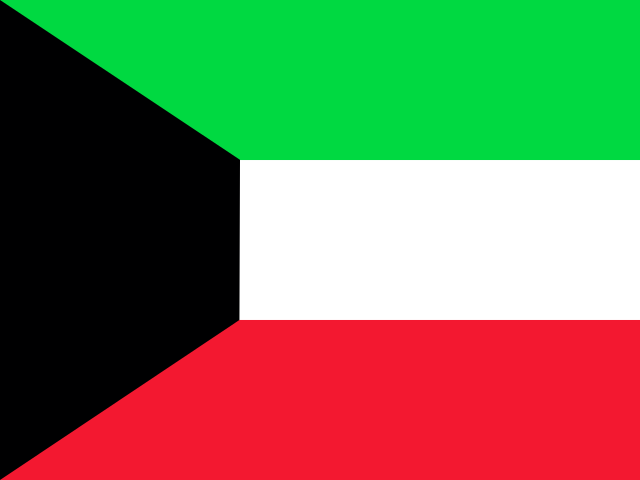
Kuwait
A small, oil-rich country at the head of the Persian Gulf, Kuwait turns desert heat up to extremes and its skyline into a showcase. Its landmark Towers have watched over the bay since 1979.
WHAT THE FLAG MEANS ◢
A horizontal tricolour of green, white and red with a black trapezoid at the hoist, the Pan-Arab colours. Article 5 of the constitution provides only that the law shall specify the flag, assigning it no meaning. The state's own account traces the four colours to a line of classical Arabic verse, which gives white for deeds, black for battles, green for pastures and red for blades.
Kuwait FACTS ◢
| Capital | Kuwait City |
|---|---|
| Continent | Asia |
| Population | 4,865,298 (2025) |
| Area | 17,818 km² |
| Population density | 273/km² |
| Currency | Kuwaiti dinar (KWD) |
| Official language | Arabic |
| Calling code | +965 |
| Internet TLD | .kw |
| Time zone | UTC+03:00 |
| Drives on the | Right |
| ISO codes | KW / KWT |
DID YOU KNOW? ◢
- It sits atop some of the world's largest proven oil reserves despite its compact size.
- It regularly records some of the hottest temperatures ever measured on the planet.
- The iconic Kuwait Towers, with their blue-green spheres, opened in 1979 and store water inside.
- It has no natural rivers or lakes and relies heavily on desalinated seawater.
Kuwait QUICK ANSWERS ◢
What is the capital of Kuwait?
The capital of Kuwait is Kuwait City.
What is the population of Kuwait?
Kuwait had a population of 4,865,298 in 2025.
What currency does Kuwait use?
Kuwait uses the Kuwaiti dinar (KWD).
What languages are spoken in Kuwait?
The official language of Kuwait is Arabic.
Think you know your flags? Play Flag Daily → · Browse all countries →
MORE ON THE FLAG ◢
The flag of Kuwait is three horizontal bands, green over white over red, with a black trapezoid pushed in from the staff. Four colours, and a reading for each of them that you will find repeated everywhere.
The Kuwaiti constitution has nothing to do with that reading. Its treatment of the flag runs to nine words and delegates the entire question to an ordinary statute. What it does do, once, is stop to put the short vowels on a word, and the word it chooses is the one meaning flag.
The meaning everybody quotes comes from somewhere else, and the state does publish it. It publishes it as a line of Arabic verse, without naming the poet, and its own English translation of that line gets the last colour wrong.
Key Takeaways
- Article 5 of the constitution says only that the law shall specify the flag, the emblem, the badges, the decorations and the national anthem. It assigns none of them a meaning.
- In the constitutional text the National Assembly publishes, the only word given short vowels for disambiguation is the word for flag in that article.
- The framers' Explanatory Memorandum does comment on Article 5, and the one word it stops to define is decorations, not flag.
- The Amiri Diwan's own account of the flag credits the colours to a line of Arabic verse, and quotes the line without naming its author.
- The English version of that same page renders the verse's last word, blades, as "past".
Article 5 hands the flag to a law and walks away
Chapter 1 of the Constitution of the State of Kuwait deals with the state and the system of government, and its fifth article is one sentence. It opens "يبين القانون عَلَم الدولة", the law shall specify the flag of the State, and runs on through the emblem, the badges, the decorations and the national anthem. That is the whole provision.
Set it beside its neighbours and the delegation is deliberate rather than accidental. Article 1 declares Kuwait an independent Arab state of full sovereignty. Article 2 makes Islam the religion of the state and Islamic sharia a principal source of legislation. Article 3 makes Arabic the official language. Article 4 sets out the succession in the descendants of Mubarak Al-Sabah at length, with the requirements for a crown prince and a promise of a separate law of constitutional rank. Article 6 declares the system of government democratic and sovereignty vested in the nation.
Every one of those articles decides something. Article 5 decides only who gets to decide.
The ordinary law that Article 5 points to could not be reached for this piece, and neither could its number. Kuwait's official gazette site did not respond, the government services portal refused the request, and the regional legal database that used to hold Gulf statutes has been withdrawn. So what follows describes what the constitution and the state's own published account say, and describes no flag statute at all.
The one word the Kuwaiti constitution stops to vowel
Arabic is normally written without short vowels, and readers supply them. Legal Arabic is no exception, and the Kuwaiti constitution is set almost entirely without them.
Almost. In the text published by the National Assembly, the word for flag in Article 5 carries two fatha marks, one over the ayn and one over the lam. Every other diacritic in the entire document is either the tanwin ending of an indefinite accusative, which is ordinary orthography and not a reading aid, or one typesetting slip.
The reason is not decorative. Unvocalised, the three letters that spell flag also spell knowledge. Read one way, Article 5 says the law shall specify the flag of the State. Read the other, it says the law shall specify the knowledge of the State. The vowels close that door, and they are the only place in the constitution where the drafters felt the need to.
It is a small thing and it says something exact. The constitution assigns the flag no meaning at all, and the one piece of care it spends on the flag is spent on making sure you know it is talking about a flag.
The framers explained a word of Article 5, and it was not the flag
The Kuwaiti constitution travels with an Explanatory Memorandum, published by the National Assembly alongside the text, which walks through the articles and glosses the ones the drafters thought needed it. Article 5 gets a note, and the note is about one word: الأوسمة, decorations.
The word as used in Article 5, it says, is intended in "المعنى الواسع", the broad sense, taking in everything of the nature of decorations, such as medals, insignia, collars and the like. It then adds that the same word means the same thing in Articles 76 and 122 of the constitution.
Article 5 names five things: the flag, the emblem, the badges, the decorations and the anthem. Of those five, the memorandum stopped for one, and it was the fourth. Nobody thought the flag needed explaining, and nobody explained it.
That leaves Kuwait's flag in an unusual position among constitutional symbols. It is named, it is delegated, it is vocalised so that you cannot misread the noun, and it is never once interpreted.
Kuwait's own account of the colours is a couplet
The state does publish a reading, and it does so where you might not think to look. The Amiri Diwan, the Emir's own court, keeps a facts page about the country, and its entry on the flag is a short paragraph that does three things.
It gives the history: the present flag was raised for the first time after independence, on 24 November 1961. It gives the geometry: a horizontal rectangle whose length is twice its width, divided into three equal horizontal sections, the topmost green, then white, then red, containing a black trapezoid. And then it does the interesting thing. The colours of the flag, it says, were inspired by a line of Arabic verse, and it prints the line:
بيض صنائعنا سود وقائعنا
خضر مرابعنا حمر مواضينا
White are our deeds, black our battles, green our pastures, red our blades.
Take that in two parts. First, it is the state's own attribution, not a folk one, which puts the poem on a different footing from the usual unsourced gloss. Second, the page calls it simply a line of Arabic verse and stops. It does not name the poet. The couplet is a famous one and is ordinarily attributed to the fourteenth-century Iraqi poet Safi al-Din al-Hilli, but the Amiri Diwan does not say so, and no Kuwaiti state source reached for this piece does.
So the flag's meaning, as the state gives it, is a quotation with the attribution removed. The same four colours turn up across the region for the same reason, and the Jordanian flag is worth reading beside this one.
The official English turns the blades into a past
The Amiri Diwan publishes the same facts page in English, and the two versions do not say the same thing about the fourth colour.
The Arabic ends the couplet with مواضينا, our blades, from a word for a sharp cutting edge. The English page renders the whole line as: "White are our actions, Black are our wars, Green are our fields, Red is our past".
Three of those are fair. The fourth is a different word. Our blades and our past differ by one letter in Arabic and are easy to slide between, and the slide falls on the colour whose usual reading, blood on a blade, depends entirely on the word being blades.
The result is that Kuwait's own English-language account of its flag gives red a meaning the Arabic does not. Anyone working from the English gets a flag whose red stands for history. Anyone working from the Arabic gets a flag whose red stands for what the poem's speakers did with their blades.
| Colour | The verse, transliterated | The Amiri Diwan's English | What the Arabic word says |
|---|---|---|---|
| White | bid sanai'ina | White are our actions | Our deeds |
| Black | sud waqai'ina | Black are our wars | Our battles |
| Green | khudr marabi'ina | Green are our fields | Our spring pastures |
| Red | humr mawadina | Red is our past | Our blades |
The verse is not in the order of the flag
One more thing the couplet does not do is match the object it is supposed to explain.
The poem runs white, black, green, red. The flag runs green, white, red, with black entering from the side as a trapezoid rather than as a band. The two orders do not correspond at any point, and black is the only one of the four whose place on the flag is not a band at all.
That matters for how the gloss should be read. The verse is not a legend to the flag, in the way a constitutional blazon sometimes is. It is a set of colour associations the design borrows from and rearranges. The Amiri Diwan's own wording is careful about this: it says the colours were inspired by the line, not that the flag was built from it.
Which is about as much as any source consulted here will support. The constitution assigns nothing, the memorandum explains a different word, and the state's account is an inspiration rather than a key. If you would like to test how well you know the flags before you know their law, Flag Daily shows you one a day and gives you three guesses at the country.
Frequently asked questions
What do the colours of the Kuwaiti flag mean?
No Kuwaiti law reachable for this piece assigns them a meaning. Article 5 of the constitution says only that the law shall specify the flag, and gives it no interpretation. The reading in circulation comes from a line of classical Arabic verse: white for deeds, black for battles, green for pastures and red for blades.
The Amiri Diwan publishes that reading itself, saying the colours were inspired by the verse rather than that they were taken from it.
Does the Kuwaiti constitution describe the flag?
No. Article 5 is a single sentence delegating the flag, the emblem, the badges, the decorations and the national anthem to an ordinary law. It contains no description, no proportion and no colours.
The ordinary law it points to could not be reached for this piece, and is not described here.
When was the current flag of Kuwait first raised?
The current flag of Kuwait was first raised on 24 November 1961, according to the Amiri Diwan's own account, which places that raising after Kuwait's independence without dating the independence itself.
The same page gives the design as a horizontal rectangle twice as long as it is wide, in three equal horizontal bands of green, white and red, with a black trapezoid.
Who wrote the poem the Kuwaiti flag's colours come from?
The Amiri Diwan, the Emir's own court, does not say. Its facts page calls the couplet a line of Arabic verse and quotes it without an author, and no Kuwaiti state source reached for this piece names one.
The line is conventionally attributed to Safi al-Din al-Hilli, a fourteenth-century poet from Iraq, and that attribution is not one this article was able to verify against a primary edition of his work.
Why does the English version of Kuwait's flag description say red is for the past?
Because of a translation slip on the page the Amiri Diwan, the Emir's court, publishes about the country. The Arabic couplet ends with the word for our blades, and the English version renders it as "Red is our past", which corresponds to a different Arabic word, one letter away.
The Arabic is the version to work from. The usual gloss of red as blood depends on the last word being blades, and it disappears from the English.
Sources
- Constitution of the State of Kuwait, Chapter 1, Article 5 - National Assembly of Kuwait. The site serves the constitution's chapters through a request the page makes after loading, so the Arabic text was taken from that response rather than from the page itself. Retrieved 30 August 2026.
- Explanatory Memorandum to the Constitution, note on Article 5 - National Assembly of Kuwait. Retrieved 30 August 2026.
- Facts and figures: the flag of the State - Al-Diwan Al-Amiri, Arabic version. Retrieved 30 August 2026.
- Facts and figures: Flag - Al-Diwan Al-Amiri, English version of the same page. Retrieved 30 August 2026.
- What could not be reached: the ordinary law that Article 5 of the constitution delegates the flag to. Kuwait's official gazette site did not respond over either scheme, the government services portal returned a refusal, and the regional legal database that used to hold Gulf statutes now returns a gone status. Neither the statute's text nor its number could be established from any source opened here, and nothing in this article describes either. Checked 30 August 2026.
PLAY ANOTHER →
Five questions a day. Everyone gets the same five.
FIVE QUESTIONSDAILYDaily CodeA short message, hidden in a different cipher every day.
ONE CIPHER A DAYDAILYOn This DayOne thing that happened today in history. Every day, a new one.
TODAY IN HISTORYDAILYGuess the CountryThree clues, three guesses. Work out where in the world it is.
THREE CLUES