
Jordan
A desert kingdom guarding one of the ancient world's great wonders, Jordan carved the rose-red city of Petra straight into its sandstone cliffs.
WHAT THE FLAG MEANS ◢
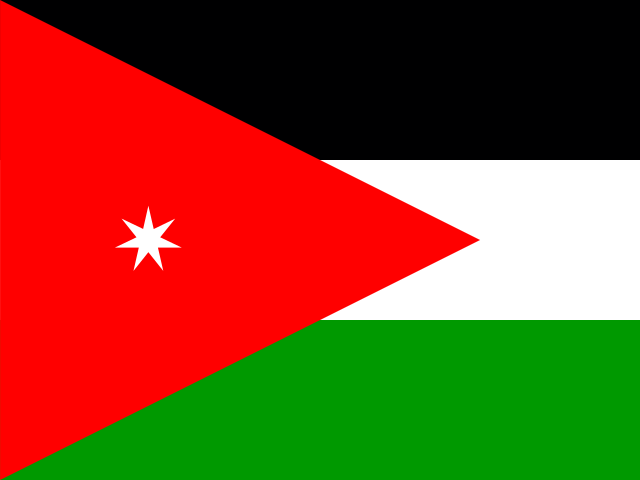
Horizontal bands of black, white and green with a red triangle at the hoist bearing a white seven-pointed star. Article 4 of the constitution prescribes the geometry in detail - the triangle's height at half the flag's length, the star fitting a circle one fourteenth of the flag's length in diameter - and assigns none of it a meaning. The state reads the bands for the Abbasid, Umayyad and Fatimid caliphates, the red for the banner the Hashemites have carried since the 1500s, and the star's seven points, most often, for the seven verses of the opening sura of the Quran. The whole design is taken from the flag of the Great Arab Revolt of 1916.
Jordan FACTS ◢
| Capital | Amman |
|---|---|
| Continent | Asia |
| Population | 11,520,684 (2025) |
| Area | 89,213 km² |
| Population density | 129/km² |
| Currency | Jordanian dinar (JOD) |
| Official language | Arabic |
| Calling code | +962 |
| Internet TLD | .jo |
| Time zone | UTC+03:00 |
| Drives on the | Right |
| ISO codes | JO / JOR |
DID YOU KNOW? ◢
- Petra, a city carved into rock over 2,000 years ago, is one of the New Seven Wonders of the World.
- Wadi Rum, a vast sandstone desert, has stood in for Mars in many films.
- It shares the Dead Sea, the lowest point on Earth's land surface, along its western edge.
- Amman, the capital, is one of the oldest continuously inhabited cities in the world.
Jordan QUICK ANSWERS ◢
What is the capital of Jordan?
The capital of Jordan is Amman.
What is the population of Jordan?
Jordan had a population of 11,520,684 in 2025.
What currency does Jordan use?
Jordan uses the Jordanian dinar (JOD).
What languages are spoken in Jordan?
The official language of Jordan is Arabic.
Think you know your flags? Play Flag Daily → · Browse all countries →
MORE ON THE FLAG ◢
Ask what the Jordanian flag means and the colours are the easy part. Three Jordanian state sites publish the same four readings for them: black for the Abbasids, white for the Umayyads, green for the Fatimids, red for the Hashemites.
The seven-pointed star is where it comes apart. Those same three state pages give it two different answers between them, a third is what the vexillologist who wrote the Britannica entry says the points originally stood for, and a fourth circulates so widely on travel guides and flag reference sites that it reads as settled, while appearing on no Jordanian state source at all.
None of the four is in the constitution. Article 4 is unusually exact about the flag and completely silent about what it is for, so every meaning attached to this flag has to be traced to somebody.
Key Takeaways
- Article 4 of the constitution fixes the flag's geometry down to a circle one fourteenth of the flag's length in diameter, and assigns no element any meaning.
- The Royal Hashemite Court publishes the colour readings instead, giving the red triangle to the Hashemite banner and keeping the Great Arab Revolt for the design as a whole.
- Two Jordanian state pages give the red to the Hashemites; the composite version, in which it stands for the dynasty and the Revolt at once, is what Wikipedia carries, citing the sunset CIA World Factbook among its three sources for the sentence.
- Jordan's state centenary site dates the star's addition to the Arab Kingdom of Syria in March 1920, while Britannica credits it to Abdullah's Transjordan flag instead.
- The same centenary site lists seven values for the seven points and calls the reading an interpretation Jordan placed on the star.
| Reading of the seven points | Who publishes it |
|---|---|
| The seven verses of al-Fatiha, the opening sura of the Quran, which the centenary site further glosses as seven named values | The Royal Hashemite Court, and the state's Great Arab Revolt centenary site |
| The unity of the Arab peoples in Jordan | The Jordanian government's King Hussein site |
| The former districts of Syria: Aleppo, Damascus, Beirut, Lebanon, Palestine, Transjordan and Deir ez-Zor | Whitney Smith, in Encyclopaedia Britannica, as the original association |
| The seven hills on which Amman was built | Travel guides and flag reference sites, and no Jordanian state page found here |
The Royal Hashemite Court supplies Jordan's colour meanings
The Royal Hashemite Court, on its own site, and not the constitution.
The Court's page on the flag and the royal anthem gives a reading for each part of the flag. The black band at the top is the banner of the eagle, العقاب, al-Uqab, which the Court describes as the banner of the Prophet and the flag of the Abbasid state. The white band in the centre is the flag of the Umayyad state. The green band at the bottom is راية الدولة الفاطمية, the flag of the Fatimid state, given in reference to the green of the Prophet's jubba.
The red triangle is راية الهاشميين, the banner of the Hashemites, which the Court dates to the era of Sharif Abu Nami.
Then the star, where the Court's Arabic uses the Quranic phrase rather than a count. It says the seven points refer to السبع المثاني in the sura of al-Fatiha, the seven oft-repeated verses. The Court's own English page renders that more plainly, as the seven verses of Surat Al Fatiha.
Note what the Court is and is not doing. It states these readings flatly and cites nothing for them, which is normal for a palace website and is worth knowing before quoting them as though they were law. They are the palace's account of the flag, published by the palace.
Two Jordanian state pages assign the red to the Hashemites
Both of them do, and both keep the Revolt for the design as a whole.
The flag as a whole does come from the Great Arab Revolt banner. The Royal Hashemite Court says so in its opening paragraph, that the flag is drawn in its shape and its colours from the banner of the Great Arab Revolt. A separate Jordanian government page, on the King Hussein site, says the same, that the flag has its "roots in the Great Arab Revolt of 1916, as it is adapted from the revolt banner".
That same page then splits the two apart in the very next sentence. It gives the bands to the Abbasid, Umayyad and Fatimid dynasties, and says that "the crimson triangle joining the bands represents the Hashemite dynasty". Not the Revolt. The dynasty.
Jordan's centenary site puts a date on the distinction. It says the Revolt's forces first raised the red Hashemite flag, and that this was the flag of the Hashemites since the era of Sharif Abu Nami, whom it describes as a contemporary of the Ottoman Sultan Selim I in 1517. On that account the red charge predates the Revolt by four centuries, and the Revolt is what brought it together with the other three colours.
The widespread alternative, in which the triangle stands for the dynasty and the Revolt at once, is a composite, and only one of its parents ever said the Revolt part. Wikipedia's flag article carries the composite and cites three sources for the sentence. Two of the three are the King Hussein page and a Flags of the World entry that reproduces that page's text word for word, and both give the triangle to the dynasty alone. The third is the CIA World Factbook, whose Jordan entry read "a red isosceles triangle on the hoist side, representing the Great Arab Revolt of 1916".
That third source has been withdrawn. The Factbook's Jordan URL now redirects to a farewell notice dated 4 February 2026 announcing that the publication has sunset, so the only citation that ever supported the Revolt half of the composite is a dead one.
Where did Jordan's seven-pointed star come from?
From the Arab Kingdom of Syria, on Jordan's own account.
No star appears on the Great Arab Revolt banner raised in the Hejaz, in either published account of it. Jordan's centenary site, run by the state to mark the Revolt's hundredth year, dates the star's arrival to a specific day: it says the seven-pointed star was added when the Arab Kingdom of Syria declared its independence under Faisal bin al-Hussein, on 8 March 1920. The same site says that when Prince Abdullah I reached Amman in 1921 he adopted the same banner as the flag of the Government of Transjordan.
Whitney Smith, who wrote the flag entry in Encyclopaedia Britannica, tells it differently. He credits the star to Abdullah's flag rather than to Syria, and says it was recognised under the Transjordan constitution of 16 April 1928.
The two accounts disagree about who added the star, and both point back to Syria for different reasons. The centenary site's reason is the occasion: the star first appears on the day that kingdom was declared. Smith's reason is the meaning, and it is his claim alone. He writes that although different interpretations have been given to the seven points, "originally they were associated with the former districts of Syria (Aleppo, Damascus, Beirut, Lebanon, Palestine, Transjordan, and Deir ez-Zor)". Seven districts, seven points. The only meaning that page gives the star is al-Fatiha.
That is a good deal of inherited machinery for one charge, and Syria itself did not keep it: its 1930 constitution prescribes a green, white and black flag with three red five-pointed stars, and no triangle at all.
Why does the white stripe sit in the middle?
So the flag could be told apart at a distance.
The Revolt banner did not have this order. The centenary site says the first design was four rectangles beginning with white, then black, then green, then red, and that the shape was then altered so the Hashemite red became a triangle joined to the other three colours. Smith's account of the resulting flag gives it as black, green and white with a red triangle at the hoist, and notes that the white and green stripes were later reversed without saying when.
The Jordanian sources supply the when and the why, and they agree with each other. The Royal Hashemite Court says the colour arrangement was changed at the suggestion of the Jordanian Arab Army's officers, putting the white in the middle لتمييزه عن بعد, so it could be told apart from a distance. The centenary site dates that change to 1922 and gives the same reason in slightly different words.
It is an unusually mundane reason for a design decision, and both state accounts give it without embellishment. The order spread, too. The centenary site notes that the Palestinian National Liberation Movement adopted the Revolt banner with the white moved to the middle, so the flag of Palestine and the flag of Jordan now differ mainly by the star.
Article 4 of Jordan's constitution, and what its translations add
The Arabic is looser than any English version of it, in one specific place.
Article 4 of the 1952 constitution is not vague. It says طولها ضعف عرضها, its length is twice its width; it divides the field into three equal parallel pieces, black over white over green; and it places at the staff مثلث قائم أحمر, a red upright triangle, with its base equal to the width of the banner and its height equal to half the length. Inside the triangle it sets كوكب أبيض سباعي الأشعة, a white seven-rayed star, of an area that can be contained by a circle whose diameter is one fourteenth of طول الراية, the length of the banner.
That is the whole provision. Not one word of it is about the Abbasids, the Hashemites or the Fatiha. The consolidated text the Constitutional Court publishes marks every amended clause with a footnote naming the Official Gazette issue that changed it, and Article 4 carries none, so it stands as it was enacted.
The looseness is in the star's placement. The Arabic puts the star's middle at the intersection of the lines بين زوايا المثلث, between the angles of the triangle. It does not use the Arabic word for bisecting. All three English texts do: the 1928 translation, the version the Jordanian government publishes at kinghussein.gov.jo, and the Constitute Project's 2016 text all say "the lines bisecting the angles of the triangle".
That is a translator's clarification, and a defensible one, since lines merely running between a triangle's angles are its sides and never meet at a point. It has been in the English since 1928. It is still not in the constitution, so a description crediting the constitution with it is describing a translation.
The 1928 text repays a second look for another reason. Article 3 of the Organic Law of Transjordan, dated 16 April 1928, carries the provision almost word for word, and that is the instrument the Royal Hashemite Court means when it says the flag was officially adopted with the enactment of the Basic Law.
It is reprinted in English in Helen Miller Davis's collection of Near and Middle Eastern constitutions, whose footnote gives the Official Gazette of 19 April 1928 and the British command paper Cmd. 3069 as its source.
Its English is also the better English. The 1928 translation gives the triangle "the altitude equal to half the length of the flag" and puts the star "within a circle of which the diameter is one-fourteenth the length of the flag". The version the Jordanian government serves today does neither. It drops the triangle's height entirely and collapses the containing circle into the star's own size, saying the star is "of such a size that it may be one-fourteenth part of its length".
That is one text, not the English as a whole. The Constitute Project's 2016 rendering keeps both, giving the triangle a height "equal to half of its length" and putting the star inside a containing circle. So the page the Jordanian government serves has lost a dimension the Arabic states and the 1928 English kept.
The seven hills of Amman, and which sources carry it
Travel guides and flag reference sites carry it. No Jordanian state page checked here does.
Search for what the seven points mean and the hills of Amman come back almost as often as the Fatiha. One Jordanian travel guide has the star representing "the seven hills on which each corner is built on the capital Amman", and a flag reference site lists it among four possibilities as "possibly the seven hills of Amman".
It is not on the Royal Hashemite Court's flag page. It is not on the state's Great Arab Revolt centenary site. It is not on the King Hussein government site, not in the constitution, and not in the 1928 Organic Law. Jordan's e-government portal has no flag section on its About Jordan page at all. Nor is it in the Wikipedia article on the flag.
What the centenary site gives instead is a list, and it introduces the list with an admission. It says that Jordan placed an interpretation on the presence of the seven-pointed star, treating it as representing the Fatiha, and then enumerates seven values for the seven verses: belief in the oneness of God, humility, social justice, supplication for the straight path, the realisation of hopes and aims, the sublimity of humanity, and a sense of national feeling.
That list travels badly, and it travels by a route worth naming. The CIA World Factbook's Jordan entry carried its own English seven, "faith in One God, humanity, national spirit, humility, social justice, virtue, and aspirations", which overlaps the Jordanian list without matching it. The travel guide reproduces the Factbook's vocabulary rather than Jordan's, and mangles it: it prints seven slots with only six distinct values, dropping humility and repeating "national spirit".
So the star has collected four readings in a little over a century, two of them on Jordanian state pages, and the centenary site says of the most-quoted one that Jordan placed it there. Picking the black, white and green out of a line-up is by far the easier half of this flag, which is what a daily flag round tests in three guesses.
Frequently asked questions
What does the seven-pointed star on the Jordanian flag mean?
The Jordanian state publishes two different answers. The Royal Hashemite Court says the seven points refer to the seven verses of al-Fatiha, the opening sura of the Quran, and the state's Great Arab Revolt centenary site gives that reading with seven named values attached to the seven verses, while describing the whole thing as an interpretation Jordan placed on the star. The King Hussein government site says instead that the star stands for the unity of the Arab peoples in Jordan. The constitution assigns it nothing.
What do the colours of the Jordanian flag stand for?
According to the Royal Hashemite Court, the black band is the banner of al-Uqab and the flag of the Abbasid state, the white band is the flag of the Umayyad state, the green band is the flag of the Fatimid state, and the red triangle is the banner of the Hashemites. No Jordanian law assigns the colours anything. Article 4 of the constitution names them only by position, uppermost to lowest.
Does the red triangle represent the Arab Revolt of 1916?
Jordan's own pages assign the red to the Hashemites, not to the Revolt. The Royal Hashemite Court and the King Hussein government site both do so, and the state's centenary site places the Hashemite banner in the era of Sharif Abu Nami in the 1500s. The flag as a whole is adapted from the Great Arab Revolt banner, and both those pages say so, but they keep the two claims apart.
When was the Jordanian flag adopted?
The Royal Hashemite Court says the flag came into use in its current form in 1922 and was officially adopted in 1928, with the enactment of the Basic Law of the Emirate of Transjordan. Article 3 of that Organic Law, dated 16 April 1928, prescribes the design in terms almost identical to Article 4 of the 1952 constitution that succeeded it.
Do the seven points stand for the seven hills of Amman?
That reading circulates widely on travel guides and flag reference sites, but it appears on no Jordanian state source checked here. The Royal Hashemite Court's flag page, the state's Great Arab Revolt centenary site, the King Hussein government site, the 1952 constitution and the 1928 Organic Law all omit it. The state pages that do explain the star give the verses of al-Fatiha instead.
Sources
- Constitutional Court of Jordan, The Jordanian Constitution, Arabic consolidated text, Article 4 - retrieved 26 August 2026.
- The Royal Hashemite Court, The Jordanian Flag and the National Anthem, and its Arabic counterpart at the matching
/ar/path - retrieved 26 August 2026. - Centenary of the Great Arab Revolt, Government of Jordan, The Banner of the Great Arab Revolt, Mother of Banners - retrieved 26 August 2026.
- Government of Jordan, The National Anthem of the Hashemite Kingdom of Jordan, whose page text carries the flag description - retrieved 26 August 2026.
- Government of Jordan, The Constitution of the Hashemite Kingdom of Jordan, Chapters 1 to 3, English text of Article 4 - retrieved 26 August 2026.
- Helen Miller Davis, Constitutions, Electoral Laws, Treaties of States in the Near and Middle East (Durham NC, Duke University Press, 1947), pp. 303 to 304 for the Organic Law of Transjordan of 16 April 1928, Article 3, and p. 263 for Article 4 of the Syrian constitution of 14 May 1930 - retrieved 26 August 2026.
- Constitute Project, Jordan 1952 (rev. 2016), English text of Article 4 - retrieved 26 August 2026.
- Whitney Smith, flag of Jordan, Encyclopaedia Britannica - read from the Internet Archive capture of 28 June 2025, the live site being unreachable from this machine - retrieved 26 August 2026.
- Wikipedia, Flag of Jordan, cited only for what it says and what it cites - retrieved 26 August 2026.
- Flags of the World, Jordan, for its reproduction of the King Hussein site's flag text; this is the entry Wikipedia cites, via its crwflags.com mirror - retrieved 26 August 2026.
- Central Intelligence Agency, The World Factbook, Jordan, cited only as the origin of a circulating gloss and never as an authority - read from the Internet Archive capture of 9 January 2021 - retrieved 26 August 2026.
- Central Intelligence Agency, Spotlighting The World Factbook as We Bid a Fond Farewell, 4 February 2026, the notice the Factbook's Jordan URL now redirects to - retrieved 26 August 2026.
- Jordan Travel, History and Symbolism of the Jordan Flag, and The World Flag, Jordan Flag, Meaning, Symbolism and History, cited as two of the places the seven hills reading appears - retrieved 26 August 2026.
PLAY ANOTHER →
Five questions a day. Everyone gets the same five.
FIVE QUESTIONSDAILYGuess the CountryThree clues, three guesses. Work out where in the world it is.
THREE CLUESDAILYOn This DayOne thing that happened today in history. Every day, a new one.
TODAY IN HISTORYDAILYDaily CodeA short message, hidden in a different cipher every day.
ONE CIPHER A DAY