
Lebanon
A slim Mediterranean country where snowy peaks look down on beaches, and cedar trees have symbolised the land for millennia. Beirut has been rebuilt so many times it's lost count.
WHAT THE FLAG MEANS ◢
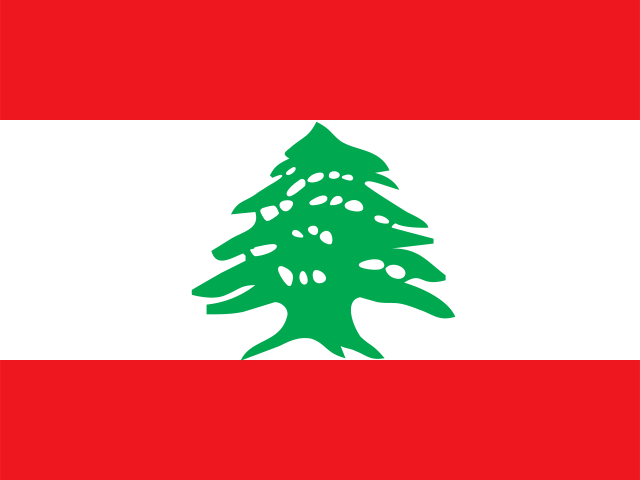
Two red horizontal bands top and bottom with a white band between them as wide as both reds together, bearing a green cedar in the centre. Article 5 of the constitution fixes all of that and the cedar's size and placement with it - a third of the white stripe, its apex touching the upper red stripe and its base the lower - and assigns none of it a meaning. The red is conventionally read for sacrifice, the white for peace and the snow of the mountains, and the cedar for the country itself.
Source: lp.gov.lb · presidency.gov.lb · checked 2026-08-26
Lebanon FACTS ◢
| Capital | Beirut |
|---|---|
| Continent | Asia |
| Population | 5,849,421 (2025) |
| Area | 10,452 km² |
| Population density | 560/km² |
| Currency | Lebanese pound (LBP) |
| Official language | Arabic |
| Calling code | +961 |
| Internet TLD | .lb |
| Time zone | UTC+02:00 |
| Drives on the | Right |
| ISO codes | LB / LBN |
DID YOU KNOW? ◢
- The cedar tree at the centre of its flag has symbolised Lebanon for thousands of years.
- In places you can ski in the mountains and swim in the sea on the same day.
- Byblos is among the oldest continuously inhabited cities in the world.
- The ancient Phoenicians, master seafarers and traders, set sail from its coast.
Lebanon QUICK ANSWERS ◢
What is the capital of Lebanon?
The capital of Lebanon is Beirut.
What is the population of Lebanon?
Lebanon had a population of 5,849,421 in 2025.
What currency does Lebanon use?
Lebanon uses the Lebanese pound (LBP).
What languages are spoken in Lebanon?
The official language of Lebanon is Arabic.
Think you know your flags? Play Flag Daily → · Browse all countries →
MORE ON THE FLAG ◢
Ask what Lebanon's flag means and you get a tidy answer: red for sacrifice, white for peace and for the snow on the mountains, and the cedar for the country itself. Those readings are conventional, and they are worth keeping in that register, because they are not what the state says.
Lebanon is one of the countries where you can check that in a few minutes, because the constitution itself describes the flag, at Article 5. Parliament publishes that text in Arabic, French and English on its own site, and Article 5 is the only place the word for the flag appears in any of the three.
Article 5 is unusually exact about the drawing. It fixes the order of the bands, the width of the white one against the two reds, the colour of the cedar, its size, and the two red stripes its top and its base have to touch. It assigns nothing to any of it. And the text it replaced, which Parliament's French edition still prints directly underneath the current one, described a Lebanese flag of blue, white and red.
Key Takeaways
- Lebanon's flag is prescribed in the constitution itself, at Article 5.
- Article 5 fixes the bands, the cedar's colour, its size and its placement, and gives none of them a meaning.
- Before December 1943, Article 5 described blue, white and red in equal vertical bands with a cedar on the white.
- The amending constitutional law is dated 7 December 1943, a fortnight after the 22 November date Lebanon keeps as Independence Day.
- The nearest thing to an official reading of a cedar is on the Lebanese Army's site, and the emblem it explains is the army's badge.
| Feature of the flag | What Article 5 of the constitution states |
|---|---|
| Order of the bands | Red, then white, then red, in horizontal sections |
| Width of the white band | Equal to the two red bands together |
| Colour of the cedar | Green |
| Size of the cedar | A third of the white band |
| Placement of the cedar | Centred, its top touching the upper red band and its base the lower |
| Proportions of the flag | Not stated |
| Shades of red and green | Not stated |
| Meaning of any element | Not stated |
What Article 5 of Lebanon's constitution actually says about the flag
The Arabic text runs to two sentences. The flag is given as أحمر فابيض فاحمر, red then white then red, in horizontal sections, with the cedar centred on the white one بلون أخضر, in the colour green. The second sentence puts the cedar in the middle, has its head touch the upper red section and its base touch the lower one, and makes its size equal لثلث حجم القسم الأبيض, to a third of the size of the white section.
Parliament's own English edition renders the whole of it in three sentences:
"The Lebanese flag shall be composed of three horizontal stripes; a white stripe between two red ones."
"The width of the white stripe shall be equal to that of both red stripes."
"In the center of and occupying one third of the white stripe shall be a green cedar tree with its top touching the upper red stripe and its base touching the lower red stripe."
That is the entire constitutional treatment of the national flag. No colour is explained, the cedar is not glossed, and no sentence anywhere in the article turns to what the design stands for.
Parliament's Arabic, French and English editions of Article 5 are not equally precise, and each is presented as the constitution.
On the bands, the Arabic and the English both say only that the white equals the two reds together, which on its face would allow two red bands of different depths. The French edition closes that: "La hauteur de la bande blanche est égale au double de chacune des bandes rouges", the height of the white band equals double each of the red bands, which forces the two reds to be equal and settles the flag at one-two-one.
On the cedar, the Arabic uses a word for size that does not name a dimension, and the English follows it with the cedar merely occupying one third of the white stripe. The French names the dimension: "un cèdre vert dont la largeur occupe le tiers de celle-ci", a green cedar whose width occupies a third of it. That has to be the right reading, because a cedar one third of the white band's height could not touch the red band above it and the red band below it, and Article 5 requires it to touch both.
Lebanon's constitution used to describe a blue, white and red flag
Parliament's French edition of the constitution prints, under most amended articles, the wording in force before the amendment. Article 5 is one of them, and its earlier text is short:
"Le drapeau libanais est bleu, blanc, rouge en bandes verticales égales avec un cèdre sur le partie blanche."
The Lebanese flag is blue, white and red in equal vertical bands with a cedar on the white part. Blue, white and red in equal vertical bands is the French flag. Parliament's own historical note files the constitution, issued on 23 May 1926, under the French mandate period, and dates the end of that mandate to 1943.
Article 5 in the Arabic and English editions on the same site carries only the current wording, so the earlier flag survives in one of the three editions Parliament publishes and not in the other two. It is not hidden, and it is not something you would meet unless you opened the French file.
The same edition does the same thing to Article 11 of the constitution, which is about language rather than flags but belongs to the same season. Its earlier text made Arabic the official national language in all the administrations of the state, and then added "Le français est également langue officielle", French is equally an official language. The constitutional law of 9 November 1943 struck that clause out, leaving the use of French to be settled by an ordinary law.
So within a month, two constitutional amendments took blue off the flag and French off the list of official languages. Both changes are recorded in Parliament's own annotations, on the articles themselves.
The flag amendment is dated 7 December 1943, after Independence Day
The dates are printed in the small italic lines Parliament sets under each amended article, and they do not run the way the anniversary does.
Articles 1 and 11 carry the constitutional law of 9 November 1943. Article 5, the flag article, carries a different one: the constitutional law of 7 December 1943. Lebanon's Independence Day, on the official list of holidays published by the Presidency of the Council of Ministers, is 22 November.
Read in order, that puts the flag amendment about a fortnight after the date the country celebrates, and roughly a month after the amendment that removed French from the constitution's language article.
The story usually told about the design is that deputies drew it by hand in the chamber during the crisis of November 1943. It may well be true. It is not something this article can support: no Lebanese state publication opened for this article records it, and the two places it would most likely be found are closed. The digital archive of the Official Gazette, which published the amending law, is behind a paid annual subscription, and the Ministry of Information's site refuses automated requests outright.
What the state does document about the new flag's first years is a handover. The Lebanese Army's historical record notes that on 17 June 1944, at a military review at the Municipal Stadium in Beirut attended by the President and the ministers, President Bechara El Khoury passed the Lebanese flag to Fouad Chehab, under a protocol signed with the French authorities two days earlier that placed Lebanese units at the government's disposal.
Does any Lebanese law assign the cedar a meaning?
Article 5 names the cedar's colour and its geometry and stops there, and the Presidency's flag protocol is about flying the flag rather than reading it. The nearest thing to an official symbolic reading of a cedar that the Lebanese state publishes is attached to a different emblem.
The Lebanese Army's page on its emblems and banners takes its own badge apart piece by piece: two crossed swords for the land forces, two wings for the air forces, an anchor for the sea forces, two laurel branches for glory and pride, and a green cedar standing for "تراث لبنان", the heritage of Lebanon.
That is the army's badge, not the national flag, and the distinction matters. The same state that prints only geometry for the flag prints a reading of every element of the badge. Where a meaning has been assigned, it gets published.
The army's flag is worth a line of its own, because it is the national flag with additions. The same page describes it as the Lebanese flag with two ears of wheat drawn in each of its four corners and the words for honour and for the homeland set around the cedar, with the army's own badge in the centre of the reverse.
The sacrifice, peace and snow readings are conventional, not constitutional
None of the sacrifice, peace and snow readings comes from anything the Lebanese state publishes that could be opened for this article.
The set turns up in reference works and across a great many websites, and it is old enough that tracing it to an author is beyond what a flag article can do. It is conventional, in the sense that it is the answer anyone will give you, and it is not legal or constitutional.
The silence is not an accident of drafting either. Article 5 had the opportunity twice, in 1926 and again in 1943, and both texts describe without interpreting. The Presidency's protocol document had a third opportunity, and takes the same line.
Saying that plainly matters, because the alternative is the failure that runs through a lot of flag writing: a popular reading gets repeated until it is quoted as though a government had written it. On the evidence of the constitution's own three editions, no Lebanese government wrote this one.
The state-published reading of a Lebanese cedar that does exist is the army's, and it is a reading of the army's own badge: heritage rather than sacrifice, peace or snow.
Lebanon's flag rules are about flying it, not about reading it
The other Lebanese state document devoted to the flag is an annexe to the Presidency of the Republic's protocol, headed "مراسم العلم اللبناني", the ceremonial of the Lebanese flag. It is entirely operational, and it is more interesting than that sounds.
The flag is raised daily from sunrise to sunset on every official state building, on the land border posts, and at the airports and seaports. A large flag on a staff stands to the right of the desk of the President, the Speaker and the Prime Minister, and of Lebanese ambassadors abroad.
The presidential palace is the standing exception. Its flags stay up "ليلاً ونهاراً", night and day, for as long as the President is in Lebanon, and they come down while he is out of the country. Which means the flagpoles at Baabda say whether the President is in the country.
The remaining rules are operational too. Flags that are "باهتة اللون", faded in colour, or torn, may not be flown at all. Half-masting for mourning happens only on a memorandum issued by the Presidency of the Council of Ministers. When the Lebanese flag is flown in Lebanon alongside the flags of other states, it takes the centre.
Nowhere in any of it is there a sentence about what the flag stands for.
Drawing it correctly, and the flags it resembles
Article 5 is at its most specific on the point casual renderings tend to lose. The cedar's top has to touch the red band above and its base the red band below, so it fills the white band's full height. A Lebanese flag with a small tree floating in the middle of the white is drawn wrong against the constitution, not merely against a style guide.
The structural twin is Canada's flag, which is also a coloured emblem centred on white between two red bands. The differences are the axis and the plant: Canada's bands run vertically and carry a red maple leaf, Lebanon's run horizontally and carry a green cedar. Flag Daily shows one flag and gives three guesses at the country, and that is a pair worth having straight before it comes up.
The other resemblance is historical. The flag Article 5 described until December 1943 shares its three colours and its vertical arrangement with France's. The 1943 text keeps the red and the white, drops the blue, turns the bands through ninety degrees and keeps the cedar in the middle throughout.
Frequently asked questions
What does the Lebanese flag mean?
The red is conventionally read for sacrifice, the white for peace and the snow of the mountains, and the cedar for Lebanon itself, but no Lebanese state text found for this article assigns those meanings. Article 5 of the constitution describes the flag in detail and interprets none of it.
Those readings are worth knowing as the conventional ones. They are not law, and they are not the state's wording.
Why is there a cedar on the Lebanese flag?
Article 5 of the constitution puts a green cedar at the centre of the white band and does not say why. The cedar was already on the flag Article 5 described before the 1943 amendment, on the white band of a blue, white and red design, so the tree survived the change of colours rather than arriving with them.
The nearest official gloss of a Lebanese cedar is on the army's badge, where the Lebanese Army's own page reads it as the heritage of Lebanon.
When did Lebanon adopt its current flag?
The constitutional law that rewrote Article 5 into the red, white and red flag with a green cedar is dated 7 December 1943. That is the date Parliament prints under the article in all three of the editions it publishes.
It falls about a fortnight after 22 November, the date on the official list of Lebanese public holidays as Independence Day.
What did Lebanon's flag look like before 1943?
Article 5 as it stood before December 1943, printed in Parliament's French edition of the constitution, described the Lebanese flag as blue, white and red in equal vertical bands with a cedar on the white part.
The constitution containing that text was promulgated on 23 May 1926, while Lebanon was under French mandate administration.
What are the proportions of the Lebanese flag?
Article 5 of the constitution does not state one. It fixes the bands rather than the flag: the white band equals the two red bands together, which Parliament's French edition puts as double each of them, giving horizontal divisions of one, two and one, with the cedar a third of the white band.
The ratio of the flag's height to its length is not fixed anywhere in Article 5, and neither are the exact shades of the red or the green.
Sources
- Lebanese Parliament, الدستور اللبناني (the Lebanese constitution, Arabic edition, PDF) - Article 5 and its amendment note, read from the page image because the file's text layer is corrupt. Retrieved 26 August 2026.
- Lebanese Parliament, The Lebanese Constitution (English edition, PDF) - the promulgation date of 23 May 1926 and the English wording of Article 5. Retrieved 26 August 2026.
- Lebanese Parliament, La Constitution Libanaise (French edition, PDF) - the only one of the three editions that prints Article 5 (ancien) and Article 11 (ancien). Retrieved 26 August 2026.
- Presidency of the Lebanese Republic, الدستور اللبناني - a second state copy of Article 5, in HTML. Retrieved 26 August 2026.
- Presidency of the Lebanese Republic, الملحقات (protocol annexes) - Annexe 4, the ceremonial of the Lebanese flag. Retrieved 26 August 2026.
- Lebanese Army, شعارات ورايات (emblems and banners) - the army flag and the element-by-element reading of the army badge. Retrieved 26 August 2026.
- Lebanese Army, محطات تاريخية (historical milestones) - the handover of the flag to Fouad Chehab on 17 June 1944. Retrieved 26 August 2026.
- Presidency of the Council of Ministers, الأعياد والعطل الرسمية (official holidays) - Independence Day on 22 November. Retrieved 26 August 2026.
- Lebanese Parliament, لمحة تاريخية (historical overview) - the 1926 constitution and the end of the mandate period. Retrieved 26 August 2026.
PLAY ANOTHER →
One thing that happened today in history. Every day, a new one.
TODAY IN HISTORYDAILYDaily CryptogramOne quote, one scrambled alphabet. Crack it before tomorrow.
CRACK THE QUOTEDAILYDaily CodeA short message, hidden in a different cipher every day.
ONE CIPHER A DAYDAILYGuess the CountryThree clues, three guesses. Work out where in the world it is.
THREE CLUES