
Lesotho
A mountain kingdom entirely surrounded by South Africa, Lesotho is the only country in the world that sits wholly above 1,000 metres. Locals ride sure-footed ponies and wrap up in bright Basotho blankets.
WHAT THE FLAG MEANS ◢
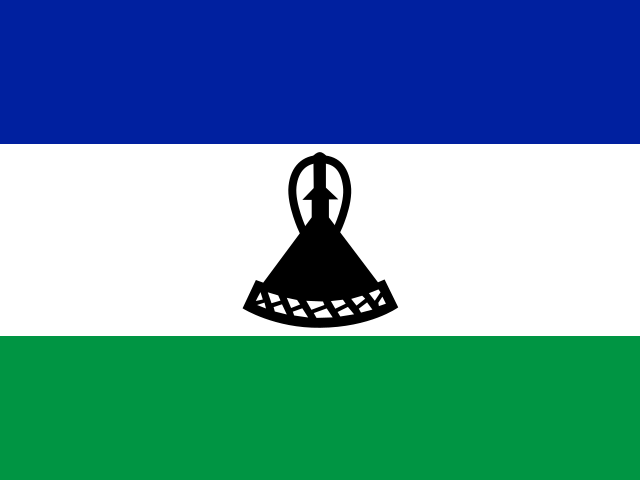
Three horizontal stripes of blue, white and green, the white one wider than the other two in the proportions three to four to three, with a black mokorotlo, the Basotho hat, centred on it. The constitution only refers the national flag to an Act of Parliament, and requires two-thirds of all the members of the National Assembly to send such a bill to the King for assent. The National Flag Act that resulted describes the design, the proportions and the Pantone colours, and assigns none of it a meaning; nor does the constitution. The blue is conventionally read for rain, the white for peace and the green for prosperity, with the hat for the Basotho people themselves. The flag dates from the fortieth anniversary of independence in 2006.
Lesotho FACTS ◢
| Capital | Maseru |
|---|---|
| Continent | Africa |
| Population | 2,363,325 (2025) |
| Area | 30,355 km² |
| Population density | 78/km² |
| Legal tender | Lesotho loti (LSL) and South African rand (ZAR) |
| Official languages | English, Sesotho |
| Calling code | +266 |
| Internet TLD | .ls |
| Time zone | UTC+02:00 |
| Drives on the | Left |
| ISO codes | LS / LSO |
DID YOU KNOW? ◢
- It's one of only three countries completely surrounded by a single other nation.
- Its entire territory lies above 1,000 metres, the highest low point of any country on Earth.
- It has the highest single-drop waterfall in southern Africa, Maletsunyane Falls.
- The colourful Basotho blanket is a national symbol worn as everyday clothing.
Lesotho QUICK ANSWERS ◢
What is the capital of Lesotho?
The capital of Lesotho is Maseru.
What is the population of Lesotho?
Lesotho had a population of 2,363,325 in 2025.
What currency does Lesotho use?
Lesotho uses the Lesotho loti (LSL) and South African rand (ZAR).
What languages are spoken in Lesotho?
The official languages of Lesotho are English and Sesotho.
Think you know your flags? Play Flag Daily → · Browse all countries →
MORE ON THE FLAG ◢
Lesotho's flag is blue, white and green with a black Basotho hat in the middle, and the reading commonly given is that the blue is rain, the white is peace and the green is prosperity.
That reading is not the Kingdom's. Lesotho has a flag statute, it is short, and it is unusually precise: it fixes the stripe widths as a ratio, the hat as a percentage, and two of the four colours by Pantone number. What it never does, in seven sections and a Schedule, is say what any of it stands for.
The constitution does not fill the gap either. It refers the flag away to Parliament and describes nothing. So the rain, peace and prosperity reading is a convention with no instrument behind it. The law that does exist is interested in something else entirely: where the flag is flown, who may vary that, and what happens to anyone still flying the one it replaced.
Key Takeaways
- The National Flag Act 2006 is the instrument that prescribes Lesotho's flag, and it assigns no colour or element any meaning.
- Its Schedule sets the stripes at proportions of 3:4:3, so the white stripe is wider than the blue and the green.
- The hat is specified only as a black Basotho Hat whose height is 92 per cent of the white stripe's width. The Act never uses the word mokorotlo.
- Two colours are given Pantone numbers, Reflex Blue C and Green 347C. White and black are given as words.
- Flying the flag the Act replaced, in a place the public can reach, is an offence punishable by a fine of M1,000, a year's imprisonment, or both.
| Instrument | What it says about the flag | Meaning assigned |
|---|---|---|
| Constitution of Lesotho, section 3(2) | The national flag shall be such flag as may be prescribed by or under an Act of Parliament | None |
| Constitution of Lesotho, section 3(3) | Such a bill cannot go to the King for assent without two-thirds of all National Assembly members at the final vote | None |
| National Flag Act 2006, section 3 and Schedule | Stripe order, a 3:4:3 ratio, a 2:3 flag, a hat as tall as 92 per cent of the white stripe's width, four colours | None |
The white stripe on Lesotho's flag is wider than the other two
It is easy to assume the three stripes are equal. The Schedule to the National Flag Act 2006 says otherwise.
Its heading is "DESCRIPTION AND DESIGN OF THE NATIONAL FLAG", and the description reads: "Three horizontal stripes from top to bottom of blue, white and green bearing the proportions 3:4:3 of the width measurement, with a black Basotho Hat centred in the white panel of a height equivalent to 92% of the width of the white stripe."
Read that ratio slowly. The white band takes four parts of ten and the blue and green take three each, so the white is a third wider than either of its neighbours. On a flag a metre tall, that is four hundred millimetres of white against three hundred of blue and three hundred of green.
The hat is pinned to the white band rather than to the flag. Its height is 92 per cent of the width of the white stripe, which on the same metre-tall flag is 368 millimetres. The Schedule says nothing about how wide the hat is, only how tall.
Two more entries close the Schedule. The flag's shape is given as "width: length 2 : 3", so a flag two metres in the hoist is three metres in the fly. And the colours are listed as four lines: "Pantone Reflex Blue C", White, Black and "Pantone Green 347C".
That last list is worth pausing on. The blue and the green each get an international colour standard. The white and the black get only the words. Four colours, two numbers.
Lesotho's flag law says nothing about the colours
The National Flag Act 2006 is Act No. 7 of 2006. Its long title is "An Act to make provision for the national flag and for related matters." It runs to seven sections and one Schedule, and it fits on three pages of the gazette.
Section 3 is the whole of the declaration: "The flag of which the description and design are set out in the Schedule hereto shall be the national flag of Lesotho." The Schedule then describes the design, in the terms quoted above, and stops.
There is no symbolism clause. No section says the blue is anything, or the green is anything, or that the hat stands for the Basotho. The words meaning, symbol and represent do not appear in the Act at any point.
What the Act does instead is regulate handling. Section 4 provides that "The national flag shall be flown from the principal Government building in Lesotho, at Government offices abroad and at such other places in Lesotho as the King may prescribe." Section 5 creates offences. Section 6 gives the King powers to add places and occasions. Section 7 repeals the previous Act.
That is a complete flag law with no interpretive content whatever. It is a specification and nothing more.
The constitution refers the flag away and guards it anyway
Lesotho's constitution puts the flag in section 3, under a heading that also covers the official languages and the National Seal. Subsection (2) is the referral: the National Seal "shall be such device, and the national anthem and national flag shall be such anthem and flag, as the case may be, as may be prescribed by or under an Act of Parliament."
So the constitution declines to describe the flag. It also declines to say what it is for.
Then subsection (3) adds a guard that is easy to miss. A bill for an Act of Parliament for the purposes of section 3 "shall not be presented to the King for assent unless it is supported at the final voting in the National Assembly by the votes of no less than two-thirds of all the members of the National Assembly."
Two-thirds of all the members, not two-thirds of those who turn up. That is a real brake on changing the flag: an absent member counts against the bill exactly as an opposed one does.
Here is the part that repays a second look. Section 85(3) lists two sets of entrenched provisions. A bill touching the first set has to go to the electors, and nothing else will do. A bill touching only the second set escapes the referendum if two-thirds of all the members of each House support it.
Section 3 is in neither set. Altering it therefore runs on the ordinary route in section 85(2), which asks for "the votes of the majority of all the members of the Assembly" and then sends the bill to the Senate.
On the natural reading of "for the purposes of this section", which the constitution does not spell out, that makes the threshold for sending a flag bill to the King for assent higher in the National Assembly than the threshold for rewriting the constitutional section that demands the Act. The protection is attached to the statute rather than to the clause that requires the statute.
No Lesotho state source that could be opened assigns the colours a meaning
The constitution assigns the colours nothing. The Act assigns them nothing. The Lesotho government's own website carries no national symbols page that could be found: a search of it returns news reports about flag-raising ceremonies and nothing that explains the design, and the archived version of its older "About Lesotho" section covers geography, history and politics without reaching the flag.
The nearest thing to an official gloss found here is a remark by King Letsie III at a flag-raising in Maseru on 2 October 2024, reported by the Lesotho News Agency on the government's site: "The flag represents more than just a symbol, it signifies the love Basotho have for their country". That is about the flag entire, and it assigns no colour anything.
A full-text search of the Lesotho Government Gazette holdings in the Gazettes.Africa archive returns exactly three issues mentioning the national flag, all from September and October 2006, and none of them interprets it. That archive does not hold every year for Lesotho, so this is a strong negative rather than a proof.
None of which makes the popular reading worthless. It is coherent, and it is the reading commonly given. It is simply somebody's reading rather than the state's, and an article that tells you the government says the blue means rain is telling you something the government has not said.
If you want to see how much of a flag is convention rather than law, Flag Daily is a decent way to notice it: three guesses at the country from the flag alone, one flag a day.
The Act calls it a Basotho Hat, and never a mokorotlo
The charge in the middle of the white stripe is commonly called the mokorotlo, the conical straw hat of Basotho dress. The Act does not call it that.
Its Schedule says only "a black Basotho Hat", capitalised exactly so, and gives it one dimension. It does not describe the shape, the material, the crown, the loops or the topknot. Anything you read about how the hat is modelled on a particular mountain is being supplied from outside the statute.
Lesotho's law does use the Sesotho word elsewhere. Legal Notice No. 79 of 2021 amended the registration-plate schedule of the Road Traffic Regulations by deleting the words "Lesotho Code of Arms", spelled that way in that paragraph, and substituting "Basotho hat (Mokorotlo)" wherever those words appeared, except at one place where the substitute is "Lesotho Defence Force emblem". So the two names are treated as the same thing in Lesotho's own drafting, and the flag Act simply picked the English one.
That distinction matters for anyone quoting the law rather than describing the flag. If you say the Act specifies a mokorotlo, you are paraphrasing. If you say it specifies a black Basotho Hat 92 per cent as tall as the white stripe is wide, you are quoting.
Flying Lesotho's old flag became a criminal offence
Section 7 of the Act is one line: "The National Flag Act, 1987 is repealed." A footnote identifies it as Act No. 1 of 1987.
Repeal alone would have ended the old flag's legal standing. Section 5 goes further. Its first limb makes it an offence to do "any act in relation to the national flag which shows disrespect, contempt or irreverence towards the national flag". Its second limb is the unusual one.
Under section 5(b), a person commits an offence who, on or after the Act's commencement, "in a place where the public have access or are permitted to have access, displays or causes to be flown the flag described in the National Flag Act, 1987" that this Act repealed. The penalty for either limb is the same: the offender "commits an offence and on conviction is liable to fine of M1,000 or to imprisonment for one year or to both."
So Lesotho did not merely retire its previous flag. It made public display of it punishable, from the moment the new Act came into force.
The Act does not say what that 1987 flag looked like, and the gazette carrying Act No. 1 of 1987 is outside the archived holdings consulted here, so this article does not describe its design. What the statute does show is that Parliament wrote a specific offence for continuing to fly it in public.
Section 6 leaves further control with the King. He may by gazette notice prescribe additional places, may "prescribe occasions upon which and the purposes for which and the manner in which the national flag may be flown", and may "prohibit, control or restrict the use of any design resembling the national flag." No notice under that section appears in any Lesotho gazette held in the archive searched for this article, on the same full-text search for the words national flag. That archive holds 1970 and 2000, then 2003 to 2006, 2012, 2014 and 2021 to 2025, so the gap between 2007 and 2011 alone is enough to stop this being a proof.
The flag was gazetted to arrive at midnight on the fortieth anniversary
The sequence in the gazette is tight, and it answers why this flag is dated to 2006 rather than to any other year.
Government Notice No. 67 of 2006, published on 22 September, records that "the National Flag Bill 2006 was presented in the National Assembly for First Reading on 8th September, 2006", and that copies were available for public scrutiny at the Clerk's office, every District Administration Office, and the office of the Director of Broadcasting.
A week later, Government Notice No. 71 of 2006 told the country where to be. It notified for general information that "the hoisting of the new National Flag of Lesotho shall be at Setsoto Stadium" on the third of October, at midnight. It was signed by Archibald Lesao Lehohla as Deputy Prime Minister and Minister responsible for Home Affairs.
Midnight on the third of October is ambiguous in ordinary usage between the midnight that opens that day and the one that closes it. The occasion, and a gazette dated the fourth, both point at the second, which is the first instant of 4 October. Lesotho became independent on that date in 1966: a Government of Lesotho page, read from a 2016 Internet Archive capture, says in as many words that "The BNP led Lesotho to Independence on 4 October 1966", and the constitution dates its own territory to the areas that "immediately before 4th October 1966 were comprised in the former Colony of Basutoland".
The Act itself completed the circle. Section 1 provides that it "shall come into operation on the date of its publication in the Gazette", and it was published in a Government Gazette Extraordinary dated Wednesday 4 October 2006. So the statute took effect on the fortieth anniversary of independence, in an issue dated for that day, the day the notified hoisting had opened.
Twenty-six days ran from the bill's First Reading to the day the statute took effect, and on the notified schedule the flag was already flying by the time it did. No artefact read for this article confirms that the ceremony went ahead as gazetted, only that it was gazetted. A one-line adoption date compresses all of that away, and the sequence is more interesting than the date.
One footnote to that stadium. It stands in a kingdom that the Lesotho government's own site described as "completely surrounded by the Republic of South Africa", so this flag has only ever had one land neighbour's flag to be told apart from, and that one is at South Africa.
Frequently asked questions
What do the colours of the Lesotho flag mean?
No Lesotho instrument that could be opened for this article assigns them a meaning. The National Flag Act 2006 describes the flag in its Schedule and assigns no colour a meaning, and section 3 of the constitution refers the flag to an Act of Parliament without describing or interpreting it. The widely repeated reading of blue for rain, white for peace and green for prosperity is a convention rather than an official gloss.
It is worth keeping the two apart when you quote them. The design is law. The symbolism is custom.
Are the stripes on the Lesotho flag equal?
No. The Schedule to the National Flag Act 2006 gives the stripes "the proportions 3:4:3 of the width measurement", so the white stripe is a third wider than the blue above it and the green below it. Descriptions calling it an equal tricolour are wrong on the Act's own numbers.
What is the black hat on the Lesotho flag?
It is the conical Basotho hat, generally called the mokorotlo, though the Act itself says only "a black Basotho Hat". The Schedule places it in the centre of the white panel and specifies its height as 92 per cent of the width of the white stripe, and gives it no other dimension or description.
Why did Lesotho change its flag on 4 October 2006?
Because the National Flag Act 2006 took effect on the fortieth anniversary of independence, which Lesotho dates to 4 October 1966. The Bill had its First Reading on 8 September 2006, a gazette notice set the hoisting of the new flag at Setsoto Stadium for midnight on 3 October, and section 1 made the Act operative on the date of its publication, in a Government Gazette Extraordinary dated 4 October 2006.
What exact colours does Lesotho's flag law specify?
Four, of which two carry standard references: "Pantone Reflex Blue C" and "Pantone Green 347C". The other two are listed simply as White and Black. The Schedule also fixes the flag's shape at "width: length 2 : 3".
Sources
- Kingdom of Lesotho, National Flag Act, 2006 (Act No. 7 of 2006), in Lesotho Government Gazette Extraordinary, Vol. LI, No. 50, 4 October 2006, pp. 394-396, via the Gazettes.Africa archive - retrieved 27 August 2026. Read from the page scans and transcribed beside this article.
- Kingdom of Lesotho, Government Notice No. 67 of 2006 (Publication of Bills), in Lesotho Government Gazette, Vol. LI, No. 48, 22 September 2006, p. 379, via the Gazettes.Africa archive - retrieved 27 August 2026.
- Kingdom of Lesotho, Government Notice No. 71 of 2006 (Notification of the Hoisting of the National Flag), in Lesotho Government Gazette, Vol. LI, No. 49, 29 September 2006, p. 388, via the Gazettes.Africa archive - retrieved 27 August 2026.
- Kingdom of Lesotho, Legal Notice No. 79 of 2021 (Road Traffic (Amendment) Regulations, 2021), in Lesotho Government Gazette, Vol. 66, No. 71, 9 July 2021, pp. 1083-1084, via the Gazettes.Africa archive - retrieved 27 August 2026.
- The Constitution of Lesotho, sections 1, 2, 3 and 85, as reproduced in the FAO legal database FAOLEX - retrieved 27 August 2026. Sections 3 and 85 were checked word for word against two further copies of the same text, one on the WHO MCA legal repository and one on Constitute.
- Government of Lesotho, His Majesty, PM Lead National Flag Raising Ceremony, Lesotho News Agency report dated 2 October 2024 - retrieved 27 August 2026.
- Government of Lesotho, About Lesotho (history section), as captured by the Internet Archive on 10 July 2016 - retrieved 27 August 2026. Read from the capture, because the page is no longer on the live site.
PLAY ANOTHER →
Three clues, three guesses. Work out where in the world it is.
THREE CLUESDAILYOn This DayOne thing that happened today in history. Every day, a new one.
TODAY IN HISTORYDAILYDaily TriviaFive questions a day. Everyone gets the same five.
FIVE QUESTIONSDAILYDaily CodeA short message, hidden in a different cipher every day.
ONE CIPHER A DAY