
Liberia
Founded in the 1800s by freed people from the United States, Liberia is Africa's oldest republic and its capital honours a US president. Its rainforests shelter some of West Africa's last wild elephants.
WHAT THE FLAG MEANS ◢
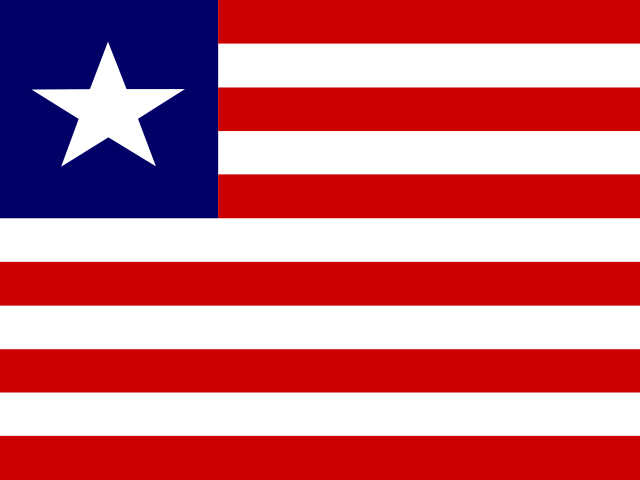
Eleven horizontal stripes, six red and five white, with a blue canton bearing a single white star, in the same stripes-and-canton layout as the United States flag but with one star in place of fifty. No Liberian constitution describes the flag, and the 1847 convention notice that fixed the design assigns it no meaning. The readings come instead from the presidential National Flag Day proclamation: the eleven stripes for the eleven signers of the declaration of independence, the star for Liberia as the only independent state in Africa at the time, red for the blood of those who died in the struggle for independence, white for purity of mind, and blue for the African continent.
Liberia FACTS ◢
| Capital | Monrovia |
|---|---|
| Continent | Africa |
| Population | 5,731,206 (2025) |
| Area | 111,369 km² |
| Population density | 51/km² |
| Currency | Liberian dollar (LRD) |
| Official language | English |
| Calling code | +231 |
| Internet TLD | .lr |
| Time zone | UTC±00:00 |
| Drives on the | Right |
| ISO codes | LR / LBR |
DID YOU KNOW? ◢
- It was founded in the 19th century as a home for freed African Americans and declared independence in 1847.
- Its capital, Monrovia, is named after US President James Monroe.
- It holds a large share of West Africa's remaining Upper Guinean rainforest.
- Ellen Johnson Sirleaf, elected here in 2005, was Africa's first elected female head of state.
Liberia QUICK ANSWERS ◢
What is the capital of Liberia?
The capital of Liberia is Monrovia.
What is the population of Liberia?
Liberia had a population of 5,731,206 in 2025.
What currency does Liberia use?
Liberia uses the Liberian dollar (LRD).
What languages are spoken in Liberia?
The official language of Liberia is English.
Think you know your flags? Play Flag Daily → · Browse all countries →
MORE ON THE FLAG ◢
The reading of Liberia's flag is easy to find, and it is official: eleven stripes for the eleven men who signed the declaration of independence, one white star for the only independent state on the continent at the time, red for blood, white for purity, blue for Africa. Every clause of that comes from Liberia's own foreign ministry.
What it does not come from is a statute. No Liberian constitution has ever described the flag, not the one of 1847 and not the one in force now. The document that created the flag is a short notice printed in the Liberia Herald in 1847, and it gives the design in three sentences without explaining any of it.
The gap between those two things is the whole story. The design is 1847. The published reading of it travels with a presidential proclamation issued each August, and the earliest text of that reading this article could open was issued by President Ellen Johnson Sirleaf in 2016.
Key Takeaways
- The 1847 convention notice describes the flag as "six red stripes with five white stripes alternately displayed longitudinally" and assigns none of it a meaning. The seal, in the same notice, gets a motto.
- Neither the 1847 constitution nor the 1986 one contains a flag provision.
- The meanings come from the annual National Flag Day proclamation. The Liberian foreign ministry has printed the passage under three presidents, from 2016 to 2025, and its wording has drifted between them.
- Eleven delegates signed the 1847 instruments, and a twelfth name is the convention's secretary. That is what makes "eleven signers" and eleven stripes line up.
- The newspaper report of the first flag-raising names seven women. Three match the list of seven given in a 2026 Liberian Observer commentary, two have no counterpart in it, and two appear merged into a single name.
| The claim you will see | Where it actually comes from | What that document says |
|---|---|---|
| Eleven stripes for eleven signatories | The presidential Flag Day proclamation | "each representing one of the eleven signers of the Declaration of Independence of Liberia" |
| Red for courage, white for moral virtue | Not the wording of any Liberian source opened for this article | The Flag Day proclamation gives red as blood shed and white as purity of mind |
| The flag was adopted on 24 August 1847 | The orders for the ceremony, dated 6 August 1847 | They call 24 August the day appointed for elevating the flag, which is not the day it was designed |
| The constitution defines the flag | Neither constitution has a flag provision | The 1986 text runs to 97 articles without one |
| Seven women designed it | The Flag Day proclamation, which credits a committee of ladies led by Mrs. Susannah Lewis | The 1847 newspaper report names seven but calls them the committee appointed by the ladies to represent them on the occasion |
What the 1847 convention actually adopted
Three sentences, and not a word of explanation.
Liberia's constitutional convention sat in Monrovia in July 1847. When it had settled the flag and the seal, the Liberia Herald printed both, and the American Colonization Society reprinted the notice in the January 1848 issue of its journal, the African Repository. That reprint is the text this article works from, read from the scanned page rather than from the scan's own error-prone machine transcription.
The notice opens by saying the flag and seal were "adopted by the convention, as the insignia of the Republic of Liberia, and ordered to be employed to mark its nationality". Then it gives the flag:
"six red stripes with five white stripes alternately displayed longitudinally. In the upper angle of the flag, next to the spear, a square blue ground covering in depth five stripes. In the centre of the blue, one white star."
That is all of it. Six and five, a blue square the depth of five stripes, one star. The same paper describes the staff as having "a gilt head in form of a spear", so "next to the spear" is putting the blue at the hoist.
What makes the silence worth noticing is what the same notice does next. The seal gets a dove with an open scroll, a ship under sail, a sun just emerging from the waters, a palm tree, a plough and a spade, and then the national motto in capitals: "THE LOVE OF LIBERTY BROUGHT US HERE". The same convention, in the same notice, was perfectly willing to put words to an emblem. It simply did not do it for the flag.
Where the official meanings come from
From a proclamation, issued once a year, and it is not law.
Every August the president of Liberia proclaims 24 August National Flag Day. The Ministry of Foreign Affairs publishes a release covering the proclamation, and since at least 2016 that release has carried a full reading of the design. The 2025 text sets out the flag as "six red stripes and five alternating white stripes, totalling eleven stripes, each representing one of the eleven signers of the Declaration of Independence of Liberia".
It then reads the rest of it. The star is described as "depicting Liberia as the then only independent state on the continent of Africa". For the colours: "the color red symbolizes the blood of those who died in the struggle for independence", "the color white indicates the purity of mind of all our fore bearers toward each other", and "the Blue for the dark continent of Africa as it was then depicted".
The ministry printed the same passage with the 2023 and 2024 proclamations, differing only in the spelling of one word and in one article. So this is a settled formula rather than one president's flourish.
The passage was being published with the proclamation by 2016. The document issued for 2006 by President Ellen Johnson Sirleaf and posted on the Executive Mansion's own site carries no reading of the design at all, and it is the only proclamation document reached for this article: her 2010 and 2011 Flag Day texts are transcribed remarks to a celebration, not proclamations, and the texts from 2016 on are ministry releases that quote the proclamation rather than reproduce it. Only the 2021 release attributes the passage to the proclamation in terms, closing the colour reading with "the Proclamation recounted"; the others print it without tagging it to anything. The 2006 text asks citizens to be "reminded of their allegiance and loyalty they owe our National Ensign, by publicly displaying it", and stops there.
What the ministry has published since 2016 is one formula, carried across three presidencies and reworded on the way. Sirleaf's 2016 release gives white as "the purity of mind and lucidity of all our forbearers toward each other"; George Weah's 2021 release gives "the Purity of mind and clearness of all its forebears toward each other"; and the 2023, 2024 and 2025 releases settle on "purity of mind of all our fore bearers toward each other", dropping the second noun altogether. The reading is stable in substance and unstable in wording, which is what a formula recopied each August looks like.
The reading is official, because the head of state is the one making it. It is also not the law of Liberia: a proclamation declaring a public holiday is not a description of the national flag, and no Liberian statute this article could open supplies one.
Two words are worth noticing for their absence. The government's reading does not say courage, and it does not say virtue. It gives red to the dead and white to the minds of the founders.
Do the eleven stripes really stand for eleven signatures?
They line up, once you know which name to leave out.
The signature block printed beneath the 1847 constitution holds twelve names. Six for Montserrado County: S. Benedict as president of the convention, J. N. Lewis, H. Teage, Beverly R. Wilson, Elijah Johnson and J. B. Gripon. Four for Grand Bassa: John Day, A. W. Gardner, Amos Herring and Ephraim Tiller. One for Sinoe: R. E. Murray. Then, set apart on its own line, "J. W. PROUT, Secretary of Convention".
Eleven delegates and one clerk. The proclamation's "eleven signers" is the delegate count, and the stripe count matches it exactly.
The attestation itself is dated "this twenty-sixth day of July, in the year of our Lord one thousand eight hundred and forty-seven, and of the Republic the first", and closes "In witness whereof we have hereto set our names". LiberLII, the Liberian legal information institute, prints the same twelve signatories beneath the declaration of independence rather than beneath the constitution. Both documents were the work of the same convention and the same signatories, so the difference is one of layout, not of substance.
Spellings are not stable across printings, so check a name in more than one. This 1848 text sets the tenth delegate as EPHRAIM TILLER, while LiberLII and an 1868 reprint both have Ephraim Titler.
Why Liberia's flag looks like the flag of the United States
Because the people who adopted it had come from there, and had been flying stripes for close to twenty years already.
No document opened for this article says the design was copied from the United States flag, and nothing found from 1847 states an intention either way. The record shows something less mysterious instead.
Liberia's declaration of independence opens by stating where its authors were from: "We the people of the Republic of Liberia were originally the inhabitants of the United States of North America." The settlement had been established under the American Colonization Society, and the colony had its own ensign long before it had a republic. A colonist writing from Monrovia, in a letter the 1868 compilation prints among the events of 1828, asked the society's board whether it would be safe to "trust a vessel across the Atlantic with our stripes and cross".
Stripes and a cross. Not stripes and a star. So the striped field was already the settlement's, and what 1847 changed was the device in the canton: independence swapped the cross for a single star. The flag of the United States carries thirteen stripes for thirteen colonies and a star for every state. Liberia's carries eleven stripes for eleven men and one star for one republic. The grammar is borrowed. The arithmetic is not.
The seven women who carried the flag out on 24 August 1847
Seven are named in the newspaper report of the day itself, and only three of them are in the list of seven a 2026 Liberian Observer commentary gives.
The Liberia Herald noted, in an undated squib the reprint places after the 6 August orders, that "The ladies of Monrovia are preparing a flag to be presented on that occasion to the Republic." Its account of the day itself describes the presentation in front of the Government House, and gives the committee in full: "Mrs. S. E. Lewis, Mrs. M. L. Hunter, Mrs. R. Johnson, Mrs. C. Hazel, Mrs. E. M. Teage, Mrs. C. Ellis, and Mrs. W. N. Yates". Seven women. Then: "Mrs. Lewis presented the flag, accompanied by a neat patriotic speech."
Mrs S. E. Lewis is Susannah Lewis, and she is the one part of the story that has survived intact. The Liberian foreign ministry still says in its proclamation coverage that "The National Flag was designed and produced by a committee of ladies led by Mrs. Susannah Lewis". Her married surname is on the 1847 signature block too: J. N. Lewis of Montserrado County.
The rest of the committee is where that later list and the newspaper part company. A Flag Day commentary published in the Liberian Observer on 24 August 2026 gives the seven as Susannah Elizabeth Lewis, Matilda Newport, Rachel Johnson, Mary Hunter, Sarah McGill Russwurm, Colonette Teage Ellis and Sarah Draper, and that is the roster the piece presents as the familiar one. No source opened here establishes how widely it circulates.
Three names survive the comparison. Lewis, Hunter and Johnson are in both. Newport, Russwurm and Draper are in the modern list and not in the 1847 report, which has a Mrs C. Hazel and a Mrs W. N. Yates where they stand. And the 1847 report treats Mrs E. M. Teage and Mrs C. Ellis as two women, where the modern list makes them one person, Colonette Teage Ellis.
The 1847 report is also careful about what the seven were for. It calls them "The committee appointed by the ladies to represent them on the occasion", which describes a delegation rather than a design team. The Liberian Observer commentary dates the design commission to a letter of 10 July 1847 from Governor Joseph Jenkins Roberts asking Susannah Lewis to head it, but that letter was not among the documents this article could open. The design credit is the proclamation's word and the newspaper's silence.
One detail usually gets lost. "The flag is made of silk", the report says, and that first flag was lettered: the motto ran across the blue field in large letters, "The love of liberty" above the star and "brought us here" below it, with "Republic of Liberia" on the reverse. The convention's own description mentions no lettering whatever. After the twenty-one-gun salute the silk one came down and a bunting flag went up in its place.
Why Flag Day is 24 August and Independence Day is 26 July
Two different days for two different documents, and only one of them is the flag's birthday in the sense people assume.
Independence is 26 July, the date on the 1847 attestation. Flag Day is 24 August, and the reason is a much later statute: the 2025 proclamation says it is issued "in consonance with an Act approved on October 25, 1915 by the Legislature of the Republic of Liberia", and the 2023 and 2024 releases say the same of the National Legislature declaring 24 August of each year National Flag Day and a public holiday. The 2006 proclamation cites the same 1915 act.
What 24 August 1847 actually was is set out in the orders published for it. The Liberia Herald ran them under the heading "THE DAY APPOINTED FOR ELEVATING THE FLAG OF THE REPUBLIC OF LIBERIA", and the Committee of Arrangements issued its "Order for the celebration of the 24th day of August, when the Flag of the Republic will be unfurled". Those orders are dated 6 August 1847.
So the date was already chosen more than a fortnight before the day itself, and the design had been settled by then too, since the orders name the flag they were gathering to raise. 24 August is the anniversary of the first hoisting, not of the decision.
The day is still kept exactly that way. In 2025 the president declared it for Sunday 24 August with the holiday observed on the Monday, under the theme "The Flag We Raise, The Values We Uphold". If you want to test whether you could actually pick this flag out of a line-up of red, white and blue stripes, a daily flag round is three guesses and a minute.
What Liberian law says about the flag now
It punishes desecration of it and ranks the President's own colours beside it. Nothing this article could open describes it.
The 1986 constitution is the current one, and it runs to 97 articles without a flag provision. Its only backward glance at 1847 is Article 95, which abrogates "The Constitution of the Republic of Liberia which came into force on the 26th day of July 1847". Two independent copies were searched end to end for this article, and the word flag appears in neither.
The 1847 constitution is no different. The word turns up once in the declaration of independence printed with it, in a boast that "The flags of most of the civilized nations of the earth float in our harbors". Other people's flags, and not its own.
Two titles of the Liberian Code of Laws Revised were read for this article, and both reach the flag without describing it. The Executive Law, at section 1.5, prescribes the President's Field Flag, Color, Boat Flag and Automobile Flag down to the inch, and positions the Color so that "it shall be placed on the left of the National Ensign of the Republic in the office of the President". The National Ensign is the fixed point the President's own colours are placed against, and the title never says what it looks like.
The Penal Law reaches it from the other side. Section 18.11, headed "Desecration of venerated objects", makes it a first degree misdemeanour to purposely desecrate "the national flag or any other object of veneration by the public or a substantial segment thereof in any public place", and defines desecration as defacing, damaging, polluting or otherwise physically mistreating it in a way the actor knows will outrage the sensibilities of people likely to see it.
So the criminal law protects the flag, the executive law arranges the president's own colours around it, and an act of 1915 gives it a holiday. Nothing opened for this article says what it looks like. The only description with an official author behind it is still the three sentences the convention published in 1847, and those explain nothing at all.
Frequently asked questions
What does the Liberian flag mean?
Liberia's presidential National Flag Day proclamation assigns the meanings, and the foreign ministry publishes them: the eleven stripes stand for "the eleven signers of the Declaration of Independence of Liberia", the single white star depicts "Liberia as the then only independent state on the continent of Africa", red is "the blood of those who died in the struggle for independence", white is "the purity of mind of all our fore bearers toward each other", and blue is the African continent, which the proclamation phrases as "the dark continent of Africa as it was then depicted". None of this is in any Liberian constitution or statute, and the 1847 notice that created the flag explains none of it.
Why does Liberia's flag look like the American flag?
Liberia was settled from the United States under the American Colonization Society, and its declaration of independence opens by saying its authors "were originally the inhabitants of the United States of North America". The colony was flying a striped flag before independence: a colonist's letter printed among the events of 1828 refers to "our stripes and cross". Independence in 1847 kept the stripes and replaced the cross with a single star. No document opened for this article records anyone in 1847 stating an intention to copy the United States flag.
How many stripes does the Liberian flag have, and why eleven?
Eleven: six red and five white, alternating, as the 1847 convention notice sets them out. Six reds against five whites puts a red stripe at the top and another at the bottom. Eleven is also the number of delegates who signed the 1847 instruments. Twelve names are printed beneath them, but the twelfth is J. W. Prout, the secretary of the convention, rather than a delegate.
Who designed the Liberian flag?
Liberia's foreign ministry credits "a committee of ladies led by Mrs. Susannah Lewis". The contemporary newspaper report of the 1847 ceremony names seven women and describes them more narrowly, as the committee the ladies of Monrovia appointed to represent them on the occasion: Mrs S. E. Lewis, Mrs M. L. Hunter, Mrs R. Johnson, Mrs C. Hazel, Mrs E. M. Teage, Mrs C. Ellis and Mrs W. N. Yates. Only three of the seven, Lewis, Hunter and Johnson, also appear in the roster given in a 2026 Liberian Observer Flag Day commentary, which adds Matilda Newport, Sarah McGill Russwurm and Sarah Draper and treats Teage and Ellis as one woman.
When is Liberia's Flag Day, and is it the same as Independence Day?
No. Independence Day is 26 July, the date on the 1847 constitution and declaration. National Flag Day is 24 August, the anniversary of the first hoisting of the flag in Monrovia in 1847, and it became a public holiday under an act of the Liberian legislature approved on 25 October 1915. Every modern Flag Day proclamation cites that act.
Sources
- The African Repository and Colonial Journal, Vol. XXIV No. 1 (January 1848), American Colonization Society: "Flag and Seal of the Republic of Liberia" (p. 12), "Celebration of Twenty-fourth of August" (pp. 14 to 15), "The Twenty-fourth" (pp. 15 to 17), and the signatures to the constitution (p. 11), all reprinted from the Liberia Herald. Scanned copy at archive.org - retrieved 26 August 2026, quotations transcribed from the page images rather than from the scan's machine-read text.
- Ministry of Foreign Affairs of the Republic of Liberia, President Boakai Declares Sunday, August 24, 2025 As "National Flag Day" - retrieved 26 August 2026. The ministry's 2024 and 2023 releases carry the same passage, identical to each other and differing from the 2025 one in two words; its 2021 release carries the same passage in an earlier wording, as does President Sirleaf's of 23 August 2016.
- Executive Mansion of the Republic of Liberia, A Proclamation by the President, National Flag Day 2006 - read from the Wayback Machine capture of 15 December 2007, retrieved 26 August 2026.
- Constitution of the Republic of Liberia 1986, LiberLII - read from the Wayback Machine capture of 24 May 2024, retrieved 26 August 2026. Cross-checked against the Comparative Constitutions Project text at constituteproject.org.
- Constitution of the Republic of Liberia 1847, with the declaration of independence, LiberLII - read from the Wayback Machine capture of 29 October 2019, retrieved 26 August 2026.
- Liberian Code of Laws Revised, Executive Law, Title 12, section 1.5, and Penal Law, Title 26, section 18.11, LiberLII - read from Wayback Machine captures of 19 June 2023 and 21 November 2021, retrieved 26 August 2026.
- Atty. Dogba K. Norris, Jr., The Woman Who Stitched Our Star, Liberian Observer, 24 August 2026 - retrieved 26 August 2026, for the roster of the seven it gives.
- G. S. Stockwell (comp.), The Republic of Liberia: its geography, climate, soil, and productions, with a history of its early settlement, A. S. Barnes & Co., New York, 1868, for the colonist's letter quoted at archive.org - retrieved 26 August 2026.
PLAY ANOTHER →
A short message, hidden in a different cipher every day.
ONE CIPHER A DAYDAILYOn This DayOne thing that happened today in history. Every day, a new one.
TODAY IN HISTORYDAILYDaily TriviaFive questions a day. Everyone gets the same five.
FIVE QUESTIONSDAILYGuess the CountryThree clues, three guesses. Work out where in the world it is.
THREE CLUES