
Liechtenstein
A doubly landlocked speck between Switzerland and Austria, Liechtenstein is ruled from a hilltop castle and makes more false teeth than almost anyone. It's small enough to walk across in an afternoon.
WHAT THE FLAG MEANS ◢
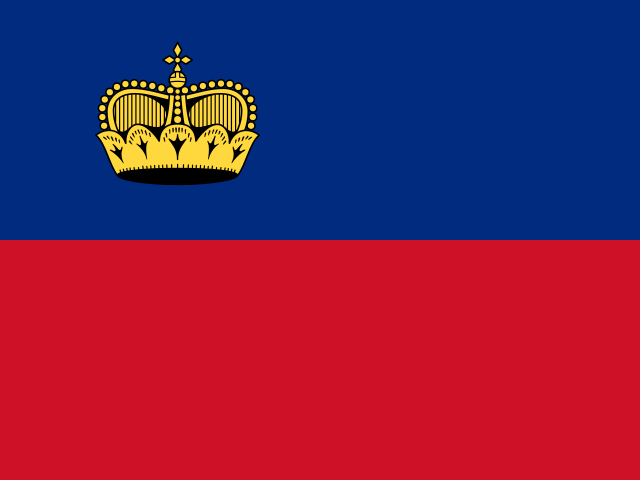
Two horizontal bands of blue over red with a golden crown in the upper hoist. Article 5 of the constitution says only that the national colours are blue and red, and that the state coat of arms is that of the Princely House of Liechtenstein; it assigns neither colour a meaning. The blue is conventionally read for the sky and the red for glowing evening fires, and the crown for the princely house and the unity of people and monarch. The crown was added in 1937, after Liechtenstein and Haiti turned up at the Berlin Olympics with the same flag.
Liechtenstein FACTS ◢
| Capital | Vaduz |
|---|---|
| Continent | Europe |
| Population | 41,024 (2025) |
| Area | 160 km² |
| Population density | 256/km² |
| Currency | Swiss franc (CHF) |
| Official language | German |
| Calling code | +423 |
| Internet TLD | .li |
| Time zone | UTC+01:00 |
| Drives on the | Right |
| ISO codes | LI / LIE |
DID YOU KNOW? ◢
- It has had no army since 1868, when its 80-man force was disbanded as too expensive to keep.
- It's among the world's smallest countries, ruled by a prince from Vaduz Castle above the capital.
- It's one of the largest producers of false teeth and dental products in the world.
- It has no airport of its own and uses the Swiss franc as its currency.
Liechtenstein QUICK ANSWERS ◢
What is the capital of Liechtenstein?
The capital of Liechtenstein is Vaduz.
What is the population of Liechtenstein?
Liechtenstein had a population of 41,024 in 2025.
What currency does Liechtenstein use?
Liechtenstein uses the Swiss franc (CHF).
What languages are spoken in Liechtenstein?
The official language of Liechtenstein is German.
Think you know your flags? Play Flag Daily → · Browse all countries →
MORE ON THE FLAG ◢
The gold object in the upper hoist of Liechtenstein's flag has a name in Liechtenstein law, and the name is not Krone. The word the statute uses is Fürstenhut, a princely hat, and it is the same word the same statute uses for the headgear on top of the princely mantle in the state arms.
The hat is also the newest thing on the flag. It has been there since 1937, and the national historical reference gives the date and the reason in a parenthesis: a colour collision with Haiti, after the previous year's Olympic Games.
As for what the blue and the red mean, no Liechtenstein instrument that governs the flag says. The constitution gives the colours one clause and no gloss. What the national reference gives instead is where they came from, which turns out to be a household rather than a landscape.
Key Takeaways
- The Wappengesetz of 1982 calls the gold object a Fürstenhut, a princely hat. The noun Krone appears in none of them: the constitution, the Wappengesetz, the Wappenverordnung or the ordinance on flag-flying.
- The Historisches Lexikon des Fürstentums Liechtenstein dates the hat to 1937 and says it was inserted after the 1936 Berlin Olympics because of a colour collision with Haiti.
- The same reference records blue and red as the princely house's secondary colours, used for liveries and uniforms, appearing as national colours first in 1793.
- Article 5 of the constitution assigns the state arms to the princely house and gives the national colours as blau-rot. It never describes a flag.
- Since 2025 the flag's colours have been fixed in Pantone, CMYK, RGB, Hex, HKS and RAL by ordinance.
| Object | Its definition in the Wappengesetz | The Fürstenhut |
|---|---|---|
| Flagge, Article 5 | Rectangular cloth attached loosely to a pole by a cord, blue over red, ratio 3:5 | In the blue stripe, towards the pole |
| Fahne, Article 6 | Rectangular cloth fixed to a pole, blue over red, ratio 3:5 | In the blue stripe, towards the pole |
| Banner, Article 7 | Hangs from a crossbar, stripes running lengthwise, blue left and red right | In the blue stripe, towards the pole |
| Wimpel, Article 8 | Small triangular cloth, blue above and red below | In the blue part |
| Standarte des Landesfürsten, Article 9 | Blue over red with a gold border, ratio 3:5 | Absent; the great state arms lie across both stripes |
| Standarte der Regierung und des Landtages, Article 10 | Blue over red with no border, ratio 3:5 | Absent; the great state arms lie across both stripes |
The gold shape is a Fürstenhut, and it is the arms' word too
Article 5 of the Wappengesetz, the law of 30 June 1982 on the arms, colours, seals and emblems of the Principality, describes the flag in two sentences. The first: "Die Flagge besteht aus einem mit einer Leine lose an einer Stange befestigten rechteckigen Tuch aus zwei gleich breiten Querstreifen, oben blau, unten rot." A rectangular cloth attached loosely to a pole by a cord, of two equally wide horizontal stripes, blue above and red below.
Then the object: "Im blauen Streifen ist gegen die Stange hin der Fürstenhut in Gold angebracht." In the blue stripe, towards the pole, the Fürstenhut is placed in gold.
The same word appears in the article on the arms. Article 1 describes the great state arms and closes by surrounding the shield with a purple, ermine-lined "mit dem Fürstenhute gekrönter Fürstenmantel" - a princely mantle crowned with the Fürstenhut. Article 5 then writes der Fürstenhut with the definite article rather than introducing a new object, so the statute is treating the thing on the flag as the thing off the arms.
The noun Krone does not appear anywhere in the constitution, the Wappengesetz, the Wappenverordnung or the ordinance on flag-flying. The participle does: gekrönter turns up three times in the Wappengesetz, twice for the crowned eagles in the quarters of the arms and once for the mantle that is crowned with the Fürstenhut. The word Fürstenhut itself appears six times in the same statute, in Articles 1, 2, 5, 6, 7 and 8, once in the dative as Fürstenhute. So the law is willing to say that something is crowned, and it never once calls this object a crown.
Why 1937, and how thin the Olympics story actually is
The Historisches Lexikon des Fürstentums Liechtenstein, the national historical reference published by the Liechtenstein-Institut, gives the date and the reason in one sentence: "Seit 1937 befindet sich im blauen Streifen ein goldener Fürstenhut (eingefügt nach den olympischen Sommerspielen 1936 in Berlin wegen einer Farbkollision mit Haiti)." Since 1937 a gold Fürstenhut has been in the blue stripe, inserted after the 1936 Summer Olympics in Berlin because of a colour collision with Haiti.
The reference is worth quoting exactly rather than paraphrasing, because its wording is narrower than the story it supports. It says Farbkollision, a collision of colours. It does not say the two flags were identical in every respect, and it does not describe Haiti's flag at all.
What it does establish is the sequence and the motive. The hat is a distinguishing mark added in the twentieth century for a practical reason, to a design without it, which is what the word seit is doing in that sentence.
It also dates the flag more exactly than the constitution can. Article 5 of the constitution has fixed the national colours since 1921 and says nothing about a hat; the hat is sixteen years younger than the clause, and it arrived through a different instrument entirely.
Where Liechtenstein's blue and red actually come from
Ask what the blue and the red stand for and Liechtenstein law has no answer for you. What the national historical reference offers instead is a provenance, and it is a documentary one rather than a symbolic one.
Its flags article separates two pairs of colours. Gold and red are the colours of the princely house itself, and it dates their first depiction precisely: "Rot und Gold gelten als Farben des fürstlichen Hauses Liechtenstein; sie sind im Arlberger Bruderschaftsbuch von 1409 erstmals dargestellt." Red and gold count as the colours of the princely house of Liechtenstein, and were first depicted in the Arlberg confraternity book of 1409.
Blue and red are the other pair, and the reference describes their origin as secondary: "Blau und Rot (Sekundärfarben des Fürstenhauses) wurden ebenfalls für Livreen und Uniformen benutzt. Als Landesfarben erscheinen sie erstmals 1793 auf einem Standartenentwurf." Blue and red, the secondary colours of the princely house, were also used for liveries and uniforms. As national colours they appear for the first time in 1793, on a draft for a standard.
So the country flies the house's second set. Gold and red, the pair whose first depiction the reference dates to 1409 and against which it calls blue and red secondary, stayed with the family: the Wappengesetz gives them their own flags in Articles 11 to 15, and Article 19(3) reserves Führung of those colours to members of the princely house alone.
A livery is a household's clothing, worn by its servants and marked in its colours to say whose household this is. Liveries and uniforms are what the reference names, and a draft standard of 1793 is the first appearance it gives these colours as the country's rather than the household's.
The constitution fixes two colours and never mentions a flag
Article 5 of the Constitution of the Principality of Liechtenstein of 5 October 1921, still in force and consolidated to 1 January 2026, is one line: "Das Staatswappen ist das des Fürstenhauses Liechtenstein; die Landesfarben sind blau-rot." The state arms are those of the princely house of Liechtenstein. The national colours are blau-rot.
That line assigns the colours no meaning, which is ordinary for a flag clause. It also never mentions a flag at all, which is less so. The constitution fixes the colours and stops, and every statement about stripes, proportions, the hat and its position is made by the 1982 statute and the ordinance under it.
The English text distributed by constituteproject, in its edition of the constitution with amendments through 2011, renders the clause as "the national colours are blue and red", which lists two colours. The constitutional text writes blau-rot as one hyphenated compound, the form the statute uses throughout for the pair, and the form it uses for the princely gold-rot.
Liechtenstein's law names five objects in the national colours, and describes each separately
The Wappengesetz does not legislate for a flag. It legislates for five objects, and the differences between them are real ones about how a piece of cloth is hung.
A Flagge is tied to a pole with a cord and flies loose, where a Fahne is fixed to its pole. In a Banner, which hangs from a crossbar, the stripes run lengthwise rather than across, so the colours end up side by side: Article 7 puts blue on the left and red on the right. The Wimpel is a small triangular pennant. Last comes the Standarte, which carries the great state arms across both stripes instead of the hat. There are two of them and they are not the same: Article 9 gives the Prince's standard a gold border, and Article 10 gives the Government and Landtag one without.
The lexicon's flags article opens by noting that everyday German collapses three of these terms, using Fahnen for Fahnen, Flaggen and Banner alike, and then sets out the same differences the statute encodes: a Fahne is a one-off fixed to its pole and treated with ceremony, a Flagge is made in quantity and hoisted on a mast to fly free, a Banner hangs from a horizontal crossbar.
The proportion is the same for most of them. Articles 5, 6 and 9 all give the ratio of height to length as drei zu fünf, three to five.
Since 2025 the colours have had hex values
Liechtenstein's flag colours are now specified numerically, in six colour systems, by a provision added in 2025.
An Article 9a and an Annex 2 were added to the Wappenverordnung by LGBl. 2025 Nr. 192, and the consolidated text that includes them is the version of 1 September 2025. Article 9a makes the annex authoritative for the shape requirements, the size relationships and the colour definitions of the national colours and the Fürstenhut in all four objects it names: Fahnen, Flaggen, Bannern und Wimpeln.
The annex gives each of the three colours in Pantone, CMYK, RGB, Hex, HKS and RAL, and it gives them twice, once for coated stock and once for uncoated. Coated: blue is Pantone 293 C and Hex #003DA5, red is Pantone 185 C and #E4002B, and the third colour, labelled Gelb (Gold), is Pantone 123 C and #FFC72C. The uncoated set changes the Pantone, CMYK, RGB and Hex values and leaves HKS and RAL unchanged.
The annex also fixes the hat's placement rather than leaving it to a drawing. For flags and Fahnen it gives three conditions, in this order: top left, within the first third of the blue area, and vertically centred. It then works an example: a cloth 6 cm high by 10 cm long takes a hat 1.8 cm high and 2.2 cm long. The Banner and the Wimpel get their own lists, of four conditions each rather than three.
Who may display which colours, and on which days
Article 16 of the Wappengesetz opens by prohibiting, on pain of punishment, every Führung and Verwendung of the Principality's arms, colours, seals and emblems, except in the cases set out in its own third paragraph and in Articles 17 to 21. Its second paragraph defines the two words, and they are not synonyms. Führung is use in personal, professional or official dealings, and the article names in particular printing on signs, writings and printed matter. Verwendung is use on objects of every kind, and it names in particular commercial articles and badges. The third paragraph is the everyday exemption: depiction in scholarly works, in school teaching, and as dignified decoration at local festivals and events.
The permissions that follow are broad for the national colours and narrow for the princely ones, and they split along the Führung and Verwendung line. Article 19(1) gives both rights over blue-red in Flaggen, Fahnen, Bannern und Wimpeln to members of the princely house, to all national and municipal authorities, to Liechtenstein's diplomatic and consular missions abroad, and to every private person in the Principality. Article 19(2) limits standards in the national colours to the Prince, the Government and the Landtag.
The princely gold-red is where the two rights come apart. Article 19(3) reserves Führung of those colours, in the same four objects, to members of the princely house alone. Article 19(4) then grants Verwendung of them to the princely house, to national and municipal authorities, and to every private person in the Principality at local festivals and events.
The ordinance on flag-flying of 8 May 1984 sets the days on which public buildings must be flagged: the national day on 15 August, the day the constitution was issued on 5 October, the founding day of the Principality on 23 January, the day the Prince acceded, his birthday and name day, and Corpus Christi. Private buildings are meant to join in. Liechtenstein's missions abroad observe only the days listed under letters a to d, so Corpus Christi is not among them.
If you want to test whether you could actually pick this flag out at speed, a daily flag round gives you three guesses at one flag, and three written clues and no flag at all is the version where the hat cannot help you.
Frequently asked questions
What does the crown on the Liechtenstein flag mean?
It is not called a crown in Liechtenstein law. Article 5 of the Wappengesetz of 1982 calls it the Fürstenhut, the princely hat, and it is the same hat that sits on the princely mantle in the state arms described in Article 1 of that law. No Liechtenstein instrument that governs the flag assigns it a symbolic meaning. What the national historical reference records is when and why it arrived: it has been in the blue stripe since 1937, inserted after the 1936 Summer Olympics in Berlin because of a colour collision with Haiti.
Why did Liechtenstein change its flag in 1937?
The Historisches Lexikon des Fürstentums Liechtenstein says the gold Fürstenhut was inserted into the blue stripe after the 1936 Summer Olympics in Berlin because of a colour collision with Haiti. The reference states a collision of colours rather than describing either design, and it does not say what the Liechtenstein field looked like before the hat went on it. What it does establish is that the hat post-dates the games and that the collision with Haiti is the reason given for it.
What do the colours of the Liechtenstein flag mean?
No Liechtenstein legal instrument assigns them a meaning. Article 5 of the 1921 constitution assigns the state arms to the princely house and gives the national colours as blau-rot, and says nothing about a flag. The national historical reference gives an origin instead of a symbolism: blue and red were the secondary colours of the princely house, used for liveries and uniforms, and first appear as national colours in 1793 on a draft for a standard.
What is the difference between Liechtenstein's flag and its banner?
The Wappengesetz treats them as different objects. Article 5's Flagge is a rectangular cloth tied loosely to a pole, with the stripes running across it, blue above and red below, in a ratio of three to five. Article 7's Banner hangs from a crossbar with the stripes running lengthwise, so the colours sit side by side, blue on the left and red on the right. Both carry the Fürstenhut in the blue.
What are the official colours of the Liechtenstein flag?
Annex 2 of the Wappenverordnung, added by LGBl. 2025 Nr. 192, gives them in six systems and in two variants. For coated stock the blue is Pantone 293 C, Hex #003DA5; the red is Pantone 185 C, Hex #E4002B; and the yellow-gold of the Fürstenhut is Pantone 123 C, Hex #FFC72C. Uncoated stock takes Pantone 293 U, 185 U and 123 U, with different Hex values.
Sources
- Rechtsdienst der Regierung, Lilex, Verfassung des Fürstentums Liechtenstein vom 5. Oktober 1921 - Article 5, consolidated text in force from 1 January 2026. Retrieved 26 August 2026.
- Rechtsdienst der Regierung, Lilex, Gesetz vom 30. Juni 1982 über Wappen, Farben, Siegel und Embleme des Fürstentums Liechtenstein (Wappengesetz), LGBl. 1982 Nr. 58 - Articles 1, 2, 4 to 10, 11 to 15, 16 and 19. Retrieved 26 August 2026.
- Rechtsdienst der Regierung, Lilex, Verordnung vom 14. Februar 1984 über Wappen, Farben, Siegel und Embleme des Fürstentums Liechtenstein (Wappenverordnung), LGBl. 1985 Nr. 18 - Article 9a and Annex 2, added by LGBl. 2025 Nr. 192. Retrieved 26 August 2026.
- Rechtsdienst der Regierung, Lilex, Verordnung vom 8. Mai 1984 über die Beflaggung, LGBl. 1984 Nr. 26 - Articles 1 to 4. Retrieved 26 August 2026.
- Paul Vogt, Fahnen, Historisches Lexikon des Fürstentums Liechtenstein online, Liechtenstein-Institut, as at 31 December 2011 - the 1937 Fürstenhut, the Berlin Olympics, the 1409 and 1793 dates. Retrieved 26 August 2026.
- Paul Vogt, Staatswappen, Historisches Lexikon des Fürstentums Liechtenstein online, Liechtenstein-Institut, as at 31 December 2011 - the princely mantle and the Fürstenhut in the arms. Retrieved 26 August 2026.
- Comparative Constitutions Project via constituteproject.org, Liechtenstein's Constitution of 1921 with Amendments through 2011 - the English rendering of Article 5, cited only for that. Retrieved 26 August 2026.
PLAY ANOTHER →
One quote, one scrambled alphabet. Crack it before tomorrow.
CRACK THE QUOTEDAILYOn This DayOne thing that happened today in history. Every day, a new one.
TODAY IN HISTORYDAILYGuess the CountryThree clues, three guesses. Work out where in the world it is.
THREE CLUESDAILYDaily CodeA short message, hidden in a different cipher every day.
ONE CIPHER A DAY