
Marshall Islands
A far-flung constellation of coral atolls in the central Pacific, the Marshall Islands invented a navigation system using maps woven from sticks to chart the ocean swells.
WHAT THE FLAG MEANS ◢
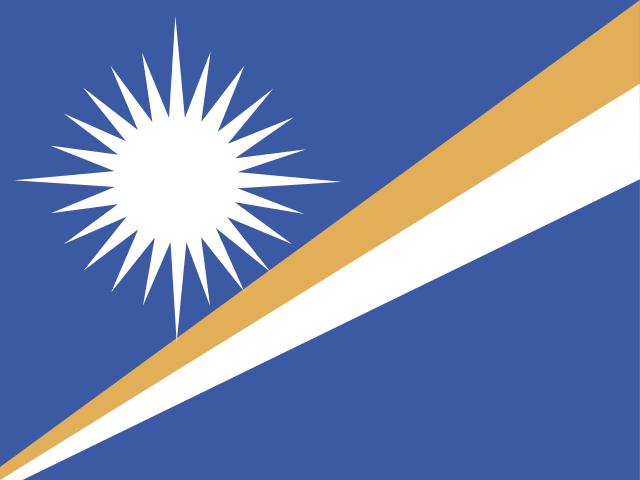
A blue field crossed by two widening diagonal stripes of orange over white rising from the lower hoist, with a large white star of twenty-four rays in the upper hoist, four of them elongated. The Official Flag of the Marshall Islands Act 1979 assigns the design no meaning at all. The schedule to the Seal Act of 1992 does, giving orange to bravery and white to peace, naming the two chains of atolls, the Ratak for sunrise and the Ralik for sunset, and giving the twenty-four rays to the municipalities of the Republic and the four longer rays to Majuro, Jaluit, Wotje and Kwajalein. The orange stripe is separately read as the Ralik and the white as the Ratak, the blue as the Pacific, and the star as the cross of Christianity.
Source: rmiparliament.org · rmigovernment.org · rmiembassyus.org · checked 2026-08-27
Marshall Islands FACTS ◢
| Capital | Majuro |
|---|---|
| Continent | Oceania |
| Population | 42,418 (2021) |
| Area | 181 km² |
| Population density | 234/km² |
| Currency | United States dollar (USD) |
| Main languages | English, Marshallese |
| Calling code | +692 |
| Internet TLD | .mh |
| Time zone | UTC+12:00 |
| Drives on the | Right |
| ISO codes | MH / MHL |
DID YOU KNOW? ◢
- Its traditional navigators read ocean swells using 'stick charts' woven from palm ribs and shells.
- Bikini Atoll, once a nuclear testing site, is now a UNESCO World Heritage Site.
- The country consists of more than 1,000 islands and islets spread across a vast stretch of ocean.
- It uses the US dollar as its currency and sits close to the International Date Line.
Marshall Islands QUICK ANSWERS ◢
What is the capital of the Marshall Islands?
The capital of the Marshall Islands is Majuro.
What is the population of the Marshall Islands?
The Marshall Islands had a population of 42,418 in 2021.
What currency does the Marshall Islands use?
The Marshall Islands uses the United States dollar (USD).
What languages are spoken in the Marshall Islands?
The Marshall Islands designates no official language. The languages of government and education are English and Marshallese.
Think you know your flags? Play Flag Daily → · Browse all countries →
MORE ON THE FLAG ◢
The meaning of the Marshall Islands flag is not in dispute: the Pacific in the blue field, the Ralik and Ratak chains of atolls in the orange and white bars, bravery and peace in those same two colours, the Republic's municipalities in the star's twenty-four rays, and its four principal centres in the four rays that run longer than the rest.
Every part of that has a source. None of it is in the Act that adopted the flag.
The Republic has a whole chapter of statute devoted to the flag: the Official Flag of the Marshall Islands Act 1979, chapter 3 of title 1 of the Marshall Islands Revised Code. It runs to twelve sections. It fixes the geometry to three decimal places, sets a minimum height for the flagstaff, and tells you that the flag may be laundered so long as it goes in a dryer afterwards. It never says what any of it means.
The meaning is in the statute book all the same, filed under the wrong emblem. The Republic of the Marshall Islands Seal Act of 1992 carries a narrative description of the national seal as a schedule, and while walking around the seal it stops to gloss the flag's own star and rays. That schedule is where the bravery, the peace, the sunrise and sunset chains and the twenty-four municipalities are written down.
Key Takeaways
- The Official Flag of the Marshall Islands Act 1979 specifies the design in detail and assigns it no meaning at any point across its twelve sections.
- The symbolism is in the schedule to the Seal Act of 1992, which gives orange to bravery and white to peace and reads the flag's two coloured rays as the two chains of atolls, Ratak for sunrise and Ralik for sunset, without binding either colour to either chain.
- That schedule gives the twenty-four rays to the municipalities of the Republic, not to electoral districts, although the Constitution happens to list twenty-four of those as well.
- The flag Act says two of the star's points are longer. The Seal Act of 1992 and the government's own flag page both say four, and the flag Act's own arithmetic does not reach twenty-four.
- The Office of the President credited the design to Emlain Kabua, wife of the first President and the Republic's first First Lady.
| Element | What it is read as | Which document says so |
|---|---|---|
| Blue field | The Pacific Ocean | The Office of the President's flag page, republished today by the RMI Embassy in Washington |
| Orange bar | Bravery; the Ralik chain, sunset | Seal Act of 1992, schedule 1, for bravery; the presidency's flag page for the pairing with a chain |
| White bar | Peace; the Ratak chain, sunrise | Seal Act of 1992, schedule 1, for peace; the presidency's flag page for the pairing with a chain |
| Twenty-four rays | The municipalities of the Republic | Seal Act of 1992, schedule 1 |
| The four longer rays | Majuro, Jaluit, Wotje and Kwajalein | Seal Act of 1992, schedule 1; the presidency names Ebeye where the statute names Kwajalein Atoll |
| The star itself | The cross of Christianity | The Office of the President's flag page |
| The flag as a whole | Nothing at all | Official Flag of the Marshall Islands Act 1979 |
Where the meaning is actually written down
Schedule 1 of the Seal Act of 1992 is a plain-prose walk around the national seal, and two sentences in, it turns into a commentary on the flag.
Reading clockwise from the angel at the centre, it comes first to a "24 point star representing the 24 municipalities of the Republic", and then to "the four longer rays", which it says "represent the 4 sub-centers of Majuro (the capital), Jaluit, Wotje, and Kwajalein Atolls". So far this is a seal description. Then it does something a seal description had no need to do, and names the other emblem: "On either side of the star are the rays which are on the flag."
Having crossed over, it keeps going. "Each ray is of two colors, one, orange representing bravery, and the other, white representing peace." Then a second layer on the same two rays: "The two-colored rays also represent the two chains of atolls, the Ratak (sunrise) and the Ralik (sunset)."
Ratak and Ralik are the country's two parallel chains of atolls, and the parentheses in that sentence are the schedule's own. The passage was enacted as an attachment to Public Law 1992-30 and renumbered in the 2003 revision of the code. No other Marshallese Act opened for this article says any of it.
Two familiar readings are not in it. The schedule says nothing about the blue field, and nothing about the star being a cross. Both of those come from the executive rather than the legislature. The Office of the President published a short flag page stating that "The deep blue background represents the Pacific Ocean" and that "The star represents the cross of Christianity, with each of the 24 points signifying a municipal district of the RMI". That page also pairs the colours to the chains individually, which the statute leaves joint: it reads "The white and orange bands represent the Ratak (Sunrise) and Ralik (Sunset) chains, respectively."
The presidency's own domain no longer carries that site. The Marshall Islands Embassy in Washington still publishes the paragraph, word for word.
What the Marshall Islands flag Act says instead
Section 302(1) is a draughtsman's paragraph. The flag "shall be blue with two (2) contiguous trapezoidal bars extending from the lower left of the flag, diagonally across to the upper right of the flag. The top bar shall be orange, and the bottom bar shall be white."
Then the star, which the Act calls the union. It "shall be a white star of twenty-four (24) points", it sits "equidistant from the left edge, the top edge and the top of the orange bar", and its points are "fifteen (15) degrees apart". Three hundred and sixty degrees divided by fifteen is twenty-four, so the spacing clause and the count clause agree with each other.
Section 302(3) then sets out nine official proportions. The hoist is 1 and the fly is 1.9. The star's outer diameter measured point to point is .620, its inner diameter .444, and the circle at its centre .196. The diagonal bars taper from .016 at the left edge to .392 at the right. That 1 to 1.9 ratio is worth noting, because the presidency's flag page says instead that "The official flag is at an aspect ratio of 2:1", which is not the figure in the Act.
Read the chapter end to end and the vocabulary of symbolism is absent. Meaning, signify and stand for never appear. Represent appears once, and only inside the word representative, in the clause putting a flag in the office of every official representative of the government. Symbolism appears once, in section 309(h), which forbids any display that would "demean the dignity of its symbolism" while declining to say what that symbolism is.
Sunset and sunrise do appear, once each and together, which is the small irony at the centre of this. In section 303(1) they are not the two atoll chains. They are the hours between which the flag may not be flown outdoors, unless the flagstaff is at least twenty-five feet tall and the flag is lit.
Two long points, or four?
Here the Republic's two statutes disagree about the same star.
Section 302(1) sets the count at twenty-four, and then adds: "the two (2) points which are parallel to the fly shall be longer than the remaining twenty (20) points."
Two plus twenty is twenty-two. That sentence cannot be describing a twenty-four-point star, so one of its two numbers is wrong, and it is possible to say which. Two later official texts make four of the points longer. The Seal Act's schedule says "the four longer rays". The Office of the President's flag page said "The four main points represent the major centers of Majuro, Ebeye, Jaluit and Wotje", and the Washington embassy publishes that sentence today. Neither the flag Act nor anything else opened for this article puts the figure at two.
The other reading is that the twenty should have been twenty-two, leaving a genuine two long points. It does not survive contact with anything else: a star with two long points and twenty-two short ones is neither the star the Seal Act describes nor the star the presidency describes. Reading the two as four contradicts neither.
So the twenty is right and the two is short by two. Take four long points away from twenty-four and twenty short ones are exactly what is left, which is the figure the clause already carries. What the clause misses is the other half of the long ones: it singles out the pair parallel to the fly and never accounts for the two beyond them. Someone drafting from the artwork could count the pair the clause names and stop there.
The Act has never been amended, and the register is not the only evidence for that. The Public Holidays Act 1988 prints an "Amended By" line under its commencement date, listing seven public laws. The flag Act's header carries no such line at all, and the register lists one version of it, the text that came into force on 12 June 1979. The sentence has stood as printed for more than four decades, contradicted only by a later Act about a different emblem.
Twenty-four of what?
The number is not in dispute. The unit is, and this is where the popular version of the flag's meaning changes the subject without saying so.
The Seal Act says municipalities. The presidency's flag page said each of the twenty-four points signifies "a municipal district of the RMI". Neither says electoral district, which is a different unit of Marshallese government with its own definition in the Constitution.
The mistake is an easy one, because both counts come to twenty-four. Article IV, section 2(1) of the Constitution provides that the Nitijela "shall consist of 33 members to be elected from the following electoral districts", and then lists them: Majuro with five seats, Kwajalein with three, Ailinglaplap, Arno and Jaluit with two each, and nineteen more with one apiece. Count the names and there are twenty-four.
So a reader who says the rays stand for the electoral districts reaches the right arithmetic through the wrong door. The rays are for the municipalities. That the Republic also has twenty-four electoral districts is a separate fact about a separate list, and no instrument connects the two.
How many municipalities there are is less settled than the Seal Act makes it sound. The Office of the President published the same seal passage on its own website with a different figure, a "24 point star representing the 21 municipalities of the Republic", and the Washington embassy reproduces that version. The result is that one government page today says the star's twenty-four points are twenty-four municipal districts in one paragraph and twenty-one municipalities in the next. Nothing in the Local Government Act enumerates them either. The Judiciary publishes the local-government constitutions the Attorney-General supplied in 2020, and that collection runs to twenty-two instruments. One of them is not one place: the constitution filed as KBE covers Kili, Bikini and Ejit together. Count those three as places rather than as documents and the total reaches twenty-four, which is the statute's figure rather than the website's.
If you want to find out whether you could pick this flag out of a line-up in the first place, a daily flag round gives you three guesses at the country.
Who designed the Marshall Islands flag
The Office of the President answered this in one sentence at the foot of its flag page: "The flag was designed by the first First Lady Emlain Kabua."
She was the wife of Amata Kabua, who was chosen as the Republic's first President when the Constitution came into force and who led the country until his death in 1996. The credit is straightforward, and it is also getting harder to find rather than easier. The presidency's page carried that line for years, and the domain it was published on no longer serves the government's site. The embassy page in Washington reproduces the rest of the paragraph exactly and stops just before the credit.
The dates around the design are worth keeping straight, because the flag and the state did not arrive together. In 1978 the Marshall Islands voted in a referendum to break away from the rest of Micronesia and to adopt a constitution of its own. The Office of the President dated the Constitution's entry into force precisely. Its history page says the Constitution "entered into force on May 1, 1979", and that the Nitijela chose Amata Kabua as the first President at the same moment. The Public Holidays Act 1988 makes that date Constitution Day. Recognition followed the Compact: on the list of diplomatic relations published by the Marshall Islands Embassy in Washington, the Federated States of Micronesia is second, dated 26 February 1987, behind the United States in October 1986.
The flag Act commenced on 12 June 1979. For its first six weeks the Republic had a constitution, a Nitijela and a President before it had a flag fixed in law.
The colours the Act declined to fix
Section 302(2) is a single sentence, and it settles far less than it looks as though it settles.
The colours, it says, "shall be of a hue authorized by Executive Order of the Cabinet, based upon the color identification system of the United States Bureau of Standards."
So the Act fixes no colour. It fixes a procedure for fixing a colour, and points that procedure at an agency of the United States, which had administered the islands as part of the Trust Territory of the Pacific Islands since 1947. The Bureau did publish a colour-designation system in that period, the ISCC-NBS method, issued as NBS Circular 553 in 1955 and then superseded and combined into NBS Special Publication 440 in 1976. The Act names no publication at all, so even the reference it makes is left open.
No such Executive Order appears among the subordinate legislation the Nitijela publishes alongside the Acts. That collection holds twenty-five titled entries, the earliest from 1989 and the most recent from 2024, and not one of them is about the flag. Twenty-four distinct documents sit behind them, because two of the 1989 entries point at the same file. It does not prove that no order was ever made, because Executive Orders are not regulations and may be held somewhere else entirely. It does mean that the hue of the Marshall Islands flag is not something a member of the public can look up beside the design it belongs to.
The agency has changed its name since. The National Bureau of Standards is, in the words of its successor's own history pages, "now NIST".
The Marshall Islands flag rules track the American code, and make it binding
The half of the Act that is not specification is conduct, and its wording tracks the United States Flag Code closely enough that the borrowing is visible line by line.
Start with the vocabulary. Title 4 of the United States Code opens by providing that "the union of the flag shall be forty-eight stars, white in a blue field", and the Marshall Islands Act borrows that word for its own star, calling it the union of the flag.
Then the prohibitions. Title 4, section 8 says the flag "should never touch anything beneath it, such as the ground, the floor, water, or merchandise". Section 309(b) of the Marshall Islands Act says the flag shall never "be permitted to touch anything beneath it, such as the ground, the floor, water or structure". The same list in the same order, with merchandise replaced by structure.
The pattern repeats. The American code says the flag "should not be dipped to any person or thing". Section 309(a) says it shall never "be dipped to any person or thing". The American code forbids using it "as a receptacle for receiving, holding, carrying, or delivering anything", and section 309(g) forbids the same thing in the same words. Half-staff drill matches too, down to hoisting the flag to the peak first and raising it to the peak again before it comes down for the day.
On that one the Marshall Islands tightened something the American text leaves open. Section 306(3) permits half-staff "only upon authorization of the Cabinet, promulgated by Executive Order". At least one day is set by statute instead of by order, because the Public Holidays Act 1988, as amended in 2003, provides that "the national flag shall be flown at half-staff on March 1st each year" for Nuclear Victims Remembrance Day, which commemorates those who suffered under United States nuclear testing in the islands.
One difference runs through all of it, and it is the important one. The American provisions say should. Title 4 attaches no sanction to them, and the one criminal provision in the chapter, section 3, reaches only advertising use of the flag within the District of Columbia. The Marshall Islands provisions say shall never, and section 312 lets the Attorney-General ask the High Court to enjoin a repeat offender. The Republic took a piece of borrowed etiquette and made it binding.
Even so, the sanction is mild, and the contrast with the Republic's other emblem is sharp. Misusing the flag gets you an injunction. Misusing the seal is a misdemeanour under section 1003 of the Seal Act, carrying a fine of not less than 500 dollars and not more than 2,500, imprisonment of not less than six months nor more than one year, or both, with each individual use a separate offence. The emblem whose description carries the meaning is the one the law actually punishes you for abusing.
Frequently asked questions
What do the colours of the Marshall Islands flag mean?
Schedule 1 of the Republic of the Marshall Islands Seal Act of 1992 gives orange to bravery and white to peace, and adds that the two coloured rays "also represent the two chains of atolls, the Ratak (sunrise) and the Ralik (sunset)". The Office of the President paired them individually, reading the white and orange bands as Ratak and Ralik respectively, and read the blue field as the Pacific Ocean. None of these meanings appears in the flag's own Act.
How many points does the star on the Marshall Islands flag have?
Twenty-four. Section 302(1) of the Official Flag of the Marshall Islands Act 1979 requires "a white star of twenty-four (24) points", and separately sets the points fifteen degrees apart, which comes to twenty-four as well. Four of those points are longer than the rest, according to the Seal Act of 1992 and to the Office of the President, although the flag Act's own wording says two.
What do the twenty-four rays on the Marshall Islands flag represent?
The municipalities of the Republic, according to schedule 1 of the Seal Act of 1992, which describes a "24 point star representing the 24 municipalities of the Republic". They are often said to stand for the country's electoral districts instead. The Constitution does list twenty-four electoral districts, in article IV section 2(1), so the count is the same, but that is a different unit from the one the statute names.
Who designed the flag of the Marshall Islands?
Emlain Kabua, wife of the first President Amata Kabua and the Republic's first First Lady. The credit comes from the Office of the President, whose flag page ended with the sentence "The flag was designed by the first First Lady Emlain Kabua." The design was adopted by an Act that commenced on 12 June 1979, six weeks after the Constitution came into force.
What do the four longer rays on the Marshall Islands flag stand for?
The country's four principal centres. Schedule 1 of the Seal Act of 1992 names them as "the 4 sub-centers of Majuro (the capital), Jaluit, Wotje, and Kwajalein Atolls". The Office of the President and the Marshall Islands Embassy in Washington give the same four but write Ebeye where the statute writes Kwajalein Atoll. The two lists differ only in whether they name the atoll or its principal town.
Sources
- Nitijela of the Republic of the Marshall Islands, Official Flag of the Marshall Islands Act 1979, 1 MIRC Ch.3 - retrieved 27 August 2026. The Marshall Islands Revised Code as published by the national parliament.
- Nitijela of the Republic of the Marshall Islands, Republic of the Marshall Islands Seal Act of 1992, 1 MIRC Ch.10 - retrieved 27 August 2026.
- Nitijela of the Republic of the Marshall Islands, Constitution of the Republic of the Marshall Islands - retrieved 27 August 2026. Article IV section 2(1) carries the list of electoral districts. The text contains no flag provision at all.
- Nitijela of the Republic of the Marshall Islands, Public Holidays Act 1988, 1 MIRC Ch.9 - retrieved 27 August 2026.
- Nitijela of the Republic of the Marshall Islands, Local Government Act 1980 and the Acts of Nitijela register by title - retrieved 27 August 2026. The register lists one version of the flag Act, and no flag regulations among the subordinate legislation.
- Office of the President, Republic of the Marshall Islands, The RMI Flag and The Seal - the Internet Archive captures of 12 March 2007, retrieved 27 August 2026. Both links go to the archive deliberately: the presidency's old domain no longer carries the government's site, so the live addresses are not safe to follow.
- Office of the President, Republic of the Marshall Islands, The Presidency and Cabinet - Internet Archive capture of 12 March 2007, retrieved 27 August 2026. The source for Amata Kabua's presidency from 1979 until his death in 1996.
- Nitijela of the Republic of the Marshall Islands, History of the Nitijela - retrieved 27 August 2026. The source for the 1978 referendum.
- Office of the President, Republic of the Marshall Islands, History - Internet Archive capture of 11 March 2007, retrieved 27 August 2026. The source for the Constitution entering into force on 1 May 1979 and for the 1947 Trusteeship.
- Embassy of the Republic of the Marshall Islands, Washington D.C., Government - retrieved 27 August 2026. Carries the presidency's flag and seal paragraphs, the six Trust Territory districts, and the dated list of countries with diplomatic relations.
- Republic of the Marshall Islands Judiciary, Constitutions of the Local Governments of the Republic of the Marshall Islands - retrieved 27 August 2026.
- Office of the Law Revision Counsel, United States Code, title 4, chapter 1, published by GovInfo - retrieved 27 August 2026.
- Kenneth L. Kelly and Deane B. Judd, Color: Universal Language and Dictionary of Names, National Bureau of Standards Special Publication 440, 1976 - retrieved 27 August 2026.
- National Institute of Standards and Technology, NIST History - retrieved 27 August 2026.
PLAY ANOTHER →
One thing that happened today in history. Every day, a new one.
TODAY IN HISTORYDAILYGuess the CountryThree clues, three guesses. Work out where in the world it is.
THREE CLUESDAILYDaily CryptogramOne quote, one scrambled alphabet. Crack it before tomorrow.
CRACK THE QUOTEDAILYDaily TriviaFive questions a day. Everyone gets the same five.
FIVE QUESTIONS