
Federated States of Micronesia
A ribbon of more than 600 islands strung across the western Pacific, sharing a single country name but four very distinct island cultures. The Federated States of Micronesia is a nation that's mostly ocean.
WHAT THE FLAG MEANS ◢
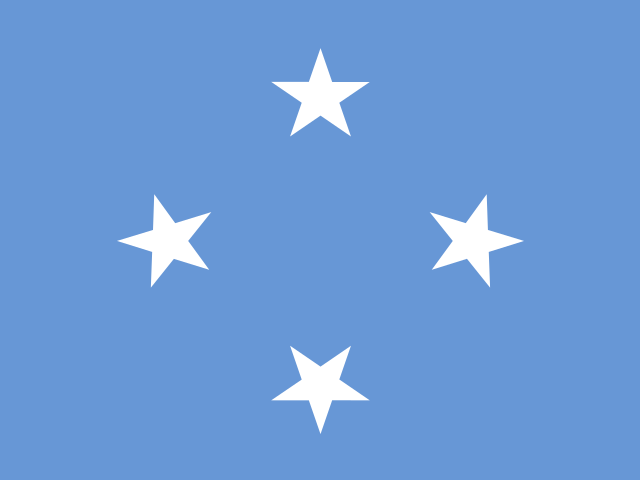
A blue field bearing four white five-pointed stars, which the flag law sets in a circle at the centre and which most viewers read as a diamond. The four stars are the federation's four states - Yap, Chuuk, Pohnpei and Kosrae - a count inherited from the six-star Trust Territory flag. FSM law fixes the flag's proportions and the size of the stars, but gives the blue no meaning and names no shade of it.
Source: fsmlaw.org
Federated States of Micronesia FACTS ◢
| Capital | Palikir |
|---|---|
| Continent | Oceania |
| Population | 113,683 (2025) |
| Area | 702 km² |
| Population density | 162/km² |
| Currency | United States dollar (USD) |
| Main language | English |
| Calling code | +691 |
| Internet TLD | .fm |
| Time zones | UTC+10:00, UTC+11:00 |
| Drives on the | Right |
| ISO codes | FM / FSM |
DID YOU KNOW? ◢
- It's spread across hundreds of islands stretching over a vast area of the western Pacific Ocean.
- The island of Yap is famous for its giant stone money, discs that can be taller than a person.
- The ruined stone city of Nan Madol was built on a network of artificial islets over a coral reef.
- Its four states each have their own distinct languages and traditions.
Federated States of Micronesia QUICK ANSWERS ◢
What is the capital of the Federated States of Micronesia?
The capital of the Federated States of Micronesia is Palikir.
What is the population of the Federated States of Micronesia?
The Federated States of Micronesia had a population of 113,683 in 2025.
What currency does the Federated States of Micronesia use?
The Federated States of Micronesia uses the United States dollar (USD).
What languages are spoken in the Federated States of Micronesia?
The Federated States of Micronesia designates no official language. The language of government and education is English.
Think you know your flags? Play Flag Daily → · Browse all countries →
MORE ON THE FLAG ◢
Four white stars, one for each state of the federation: Yap, Chuuk, Pohnpei and Kosrae. That part is settled, and almost every page about the Micronesian flag gets it right.
The blue is where the confident answers run out. Section 501 of title 1 of the Code of the Federated States of Micronesia adopts the flag in a single sentence, and that sentence gives the colour no meaning whatsoever:
"There shall be and there is hereby adopted an official flag of the Federated States of Micronesia, which shall consist of a circle of four white stars centered on a field of blue."
A field of blue. Not a sky, not an ocean, not a Pantone number. The rest of the section fixes proportions and star size, and the constitution adds nothing: none of its fifteen articles mentions the flag.
Key Takeaways
- The four stars are the four states, Yap, Chuuk, Pohnpei and Kosrae, inherited from a six-star Trust Territory flag.
- FSM law fixes the shape, the proportions and the star size, and gives the blue neither a meaning nor a shade.
- The statute sets the stars in "a circle", wording held over from the six-star design, though four points on a circle read as a diamond.
- The star count fell from six to four in 1978: the Northern Marianas, Palau and the Marshall Islands stayed out of the federation, and Kosrae had been made a district of its own in 1977.
- Flags in official service run from pale blue to a strong dark blue, and Flags of the World records two different specifications in circulation.
What do the four stars on the Micronesian flag mean?
One star for each state. They are equal in size and equal in placement, which is a political statement rather than a demographic one.
The states behind them are nothing like equal. In the 2023 census run by the FSM Statistics Division, Chuuk held 33,885 people and Pohnpei 26,102, while Yap had 10,739 and Kosrae 5,092. One star covers a state more than six times the size of another.
Two of the four carried different names when the flag took its present shape: Chuuk was Truk, and Pohnpei was spelled Ponape.
As for the arrangement, the law says "a circle of four white stars". Four points spaced around a circle are what most viewers call a diamond, and most descriptions say diamond. Both describe the same picture. Only one is the wording in the statute.
Why did the Micronesian flag lose two stars?
Because the federation that inherited the flag had four states, not six districts. Three of the six the stars counted stayed out, and a fourth district had meanwhile been created.
The design began as the emblem of the Trust Territory of the Pacific Islands, the United Nations trusteeship administered by the United States after Japan lost the islands it had held under a League of Nations mandate. The vexillologist Michel Lupant, working from the Trust Territory's 1962 annual report, records that a territory-wide contest that year was won by Gonzalo Santos of Saipan, who took a prize of 250 dollars, and that his six white stars in a circle on blue were adopted by the Council of Micronesia at Koror on 3 October 1962.
Kosrae then moved the other way. Lupant records it being detached from the Ponape district in 1977 and made a district of its own, which took the number of districts to seven. Districts also started leaving: the Northern Marianas negotiated commonwealth status, and at the referendum of 12 July 1978 the districts of Palau and the Marshall Islands rejected the proposed constitution of the Federated States of Micronesia. Yap, Truk, Ponape and Kosrae approved it. Seven districts, three out, four states.
A four-star version was adopted on 30 November 1978, according to Lupant. The constitution took effect on 10 May 1979, a date FSM law still keeps as a national holiday.
| Provision | Congress of Micronesia, Public Law 1-1 (1965) | FSM Code, title 1, section 501 (current) |
|---|---|---|
| Stars | Six white, in a circle | Four white, in a circle |
| Field | "a field of blue" | "a field of blue" |
| Flag width to flag length | 1 to 1.9 | 1 to 1.9 |
| Flag width to star width | 4 to 1 | 5 to 1 |
| Meaning assigned to any element | None | None |
Public Law 1-1 was the first law the territorial Congress of Micronesia ever passed, and Lupant transcribed it from the archives of the College of the Marianas. Beyond the star count, one substantive change shows up: the FSM version shrank each star from a quarter of the flag's width, the short edge, to a fifth.
Does the law say the blue stands for the Pacific Ocean?
It does not. The ocean reading is repeated almost everywhere and appears in no FSM statute.
What makes that worth knowing is the alternative on record. Lupant, citing the Trust Territory's own annual report for 1962, gives the symbolism attached to the flag when it was new: the white stars stood for the six districts and also for peace, and the blue field stood for freedom and loyalty. Freedom and loyalty, not water.
A page telling you the blue "represents the Pacific Ocean" is reporting a convention rather than a rule.
Is the Micronesian flag light blue or dark blue?
Both, in practice, because nothing official settles it.
Lupant visited Pohnpei and Chuuk in 2009 and found flags in government use ranging from light blue to considerably darker, with the darker shade by then more common.
Published specifications disagree as well. Flags of the World states plainly that no official source gives exact colours for the national flag, and records the split: the protocol manual issued for the London 2012 Olympics specified PMS 277, a pale blue, while the 2023 Album des Pavillons uses Pantone 286c, a strong dark blue. To a printer, those are two different flags.
Calling the field "light blue" therefore describes some Micronesian flags rather than the Micronesian flag.
How much does the flag matter in Micronesia?
Less than an outsider would guess, and for reasons unrelated to the design.
Scot Guenter, writing in the vexillology journal Raven, gathered accounts from citizens of the FSM, Palau and Guam in 2003. His Micronesian respondents named their home island first and the federation second, and described flags mainly as markers for municipal sports teams, church processions and state constitution days rather than as objects of national reverence.
Guenter concluded that singing, dancing and chanting still do more to hold identity together there than flag ritual does.
If you want to find out how well you can tell the Pacific flags apart, try Flag Daily.
Frequently asked questions
What do the four stars on the flag of the Federated States of Micronesia represent?
The four states of the federation: Yap, Chuuk, Pohnpei and Kosrae. The flag statute does not say so itself, since it only describes the design, but the count comes from the four former Trust Territory districts that voted to federate in 1978.
When was the four-star Micronesian flag adopted?
The vexillologist Michel Lupant dates the four-star version to 30 November 1978, between the July referendum and the constitution taking effect on 10 May 1979.
Why does the Micronesian flag look like the Trust Territory flag?
Because it is that flag with two stars removed. The FSM Code traces its flag section back through the Trust Territory Code of 1966, and the current provision keeps the older wording, including the phrase setting the stars in a circle.
What shade of blue is the Micronesian flag?
There is no official shade. The statute says only "a field of blue", and Flags of the World records that no official source gives exact colours for the national flag.
What are the official proportions of the Micronesian flag?
Section 501 sets the flag's width to its length as 1 to 1.9, the ratio 10:19, and each star at one fifth of the flag's width. The same section allows the flag to be reproduced for unofficial purposes with different dimensions.
Sources
- Legal Information System of the Federated States of Micronesia, FSM Code, Title 1, Chapter 5: Flag - retrieved 12 August 2026.
- Legal Information System of the Federated States of Micronesia, Constitution of the Federated States of Micronesia, Articles I to XV - retrieved 12 August 2026.
- Legal Information System of the Federated States of Micronesia, FSM Code, Title 1, Chapter 6: Holidays - retrieved 12 August 2026.
- Michel R. Lupant, From the Trust Territory of Pacific to the Federated States of Micronesia, Proceedings of the 24th International Congress of Vexillology, North American Vexillological Association, 2011 - retrieved 12 August 2026.
- Scot Guenter, Micronesian Flag Cultures: An Exercise in Comparative Vexillology, Raven: A Journal of Vexillology, volume 11, 2004 - retrieved 12 August 2026.
- FSM Statistics Division, Department of Resources and Development, Population Statistics, 2023 Census factsheets - retrieved 12 August 2026.
- Flags of the World, Micronesia - retrieved 12 August 2026.
PLAY ANOTHER →
Five questions a day. Everyone gets the same five.
FIVE QUESTIONSDAILYGuess the CountryThree clues, three guesses. Work out where in the world it is.
THREE CLUESDAILYDaily CryptogramOne quote, one scrambled alphabet. Crack it before tomorrow.
CRACK THE QUOTEDAILYOn This DayOne thing that happened today in history. Every day, a new one.
TODAY IN HISTORY