
Montenegro
A small Balkan country whose name means 'Black Mountain', Montenegro folds dramatic peaks straight down to the Adriatic, with a fjord-like bay carved into its coast.
WHAT THE FLAG MEANS ◢
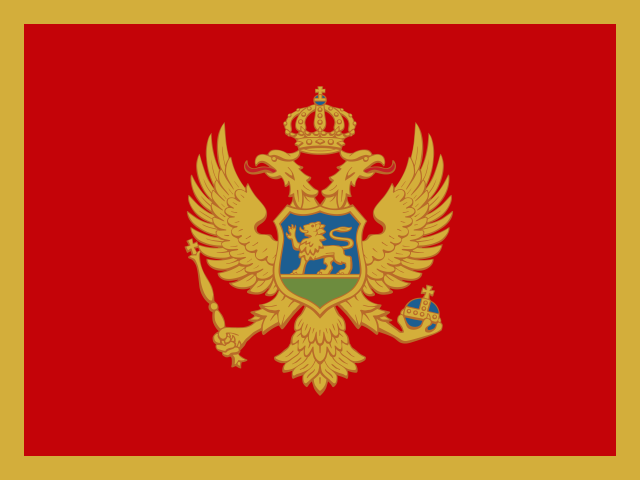
A red field with a golden brim, bearing the coat of arms in the centre: a golden crowned double-headed eagle holding a sceptre and an orb, with a golden lion on a shield at its breast. Article 4 of the constitution describes the arms more briefly, as a golden double-headed eagle with a lion on its chest, and assigns neither flag nor arms a meaning. The double-headed eagle is conventionally read for the unity of church and state and the lion for episcopal and national authority, and both descend from the insignia of the Petrovic-Njegos rulers, though no instrument says so.
Montenegro FACTS ◢
| Capital | Podgorica |
|---|---|
| Continent | Europe |
| Population | 623,129 (2025) |
| Area | 13,883 km² |
| Population density | 45/km² |
| Currency | Euro (EUR) |
| Official language | Montenegrin |
| Calling code | +382 |
| Internet TLD | .me |
| Time zone | UTC+01:00 |
| Drives on the | Right |
| ISO codes | ME / MNE |
DID YOU KNOW? ◢
- Its name translates as 'Black Mountain'.
- The Bay of Kotor is often described as Europe's southernmost fjord-like inlet, though it's actually a submerged river canyon.
- Tara River Canyon is one of the deepest river canyons in the world.
- Despite not using the euro through the eurozone, it adopted the euro as its currency.
Montenegro QUICK ANSWERS ◢
What is the capital of Montenegro?
The capital of Montenegro is Podgorica.
What is the population of Montenegro?
Montenegro had a population of 623,129 in 2025.
What currency does Montenegro use?
Montenegro uses the Euro (EUR).
What languages are spoken in Montenegro?
The official language of Montenegro is Montenegrin.
Think you know your flags? Play Flag Daily → · Browse all countries →
MORE ON THE FLAG ◢
Article 4 of Montenegro's constitution is four sentences long, and each of them is one line. Montenegro has a coat of arms, a flag and an anthem. The arms are a golden double-headed eagle with a lion on its chest. The flag is red, with the arms in the middle and a golden brim. The anthem is Oj svijetla majska zoro.
That is the entire constitutional treatment of a flag carrying a crowned double-headed eagle, a lion, a sceptre, an orb and three crosses. Not one word of interpretation.
The statute underneath it is a different matter. It measures the flag's golden brim to a twentieth of the flag's narrower part, tells you where the physical original is kept, and then does the thing worth the whole detour: it protects the symbols of five earlier Montenegros.
Key Takeaways
- Article 4 of the constitution covers the arms, the flag and the anthem in four one-line sentences and interprets none of them.
- The constitutional blazon of the arms is much shorter than the statutory one. It does not mention the crown, the sceptre or the orb that the Law on State Symbols requires.
- That Law fixes the flag at two to one, the arms at two thirds of its height and the golden brim at one twentieth of the narrower part, and puts the arms' centre on the crossing of the diagonals.
- The originals of the arms and the flag are kept with the President of the Parliament, and the Government separately determines a reference standard, the etalon, for each.
- Article 28 of the same Law extends its protection to the symbols of five earlier Montenegros: the Principality, the Kingdom, the People's Republic, the Socialist Republic and the Republic under the 1993 Act.
Four sentences, and none of them a reason
The Constitution of Montenegro puts its symbols at Article 4, under the heading Državni simboli, between the article on state territory and the article naming the capital. In the Montenegrin text:
"Crna Gora ima grb, zastavu i himnu."
Montenegro has a coat of arms, a flag and an anthem. Then the arms:
"Grb Crne Gore je zlatni dvoglavi orao sa lavom na prsima."
The coat of arms of Montenegro is the golden double-headed eagle with a lion on its chest. Then the flag, which is the longest of the four and still one line:
"Zastava Crne Gore je crvene boje sa grbom na sredini i zlatnim obrubom."
The flag of Montenegro is red in colour, with the coat of arms in the middle and a golden brim. Thirteen words in the original, and the fourth sentence names the anthem.
Article 5 then disposes of the capital in one line each for Podgorica and, separately, for Cetinje as the Old Royal Capital. Article 6 begins on rights. Whatever the eagle and the lion are for, the constitution has already moved on.
The constitution's blazon leaves out the crown
Compare that blazon with the one in the Law on State Symbols and the Statehood Day of Montenegro, and the constitution turns out to be describing a simpler bird.
The Law's article 4 gives the arms in full:
"Grb Crne Gore (u daljem tekstu: Grb) je u obliku zlatnog krunisanog dvoglavog orla, uzdignutih krila u poletu, sa skiptrom u desnoj i šarom u lijevoj kandži na crvenoj osnovi. Na prsima orla je štit sa zlatnim lavom u prolazu. Lav je na zelenom polju sa plavom pozadinom. Kruna iznad orlovskih glava i skiptar su zlatni sa krstom na vrhu. Šar je plavi sa zlatnim okovom i krstom."
A golden crowned double-headed eagle, wings raised in flight, with a sceptre in the right and an orb in the left claw, on a red base. On the eagle's chest a shield with a golden lion passant. The lion on a green field with a blue background. The crown above the eagle's heads and the sceptre are gold, each with a cross on top. The orb is blue with a golden mounting and a cross.
Set the two side by side and the constitution is missing the crown, the sceptre, the orb, the wings in flight, the red base, the green field, the blue background and all three crosses.
| What it says | Constitution, article 4 | Law on State Symbols, article 4 |
|---|---|---|
| The eagle | Golden, double-headed | Golden, crowned, double-headed, wings raised in flight |
| In its claws | Not mentioned | A sceptre in the right claw, an orb in the left, as the eagle bears them |
| The field it sits on | Not mentioned | Red |
| On its chest | A lion | A shield with a golden lion passant |
| Around the lion | Not mentioned | A green field, a blue background |
| Crosses | Not mentioned | On the crown, on the sceptre and on the orb |
Neither instrument says what any of it means. The constitution simply says less of it.
The statute measures the flag down to the width of its golden brim
Article 5 of the same Law opens by saying the constitution's sentence over again:
"Zastava Crne Gore (u daljem tekstu: Zastava) crvene je boje, sa Grbom na sredini i zlatnim obrubom."
The flag of Montenegro is red in colour, with the arms in the middle and a golden brim. That is the constitution's flag sentence almost word for word, with the defined term inserted and the colour clause inverted. Then the Law does what the constitution declined to do, in four more sentences:
"Odnos dužine i širine zastave je dva prema jedan."
The ratio of the flag's length to its width is two to one. Then three more sentences, each fixing one thing:
"Grb na zastavi zauzima 2/3 visine zastave."
The arms on the flag occupy two thirds of the flag's height.
"Središnja tačka Grba poklapa se sa tačkom u kojoj se sijeku dijagonale zastave."
The centre point of the arms coincides with the point where the flag's diagonals intersect.
"Širina zlatnog obruba je 1/20 užeg dijela zastave."
The width of the golden brim is one twentieth of the narrower part of the flag.
That is a flag whose geometry is fixed to the last fraction, in five sentences, none of which says why any of it is there. The one interpretive statement in the whole Law is at article 2, and it applies to the symbols collectively rather than to any part of them: the state symbols represent Montenegro and express belonging to Montenegro.
Article 9 then locks the design down. Nothing on the arms or the flag may be corrected, added or changed, with one exception: where special regulations provide for it, the arms and the flag may be used as a constituent part of other emblems or marks of state bodies and other institutions. Article 10 forbids using either as a trade or service mark, a design or any other sign for designating goods or services, except with prior permission from the state body responsible for culture. Article 8 pulls the other way: use of the arms and the flag in artistic creation and in teaching and educational work is free, so long as it does not offend public morals or the reputation and dignity of Montenegro. Article 29 sets the penalty for a legal person at between 1,000 and 20,000 euro.
The original is kept with the President of the Parliament
Article 3 of the Law is two sentences, and it is the only provision that says where the authoritative originals are kept.
The Government of Montenegro determines the etalon of the arms, the etalon of the flag and the musical notation of the anthem. An etalon is a reference standard, the object other objects are checked against.
Then:
"Izvornik Grba i izvornik Zastave i melodijsko-tonski zapis Himne čuvaju se kod predsjednika Skupštine Crne Gore."
The original of the arms, the original of the flag and the melodic and tonal record of the anthem are kept with the President of the Parliament of Montenegro.
So the authoritative flag of Montenegro is not a description. It is a thing, in the keeping of the President of the Parliament, the office an English reader would call the Speaker. The Law does not say how the original and the Government's reference standard relate to each other, only that one of them is determined by the Government and the other is held by the Speaker, and that article 30 set a sixty-day deadline from entry into force for the etalons and the anthem's notation to be determined, without naming who was to do it. The Albanian flag carries a double-headed eagle of its own and is worth reading beside this one.
Montenegro protects the symbols of five earlier Montenegros
Chapter V of the Law has one article, and it is the reason this statute is worth reading in full.
"Državni i vojni simboli Knjaževine Crne Gore i Kraljevine Crne Gore, simboli Narodne Republike Crne Gore i Socijalističke Republike Crne Gore i simboli Republike Crne Gore utvrđeni Zakonom o Grbu i Zastavi Republike Crne Gore"
and, after the gazette reference for that 1993 Act:
"uživaju zaštitu, kao i državni simboli utvrđeni ovim zakonom."
The state and military symbols of the Principality of Montenegro and of the Kingdom of Montenegro, the symbols of the People's Republic of Montenegro and of the Socialist Republic of Montenegro, and the symbols of the Republic of Montenegro determined by the Law on the Coat of Arms and Flag of the Republic of Montenegro of 1993, enjoy protection, as do the state symbols determined by this Law.
Five earlier Montenegros are named there, from a principality to a socialist republic to the republic of the 1990s, and article 28 says the symbols of every one of them enjoy protection on the same terms as the state symbols the Law itself determines, in a chapter headed Historical symbols.
One limit on that, which the Law leaves implicit and is worth making explicit. The penalty article, article 29, lists eight offences. Six of them concern the arms and the flag as articles 4 and 5 define them, and the other two concern the anthem. Nothing in it attaches to misusing the Principality's symbols or the Socialist Republic's. Article 28 says the historical symbols enjoy protection on the same terms; the enforcement machinery in the same Act does not follow them there.
The Law as enacted took effect on publication in 2004, and its article 31 repealed the 1993 Act on the Coat of Arms and Flag of the Republic of Montenegro, and that republic's symbols are the fifth item on the list article 28 protects. A statute that repeals a flag law and then protects the flag that law created is doing something more careful than housekeeping. Article 31 repealed one other thing in the same breath, the 1976 Act on the Holiday of the Socialist Republic of Montenegro. That republic's symbols are the fourth item on the same list, though article 28 ties only the fifth item to an instrument by name.
What none of it says
Nothing in either instrument explains the eagle, the lion, the crown, the sceptre, the orb, the crosses or the red.
The readings in circulation are that the double-headed eagle stands for the unity of church and state, that the lion stands for episcopal and national authority, and that both descend from the insignia of the Petrovic-Njegos rulers. None of that appears in the constitution or in the Law on State Symbols, and no source carrying it was opened for this piece either; it is reported here as the reading a reader will meet, not as anything established.
The Law protects the past by naming it instead. It will not tell you what the eagle means, and it will tell you that the symbols of the Principality and the symbols of the Kingdom are both still protected, which is a kind of answer if you are willing to read a statute sideways.
One more date, since the Law fixes it: article 26 makes the Statehood Day of Montenegro the thirteenth of July. If you would rather test whether you can pick this flag out of a line-up before reading anybody's statute, Flag Daily shows you one a day and gives you three guesses at the country.
Frequently asked questions
What does the double-headed eagle on the Montenegro flag mean?
Neither the constitution nor the Law on State Symbols says. Article 4 of the constitution gives the arms as the golden double-headed eagle with a lion on its chest, and the Law describes it in far more detail without interpreting any of it.
The church-and-state reading set out earlier in this piece appears in neither instrument.
What are the official proportions of the Montenegro flag?
Two to one, length to width, fixed by article 5 of the Law on State Symbols and the Statehood Day of Montenegro. The same article puts the coat of arms at two thirds of the flag's height, places its centre where the flag's diagonals cross, and sets the golden brim at one twentieth of the narrower part of the flag.
The constitution states no proportion at all. Its whole flag provision is that the flag is red, with the arms in the middle and a golden brim.
Where is the official version of the Montenegrin flag kept?
With the President of the Parliament. Article 3 of the Law on State Symbols provides that the original of the arms, the original of the flag and the melodic and tonal record of the anthem are kept with the President of the Parliament of Montenegro.
The same article gives the Government the job of determining the etalon of the arms, the etalon of the flag, and the musical notation of the anthem.
Does Montenegro protect its old flags?
Yes, by statute. Article 28 of the Law on State Symbols protects the state and military symbols of the Principality of Montenegro and of the Kingdom of Montenegro, the symbols of the People's Republic of Montenegro and of the Socialist Republic of Montenegro, and the symbols of the Republic of Montenegro under the 1993 Act, on the same terms as the state symbols the Law itself determines, though the Law's own penalty provisions reach only the current arms, flag and anthem.
The article sits in a chapter headed Historical symbols and gives those five sets the same standing as the flag now flown. The Law's penalty article, however, reaches only the current arms and flag and the anthem, so it does not itself reach the historical symbols.
Can the Montenegrin flag be used as a trademark?
Only with permission. Article 10 of the Law on State Symbols forbids using the arms or the flag as a trade or service mark, a design, or any other sign for designating goods or services, unless prior permission is obtained from the state body responsible for culture. Article 8 leaves artistic, teaching and educational use free, provided it does not offend public morals or the reputation and dignity of Montenegro.
Article 9 separately forbids correcting, adding to or changing anything on the arms or the flag, and article 29 sets fines of between 1,000 and 20,000 euro for a legal person.
Sources
- Ustav Crne Gore, Articles 3 to 6 - Government of Montenegro, bilingual Montenegrin and English edition of the Constitution of Montenegro. Article 4 is the symbols article and article 5 names the capital and the Old Royal Capital. Retrieved 30 August 2026.
- Zakon o državnim simbolima i Danu državnosti Crne Gore, consolidated text, articles 2 to 5, 8 to 10, 26, 28 to 32 - Government of Montenegro. The consolidated text lists its six constituent Acts, beginning with Službeni list Republike Crne Gore number 047/04 of 12 July 2004 and running to Službeni list Crne Gore number 047/19 of 12 August 2019. Retrieved 30 August 2026.
PLAY ANOTHER →
Five questions a day. Everyone gets the same five.
FIVE QUESTIONSDAILYDaily CodeA short message, hidden in a different cipher every day.
ONE CIPHER A DAYDAILYGuess the CountryThree clues, three guesses. Work out where in the world it is.
THREE CLUESDAILYOn This DayOne thing that happened today in history. Every day, a new one.
TODAY IN HISTORY