
Albania
A mountainous Balkan country on the Adriatic and Ionian coasts where locals nod their heads to say no and shake them to say yes. Albania keeps you guessing.
WHAT THE FLAG MEANS ◢
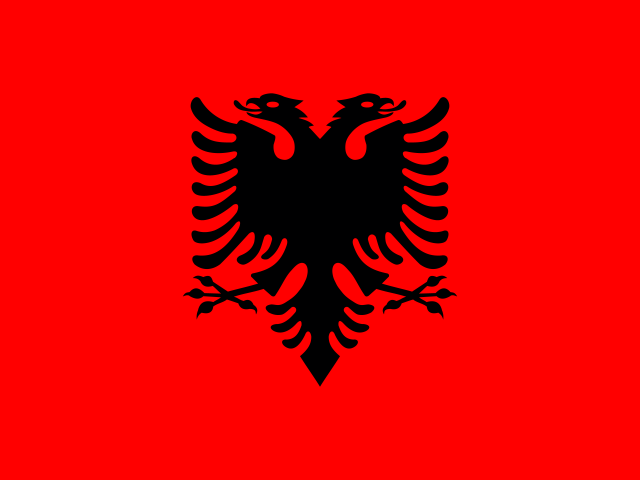
A red field, called blood-red by the 2002 flag law, charged with a black double-headed eagle with open wings, nine feathers to each wing and seven to the tail. Neither the constitution nor that law assigns the colour or the eagle a meaning. The eagle was a device of several medieval Albanian noble houses before Skanderbeg carried it in the 15th century, and whether Shqipëria takes its name from the word for eagle is unsettled.
Source: commons.wikimedia.org · checked 2026-08-12
Albania FACTS ◢
| Capital | Tirana |
|---|---|
| Continent | Europe |
| Population | 2,349,580 (2025) |
| Area | 28,748 km² |
| Population density | 82/km² |
| Currency | Albanian lek (ALL) |
| Official language | Albanian |
| Calling code | +355 |
| Internet TLD | .al |
| Time zone | UTC+01:00 |
| Drives on the | Right |
| ISO codes | AL / ALB |
DID YOU KNOW? ◢
- Its people call their country Shqipëria, often translated as the 'Land of the Eagles'.
- Mother Teresa, one of the most famous humanitarians of the 20th century, was of Albanian heritage.
- It's dotted with hundreds of thousands of concrete bunkers built during its mid-20th-century isolation.
- The Albanian language forms its own unique branch of the Indo-European family, related to no other living tongue.
Albania QUICK ANSWERS ◢
What is the capital of Albania?
The capital of Albania is Tirana.
What is the population of Albania?
Albania had a population of 2,349,580 in 2025.
What currency does Albania use?
Albania uses the Albanian lek (ALL).
What languages are spoken in Albania?
The official language of Albania is Albanian.
Think you know your flags? Play Flag Daily → · Browse all countries →
MORE ON THE FLAG ◢
Albania's flag law is exact about the bird and silent about its meaning. It sets the shade of the field, the proportions of the cloth, and the plumage: nine feathers to each wing of the eagle, seven to the tail. It never says what the eagle stands for, and it never says what the red is for.
That silence is the most dependable fact available about the Albanian flag. Every colour meaning you will read for it comes from somewhere other than Albanian law.
Key Takeaways
- Albania's constitution describes the flag in a single sentence and assigns it no symbolism at all.
- The 2002 flag law specifies nine feathers on each wing of the eagle and seven in the tail.
- Article 3 calls the field blood red; Appendix 1 fixes the printed colour as CMYK 0-100-100-0.
- The eagle was Albanian heraldry before Skanderbeg, and there is no evidence the double-headed eagle was ever the official flag of the Byzantine Empire.
- The flag carried a five-pointed red star outlined in gold through the communist decades.
What does the double-headed eagle on the Albanian flag mean?
Officially, nothing has been assigned to it. Albania puts its national symbols in Article 14 of the constitution, and paragraph 2 of that article reads in full: "The national flag is red with a two-headed black eagle in the centre." No gloss on the colour, no explanation of the two heads, no reading of the bird.
The rest of Article 14 runs in order around it: the official language at paragraph 1, then at paragraph 3 the state seal, a red shield carrying the same eagle with Skanderbeg's helmet in gold above it. Paragraph 4 is the anthem (the Council of Europe's English text gives it as "United Around Our Flag"), paragraph 5 is Flag Day on 28 November, and paragraph 6 is the capital. Paragraph 7 then hands the rest to statute: the form, dimensions and use of the national symbols "shall be regulated by law".
The law it hands them to is just as reticent. Law no. 8926, dated 22.07.2002, runs to ten articles and four appendices. Read end to end, it specifies, regulates and illustrates, and at no point interprets. So when you read that the red stands for bravery or for blood shed in war, and the two heads for church and state, or east and west, you are reading interpretation. Some of it is old and widely held. None of it is law.
Where did the eagle on the Albanian flag come from?
Not from one man, and not all at once. Under the heading "Symbolism", the Albanologist Robert Elsie traces the eagle back to the earliest records, pointing to a stone carving from 1190, in the era of the principality of Arbanon. He notes that it served as a heraldic device for several ruling families in the late Middle Ages, among them the Kastrioti, the Muzakaj and the Dukagjini.
Gjergj Kastrioti, remembered as Skanderbeg, is the reason one of those family devices became national. Elsie's account is that Skanderbeg placed a black double-headed eagle on his flag and on his seal during the fifteenth-century revolt against the Ottomans, and that the Arbëreshë communities of southern Italy, founded by refugees from that war, carried the same form of the eagle with them.
Four centuries later it came back as politics. The nineteenth-century national movement took the double-headed eagle up as a symbol of resistance to Ottoman rule, and Elsie dates the current flag's first official raising to 28 November 1912, when Ismail Qemali declared independence at Vlorë.
Was the double-headed eagle on the Albanian flag Byzantine?
This is the claim repeated most and evidenced least. In the same passage, Elsie writes in a single clause that Skanderbeg's eagle derives "from the banner of the Byzantine Empire", and versions of that sentence have travelled a long way without picking up a citation.
The trouble is the Byzantine half. Georgios Theotokis, a Byzantinist, puts it bluntly: despite the common belief that the two-headed eagle was the official flag of the Byzantine Empire, "there is absolutely no shred of evidence to support that". It becomes far commoner under the Palaiologoi, who on his account used it "as a symbol of the senior members of the imperial family" rather than as insignia of the state.
So the honest version is narrower than the popular one, and it is still a real answer. The two-headed form is Byzantine in the sense that matters. Theotokis's dating is that "single- and double-headed eagles both appear from around the middle 12th century onward in the decoration of buildings built by members of the imperial family of the Komnenoi", after which the double-headed version spreads through Palaiologan court use and across the late medieval Orthodox world. That the single-headed form appears in the same buildings at the same time is the point: this is family decoration, not state insignia. Albanian noble houses were part of that world, and Serbia and Montenegro carry the same motif today for the same reason. What cannot be shown is the specific thing the popular version claims: a Byzantine national flag for an Albanian one to descend from. On the evidence there was no such flag.
Why is Albania called the Land of the Eagles?
Because of a word that sounds like another word. Which of the two came first is genuinely unsettled.
Albanians call their country Shqipëria and themselves shqiptarë. Under the heading "Identification", Elsie reports the linguist Gustav Meyer's derivation of those from the verbs shqipoj, to speak clearly, and shqiptoj, to pronounce, and through them from Latin excipere, to listen to or take up. On that reading the name is about intelligible speech and has nothing to do with birds.
The Albanologist Maximilian Lambertz preferred the other link, to shqipe or shqiponjë, the eagle. Elsie sets the two side by side and adds the caution that matters: the eagle explanation "may, however, simply be a folk etymology or constitute the very reason why the Albanians identify themselves with the eagle".
That last clause inverts the story most people are told. Rather than the country being named after the eagle, the resemblance between the words may be what fixed the eagle to the country.
What are the official dimensions and colours of the Albanian flag?
Law no. 8926 is where the flag stops being a description and becomes a specification. Article 3 defines it as a field of blood-red colour, the Albanian ngjyrë të kuqe gjaku, bearing a black double-headed eagle in the middle with its wings open at the sides. It then counts the feathers.
| What the statute fixes | Value | Provision |
|---|---|---|
| Field colour | Blood red | Article 3, paragraph 1 |
| Eagle | Black, double-headed, wings open at the sides | Article 3, paragraph 1 |
| Feathers per wing | Nine | Article 3, paragraph 1 |
| Feathers in the tail | Seven | Article 3, paragraph 1 |
| Proportions | 1 to 1.4 | Article 3, paragraph 2 |
| Printed colour | CMYK 0-100-100-0 | Appendix 1 |
Article 3 names the colour; Appendix 1 fixes it without naming it. Instead of a Pantone reference the appendix prints four process percentages: no cyan, full magenta, full yellow, no black. That is pure printer's red.
Article 4 governs conduct rather than design. Every Albanian citizen has the right to hold, raise or use the flag. Public institutions must fly it inside and out, and under this law may not raise foreign flags on their premises. The exception is receptions and protocol ceremonies, where the national flag must always be present and may never be the smaller one.
Why did the Albanian flag have a star above the eagle?
Because for the communist decades it was a party emblem as well as a national one. Article 108 of the constitution of the People's Socialist Republic of Albania describes the state flag as "a red background with a black double-headed eagle in the middle, above which there is a five-pointed red star, outlined in gold", and gives the same 1 to 1.4 proportions the current law keeps. The long-running Flags of the World reference site dates the red star above the eagle's heads to 1946 and its removal to 1992; a golden star had appeared in the upper hoist in 1944, before the canton symbol was removed and the star moved above the heads. Those are the conventional dates rather than ones the 1976 text can settle.
The neighbouring article shows how much heavier that era's symbolism ran. Article 107 sets out an emblem in which the eagle is ringed by two sheaves of wheat, topped by a red star and tied at the base with a ribbon bearing the date 24 May 1944. None of that furniture ever reached the flag. The wheat, the ribbon and the date stayed on the emblem.
The constitution adopted in 1998 describes a flag with nothing above the eagle at all. What survived the change was the ratio, the field and the bird, which is the version you now have to pick out of a lineup of eagle flags in Flag Daily once the feather count is in your head.
Frequently asked questions
Does Albanian law say what the eagle on the flag means?
Neither the constitution nor the 2002 flag law assigns it a meaning. Article 14 says only that the flag is red with a two-headed black eagle in the centre, and Law no. 8926 specifies the design across ten articles and four appendices without interpreting any of it. Readings of the red as blood or bravery, and of the two heads as church and state, are popular interpretations rather than official ones.
Why does Albania's flag have an eagle at all?
Because Skanderbeg's fifteenth-century revolt turned one noble family's heraldic device into a national one. Robert Elsie traces the eagle in Albanian use back to a stone carving of 1190, three centuries before Skanderbeg put a black double-headed eagle on his flag and seal.
Is the Albanian eagle Byzantine?
The link is weaker than it is usually stated. The double-headed eagle circulated widely in the late medieval Orthodox world, but the Byzantinist Georgios Theotokis says there is no evidence it was ever the official flag of the Byzantine Empire, and that the Palaiologan emperors used it to mark senior members of the imperial family rather than the state. Albanian accounts describing the eagle as descending from a Byzantine banner are describing a banner nobody has produced.
Why does the Albanian eagle have two heads?
No Albanian instrument explains it, and the familiar readings of the two heads as church and state, or as east and west, have no documentary basis behind them. The answer is that Albania did not invent the form. Georgios Theotokis finds that "single- and double-headed eagles both appear from around the middle 12th century onward in the decoration of buildings built by members of the imperial family of the Komnenoi", and the two-headed version had spread widely across the late medieval Orthodox world before Albanian noble houses took it up. They adopted an eagle that already had two heads.
Did the Albanian flag ever look different?
Yes, several times in the twentieth century. Flags of the World records a white star above the eagle under the 1914 principality, a plain black eagle from 1920, Skanderbeg's helmet in gold above the eagle under King Zog from 1928, and, from the 1939 Italian occupation, the eagle set inside a red shield with Skanderbeg's helmet in black rather than gold. The longest-lived variant was the communist one, a five-pointed red star outlined in gold above the eagle's two heads, which Article 108 of the 1976 constitution describes and which Flags of the World dates from 1946 to 1992. The current constitution describes a flag with nothing above the eagle.
Sources
- Constitution of the Republic of Albania, Article 14, paragraphs 1 to 7. English text published by the Venice Commission of the Council of Europe, CDL-REF(2016)064 - retrieved 12 August 2026.
- Law no. 8926, dated 22.07.2002, on the form and dimensions of the national flag, the national anthem and the coat of arms. Read in full: ten articles and four appendices, of which Article 3, Article 4 and Appendix 1 are cited here. Albania's official gazette portal serves no plain-fetchable text, so the copy used is the Wikimedia Commons scan, whose file page gives its source and author as the Albanian Parliament - retrieved 12 August 2026.
- Constitution of the People's Socialist Republic of Albania (1976), Articles 107 and 108, text held by the GLOBALCIT national constitutions database - retrieved 12 August 2026.
- Robert Elsie, "Albania", in Countries and Their Cultures, sections "Identification" and "Symbolism" - retrieved 12 August 2026.
- Georgios Theotokis, "The double-headed eagle as a symbol in the Byzantine Empire: myths and realities", Medievalists.net - retrieved 12 August 2026.
- Flags of the World, Albania, for the 1946 and 1992 dates. It reads the law's colour value as CMYK 0-100-100-0 and its proportions as 5 to 7, the same ratio as 1 to 1.4, so those two figures do not rest on the Commons scan alone. It carries no feather count - retrieved 12 August 2026.
PLAY ANOTHER →
One quote, one scrambled alphabet. Crack it before tomorrow.
CRACK THE QUOTEDAILYGuess the CountryThree clues, three guesses. Work out where in the world it is.
THREE CLUESDAILYOn This DayOne thing that happened today in history. Every day, a new one.
TODAY IN HISTORYDAILYDaily CodeA short message, hidden in a different cipher every day.
ONE CIPHER A DAY