
Serbia
A landlocked country at the crossroads of Central and Southeast Europe, Serbia sits where the Sava meets the Danube - and where, legend holds, more Roman emperors were born than anywhere outside Rome.
WHAT THE FLAG MEANS ◢
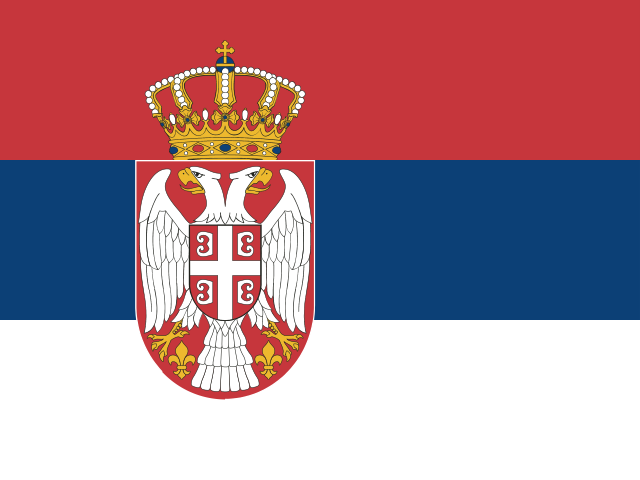
Serbian law defines two flags. The National flag is a horizontal tricolour of red, blue and white in bands of equal height; the State flag is that same tricolour with the Lesser coat of arms over it, the arms' centre shifted toward the hoist by one seventh of the flag's total length. The arms are a red shield bearing a silver double-headed eagle between two golden lilies in the base, with a smaller red shield on its breast carrying a silver cross between four firesteels, the shield crowned with a golden crown. Article 7 of the constitution names both flags and leaves their appearance to law; neither it nor the flag law assigns any of it a meaning. The government publishes the readings of the colours that circulate without adopting them. Red, blue and white are conventionally called the Pan-Slavic colours.
Source: media.srbija.gov.rs · paragraf.rs · srbija.gov.rs · predsednik.rs · parlament.sr.gov.yu · checked 2026-08-27
Serbia FACTS ◢
| Capital | Belgrade |
|---|---|
| Continent | Europe |
| Population | 6,549,143 (2025) |
| Area | 77,589 km² |
| Population density | 84/km² |
| Currency | Serbian dinar (RSD) |
| Official language | Serbian |
| Calling code | +381 |
| Internet TLD | .rs |
| Time zone | UTC+01:00 |
| Drives on the | Right |
| ISO codes | RS / SRB |
DID YOU KNOW? ◢
- Belgrade is one of the oldest continuously inhabited cities in Europe, its fortress overlooking the meeting of the Danube and Sava rivers.
- As many as eighteen Roman emperors were born on the territory of modern Serbia, including Constantine the Great.
- Inventor Nikola Tesla was of Serbian heritage, and Belgrade's airport is named after him.
- The raspberry is a national pride: Serbia is one of the world's leading exporters of them.
Serbia QUICK ANSWERS ◢
What is the capital of Serbia?
The capital of Serbia is Belgrade.
What is the population of Serbia?
Serbia had a population of 6,549,143 in 2025.
What currency does Serbia use?
Serbia uses the Serbian dinar (RSD).
What languages are spoken in Serbia?
The official language of Serbia is Serbian.
Think you know your flags? Play Flag Daily → · Browse all countries →
MORE ON THE FLAG ◢
Serbia's flag is usually described as a red, blue and white tricolour carrying the coat of arms toward the hoist. That is a true description of one Serbian flag. There are two of them in law, set out in separate articles, and the plain tricolour without the arms is the one ordinary use is pointed at.
Ask what the colours mean and no Serbian instrument answers. The 2006 constitution mentions the flag in exactly one article and does not even list its colours. The 2009 flag law sets out both designs, the proportion, the exact offset of the arms and the full text of the anthem, and assigns not one element a meaning. The government decree that followed in 2010 fixes the colours to Pantone numbers and stops there.
The readings people repeat do have a publisher. The Government of Serbia prints two of them on its own website, and carefully attributes both to somebody other than itself.
Key Takeaways
- Article 7 of the 2006 constitution is the only article in it that mentions the flag. It names a National flag and a State flag, defers the design to law, and never names a colour.
- The 2009 flag law defines the State flag in article 18 and the National flag in article 19. Only the State flag carries the Lesser coat of arms.
- Article 18 of that 2009 law puts the arms off centre by a stated fraction: one seventh of the flag's total length, toward the hoist.
- A 2010 decree fixes red at Pantone 192C, blue at 280C and the arms' gold at 123C, plus a dark red used only for the mantle. The white band gets no value at all.
- Nothing in the constitution, the law or the decree says what red, blue or white stand for.
| Point of comparison | State flag (Државна застава) | National flag (Народна застава) |
|---|---|---|
| Defined by | Article 18 of the 2009 law | Article 19 of the 2009 law |
| Design | Red, blue and white bands of equal height, with the Lesser coat of arms over all | Red, blue and white bands of equal height |
| Position of the arms | Centre shifted toward the hoist by 1/7 of the flag's total length | No arms |
| Flown permanently at | Main entrances of state bodies other than the National Assembly, and their offices (article 20) | Main entrance of the National Assembly, and of provincial, local and public-service buildings (article 28) |
| At elections | Polling stations on the day of elections to state bodies (article 22) | Polling stations on the day of provincial and local elections, but the State flag if the two are held together (article 28) |
Two flags, two articles, one difference
The instrument is the Zakon o izgledu i upotrebi grba, zastave i himne Republike Srbije, published in Službeni glasnik RS 36/2009. Serbian is digraphic, written in both Cyrillic and Latin, and the constitution makes Cyrillic the script in official use, so the quotations below are from the Cyrillic text published on the Serbian government's own media server.
Article 17 sets the frame: "Застава Републике Србије постоји и користи се као Државна застава и као Народна застава, са размерама 3:2 (дужина према висини)." The flag exists and is used as a State flag and as a National flag, in a ratio of three to two, length to height.
Then the law splits. Article 19 gives the National flag in one line: "Народна застава јесте хоризонтална тробојка са пољима истих висина, одозго на доле: црвена, плава и бела." A horizontal tricolour with fields of equal heights, from top to bottom red, blue and white. Nothing else.
Article 18 gives the same description with the State flag as its subject, and then adds the Lesser coat of arms over the whole of it, with the arms placed "центра помереног ка јарболу за 1/7 укупне дужине заставе", the arms' centre shifted toward the mast, which is to say toward the hoist, by one seventh of the flag's total length.
That clause is the entire difference between the two flags in law, and it is why a description of "the Serbian flag" that mentions the arms is incomplete rather than wrong. It has described the state's flag and left out the people's.
How precise is the law about the design?
Precise to a seventh of its length in the law, and to a fifty-sixth of it in the decree that draws it. Precise about the wrong things, if you came looking for symbolism.
Article 9 hands the Government the job of establishing the izvornik, the authoritative original of the arms and the flag, and the anthem's score. It did so by decree on 11 November 2010, published in Službeni glasnik RS 85/2010. That decree does its work in pictures: articles 2 to 5 list thirty-three numbered figures, among them a construction drawing of the State flag. On that drawing the shield is exactly one quarter of the flag's length wide and starts 13/56 of the length in from the hoist, which places its centre 5/14 of the way across, one seventh short of the middle. The whole device, crown to shield point, is exactly half the flag's length tall, and each band is two ninths of the length deep, which is another way of writing the 3:2 ratio of article 17.
Between them the law and the decree pin the geometry to a fraction, and neither says what any of it means. That combination, a device positioned in fifty-sixths and a palette explained nowhere, is worth knowing before you try to place a tricolour in Flag Daily, which shows one flag a day and gives you three guesses at the country.
What do the colours of the Serbian flag mean?
In law, nothing at all. The absence is worth stating flatly because it is complete rather than partial.
The Constitution of the Republic of Serbia of 2006 contains the word for flag six times, and all six sit inside article 7 and its heading. That article gives Serbia a coat of arms, a flag and an anthem, provides that "Застава Републике Србије постоји и користи се као Народна застава и као Државна застава", and ends "Изглед и употреба грба, заставе и химне, уређују се законом": appearance and use are regulated by law. It never names a colour.
The 2009 law names the colours and interprets none of them. It has been amended once, by Službeni glasnik RS 10/2023, and that amendment renamed courts and prosecution offices and added two high councils, one judicial and one prosecutorial, to the articles listing where the arms go. Articles 17, 18 and 19 came through it untouched.
The 2010 decree reaches the colours only as numbers. Its article 6 gives them "у систему Pantone: црвена основна 192C / црвена тамна 704C / плава 280C / жута 123C", with CMYK and RGB equivalents, and adds one operative sentence about any of them: "Црвена тамна користи се само за порфиру." The dark red is for the mantle alone.
There is a gap in that list worth noticing. The decree gives Pantone numbers for red, dark red, blue and yellow, and adds black in CMYK and RGB. White is not in it, and neither is the eagle's silver. Two of the flag's three bands have a value; the third, a full third of the flag, has none.
Serbia is not alone in this. Croatia's constitution and flag act, next door, pin its chequerboard down to the field count and the colour of one corner, and are just as silent on what red, white and blue mean.
Whose readings are the ones everybody repeats?
The Government of Serbia publishes them, and labels them.
Its own page on the symbols of Serbia gives the familiar version, and opens it with a disclaimer. It is believed among the people, the page says, that the red stands for the blood shed for the land, the blue for freedom and the infinity toward which one aspires, and the white for the mother's milk that feeds strong Serbian children. In the original: "У народу се верује да црвена боја на застави Србије представља крв проливену за земљу, плава слободу и бескрај коме се тежи, док бела представља мајчино млеко које храни јаку српску децу."
The same page then offers a competing account, and attributes that one too. Students of flags believe, it says, that the colour symbolism is not tied to our particular territory and national experience, and that the meanings are universal; on their reading blue is fidelity and loyalty, and white is purity and sincerity. In the original: "Проучаваоци застава верују да симболика боја није везана за наше конкретно подручје и национално искуство, већ су значења универзална."
Two glosses, on one government page, pointed at each other, with the state signing neither.
The English edition softens the second one. The Serbian says flatly that the symbolism is not tied to Serbia; the English says the meanings "may not be unique" to the country and instead "carry universal significance". A hedge appears in translation that the Serbian does not have.
Are Serbia's colours Pan-Slavic?
That label belongs to flag scholarship rather than to Serbian law.
The word was searched for in every Serbian primary and state source used here, read end to end: the 2006 constitution, the 2009 law and the 2010 decree, each in both scripts, plus the 2004 parliamentary recommendation, the 2006 government conclusion, the Presidency's national-symbols page, and the Government's symbols page in Serbian and in English. That is eleven documents, and not one uses the word Slavic, in either language. Every near match is a different word: proslava, the word for celebrations, slavan and slave from lines of the anthem, slavery in the English rendering of it, and Yugoslavia in a repeal clause.
The Government's page approaches the question from the opposite side. What it reports from students of flags is that these colour meanings are universal rather than particular to Serbia. That is a claim about the habits of vexillology, and the Pan-Slavic label is another one.
There is also a documented alternative that the law's silence leaves room for. Sima Avramović, professor at the Belgrade Faculty of Law, writing in the faculty's Anali on the 1835 Sretenje constitution, records, from the older Serbian literature he cites, that the Russian envoy Butenyev treated the Serbian tricolour with suspicion and asked why it was "као француска", like the French one. In 1835, the comparison one Russian envoy reached for was to Paris, not to Prague.
That 1835 act is also the earliest Serbian constitutional text to name the colours, and its chapter two reads, in two online transcriptions, "Боја народна Србска јест отворено - црвена, бјела и челикасто-угасита": the Serbian national colour is open red, white and steel dark. If that is the wording, the order in 1835 was not the order today. It is reported here as a transcription rather than as a fact, because no facsimile of the 1835 text was found, and the two transcriptions share a distinctive typographic oddity in the next paragraph, which suggests they are not independent of each other.
The eagle on the flag was legislated by a kingdom
Article 10 of the 2009 law does not describe the arms at all. It adopts them by reference: "Грб Републике Србије јесте грб утврђен Законом о грбу Краљевине Србије од 16. јуна 1882. године и користи се као Велики грб и као Мали грб." The arms of the Republic are the arms established by the Law on the Coat of Arms of the Kingdom of Serbia of 16 June 1882.
For the device on its state flag, a republic's flag law rests on a statute of a kingdom. The 1882 text itself could not be opened for this article: no scan of it was found, and the National Library of Serbia's digitised newspaper collection was reachable but not searchable. So its date is reported here only as the 2009 statute states it, and nothing about its wording or authorship is claimed at all.
What the modern law does describe is the blazon. Article 12 makes the Lesser arms a red shield bearing, between two golden lilies in the base, a double-headed silver eagle carrying on its breast a red shield with a silver cross between four firesteels, their edges turned toward the cross's vertical bar, the whole under a golden crown. In the original: "Мали грб јесте црвени штит на којем је, између два златна крина у подножју, двоглави сребрни орао, златно оружан и истих таквих језика и ногу, са црвеним штитом на грудима на којем је сребрни крст између четири иста таква оцила бридовима окренутих ка вертикалној греди крста."
Three of those details are easy to lose: the eagle's silver, the two golden lilies, and the orientation the law gives the firesteels.
For five years the flag rested on a recommendation
Serbia adopted this flag before it had a law for it.
The National Assembly issued a Preporuka o korišćenju grba, zastave i himne Republike Srbije in Službeni glasnik RS 93/2004. Its opening line says what it is: "Do konačnog utvrđivanja državnih simbola Srbije, u skladu sa članom 5 Ustava Republike Srbije, koristiće se". Until the final determination of Serbia's state symbols, the following shall be used.
The Government followed with a Zaključak o upotrebi grba, zastave i himne Republike Srbije, consolidated text in Službeni glasnik RS 61/2006, whose first operative sentence recommends to ministries, courts, the Assembly and local bodies that they use the symbols in line with it. From 2004 to 2009 the flag over Serbian ministries was carried by a recommendation, and by a recommendation about it.
The 2009 law changed the force of those words, and barely the words themselves. Set the recommendation's descriptions beside the law's and the National flag sentence is identical, sixteen words with no difference at all; the Lesser arms blazon is fifty-one words in each, differing twice over in one case ending, kome against kojem; the Greater arms blazon is seventy-two words in each, with four inflectional changes of the same order. Article 45 then repealed the two acts still formally on the books, the federal Yugoslav one of 1993 and the Socialist Republic of Serbia's arms act of 1985.
What changed in 2010, and what did not
The drawings changed and the colours changed. The legal description did not.
The National Assembly's own graphic-standards booklet from the recommendation years, still on its website in March 2009, described the Lesser arms in prose to an extraordinary level. It opens "Мали грб Републике Србије је двоглави бели орао на црвеном штиту полуокруглог облика са круном изнад штита", then counts the feathers on the necks, the wings and the tail, and gives a crown "украшена са четрдесет белих бисера, осам плавих сафира и два црвена рубина", forty white pearls, eight blue sapphires and two red rubies. Note that opening adjective: бели, white, where the gazette text of the recommendation and the later law both say сребрни, silver.
And the booklet's Pantone values were red 193c, blue 287c, yellow 116c. The 2010 decree replaced them with 192C, 280C and 123C. Serbia's specified shades changed in 2010, on a decree, without a word of the legal description changing, and the old ones did not go away: Flags of the World, collecting what other reference works print for Serbia, still finds 193c and 287c among them, alongside a third set that matches no Serbian instrument at all.
The prohibitions, and who they bite
Article 4 of the 2009 law is the flat prohibition: "На заставу и у грб Републике Србије не може се ништа исписати, односно уписати, нити се они могу мењати." Nothing may be written on the flag or into the arms, and neither may be altered. Its second paragraph opens one door: a special law may allow a date or a name on the flag, or the flag's use inside another emblem.
Article 5 of the same law bars the flag and the arms from use as a trademark, sample, model or any other mark for goods or services, and its article 6 requires a damaged or unfit one to be withdrawn. Article 33 keeps the flag off the ground, out of use as a cover, mat, curtain or drapery, off vehicles and other objects, and off conference tables and lecterns except as a table flag.
The penalties tell you who the law is aimed at. Article 41 fines a legal person on three grounds, the first of them using the symbols in a form the constitution and the law do not establish, and fines the responsible officer within it as well. Only article 42 reaches a private individual acting in no official capacity, and only for one thing: showing a damaged or unfit flag or coat of arms, at 5,000 to 20,000 dinars.
The claim that ordinary Serbs are forbidden the State flag simplifies this. Article 29 hands the National flag to celebrations and to cultural and sporting events, but article 24 lets the State flag be flown in other cases too, so long as its use is not contrary to that same law. The plain tricolour is the one the law hands you, not the only one you are allowed.
Frequently asked questions
What do the colours on the Serbian flag mean?
No Serbian legal instrument assigns them a meaning: the 2006 constitution does not name the colours, the 2009 flag law names them without interpreting them, and the 2010 decree gives them only Pantone, CMYK and RGB values. The Government of Serbia publishes two readings on its symbols page, but attributes one to popular belief and the other to students of flags, and adopts neither as the state's own.
What is the difference between Serbia's state flag and its national flag?
The coat of arms. Article 19 of the 2009 law defines the National flag as a horizontal tricolour of red, blue and white in bands of equal height. Article 18 defines the State flag as that same tricolour with the Lesser coat of arms placed over all of it. Article 17 sets a ratio of 3:2, length to height, for both.
Where exactly does the coat of arms sit on Serbia's state flag?
Off centre, toward the hoist, by one seventh of the flag's total length. Article 18 of the 2009 law states that fraction in words, and the construction drawing in the 2010 decree gives it in dimensions: the shield is a quarter of the flag's length wide and starts 13/56 of the length in from the hoist.
When did Serbia adopt the flag it uses now?
A parliamentary recommendation in Službeni glasnik RS 93/2004 put the design into use, and the flag law of 2009 gave it binding force. The 2006 constitution came in between, naming a National flag and a State flag without describing either. A government decree of 11 November 2010 then fixed the official drawings and moved the specified shades off the values in the National Assembly's earlier graphic standards.
Which Serbian flag may an ordinary person fly?
The National flag, the plain tricolour, is the one the 2009 flag law points at ordinary use: its article 29 allows it at celebrations and at cultural, sporting and similar events. The State flag's listed uses in articles 20 to 24 of the same law are official ones, though article 24 ends by permitting other cases not contrary to that same law. The only offence in that act a private individual can commit is showing a damaged or unfit flag or coat of arms, under its article 42.
Sources
- Constitution of the Republic of Serbia, Službeni glasnik RS 98/2006, article 7. Official Cyrillic text published by the Government of Serbia, media.srbija.gov.rs. Retrieved 27 August 2026.
- Zakon o izgledu i upotrebi grba, zastave i himne Republike Srbije, Službeni glasnik RS 36/2009. Official Cyrillic text published by the Government of Serbia, media.srbija.gov.rs. Retrieved 27 August 2026.
- The same law, consolidated to include Službeni glasnik RS 10/2023, Latin text published by Paragraf Lex, paragraf.rs. Retrieved 27 August 2026.
- Uredba o utvrđivanju izvornika Velikog i Malog grba, izvornika zastave i notnog zapisa himne Republike Srbije, Službeni glasnik RS 85/2010. Cyrillic text and official figure set published by the Government of Serbia, srbija.gov.rs; Latin text published by the Republic Secretariat for Legislation, rsz.gov.rs. Retrieved 27 August 2026.
- Government of Serbia, "Симболи Србије", srbija.gov.rs, and its English edition, "National symbols", srbija.gov.rs. Retrieved 27 August 2026.
- President of the Republic of Serbia, "Nacionalni simboli", predsednik.rs. Retrieved 27 August 2026.
- Preporuka o korišćenju grba, zastave i himne Republike Srbije, Službeni glasnik RS 93/2004, and Zaključak o upotrebi grba, zastave i himne Republike Srbije, consolidated text, Službeni glasnik RS 61/2006. Texts published by Paragraf Lex, demo.paragraf.rs. Retrieved 27 August 2026.
- National Assembly of the Republic of Serbia, Grb, zastava, standardi graphic-standards booklet, parlament.sr.gov.yu. The page is long gone. Repeatedly captured between 5 March 2005 and 15 March 2009, and read here from the 5 March 2005 capture. Scanned with no text layer, so it was rendered and transcribed. Retrieved 27 August 2026.
- Sima Avramović, article on the Sretenje constitution at 175 years, Anali Pravnog fakulteta u Beogradu 1/2010, pp. 36 to 65, anali.rs. Retrieved 27 August 2026.
- Constitution of the Principality of Serbia, 1835, chapter two, in the transcriptions published by Nova srpska politička misao, nspm.rs, and by Serbian Wikisource. Retrieved 27 August 2026.
- Flags of the World, "Serbia", crwflags.com, for the colour values that competing reference works publish. Retrieved 27 August 2026.
PLAY ANOTHER →
One thing that happened today in history. Every day, a new one.
TODAY IN HISTORYDAILYGuess the CountryThree clues, three guesses. Work out where in the world it is.
THREE CLUESDAILYDaily CodeA short message, hidden in a different cipher every day.
ONE CIPHER A DAYDAILYDaily TriviaFive questions a day. Everyone gets the same five.
FIVE QUESTIONS