
Nauru
The world's smallest island nation and third-smallest country of any kind, Nauru is a single speck of Pacific coral roughly 21 square kilometres in size, with no official capital city at all.
WHAT THE FLAG MEANS ◢
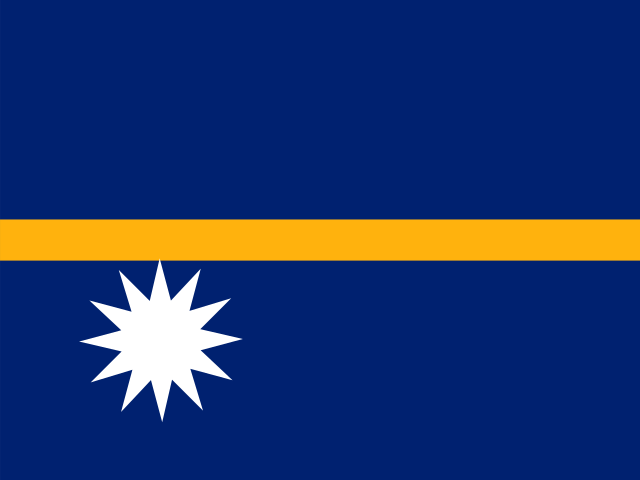
A blue field crossed by a narrow horizontal yellow stripe, with a white twelve-pointed star just below it near the hoist. Schedule 3 of the Naoero National Anthem Emblem and Flag Protection Act 2018 puts the meanings in the statute itself and calls the stripe yellow, not gold: the blue represents the Pacific Ocean, the star indicates the country's location in relation to the Equator, which is the yellow stripe, and the twelve points symbolise the twelve original tribes of Nauru. The Act gives the white no meaning, so the much-repeated reading of it as phosphate is not the statute's.
Nauru FACTS ◢
| Capital | Yaren District |
|---|---|
| Continent | Oceania |
| Population | 12,025 (2025) |
| Area | 21 km² |
| Population density | 573/km² |
| Currency | Australian dollar (AUD) |
| Main languages | English, Nauruan |
| Calling code | +674 |
| Internet TLD | .nr |
| Time zone | UTC+12:00 |
| Drives on the | Left |
| ISO codes | NR / NRU |
DID YOU KNOW? ◢
- It's the world's smallest island country, covering only about 21 square kilometres.
- It has no official capital, making it one of the few countries in the world without one.
- Its economy was once built almost entirely on mining phosphate from ancient seabird deposits.
- You can drive right around the entire island on a road only about 19 kilometres long.
Nauru QUICK ANSWERS ◢
What is the capital of Nauru?
The capital of Nauru is Yaren District.
What is the population of Nauru?
Nauru had a population of 12,025 in 2025.
What currency does Nauru use?
Nauru uses the Australian dollar (AUD).
What languages are spoken in Nauru?
Nauru designates no official language. The languages of government and education are English and Nauruan.
Think you know your flags? Play Flag Daily → · Browse all countries →
MORE ON THE FLAG ◢
Nauru's flag is a diagram of where Nauru is. The blue is the Pacific, the yellow stripe running across the middle is the Equator, and the white star sits below the stripe because the island sits below the Equator. Read it the right way and it tells you which side of the Equator the country is on.
It will not tell you more than that. The statute fixes the star's position relative to the stripe and sets no coordinate anywhere, so the flag encodes a hemisphere rather than a latitude.
What makes it worth more than a caption is that none of this is folklore. The meanings of the Nauru flag are written into an Act of Parliament, which is rare. Most countries legislate what their flag looks like and leave what it means to whoever is writing the tourist brochure.
Key Takeaways
- Schedule 3 of the Naoero National Anthem Emblem and Flag Protection Act 2018 states the flag's meanings in the statute itself.
- The law assigns three meanings: blue for the Pacific Ocean, the star for the country's position relative to the Equator, and the 12 points for the 12 original tribes.
- It says nothing about the white standing for phosphate, which is the single most repeated claim about this flag.
- The Act was certified on 26 January 2018, five days before the fiftieth anniversary of independence on 31 January 1968.
- In 2019 Parliament deleted the phosphorus symbol from the national emblem and replaced it with a Christian cross. The star survived and was given an explicit meaning.
What the 2018 Act says the Nauru flag means
Schedule 3 answers this in three sentences, and it is worth reading in full rather than paraphrased:
The rectangular flag is divided into three portions horizontally; the top portion is blue; the middle portion is yellow; the bottom portion is blue and a large white 12-pointed star below the yellow stripe on the hoist side. The top and bottom portions are in equal portions. The blue represents the Pacific Ocean, the star indicates the country's location in relation to the Equator (the yellow stripe) and the 12 points symbolise the 12 original tribes of Nauru.
Three things in that are worth noticing.
The statute calls the stripe yellow, not gold. Almost every description you will read outside Nauru says gold. The Act does not.
The two blue portions are declared equal, which puts the stripe exactly halfway down and makes the geometry do the work: a line through the middle of the world, and the island beneath it. Very few of the country factsheets describe a flag you can navigate by.
And the meanings are attached to specific elements rather than to the flag as a whole. Blue gets one. The star gets one. The star's twelve points get a separate one. The white does not get anything at all.
What do the twelve points on the Nauru flag stand for?
The twelve original tribes of Nauru, and the law says so twice.
Schedule 3 gives the flag's version. Then a 2019 amendment rewrote the national emblem and restated it there, describing the star above the shield as representing "the 12 different tribes" and adding, in case anyone missed the connection, that "the star also appears in the flag".
That second statement matters because the 2018 wording had been vaguer. It called the emblem's star simply "taken from the flag" and left the meaning implied. Parliament went back and made it explicit.
What the law does not do is name the twelve. Lists circulate, and they are broadly consistent with each other, but no Nauruan statute I could reach sets them out, and neither does the Constitution. If you want the names on a legal footing, that footing does not appear to exist.
What the Nauru flag's law does not say
This is where a flag page usually starts inventing, so it is worth being precise about the gaps.
The white is not explained. The most widely repeated claim about this flag is that the star's white stands for phosphate, the rock Nauru's economy was built on. Schedule 3 does not say it. It assigns meanings to the blue, the star and the star's points, and stops. Whatever the white was chosen for, the statute declines to tell you.
The star's position on the hoist side is stated, not explained. The Act places the star "below the yellow stripe on the hoist side" and separately says the star indicates the country's location in relation to the Equator. Being below the stripe carries that meaning. Being towards the hoist rather than the centre is described as a fact of the design and given no reading of its own, though you will find confident explanations for it elsewhere.
There is no ratio. Schedule 3 fixes the horizontal division and the equal blue portions but sets no overall proportion for the cloth and no shade references for the blue or the yellow. The description is geometric rather than chromatic.
And there is no adoption date, or designer. Section 13 creates the official flag in the present tense, and neither the Act nor Nauru's Constitution records when the design was first flown or who drew it. Nauru became independent on 31 January 1968, which the United Nations records as the date the Trusteeship Agreement was terminated under General Assembly resolution 2347 (XXII), and the flag is generally said to date from that day. The circulating account of its authorship is that the design came out of a local competition and was put into final form by an Australian flag maker. Both of those are widely repeated and neither is in the legislation, so treat them the same way you should treat the phosphate claim above: as an account, not a record.
Nauru took phosphorus off its coat of arms in 2019
The best evidence that these symbols are actively maintained rather than inherited is what happened to the national emblem.
Schedule 2 of the 2018 Act described the emblem's upper section as "the alchemical symbol of phosphorous... over a golden woven background". Phosphate rock dominated the country's economy for most of a century, so putting its chemical sign at the top of the shield was an accurate piece of national self-description.
Eighteen months later Parliament deleted the whole schedule and substituted a new one. Section 4 of the 2019 Amendment Act says exactly that: "Schedule 2 is deleted and substituted as follows".
| Element | 2018 Schedule 2 | 2019 substitution |
|---|---|---|
| Upper section | "the alchemical symbol of phosphorous... over a golden woven background" | "the cross on the backdrop of a woven mat", representing "the cross sitting on Mount Calvary" |
| The star | "taken from the flag" | "represents the 12 different tribes. The star also appears in the flag" |
| Tribal gear | "ropes from palm leaves, feathers of the frigate bird and shark teeth" | ikirira, ropes "woven from coconut husks with red Adenanthera pavonina L. beans", two frigate bird feathers, two ikibar deep-sea scallop shells |
| Flowers | "a branch of calophyllum flowers" | "a branch of 7 tomano (calophyllum) flowers with 6 leaves" |
| The motto | named only as the national motto | explained: it "symbolises the importance of the Christian religion and Nauru strives to put God's Will First in everything it does" |
The replacement is more specific throughout. The frigate bird is now named as the national bird, the flowers are counted, and the shells are said to be "a sign of bravery". But the headline change is the first row: a country replacing a mining symbol with a religious one, and swapping shark teeth for seashells while it was there, is doing something more deliberate than tidying.
What happens if you misuse the Nauru flag?
Rather a lot, by the standards of flag law.
Modifying the flag, or displaying, burning, mutilating, insulting, damaging or tearing it, carries a fine of up to $100,000 or up to five years in prison, or both. The same maximum applies to using it in a trademark or an advertisement, to producing or embossing it on merchandise or uniforms, and to using it as a political party or candidate logo during a national election campaign. The Act writes that figure as a bare dollar sign and names no currency.
Commercial use and production both require the prior written approval of "the Minister", which section 3 defines as the President of the Republic. Not a department, not a registrar. The head of state.
There are behavioural duties too. Anyone present while the flag is raised or lowered must come to a standstill until it is finished, and drivers must stop their vehicles and keep them motionless. The same rules apply to the national anthem.
Countries handle that job very differently. Australia, which administered Nauru on behalf of a joint Administering Authority with New Zealand and the United Kingdom, took half a century to put its own flag into legislation. If you want to test how many flags you can actually place, Flag Daily is one a day.
Frequently asked questions
What do the colours on the Nauru flag mean?
The 2018 Act says the blue represents the Pacific Ocean and identifies the yellow stripe as the Equator, the latter in an aside inside the sentence about the star rather than as a statement of its own. The white is given no meaning at all in the statute.
Why does the Nauru flag have a twelve-pointed star?
Because the twelve points stand for the twelve original tribes of Nauru. That meaning appears in Schedule 3 of the 2018 Act and again in the 2019 rewrite of the national emblem, which describes the same star as representing the twelve different tribes.
Does the white on the Nauru flag stand for phosphate?
Not according to the law. The claim is widely repeated, and phosphate was central to Nauru's economy, but Schedule 3 explains the blue, the star and the star's points and says nothing about the white. Treat it as an interpretation rather than an official meaning.
Where is the Equator on the Nauru flag?
It is the yellow stripe across the middle, with the two blue portions above and below declared equal in the statute. The star sits below the stripe because Nauru lies south of the Equator, which is what the Act means by the star indicating the country's location in relation to it.
When did Nauru adopt its flag?
The flag is usually dated to independence day, 31 January 1968, the date on which the United Nations terminated the Trusteeship Agreement under General Assembly resolution 2347 (XXII). No Nauruan legal instrument confirms it: the 2018 Act contains no adoption clause at all, creating the flag in the present tense instead, and the Constitution never mentions a flag.
Sources
- Republic of Nauru, Naoero National Anthem Emblem and Flag Protection Act 2018 (No. 5 of 2018, certified 26 January 2018) - Schedule 3 for the flag's description and meanings, section 3 for the definition of "Minister", Schedule 2 for the original emblem, section 5 in Part 2 for the national anthem duties, Part 6 (sections 13 to 17) for the creation of the flag and its standstill duties, and Part 7 (sections 18 to 23) for the prohibited uses and their penalties. Retrieved 10 August 2026.
- Republic of Nauru, Naoero National Anthem Emblem and Flag Protection (Amendment) Act 2019 (No. 20 of 2019, certified 12 July 2019) - the deletion and substitution of Schedule 2, the removal of the phosphorus symbol, and the star's twelve tribes. Retrieved 10 August 2026.
- United Nations, Repertory of Practice of United Nations Organs, Supplement No. 4, volume II, Article 86 - Nauru's independence on 31 January 1968 and General Assembly resolution 2347 (XXII). Retrieved 10 August 2026.
- Comparative Constitutions Project, Constitution of Nauru - checked for any reference to a flag, emblem, national symbol or tribe. There is none. Retrieved 10 August 2026.
PLAY ANOTHER →
A short message, hidden in a different cipher every day.
ONE CIPHER A DAYDAILYDaily CryptogramOne quote, one scrambled alphabet. Crack it before tomorrow.
CRACK THE QUOTEDAILYOn This DayOne thing that happened today in history. Every day, a new one.
TODAY IN HISTORYDAILYGuess the CountryThree clues, three guesses. Work out where in the world it is.
THREE CLUES