
Nepal
A Himalayan nation stacked between India and China, Nepal owns the roof of the world and packs eight of Earth's fourteen highest peaks into its northern skyline, Everest included.
WHAT THE FLAG MEANS ◢
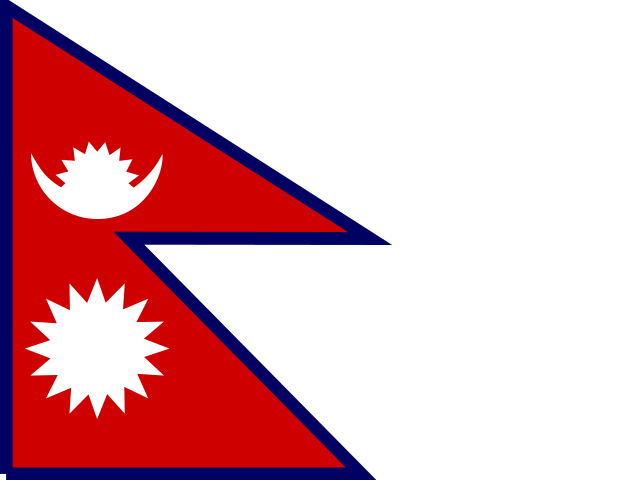
The world's only non-rectangular national flag, formed of two stacked crimson pennants with a deep blue border. Article 8 counts the charges: a white crescent moon in the upper figure showing eight of its sixteen rays, and a white twelve-rayed sun in the lower. Schedule 1 then gives a twenty-four-step ruler-and-compass construction for drawing it, in four parts, and leaves only the flag's size to the Government of Nepal. Neither assigns a meaning; the blue is conventionally read for peace, and the hope that the nation will endure as long as the sun and moon do.
Source: lawcommission.gov.np · checked 2026-08-26
Nepal FACTS ◢
| Capital | Kathmandu |
|---|---|
| Continent | Asia |
| Population | 29,618,118 (2025) |
| Area | 147,181 km² |
| Population density | 201/km² |
| Currency | Nepalese rupee (NPR) |
| Official language | Nepali |
| Calling code | +977 |
| Internet TLD | .np |
| Time zone | UTC+05:45 |
| Drives on the | Left |
| ISO codes | NP / NPL |
DID YOU KNOW? ◢
- Mount Everest, the highest point on Earth, sits on its border with China.
- Eight of the world's ten tallest mountains are located within its borders.
- Its national flag is the only one in the world that isn't a rectangle, made of two stacked triangles.
- Lumbini, in its southern plains, is widely regarded as the birthplace of the Buddha.
Nepal QUICK ANSWERS ◢
What is the capital of Nepal?
The capital of Nepal is Kathmandu.
What is the population of Nepal?
Nepal had a population of 29,618,118 in 2025.
What currency does Nepal use?
Nepal uses the Nepalese rupee (NPR).
What languages are spoken in Nepal?
The official language of Nepal is Nepali.
Think you know your flags? Play Flag Daily → · Browse all countries →
MORE ON THE FLAG ◢
Nepal's law does not tell you what its flag means. It tells you how to draw it.
Article 8 of the Constitution of Nepal 2015 describes the flag in one sentence and then hands the rest to Schedule 1, three pages from the back of the book. Schedule 1 is a ruler-and-compass construction in twenty-four numbered steps, grouped under four headings, with every point on the flag given a letter of the Devanagari alphabet. Work through it with a straight edge and a pair of compasses and the flag comes out exact, at any size.
The description and the construction between them fix the flag's geometry to the last arc. Neither says what a single element of it stands for, and neither says why the shape is a pair of joined pennants rather than a rectangle.
Key Takeaways
- Schedule 1 of the Constitution of Nepal 2015 draws the flag in twenty-four numbered steps under four headings, exactly and at any size. The one dimension it leaves unsettled is the flag's own size, which it hands to the Government of Nepal.
- The Government fixed five sizes in a 2012 gazette procedure, whose specimen drawings give each as the dimensions of a rectangle. Two of the five are the 4:3 that step 2 of Schedule 1 sets for the shape inside the border, and the other three match nothing in the schedule at all.
- Neither Article 8 nor Schedule 1 says what the crimson, the deep blue, the moon or the sun stand for. Article 9(3) names crimson the national colour in the same list that names the rhododendron the national flower, which is not a statement that one stands for the other.
- No Nepali instrument says why the flag is a pair of joined pennants rather than a rectangle. Writing for the vexillological archive Flags of the World, M. Schmöger turns the question around: national flags standardised on the rectangle because the category began as a European ship flag, and Nepal kept the older shape that flags of the Indian area often had too, probably the only one of them to have survived. That is scholarship, not law.
- The best-known reading, that the sun and the moon express a wish for the nation to last as long as they do, was recorded in 1928 by Perceval Landon as the sense of Nepal's coat of arms, from a Kathmandu pandit whose gloss on the two symbols names flags as well. No Nepali constitution has ever stated it of the flag.
Twenty-four steps, and a page full of imaginary lines
Schedule 1 opens under a heading meaning the method of making the national flag of Nepal, and divides into four parts: the method of making the shape inside the border, then the moon, then the sun, then the border.
It begins the way a school geometry exercise begins. "On the lower portion of a crimson cloth draw a line AB of the required length from left to right." Then: "From A draw a line AC perpendicular to AB making AC equal to AB plus one third AB."
That second step is the whole proportion of the shape inside the border, settled in one clause. Everything after it is derived, and step 23 adds the border outside it.
The moon takes thirteen steps, the sun four. The point counts that Article 8 gives are produced rather than asserted: "Eight equal and similar triangles of the moon are to be made in the space lying inside the semi-circle of No. (16) and outside the arc of No. (17) of this Schedule", and twelve for the sun "with the two apexes of two triangles touching line HI".
Then the schedule does something that reads oddly in a founding document. It tells you which of its own lines to rub out.
"The lines HI, RS, FE, ED, JG, OQ, JK and UV are imaginary. Similarly, the external and internal circles of the sun and the other arcs except the crescent moon are also imaginary. These are not shown on the flag."
Eight construction lines, both circles of the sun and every arc except the crescent moon exist only as scaffolding. The flag is what is left when they go.
One detail is lost in translation, and it is worth keeping. The Nepali original labels the points क, ख, ग, घ and onward through the Devanagari consonants; the official English renders them A, B, C, D. So the border width that the English calls TN is न ढ in the text the Constituent Assembly actually passed. The same thing happens to the charges. Article 8's Nepali reads "सोह्रमा आठ कोण देखिने", eight कोण visible out of sixteen, and कोण is an angle or a point. The word "rays" is the translator's.
Does Nepal's constitution say what any of it means?
No. And the place where a reader expects it to is the place that most often gets misread.
Article 8 is two clauses long. The first describes the flag: "two juxtaposed triangular figures with a crimson-coloured base and deep blue borders, there being a white emblem of the crescent moon with eight rays visible out of sixteen in the upper part and a white emblem of a twelve rayed sun in the lower part". The second says the method of drawing it "shall be as provided for in Schedule-1". There is no third clause.
Article 9(3) is the near miss. It reads: "The Rhododendron Arboreum shall be the national flower, Crimson Colour shall be the national colour, Cow shall be the national animal and Lophophorus shall be the national bird of Nepal."
Four national symbols in one list. The crimson of the flag and the rhododendron are two entries on it, not a statement that one stands for the other. The widely repeated line that Nepal's crimson is the colour of the rhododendron welds two adjacent items of a list into a meaning the sentence does not carry.
Nothing in the 2015 constitution assigns the blue a meaning either. What Schedule 1 gives it is a dimension and a shade. The border is "गाढा नीलो", deep blue, its width taken from the construction, "provided on all the side of the flag", with the external angles at the flag's five corners made equal to the internal ones.
The man who says he drew it, and the reading he gives the moon and the sun
The construction has an author, and he has named himself.
In a first-person account published by the Kathmandu daily Annapurna Post in 2019, Shankar Nath Rimal, an engineer trained at Bengal Engineering College under Calcutta University, says the job of fixing the flag's specification came to him in the early 1960s. He says the question of Nepal's flag came up after the country joined the United Nations, that when it reached the king it was decided to give the flag a definite shape, and that the work came to him because he knew graphics and had designed other things. He studied the flag with pandits and gurus and concluded that rather than change its shape or its colour he should build it a definite standard.
He says he submitted the drawing, heard nothing, and only learned it had been accepted when he saw the new constitution describing the flag to the standard he had given. He puts it plainly: "नेपालको संविधान २०७२ मा उल्लेख भएको झण्डा पनि २०१८ सालमा मैले डिजाइन गरेको त्यही झण्डा हो।" The flag named in the constitution of 2072 BS, he says, meaning the 2015 constitution, is the same flag he designed in 2018 BS, the Nepali year that began in April 1961.
Then he gives the charges a meaning that appears in no instrument:
"झण्डामा प्रयोग भएका चन्द्रमा मन र बुद्धिको प्रतीक हो भने सूर्य ऊर्जा र पौरखको प्रतीक हो। मन र बुद्धिको अधिनमा ऊर्जा र पौरख बस्नुपर्छ भन्ने अर्थमा चन्द्रमा माथि र सूर्य झण्डाको तल्लो भागमा राखिएको छ।"
Rendered into English, that is: the moon is a symbol of the mind and the intellect, the sun of energy and enterprise, and the moon is placed above and the sun in the lower part in the sense that energy and enterprise must sit under the control of mind and intellect.
That is one man's account of his own work, decades after the fact, and not the state speaking. No source corroborating it was found here. It is worth knowing precisely because it differs from the reading everyone repeats, and because it lines up with the rules Nepali law does make about which way up the flag goes.
Five sizes, sunrise, and which way up the flag goes
Schedule 1 ends on one unresolved line: "The size of the National Flag of Nepal shall be as determined by the Government of Nepal."
The Government did determine it. The Procedure Relating to the Use of the National Flag and the National Anthem, 2069 BS, published in the Nepal Gazette in 2012 and amended in 2019, sets out five sizes in its section 4, and its own schedule prints a specimen drawing for each.
| Who flies it | Size the procedure prescribes | Ratio of the two figures |
|---|---|---|
| Constitutional bodies and government offices | 8 x 6 feet | 4:3 |
| Bodies wholly or partly owned by the Government of Nepal | 6 x 4 feet | 3:2 |
| An office head's room, non-governmental bodies, and citizens personally | 4 x 3 feet | 4:3 |
| An office head's desk, and vehicles carrying designated office-holders | 30 x 20 centimetres | 3:2 |
| National festivals and state visits, flown beside roads and at junctions | 3 x 2.5 feet | 6:5 |
The same procedure requires flags at offices and residences to be replaced with new ones every year at Bada Dashain and the New Year, and at any time if one is torn, faded or otherwise unseemly. It tells each body to arrange a whole financial year's crimson, blue and white cloth at the start of the year, so that colour and fabric come out uniform. It requires flags at the offices it lists to be up within five minutes of sunrise and down as the sun sets, and flown from a pole at least 5 metres 80 centimetres high.
The procedure also says which way up the flag goes, in two separate places. Its section 11 forbids, among other things, flying the flag upside down, and the Nepali defines what upside down means: "चन्द्रमा तल पर्ने गरी", so that the moon falls below. Its section 8 says that when the flag is draped on a body, the moon goes toward the head and the sun below it. Both rules put the moon uppermost, which is the order Rimal says was deliberate.
The size Nepal prescribes for the flag is the size of a rectangle
Look at what the procedure's five sizes are measuring, though.
Each specimen in the procedure's schedule shows the flag drawn inside a black rectangle. The "लम्बाइ" label runs down the rectangle's vertical side and the "चौडाइ" label along its horizontal one. Nepal's is the only national flag in the world that is not a rectangle, a distinction the vexillological archive Flags of the World gives a whole section of its Nepal page to explaining. The procedure measures it by the rectangle it does not fill.
The figures do not agree with each other. Eight by six and four by three are both 4:3. Six by four and thirty by twenty are both 3:2. Three by two and a half is 6:5. Schedule 1 fixes the flag's proportions completely, so one flag cannot sit correctly inside three differently shaped boxes.
Two of the five do agree with the construction. Step 2 of Schedule 1 makes AC equal to AB plus one third of AB, so the shape inside the border is exactly 4:3, and the 8 by 6 foot and 4 by 3 foot specimens are exactly 4:3 as well. The 6 by 4, the 30 by 20 centimetre and the 3 by 2.5 match nothing in Schedule 1. The procedure never says whether its numbers describe the whole flag or the shape inside the border, and it does not reconcile them with the construction.
There is a loose thread in the same schedule. The specimen for the smallest size, appendix ङ, is captioned as relating to clause च of section 4(1). Section 4(1) runs from क to ङ and has no clause च.
What changed in Nepal's schedule between 1962 and now
The construction is not new. The Constitution of the Kingdom of Nepal 2015 BS, whose closing line dates it to 1 Falgun 2015 BS, February 1959, does not mention the flag anywhere. The construction arrives with the next one, the Constitution of Nepal 2019 BS, whose closing line dates it to 1 Poush 2019 BS, 16 December 1962. That 1962 schedule runs to the same twenty-four steps under the same four headings, with the same Devanagari point labels.
Two things did change.
The first is a word. The 1962 article ends by calling the design "परम्परागत झण्डा", the traditional flag, before naming it the national flag. The 1990 constitution and the 2007 interim constitution both kept that word. The 2015 constitution dropped it, and when the Home Ministry's flag procedure was amended in 2019 to cite the new constitution, the word went out of the procedure too. The flag is now described entirely by its geometry, with no claim about its age attached to it.
The second is a letter, and it is stranger. Step 23 of the schedule fixes the border's width by naming two lettered points. The 1962 schedule names न ठ. The 1990 constitution, the 2007 interim constitution and the 2015 constitution all name न ढ. Those are different points: step 13, in both texts, draws a semi-circle centred on ठ with a radius running to ढ, so the two cannot be the same place, and the 1962 text does not fix the same border width as every text since. The change is visible without trusting anyone's reading of a scan. The 1962, 1990 and 2007 texts were all typeset in a legacy Nepali font that stores ठ as the character 7 and ढ as 9, and in that underlying layer the 1962 text reads न 7 where 1990 and 2007 both read न 9. No Nepali source found here comments on the change, and which of the two readings is the drafting error is not something the documents settle.
One more thing arrived quietly. The 1962 schedule is pure text. The 2015 schedule opens with a colour illustration of the flag before the first instruction.
Not a rectangle: where vexillologists say the shape came from
Both of Nepal's neighbours fly rectangles: India a horizontal triband, China a red field with five stars. Nepal kept two joined pennants, and a constitution that will hand you the compasses. Neither the constitutions nor the gazette procedure says why.
The answer vexillologists give is scholarship rather than law, and it turns the question around: instead of asking why Nepal's flag is not a rectangle, ask why everyone else's is. Writing for Flags of the World, M. Schmöger sets out the case that the national flag as a category has its origin in a limited area, Europe and the Mediterranean, and began as a ship flag, where rectangular cloth of roughly 1.5:1 to 2:1 seemed the most practical. Countries standardised on that shape, it was afterwards adapted for use on land, and national flags outside Europe developed only after that standard existed, so they imitated it. Ethiopia's separate red, yellow and green pennants, on his account, were transformed into a rectangular triband for exactly that reason.
Nepal, he argues, kept the original shape. Other flags in the Indian area were often pennant-like too, and the Nepali one is probably the only one to have survived, a "living fossil" of the kind that persists in secluded places: a landlocked, mountainous country, or Switzerland, which still flies a square.
Other contributors to the same archive put the shape in a regional frame. Armano Grande notes that the triangular shape reflects the historical shape of flags used by kingdoms on the Indian subcontinent, and that temple flags in India are still predominantly triangular. Christopher Southworth observes that a pennant with its lower edge at right angles to the hoist is obsolete in the West but was known in medieval times, and that the only other double version he can name is the flag of the former princely state of Dewas.
None of that is a Nepali source, and none of it is law. It is the best answer available to the question the constitution declines.
Who actually published the readings everybody repeats
The best known gloss of Nepal's flag is that the sun and the moon express the hope the nation will last as long as they do. That reading is real and it is old. The earliest record found for its wording is a description of Nepal's coat of arms.
Perceval Landon's Nepal, published in London in 1928, sets out the royal arms from notes "given to me by a pandit in Katmandu". Of the sun and moon flanking the crossed kukris he writes that they "are very common symbols on coins, flags, copper and other inscriptions, and are inserted to invoke the blessing of the gods, and to make the objects or the name and fame of the donor as everlasting as the two prominent orbs in heaven". Summing the arms up, he says the whole is a prayer for the bearer to discharge his duties, defend the country's rights "and to perpetuate its name and fame as long as the sun and moon last".
Read the first of those two quotations closely and it does not confine the wish to the arms. The pandit's gloss on the two symbols names flags explicitly, alongside coins and inscriptions, and the everlastingness sense goes with them wherever they are put.
What is specific to the arms is the summing-up formula. The prayer to "perpetuate its name and fame as long as the sun and moon last" is Landon's account of the whole armorial bearings, in 1928, from a Nepali pandit to a British writer. That is the wording the popular gloss of the flag uses, and it is recorded of the arms.
So the reading is a convention with a real pedigree behind it, and nothing here disputes that people read the flag that way. What no Nepali constitution has ever done is state it.
The reading of the two triangles as Hinduism and Buddhism has a state source attached to it, but only at second hand. Flags of the World traces it to National Emblems of Nepal, issued by Nepal's Department of Publicity in December 1963. That booklet could not be obtained, so what its wording actually is remains unverified here.
Two other things circulate as though official and are not. The pairing of the moon with the cool of the mountains and the sun with the heat of the lowlands, the most repeated gloss of all in English, appears in none of the Nepali instruments read here and on no Nepali government page found. And the Pantone values sometimes quoted for the flag, PMS 186 and PMS 287, come from the London 2012 Olympic flags and anthems manual. The caveat usually attached to them is not the manual's own: it is Ian Sumner's, writing for Flags of the World, who records that each national Olympic committee was sent an image of its flag for approval and that while the specifications "may not be the official, government, version of each flag, they are certainly what the NOC believed the flag to be". Nepal's own law names two colour words, "सिम्रिक" and "गाढा नीलो", and no numbers at all.
If you want to find out whether you could pick the shape out of a line-up, a daily flag round gives you a flag and three guesses at the country, and three written clues and no flag at all is the harder version.
Frequently asked questions
Why is Nepal's flag not a rectangle?
No Nepali instrument gives a reason. The Constitution of Nepal 2015 describes the flag as two joined triangular figures and provides a twenty-four-step method for drawing it, but neither Article 8 nor Schedule 1 explains the shape, and the word the 1962 constitution used for the design, the traditional flag, is one the 2015 constitution dropped. The account vexillologists give is scholarship rather than law. Writing for the archive Flags of the World, M. Schmöger puts it this way: national flags standardised on the rectangle because the category began as a European ship flag, and Nepal kept the older shape that flags of the Indian area often had too, probably the only one of them to have survived.
How many steps are there in the constitution's method for drawing Nepal's flag?
Twenty-four, in Schedule 1, under four headings: the shape inside the border, the moon, the sun, and the border. Step 2 fixes the proportion of the shape inside the border by making the vertical equal to the base plus one third of the base, and step 23 then adds the border outside it. An explanation at the end lists eight construction lines, both circles of the sun and every arc except the crescent moon as imaginary and not shown on the flag.
What do the sun and the moon on Nepal's flag mean?
Nothing that Nepali law states. Shankar Nath Rimal, an engineer who says he drew the constitutional construction, told a Nepali newspaper in 2019 that the moon stands for mind and intellect and the sun for energy and enterprise, and that the order of the two is deliberate. The oldest record found for the much older reading, that the two express a wish for the nation to last as long as they do, is Perceval Landon's 1928 book, where a Kathmandu pandit gives that wording as the sense of Nepal's coat of arms. No Nepali constitution states it of the flag.
What colours does Nepal's constitution specify for the flag?
Two words and no numbers. The field is crimson, "सिम्रिक", and the border deep blue, "गाढा नीलो". Article 9(3) separately names crimson the national colour, in a list that also names the rhododendron the national flower, which is not the same as saying the flag's crimson is the flower's. The Pantone values sometimes quoted come from an Olympic protocol manual rather than from Nepal.
What size is Nepal's national flag?
Schedule 1 leaves the size to the Government of Nepal, and a 2012 gazette procedure fixes five: 8 x 6 feet for government offices, 6 x 4 for state-owned bodies, 4 x 3 for an office head's room and for citizens, 30 x 20 centimetres for a desk or a vehicle, and 3 x 2.5 feet for roadside display on national occasions. Each is given as the dimensions of the rectangle the flag is drawn inside.
Sources
- Nepal Law Commission, Constitution of Nepal, Articles 8 and 9 and Schedule 1, Nepali text and official English translation of the second amendment - retrieved 26 August 2026.
- Nepal Law Commission, Constitution of Nepal 2019 (2019 BS, 1962), Article 5 and Schedule 1, Nepali text - retrieved 26 August 2026.
- Nepal Law Commission, Constitution of the Kingdom of Nepal 2015 (2015 BS, 1959), Nepali text, checked for any mention of the flag - retrieved 26 August 2026.
- Nepal Law Commission, Interim Constitution of Nepal 2063 (2063 BS, 2007) and Constitution of the Kingdom of Nepal 2047 (2047 BS, 1990), Nepali texts - retrieved 26 August 2026.
- Government of Nepal, Ministry of Home Affairs, Procedure Relating to the Use of the National Flag and the National Anthem, 2069 BS, Nepal Gazette vol. 62 no. 8 part 3, 22 Jestha 2069 BS, that is June 2012 - retrieved 26 August 2026.
- Government of Nepal, Ministry of Home Affairs, First Amendment to that Procedure, 2076 BS, Nepal Gazette vol. 69 extraordinary no. 9 part 5, 2076/5/2, that is August 2019 - retrieved 26 August 2026.
- Annapurna Post, जसले नेपालको राष्ट्रिय झण्डा डिजाइन गरे, 12 Asoj 2076 BS, September 2019, based on a conversation with Shankar Nath Rimal by Saloja Dahal - retrieved 26 August 2026.
- Perceval Landon, Nepal, vol. 1, first published London 1928, Appendix I, pp. 233 to 236, read from the 1993 Asian Educational Services reprint on the Internet Archive and checked against the page images - retrieved 26 August 2026.
- Flags of the World, Nepal, for Nepal's being the only non-rectangular national flag and for the pennant-survival account of why (M. Schmöger, 2004; Armano Grande, 2008; Christopher Southworth, 2009), for the attribution of the two-religions reading to National Emblems of Nepal (Department of Publicity, December 1963), and for the London 2012 Pantone values and Ian Sumner's note on what they are - retrieved 26 August 2026.
PLAY ANOTHER →
One quote, one scrambled alphabet. Crack it before tomorrow.
CRACK THE QUOTEDAILYOn This DayOne thing that happened today in history. Every day, a new one.
TODAY IN HISTORYDAILYDaily CodeA short message, hidden in a different cipher every day.
ONE CIPHER A DAYDAILYGuess the CountryThree clues, three guesses. Work out where in the world it is.
THREE CLUES