
Papua New Guinea
Papua New Guinea occupies the eastern half of the world's second-largest island, plus hundreds more, and is one of the most linguistically diverse places anywhere - home to over 800 languages.
WHAT THE FLAG MEANS ◢
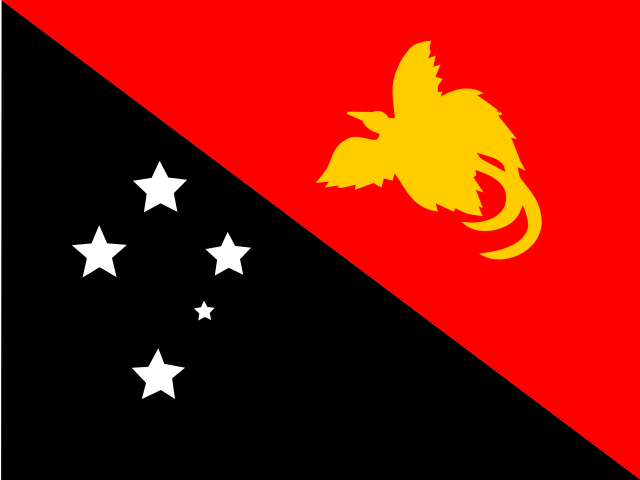
Divided diagonally from upper hoist to lower fly: an upper scarlet segment carrying a soaring mid-yellow bird of paradise, and a lower black segment carrying five white five-pointed stars representing the Southern Cross. The National Identity Act 1971 fixes those colours by reference number and every position as a fraction of the flag's length, and assigns no element a meaning beyond identifying the stars as the Southern Cross; the constitution describes nothing. The design is a schoolgirl's alteration of a flag the constitutional select committee had itself proposed, taken up on that committee's recommendation in 1971, and she described its colours as the ones most commonly used in traditional ceremonies.
Papua New Guinea FACTS ◢
| Capital | Port Moresby |
|---|---|
| Continent | Oceania |
| Population | 10,762,817 (2025) |
| Area | 462,840 km² |
| Population density | 23/km² |
| Currency | Kina (PGK) |
| Official languages | English, Hiri Motu, Papua New Guinean Sign Language, Tok Pisin |
| Calling code | +675 |
| Internet TLD | .pg |
| Time zones | UTC+10:00, UTC+11:00 |
| Drives on the | Left |
| ISO codes | PG / PNG |
DID YOU KNOW? ◢
- More than 800 languages are spoken here, roughly an eighth of all the languages on Earth.
- It's home to most of the world's species of birds-of-paradise, famous for their dazzling courtship displays.
- Much of its rugged interior remained unknown to the outside world until well into the 20th century.
- It shares the island of New Guinea with Indonesia, split almost down the middle.
- Its highlands grow prized coffee, a major export from the mountainous interior.
Papua New Guinea QUICK ANSWERS ◢
What is the capital of Papua New Guinea?
The capital of Papua New Guinea is Port Moresby.
What is the population of Papua New Guinea?
Papua New Guinea had a population of 10,762,817 in 2025.
What currency does Papua New Guinea use?
Papua New Guinea uses the Kina (PGK).
What languages are spoken in Papua New Guinea?
The official languages of Papua New Guinea are English, Hiri Motu, Papua New Guinean Sign Language and Tok Pisin.
Think you know your flags? Play Flag Daily → · Browse all countries →
MORE ON THE FLAG ◢
Papua New Guinea's flag is split corner to corner: scarlet above with a yellow bird of paradise soaring across it, black below with the five white stars of the Southern Cross. The law that prescribes it is exacting. Every element is fixed to a hundredth of the flag's length, and the two field colours are identified by reference number.
Read Schedule 1 of the National Identity Act 1971 end to end and it interprets exactly one element: the five stars are there "representing the Southern Cross". That is the whole of it. Nothing is said to stand for the land, the people, tradition or sovereignty.
Which makes the interesting question not what the flag means but who decided that it did. Every reading in circulation can be traced to somebody. One comes from the schoolgirl who drew the design, recorded in a parliamentary committee's report. One comes from Papua New Guinea's national museum, and it is not the reading you will meet most often. And the design whose colours a committee chairman explained to the House of Assembly, clause by clause, is the one this flag replaced.
Key Takeaways
- The National Identity Act 1971 describes the flag exhaustively and assigns no element a meaning, apart from identifying the five stars as the Southern Cross. The constitution never describes it at all.
- The colours are called traditional because the designer said so: the select committee's 1971 report records Susan Karike describing them as those "most commonly used by our people in their traditional ceremonies".
- The colour symbolism read to the House of Assembly in 1970 belonged to the tricolour that was then rejected.
- A nationwide call for flag designs did happen, in 1970, and what it produced was the design that lost. The adopted flag came from a classroom exercise on the committee's 1971 tour.
- No Papua New Guinean instrument opened for this article names the species of bird on the flag. Schedule 1 says only "a soaring Bird of Paradise".
| The claim | Where it comes from | What it actually establishes |
|---|---|---|
| The colours are traditional Papua New Guinean colours | Susan Karike's submission, quoted in the select committee's report of March 1971 | That the designer chose them for that reason, not that any law says so |
| The bird is a raggiana bird-of-paradise | Reference works and encyclopaedias | The flag statute names no species; the emblem statute names only a genus, and misspells it |
| The stars show the country's place in the southern sky | General reference material about flags carrying the Southern Cross | The statute says only that they represent the Southern Cross; the one Papua New Guinean gloss available reads them as Pacific ties |
| The design won a national competition | Widely repeated summaries, including Wikipedia's flag article | A nationwide call in 1970 produced hundreds of entries and shaped the design that was rejected. The adopted flag came from a classroom colouring exercise on the committee's 1971 tour |
What Papua New Guinea's flag law actually says
The consolidated text of Papua New Guinea's constitution runs to 177 pages and uses the word "flag" exactly twice, both times in section 3. Subsection (1) says that "Acts of the Parliament may make provision for and in respect of" a National Flag, a National Emblem, a National Motto, a National Seal and a National Anthem. Subsection (2) then provides that until Parliament acts, "the National Flag, National Emblem and National Seal are those that were in use immediately before Independence Day".
That is the whole constitutional treatment. It is a referral plus a fallback, and it means the flag Papua New Guinea flew at independence in 1975 was already four years old.
The operative instrument is the National Identity Act 1971, an Act whose long title says it exists "to foster and encourage the growth of a feeling of national identity and unity in Papua New Guinea". Its Schedule 1 reads, in full at its opening:
"The Papua New Guinea National Flag is a rectangular flag, proportions four to three, divided diagonally from the top of the hoist to the bottom of the fly, the upper segment scarlet (Collies No. 305) overprinted on mid-yellow (Collies No. 537) charged with a mid-yellow (Collies No. 537) representation of a soaring Bird of Paradise, and the lower segment black (Collies No. 309) charged with five white five-pointed stars representing the Southern Cross."
Two things in that sentence are worth slowing down on. The upper field is scarlet, not red, and the bird is mid-yellow, not gold, each pinned to a numbered colour reference. What the Collies numbers refer to is not explained in the Act, and no state publication reachable for this article identifies the system, so the flag's legal colours are anchored to a scale the statute does not define.
And the scarlet is "overprinted on mid-yellow", which is a printing instruction rather than a description. Read literally, the bird is not printed onto the red. It is the yellow underneath, left showing.
After that opening sentence the schedule turns into a specification. The bird is "Stylized, in silhouette, viewed from underneath with wings elevated and display plumes trailing". Six points on it are tabulated as fractions of the flag's length, and so are the centres of all five stars, which the schedule names Alpha, Beta, Gamma, Delta and Epsilon Crucis. Nowhere does it say what any of it stands for.
Where the red, the black and the gold come from
The most repeated statement about this flag is that red and black are traditional Papua New Guinean colours. That is not something the state asserted. It is something the designer said, and it survives because a parliamentary committee wrote it down.
The committee was the Select Committee on Constitutional Development, whose chairman was Paulus Arek, and it reported to the House of Assembly on 4 March 1971. Its chain of custody is worth stating before anything is quoted from it. Neither the report nor the Hansard of the House is online, and both are reproduced in this article from an account written by the committee's deputy chairman, Geoff Littler, published by the Papua New Guinea Association of Australia. Where this article says the committee said something, what can be checked is that Littler says it did.
With that said, paragraph 52 of the report reads: "In her submission to the Committee Susan described the colours of the flag as being the colours most commonly used by our people in their traditional ceremonies."
Littler, who took the drawing from her hand at Yule Island, restates it in the same document in his own words: "Susan described the colours as those most commonly used by the people in their traditional ceremonies." That is the same witness twice, not two witnesses.
The independent repetition is from the state. The National Museum and Art Gallery of Papua New Guinea, whose Susan Karike Gallery is named for her, publishes the same account: "The colors Karike used were described as common colors used during traditional ceremonies." It does not say what its own source is.
All of them report the designer's reason. None converts it into an official meaning, and no instrument does either.
Reference works then paraphrase it, and the paraphrase drifts. Whitney Smith's entry on this flag for Britannica has the two colours "chosen because they are featured extensively in local art and clothing", which is a wider claim than ceremonial use and is not what the committee recorded.
There is a fourth account, and it does not agree with the others. In April 2017, days after Karike's death, the Papua New Guinean daily The National published a feature which said that "the black background represents the darkness we were in before missionaries brought us to the light of the Gospel, the White southern cross stars represents a nation coming out of that darkness, the Red represents us covered by the blood of Jesus and the Yellow bird of paradise represents the Holy Spirit". She was a pupil at a Catholic mission school, so the reading is not implausible. It appears in no state source that could be opened for this article, and it sits oddly beside the committee's own record of what she told it. Both are attributed to the same person.
The colour symbolism read to the House belonged to a different flag
Here is the part that gets lost. Papua New Guinea's House of Assembly was given a full, clause-by-clause reading of a flag's colours in 1970. It was not this flag.
Arek presented a proposed design to the House on 17 November 1970 and, in the statement Littler reproduces, told members that "The flag and crest do not represent the ideas of one single person but rather have been designed taking into account the overwhelmingly popular colours, designs and ideas submitted by the people to your Committee." The design was a vertical tricolour drawn up by Hal Holman, an artist at the Department of Information and Extension Services. Littler lists its colours as green, gold and blue; Flags of the World and Britannica both give the order from the hoist as blue, yellow and green, so treat the sequence as unsettled.
Arek then gave the House its meanings. "The BLUE represents the islands of our country and the sea, which surrounds them. The Cross lies above our whole country and guides our people in their travel on land and sea." "The GOLD represents the coastal areas of our country, its past and future mineral wealth and unity." "The GREEN represents the mainland and highland areas of our country and a Bird of Paradise, our unique bird, is turned towards the islands to represent one unified country."
The committee then toured the country to test it, and the country did not want it. Littler's summary of what he heard is blunt: "Mostly they regarded the design as a mechanically contrived outcome designed by the Select Committee and not produced by a real person."
So the tricolour was dropped, and its symbolism went with it. The design that replaced it arrived with the designer's reason for the colours and nothing else, and no comparable statement for the adopted flag appears in any record reachable for this article. That gap is why the glosses in circulation can be traced to named authors outside government.
Was there really a national flag competition?
Yes and no, and the two halves are usually run together. There was a nationwide call for flag designs, and the flag that was adopted did not come out of it.
The call came first, under the first House of Assembly. Littler's account opens with it: John Guise's select committee "called upon the people and schools throughout PNG for submissions about their country's flag", and "Hundreds of entries were submitted which, due to time restraints, were handed over to the Second Select Committee of Constitutional Development" under Paulus Arek. What that pile of entries produced was not a winner. In October 1970 the committee had its staff analyse the submissions for the most popular colours and symbols, found gold, green and blue and birds, drums, spears and stars, and handed those to Hal Holman to draw the test flag with. So the public submissions shaped the design that lost.
A flag campaign is on the record outside Papua New Guinea too, though not obviously the same one. Arek's committee reported to the House on 13 November 1969, in a document Australia's foreign affairs department later published in its historical documents series, that its sub-committees "will conduct campaigns" including one "to select the best design for a suitable flag for the country". Littler puts the original call under Guise's committee in the earlier House; this report has Arek's committee planning campaigns of its own. Both can be true, and nothing reachable here settles which submissions came from which. The same report notes that the committee would make clear to people that choosing a name, a flag and a national song were "separate matters from the question of independence or self-government for the country". The flag exercise was on the official record, in writing, six years before independence.
The adopted design arrived by a different route four months later. Littler's is the most detailed account. The committee split into two groups and toured in January and February 1971 showing people the tricolour. His group reached Yule Island on 12 February 1971, and at the meeting a pupil of the Catholic mission school there handed him a revised design drawn on a page torn from an exercise book. On 1 March the committee met in Port Moresby and narrowed the choice to two of the designs it had collected on that tour. It adjourned undecided. That evening Ross Johnson had his wife, Pat, put Karike's design onto a piece of cloth slightly larger than a tea towel. Shown the made-up flag the next day, the committee agreed. The report went to the House on 4 March.
The committee's own words in paragraph 51 are procedural, not competitive: "Because of the wide variety of views about the colour and design of the suggested flag, your Committee has decided to choose one of the submissions made to it on its recent tour."
The National Museum's account is narrower still, and it is the one that best explains where the competition story came from. It says the committee showed the proposed design to the students and that "Students were instructed to colour the proposed flag design with the colours they preferred." Karike did not like the layout either, and "She thought it was not traditionally appropriate, so she altered it by first drawing a diagonal line to separate the two segments of the flag."
Holman himself, writing decades later, said the colouring exercise was deliberate policy, because it would have been improper for an expatriate to be seen designing the flag, and that his outline drawings were "circulated widely throughout PNG in a colouring-in competition", after which "a Yule Island schoolgirl named Susan Kareke was announced as the winner". He is an interested witness with a competing claim, so his framing is worth weighing rather than adopting. But a third participant supports the mechanism without the grievance. John Middleton, a committee member, wrote in 1998 that "A school girl, Susan, had drawn a diagonal line across the test flag and reduced the colours to two, red and black. She explained she did not like the colours and layout of the original flag as they were not traditional."
That is four accounts: from the committee's deputy chairman who was at Yule Island, from a committee member who was not, from the artist whose design was altered, and from the national museum. All four describe the same act, a student redrawing a flag the committee had brought to her school. So the usual compression, that the design was chosen from a schoolgirl's entry to a national competition, puts the adopted flag in a process it did not come out of. Wikipedia's article on the flag has "after a nationwide design competition in early 1971, a winning redesign by 15-year old schoolgirl Susan Karike was chosen instead", which folds the 1970 call, the classroom exercise and the committee's choice into a single event.
The dates get compressed the same way. Whitney Smith's Britannica entry on the flag says "The national parliament recognized the flag on March 11, 1971", and Wikipedia's flag article repeats 11 March. That date is in no gazette and in no participant account reachable here, and Papua New Guinea had no national parliament in 1971. It had a House of Assembly, which adopted the committee's report on 4 March and passed the Bill in June.
One further detail belongs to the story rather than to the record. Ples Singsing, a Papua New Guinean writers' blog, published an account in November 2021 in which the House divided on the flag, "31 votes in favour and 31 against", and the Speaker, John Guise, cast the deciding vote. It is a good story and it is repeated elsewhere. No participant account mentions any such division, and no record reachable for this article contains it; Littler describes a committee consensus and a report adopted on 4 March.
What the five stars are for
The statute identifies them and stops. Five white five-pointed stars, "representing the Southern Cross", with Epsilon Crucis at half the diameter of the other four, which is why the small one looks like a mistake and is not. Australia's flag carries the same constellation and separates its Epsilon by point count as well as by size. That two-size treatment is also why the design survives being shrunk: Flag Daily puts up one flag a day and gives three guesses at the country, and a silhouette in one flat colour over two plain fields is exactly the sort of shape that still reads at that size.
Beyond the identification, the readings diverge, and they diverge by source. The National Museum says of the stars that they symbolise "relationship with other Pacific countries", and adds that "The bird of paradise was soaring above the Southern Cross which also symbolized Papua New Guinea emerging into nationhood". That is the closest thing to a state gloss available, and it is about neighbours rather than about astronomy.
The reading you will more often meet, that the constellation marks the country's place in the southern sky, does not come from a Papua New Guinean source at all. It is a general observation about flags carrying the Southern Cross, applied to this one along with the rest. A Flags of the World contributor's note dated 1 November 1996 gives a third version again, the stars "reflecting ties with Australia and other nations of the South Pacific", and adds in the next sentence that "Black, red and yellow are also traditional colors in Papua New Guinea". That is the earliest dated statement of either reading found for this article. Neither is Papua New Guinea speaking about its own flag, and the one state statement that exists says something else.
Which bird of paradise is on the Papua New Guinea flag?
Almost every description of this flag names the bird as a raggiana bird-of-paradise. Papua New Guinea's own instruments do not.
Schedule 1 of the National Identity Act says "a soaring Bird of Paradise" and describes its posture, not its species. The nearest thing to a Latin name anywhere in the Act sits in Schedule 3, which covers the national emblem rather than the flag. The gazette issue that first published the flag, in July 1971, prints that schedule as "a partially stylized representation of the wide-spread Bird of Paradise Gerrus paradisaea in display". The consolidated text of the Act prints the same passage as "the widespread Bird of Paradise Genus paradisaea".
The two official renderings do not agree with each other, and neither reaches a species. Paradisaea is the genus the plumed birds-of-paradise belong to, and the raggiana is one member of it. The raggiana is treated as the national bird by long practice, but that status comes from neither schedule, and no Papua New Guinean instrument reachable for this article supplies it.
There is also a second route to the name, and it can be dated. Wikipedia's article on the raggiana lists "Gerrus paradisaea" among the species' synonyms, cited to Peter Ryan's Encyclopaedia of Papua and New Guinea of 1972, the year after the gazette; the same article says that in 1971 the species "was made the national emblem and was included on the national flag". So the misprinted genus was recorded as a synonym of this one species within a year of being published, which is how a phrase in a schedule about the emblem ends up naming a species in descriptions of the flag.
There is one more difference between the two schedules worth noting. The flag's bird is a flat silhouette in a single colour. The emblem's bird is coloured naturalistically, right down to "Deep red (slightly brownish)" display plumes and a grey-blue bill. The same creature, specified twice, once as a shape and once as an animal.
What the gazette of 1 July 1971 published
The flag first appeared in the Papua New Guinea Government Gazette Extraordinary No. 1, published at Port Moresby on Thursday 1 July 1971. The Administrator, Leslie Wilson Johnson, had assented to the National Identity Ordinance 1971 on 24 June and fixed 1 July as the day it came into operation by a notice dated 25 June. Four pages carry the lot: the Administrator's statement on page 1, the assent and commencement notices, the change of national name and the national emblem across pages 2 and 3, a full-colour reproduction of the flag at the foot of page 3, and the Ordinance's description of it on page 4.
That colour plate is Schedule 2 of the Act, the reproduction the flag schedule refers to. The consolidated text of the Act on PacLII carries Schedule 2 as a heading with nothing underneath it, so the gazette is where the picture the statute points at actually survives.
Page 1 runs the Administrator's statement three times over, in English, then Hiri Motu, then Tok Pisin, each version under its own heading and each separately signed and dated. The English version says the House of Assembly had passed a Bill "establishing a national name, a flag and an emblem for this country". At the same point the Hiri Motu version reads "Inai Bill be bese badana ena ladana, ena pepe bona ena toana ia hamaoromaoroa, inai tano ena", and the Tok Pisin version reads "lo bilong makim nem na plak na spesol mak bilong nation o bikpela wanlain bilong dispela kantri".
The national name was the third thing the Ordinance did, and page 2 spells out what it meant in practice. From 1 July 1971 the correct national name was Papua New Guinea, and officials were told to stop writing "the Territory of Papua and New Guinea" on anything new or reprinted. Statutory bodies whose own titles carried the old words were exempted for the time being. The country got its flag, its emblem and its name in one four-page issue.
Delta Crucis was in the wrong place for a week
Page 4 of the 1 July gazette gave the position of Delta Crucis as "17/96 along the fly and 20/96 down the hoist." That is wrong, and badly so. It puts Delta almost on top of Gamma and collapses the cross.
Gazette No. 3, published a week later on 8 July 1971, carried the fix at page 41, wedged between an appointment to the Passenger Transport Control Board and a notice about District Advisory Councils. The whole item is one sentence: "IN the description of the National Flag in the Papua New Guinea Government Gazette No. 1 of 1st July, 1971, the position of the star Delta Crucis should read", followed by the corrected figures, 34/96 along the fly and 40/96 down the hoist.
The corrigendum is not a new find. A Flags of the World contributor reported it in April 2016. What the gazette scan adds is the position on the page and the arithmetic below.
The correction matches the law as it stands today. The current Schedule 1 puts Delta Crucis at 35/100 along the fly and 42/100 down the hoist. Converted, the corrigendum's figures are 0.354 and 0.417 of the flag's length, against 0.35 and 0.42 in the modern text. The figures as first published convert to 0.177 and 0.208, which are nowhere near. Delta is the fly-side end of the cross's short arm, and the position first printed would have put it up beside Gamma at the head of the cross, less than one star's width from it.
The flag was re-specified in 1972, and the reason was metric
The Schedule 1 wording set out in this article is not the 1971 text. The 1971 Gazette works in ninety-sixths of the flag's length. The Act works in hundredths. The consolidated text does not record the change: its footnotes annotate thirty-three amendments and not one of them is to Schedule 1.
It was the National Identity (Amendment) Ordinance 1972, No. 66 of 1972, assented to on 8 December 1972 and tabled in the Australian Senate the following February. Its long title states the purpose outright: the Ordinance amends the 1971 Ordinance in order "to describe the National Flag in a way that will be easy to express in the metric system of measurement". It came into operation on 29 March 1973, by a commencement notice the Administrator published in the Gazette alongside two unrelated Ordinances.
The same amendment moved National Day from the second Monday in September, which the 1971 Gazette had announced, to a fixed 15 September. That provision has not survived into the current Act: the words "National Day" do not appear in the consolidated text at all, and the day the country commemorates independence is now the one "fixed under the Public Holidays Act 1953", which is how section 10B of the Act, on reciting the national pledge, refers to it.
The conversion also let a small oddity through. Schedule 1 says the tabulated points of the bird "are on the perimeter of that circle", the circle being 34.5/100 of the flag's length in diameter with its centre 67/100 along the fly and 24/100 down the hoist. Four of the six tabulated points sit within 0.21/100 of that perimeter. The cross-over point of the elongated tail feathers is 1.11/100 outside it, and the second extremity of the tail feathers is 5.60/100 outside it, a third again as far from the centre as the radius. The schedule asserts something about its own geometry that its own numbers do not satisfy, which is what a drawing office document looks like when it is read as a proof.
How the flag is meant to be flown
Section 4 of the Act left the protocol to rules, and they exist: the Rules Respecting the Use of the National Flag and the National Emblem 1973. They are where the flag's orientation gets settled.
On a halyard, the bird of paradise goes uppermost. On a staff, "the Southern Cross to be in the position nearest the staff and furthest from the peak". Draped over a casket, the Southern Cross lies over the right breast. And the flag has a defined wrong way up: "To fly a flag upside down is a signal of distress. The National Flag should not therefore be displayed with the Bird of Paradise down on any occasion except as a signal of distress." The proportion is restated as well, as "4 in the fly to 3 in the hoist", with standard sizes counted in nine-inch breadths of bunting.
Section 4 of the 1973 Rules says the flag should never be "displayed in a position inferior to any other flag or ensign", which is standard. What makes it interesting is what it replaced. The interim rules the Administrator published in the 1971 Gazette said the opposite: "Where flown or used with the Australian National Flag, that flag must take precedence", at the peak on a shared halyard and higher on separate staffs. The same paragraph then adds that "it is desirable to avoid flying or using the two flags together".
Frequently asked questions
What do the colours of the Papua New Guinea flag mean?
No Papua New Guinean law assigns the colours a meaning. The National Identity Act 1971 fixes the upper segment as scarlet and the lower as black by reference number and says nothing about what either stands for. The reason usually given traces to the designer, Susan Karike: the select committee's 1971 report records her describing them as "the colours most commonly used by our people in their traditional ceremonies", and the National Museum and Art Gallery of Papua New Guinea repeats that account.
Who designed the Papua New Guinea flag?
Susan Karike, a fifteen-year-old pupil at the Catholic mission school on Yule Island, altered a design the parliamentary select committee had brought to her school in February 1971, drawing a diagonal across it and changing the colours. The committee chose her version and the House of Assembly adopted its report on 4 March 1971. The underlying test flag, with the Southern Cross and bird of paradise already on it, had been drawn by Hal Holman, an artist with the Administration, and he later claimed a share of the credit.
When was the Papua New Guinea flag adopted?
Officially, on 1 July 1971. The Administrator assented to the National Identity Ordinance 1971 on 24 June and fixed 1 July as the day it came into force, which is the date its description was published in Papua New Guinea Government Gazette Extraordinary No. 1. The House of Assembly had adopted the select committee's recommendation on 4 March 1971, and the flag was raised on Independence Hill on 16 September 1975, the day Papua New Guinea became independent.
Which bird is on the Papua New Guinea flag?
The law does not say. Schedule 1 of the National Identity Act 1971 describes only "a soaring Bird of Paradise", stylised in silhouette "with wings elevated and display plumes trailing". The raggiana bird-of-paradise is very widely named, and it is Papua New Guinea's national bird by long practice, but no flag instrument identifies a species. The separate schedule covering the national emblem gives a genus instead, and the Gazette and the consolidated Act spell it differently from one another.
Why does the Papua New Guinea flag have the Southern Cross?
Because the design it was altered from already carried it, and the statute keeps it: the five white stars are described as "representing the Southern Cross" and are individually named after Alpha, Beta, Gamma, Delta and Epsilon Crucis. As to what they signify, the National Identity Act says nothing further. The National Museum and Art Gallery of Papua New Guinea reads them as a "relationship with other Pacific countries" rather than as a statement about latitude.
Sources
- Constitution of the Independent State of Papua New Guinea, s. 3 (National Symbols), consolidated text, Papua New Guinea Consolidated Legislation, PacLII - read from the Internet Archive capture of 18 November 2017, the live site being unreachable. Retrieved 27 August 2026.
- Constitution of the Independent State of Papua New Guinea, as amended to 2016, Constitute Project - read as a second, independent text of s. 3, which agrees with the PacLII consolidation word for word. Retrieved 27 August 2026.
- National Identity Act 1971 (Chapter 9), Schedules 1, 2 and 3, consolidated text, Papua New Guinea Consolidated Legislation, PacLII - read from the Internet Archive capture of 1 March 2021. Retrieved 27 August 2026.
- Rules Respecting the Use of the National Flag and the National Emblem 1973, made under the National Identity Act 1971, PacLII - read from the Internet Archive capture of 28 October 2024. Retrieved 27 August 2026.
- Papua New Guinea Government Gazette Extraordinary, No. 1, Port Moresby, 1 July 1971, pages 1 to 4, National Library of Australia, Trove - retrieved 27 August 2026.
- Corrigendum, Papua New Guinea Government Gazette, No. 3, 8 July 1971, page 41, National Library of Australia, Trove - retrieved 27 August 2026.
- National Identity (Amendment) Ordinance 1972, No. 66 of 1972, tabled paper presented to the Australian Senate 27 February 1973, Parliament of Australia - retrieved 27 August 2026.
- Notice of Commencement, Papua New Guinea Government Gazette, 29 March 1973, page 1, National Library of Australia, Trove - retrieved 27 August 2026.
- Geoff Littler, "The Papua New Guinea Crest and Flag", Papua New Guinea Association of Australia - quoting Paulus Arek's statement to the House of Assembly of 17 November 1970 and paragraphs 50 to 52 of the Select Committee on Constitutional Development's report. Retrieved 27 August 2026.
- National Museum and Art Gallery of Papua New Guinea, Susan Karike Gallery - read from the Internet Archive capture of 11 August 2024, the live site being unreachable from this network. Retrieved 27 August 2026.
- Hal Holman, "The true inside story of the saga of the PNG flag", including John Middleton's letter of 22 September 1998, PNG Attitude - read from the Internet Archive capture of 6 October 2022. Retrieved 27 August 2026.
- Lemach Lavari, "Designers of our symbol of unity", The National, 21 April 2017 - retrieved 27 August 2026.
- Papua New Guinea, Flags of the World - contributor notes by Nick Artimovich (1 November 1996), Christopher Southworth (20 January 2004), Zeljko Heimer (29 March 2003 and 21 January 2012) and Jeff Thomson (20 April 2016, on the corrigendum). Retrieved 27 August 2026.
- Whitney Smith, Flag of Papua New Guinea, Britannica - read from the Internet Archive capture of 22 August 2026, Britannica being unreachable from this network. Cited for the provenance of two circulating claims. Retrieved 27 August 2026.
- Flag of Papua New Guinea and Raggiana bird-of-paradise, Wikipedia - cited as instances of the circulating claims this article examines, not as authority for them. The single exception is the raggiana article's synonym citation, which is used to date "Gerrus paradisaea" to Peter Ryan's Encyclopaedia of Papua and New Guinea of 1972; Ryan itself was not opened. Retrieved 27 August 2026.
- "Susan Karike: PNG Flag designer", Ples Singsing, 21 November 2021 - read from the Internet Archive capture of 10 June 2023. Cited as an instance of the 31 to 31 vote story. Retrieved 27 August 2026.
- First Interim Report of the Select Committee on Constitutional Development, Port Moresby, 13 November 1969, in Documents on Australian Foreign Policy, Volume 26, Department of Foreign Affairs and Trade - cited for the committee's name, its chairman and the terms of the flag campaign. Retrieved 27 August 2026.
PLAY ANOTHER →
Three clues, three guesses. Work out where in the world it is.
THREE CLUESDAILYOn This DayOne thing that happened today in history. Every day, a new one.
TODAY IN HISTORYDAILYDaily CodeA short message, hidden in a different cipher every day.
ONE CIPHER A DAYDAILYDaily CryptogramOne quote, one scrambled alphabet. Crack it before tomorrow.
CRACK THE QUOTE