
Poland
Poland sits at the crossroads of Europe with a millennium of history behind it, from medieval Kraków to the Baltic coast - a country that has redrawn its borders more than once and kept its identity intact.
WHAT THE FLAG MEANS ◢
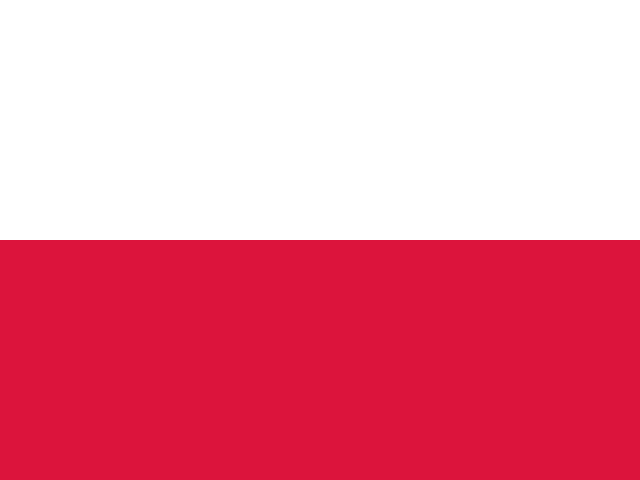
Two equal horizontal bands, white over red, the same white and red as the national coat of arms, which article 28 of the constitution gives as a crowned white eagle upon a red field. Neither that article nor the 1980 Act on the coat of arms, colours and anthem assigns the colours a meaning, though the Act's annexes fix them as CIE coordinates with a stated tolerance and set the ratio at 5:8. They are traditionally read as purity and nobility, and valour, and no instrument supports either reading.
Poland FACTS ◢
| Capital | Warsaw |
|---|---|
| Continent | Europe |
| Population | 36,435,861 (2025) |
| Area | 312,683 km² |
| Population density | 117/km² |
| Currency | Złoty (PLN) |
| Official language | Polish |
| Calling code | +48 |
| Internet TLD | .pl |
| Time zone | UTC+01:00 |
| Drives on the | Right |
| ISO codes | PL / POL |
DID YOU KNOW? ◢
- The Wieliczka Salt Mine near Kraków contains entire chapels, chandeliers and sculptures carved from rock salt.
- Scientist Marie Curie, the first person to win Nobel Prizes in two different sciences, was born in Warsaw.
- Astronomer Nicolaus Copernicus, who placed the Sun at the centre of the solar system, was Polish.
- Białowieża Forest, on its eastern edge, shelters Europe's largest population of wild European bison.
- Its capital, Warsaw, was painstakingly rebuilt after being largely destroyed in World War II.
Poland QUICK ANSWERS ◢
What is the capital of Poland?
The capital of Poland is Warsaw.
What is the population of Poland?
Poland had a population of 36,435,861 in 2025.
What currency does Poland use?
Poland uses the Złoty (PLN).
What languages are spoken in Poland?
The official language of Poland is Polish.
Think you know your flags? Play Flag Daily → · Browse all countries →
MORE ON THE FLAG ◢
Polish law is exact about what colour its flag is, to a degree almost no other country attempts. Annex 2 to the governing Act gives the white and the red as chromaticity coordinates, with a relative luminance, a permitted colour difference, the illuminant the measurement is taken under and the geometry of the instrument taking it.
It says nothing whatever about what either colour means.
That is not an oversight. The most likely explanation, and it is a reading rather than a sourced finding, is that Polish white and red were never symbols that had to be chosen and then explained. They are the tinctures of the coat of arms, a white eagle on a red field, and a tincture does not need a meaning assigned to it because it already has a referent.
Key Takeaways
- The white is x 0,315, y 0,320, Y 82,0 and the red is x 0,570, y 0,305, Y 16,0, in CIE 1931 chromaticity coordinates and relative luminance, measured under illuminant C at d/0 geometry. The Act writes the comma as its decimal separator.
- Each colour carries a tolerance and they are not the same: the permitted colour difference for the red, ΔE 8,0, is twice that for the white.
- The 5:8 ratio is not in any article. It is a sentence in annex 3.
- Hung vertically, the white goes on the left of the face you are looking at. That rule is in the Act, at article 4(2).
- Nothing in the Act assigns the colours a meaning, and nothing in article 28 of the constitution does either.
The colour specification, in full
Annex 2 is headed Barwy Rzeczypospolitej Polskiej, the colours of the Republic of Poland, and its whole content is one heading and one table.
The heading sets out what is being specified: "Współrzędne trójchromatyczne barw x, y, ich składowa Y oraz dopuszczalna różnica barwy Δ E w przestrzeni barw CIE 1976 (L* u* v*) ustalona według wzoru CIELUV przy iluminacie C i geometrii pomiarowej d/0".
The trichromatic coordinates of the colours x, y, their component Y, and the permissible colour difference ΔE in the CIE 1976 (L* u* v*) colour space, determined by the CIELUV formula, under illuminant C and d/0 measurement geometry.
Then the table:
| Barwa | x | y | Y | ΔE |
|---|---|---|---|---|
| biała (white) | 0,315 | 0,320 | 82,0 | 4,0 |
| czerwona (red) | 0,570 | 0,305 | 16,0 | 8,0 |
Two different CIE systems are named in that one heading, and it is worth separating them. The x, y and Y figures are CIE 1931 quantities: a chromaticity coordinate and a relative luminance. The tolerance is expressed in the later CIE 1976 L* u* v* space, where a single number can stand for a perceived distance. The Act specifies the colour in one system and the permitted error in another.
Read that against most national flag law and the difference in ambition is obvious. A great many countries name their colours as words. A smaller number give Pantone references, which are a manufacturer's swatch book. Poland gives a position in a colour space, states the standard illuminant the measurement is to be made under, and specifies the measurement geometry.
The tolerances are the part worth pausing on. ΔE is how far a sample may sit from the specified point and still comply. Poland allows 4,0 for the white and 8,0 for the red, so the permitted colour difference for the red is twice that for the white. Neither figure is explained, and the Act does not say why the red should have the wider one.
The ratio is in an annex, not in an article
Article 4(1) describes the colours and their arrangement: "Barwami Rzeczypospolitej Polskiej są kolory biały i czerwony, ułożone w dwóch poziomych, równoległych pasach tej samej szerokości, z których górny jest koloru białego, a dolny koloru czerwonego."
The colours of the Republic of Poland are white and red, arranged in two horizontal parallel stripes of the same width, of which the upper is white and the lower red.
Article 6(1) then defines the flag itself: "Flagą państwową Rzeczypospolitej Polskiej jest prostokątny płat tkaniny o barwach Rzeczypospolitej Polskiej, umieszczony na maszcie." A rectangular piece of cloth in the colours of the Republic, mounted on a mast.
Rectangular, and no more than that. The proportion appears in no operative article. It is a single line at the head of annex 3, which reads "Stosunek szerokości flagi do jej długości" and then gives the answer as 5:8: the ratio of the width of the flag to its length.
The annexes are part of the Act, not commentary on it. Article 4(3) provides that the pattern of the colours is contained in annex 2, and article 6(3) that the patterns of both state flags are in annex 3, so the articles reach out and pull the annexes in.
The same annex fixes the arms on the version that carries them, under the heading "Stosunek wysokości godła do szerokości flagi", at 2:5: the height of the coat of arms to the width of the flag.
So the two most quoted numbers about the Polish flag, the 5:8 and the size of the eagle, are both annex material. That is a division of labour rather than a demotion: the articles say what the flag is, the annexes say how to make one, and both are enacted.
Poland has two state flags, and both are the state flag
Article 6 does something that surprises people who assume the eagle version is ceremonial or naval.
Paragraph 1 makes the plain white-and-red cloth the state flag. Paragraph 2 then says: "Flagą państwową Rzeczypospolitej Polskiej jest także flaga określona w ust. 1, z umieszczonym pośrodku białego pasa godłem Rzeczypospolitej Polskiej." The state flag of the Republic of Poland is also the flag defined in paragraph 1, with the coat of arms of the Republic placed in the middle of the white stripe.
Both are the state flag. The eagle version is not a variant or an ensign in Polish law; it is the same legal object with a second permitted form, and the Act goes on to set out where each is flown.
The rule for hanging it vertically
Article 4(2) covers something most flag statutes never reach: "Przy umieszczaniu barw Rzeczypospolitej Polskiej w układzie pionowym kolor biały umieszcza się po lewej stronie płaszczyzny oglądanej z przodu."
When the colours of the Republic of Poland are placed in a vertical arrangement, the white is placed on the left of the plane viewed from the front.
That is a genuinely useful provision, because a two-stripe horizontal flag rotated ninety degrees can go either way and half the time people get it wrong. Poland legislated the answer.
It also quietly settles a related question. Because the rule is stated in terms of the viewer's left, a vertically hung Polish flag is white-left and red-right from the front, whichever way it was turned to get there.
Flag Daily gives you one flag a day and three guesses at the country. White over red is worth fixing in your memory before it comes up, because Indonesia and Monaco are red over white and Poland is the other way up. The Czech flag is the near neighbour that avoids the problem entirely, by carrying a blue wedge.
The Act makes reverence a duty, not just a courtesy
Article 1 opens the whole statute and its second paragraph is a striking piece of drafting: "Otaczanie tych symboli czcią i szacunkiem jest prawem i obowiązkiem każdego obywatela Rzeczypospolitej Polskiej oraz wszystkich organów państwowych, instytucji i organizacji."
Surrounding these symbols with reverence and respect is the right and the duty of every citizen of the Republic of Poland, and of all state organs, institutions and organisations.
A right and a duty, in the same clause, owed by citizens and by the state alike. Read that beside the colour table and the character of the Act comes through: it is simultaneously a precise technical specification and a statement about how the thing specified is to be treated.
The Act also names the day. Article 6a: "Ustanawia się dzień 2 maja Dniem Flagi Rzeczypospolitej Polskiej." 2 May is established as the Flag Day of the Republic of Poland.
Three more things the Act does with the flag and its colours
The 1980 Act runs well past the specification, and three of its provisions answer questions people actually have.
Anyone may use the colours. Article 5(2): "Każdy ma prawo używać barw Rzeczypospolitej Polskiej, w szczególności w celu podkreślenia znaczenia uroczystości, świąt lub innych wydarzeń, z uwzględnieniem art. 1 ust. 2." Everyone has the right to use the colours of the Republic of Poland, in particular to mark the significance of ceremonies, holidays or other events, having regard to article 1(2), which is the reverence clause.
It goes to half mast for national mourning. Article 11(2): "W czasie trwania żałoby narodowej flagę państwową opuszcza się do połowy masztu." During national mourning the state flag is lowered to half mast. Under article 11(1) the President "może", may, introduce national mourning by regulation, so it is a power rather than a procedure.
It may not be sold on things, except in stylised form. Article 16(1): "Symbole Rzeczypospolitej Polskiej nie mogą być umieszczane na przedmiotach przeznaczonych do obrotu handlowego." The symbols of the Republic of Poland may not be placed on objects intended for commercial trade. Note that article 16 reaches all three symbols and not the flag alone. Article 16(2) then allows the arms or the colours on such objects "w formie stylizowanej lub artystycznie przetworzonej", in a stylised or artistically transformed form, which is the subsection any stylised eagle on merchandise sits under.
Where the meaning would be, if there were one
Search the Act for symbolism and it is not there. No word for symbolises, none for blood, valour or courage, and the one apparent match for purity turns out to be uroczystość, meaning a ceremony.
The constitution does not supply it either. Article 28 gives the crowned white eagle on a red field as the coat of arms, makes white and red the colours of the Republic, names the anthem, places all three under legal protection, and refers the details to statute. That is a complete provision on the national symbols with no interpretation of any of them.
One caveat on that article. The wording above is from an English compilation, not a Polish state text: the Sejm's own constitution pages answer a bot challenge and the Internet Archive's capture of them is a copy of that challenge. It is the one claim here not taken from an instrument as the Polish state published it.
Why the meaning is missing is a different question from whether it is missing. This article's answer to the first is a reading, and it is that the colours are heraldic tinctures taken from the arms, and that a tincture carries its referent with it rather than needing a meaning assigned. No source consulted for this article states that, and one thing that might look like evidence for it is not: article 28 does give the arms in paragraph 1 and the colours in paragraph 2, but paragraphs 4 and 5 run through the same arms, colours and anthem sequence again, so it is the provision's enumeration convention rather than a statement about derivation.
The readings you will meet, white for purity or nobility and red for valour or the blood of the fallen, are not in Polish law, and Polish law has never needed them to be. Whether they are glosses over a heraldic fact, as this article suggests, or something older, is not settled here.
Frequently asked questions
What do the colours on the Polish flag mean?
Polish law does not say. Neither the 1980 Act on the coat of arms, colours and anthem nor article 28 of the constitution assigns white or red a meaning, and the purity and valour readings in circulation are not law. The colours are the same white and red as the coat of arms, a crowned white eagle on a red field; that they are heraldic tinctures rather than chosen symbols is this article's reading of why no meaning was ever assigned, not a sourced finding.
What is the exact shade of the Polish flag?
The white is x 0,315, y 0,320 with Y 82,0, and the red is x 0,570, y 0,305 with Y 16,0. Those are CIE 1931 chromaticity coordinates and relative luminance, measured under illuminant C at d/0 geometry, and the Act writes the comma as its decimal separator, so x 0,315 means 0.315. Each colour also carries a permitted difference ΔE, expressed in the later CIE 1976 space: 4,0 for the white and 8,0 for the red.
What is the ratio of the Polish flag?
Five to eight. It is not in any article of the Act; it is stated in annex 3, which begins by saying that the ratio of the flag's width to its length is 5:8.
Which way up does the Polish flag hang vertically?
White on the left, red on the right, as seen from the front. Article 4(2) of the Act sets that out expressly, in terms of the plane viewed from the front, so it holds whichever way the flag was rotated.
Is the Polish flag with the eagle on it a different flag?
No. Article 6 makes both the state flag: the plain white-and-red cloth in paragraph 1, and the same flag with the coat of arms in the middle of the white stripe in paragraph 2. The Act then governs where each is flown.
Sources
- Ustawa z dnia 31 stycznia 1980 r. o godle, barwach i hymnie Rzeczypospolitej Polskiej oraz o pieczęciach państwowych, consolidated text, Dz. U. z 2025 r. poz. 299, Kancelaria Sejmu - articles 1, 4, 5, 6, 6a, 11 and 16, annex 2 with the colour coordinates and tolerances, and annex 3 with the 5:8 ratio and the arms proportion. The publisher is the Sejm Chancellery and the document is its own PDF; the link is to the Internet Archive capture of 15 November 2025, because isap.sejm.gov.pl answers a security challenge to every client tried. Retrieved 26 August 2026.
- Constitution of the Republic of Poland, article 28, English text, Comparative Constitutions Project / constituteproject.org - the coat of arms, the colours of the Republic, the anthem, their legal protection and the reference to statute. This is a third-party compilation, not a Polish state text. No Polish state text of the constitution could be opened, and that limitation is stated in the body. Retrieved 26 August 2026.
PLAY ANOTHER →
Five questions a day. Everyone gets the same five.
FIVE QUESTIONSDAILYGuess the CountryThree clues, three guesses. Work out where in the world it is.
THREE CLUESDAILYDaily CryptogramOne quote, one scrambled alphabet. Crack it before tomorrow.
CRACK THE QUOTEDAILYDaily CodeA short message, hidden in a different cipher every day.
ONE CIPHER A DAY