
Czech Republic
A landlocked heart-of-Europe nation of castles and hop fields, the Czech Republic drinks more beer per person than any country on Earth and gave the world the word 'robot'.
WHAT THE FLAG MEANS ◢
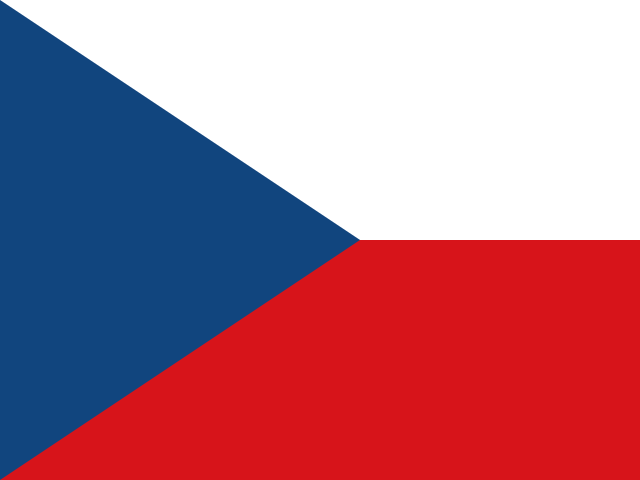
Two horizontal bands, white over red, with a blue wedge at the hoist reaching half the flag's length. It is the Czechoslovak flag of 1920, taken over unchanged and adopted for the Czech Republic in December 1992, three weeks after the constitutional act dissolving the federation had barred both successor states from using its symbols. The white and red are the colours of the Czech and Moravian arms; a third colour was added in 1920 because a plain white-and-red flag was already flying in neighbouring states, Poland among them. Act No. 3/1993 Coll. fixes the geometry and the 2:3 ratio and assigns the colours no meaning, and neither does the constitution - the readings of the blue as Slovakia, Moravia and Subcarpathian Ruthenia, and of the three colours together as Pan-Slavic, come from the reasoning attached to the bills rather than from the statute.
Czech Republic FACTS ◢
| Capital | Prague |
|---|---|
| Continent | Europe |
| Population | 10,886,878 (2025) |
| Area | 78,871 km² |
| Population density | 138/km² |
| Currency | Czech koruna (CZK) |
| Main language | Czech |
| Calling code | +420 |
| Internet TLD | .cz |
| Time zone | UTC+01:00 |
| Drives on the | Right |
| ISO codes | CZ / CZE |
DID YOU KNOW? ◢
- Its people drink more beer per capita than any other nation in the world.
- The word 'robot' comes from a 1920 Czech play by Karel Čapek.
- Prague Castle is often cited as the largest ancient castle complex in the world.
- Pilsner, the pale lager style brewed worldwide, was invented in the city of Plzeň.
Czech Republic QUICK ANSWERS ◢
What is the capital of the Czech Republic?
The capital of the Czech Republic is Prague.
What is the population of the Czech Republic?
The Czech Republic had a population of 10,886,878 in 2025.
What currency does the Czech Republic use?
The Czech Republic uses the Czech koruna (CZK).
What languages are spoken in the Czech Republic?
The Czech Republic designates no official language. The language of government and education is Czech.
Think you know your flags? Play Flag Daily → · Browse all countries →
MORE ON THE FLAG ◢
The Czech flag has a blue triangle because a white-and-red flag was already taken. In 1919 the Czechoslovak government told its parliament in writing that the two colours of the Kingdom of Bohemia were the obvious choice for the new state, and then, in the same paragraph, that they could not be used on their own. Poland and the Austrian Republic were using the same pair.
So a third colour had to be found. The government proposed blue, in agreement with a commission of specialists whose trials worked through a cross, a vertical bar and a chevron before settling it on the flag as a wedge driven in from the hoist.
That is the design the Czech Republic flies today, and it is not a Czech design. It was drawn for Czechoslovakia, adopted on 30 March 1920, and the constitutional act that wound Czechoslovakia up told both of its successor states, in a single sentence, that they could not use the federation's symbols. On any plain reading that meant this flag.
Key Takeaways
- The design is Czechoslovakia's, prescribed by Act No. 252/1920 Coll. of 30 March 1920. The Czech Republic took it over unaltered.
- The government's own memorandum to the 1919 bill gives the reason for a third colour: white and red alone were already in use in Poland and in Austria.
- No Czech instrument assigns the colours a meaning. Act No. 3/1993 Coll. describes the flag geometrically and stops.
- Constitutional Act No. 542/1992 Coll. barred both successor states from using the federation's symbols. The Czech National Council adopted this flag three weeks later, by 151 votes to none.
- From 1990 until the end of 1992 the Czech Republic had a flag of its own: the plain white-over-red bicolour, abolished by Article 112 of the Constitution.
The instruments this article relies on, which are not the whole chain:
| Instrument | Date | What it does about the flag |
|---|---|---|
| Act No. 252/1920 Coll., § 1 | 30 March 1920 | Prescribes a red lower field, a white upper field, and a blue wedge from the hoist to the centre, in the text the constitutional committee reported and the house approved without debate |
| Constitutional Act No. 67/1990 Coll., Art. 2(1) | 13 March 1990 | Gives the Czech Republic a plain white-over-red bicolour at 2:3 |
| Constitutional Act No. 542/1992 Coll., Art. 3(2) | 25 November 1992 | Forbids both successor states to use the federation's state symbols |
| Constitution of the Czech Republic, Art. 14 | 16 December 1992 | Names the state symbols and leaves them, and their use, to ordinary statute |
| Act No. 3/1993 Coll., § 4(1) | 17 December 1992 | Prescribes a white upper stripe, a red lower stripe, and a hoist blue wedge to half the flag's length, at 2:3 |
| Act No. 352/2001 Coll. | 18 September 2001 | Governs how the symbols may be used, and fixes which way up the wedge goes |
The Chamber of Deputies' archive lists two more between 1920 and 1990 that this article does not reach, a government regulation of 1939 and an act of 1960, and a second 1990 act covering the symbols of the federation itself.
Why does the Czech flag have a blue triangle?
Because two colours could not tell the new country apart from its neighbours.
The reasoning survives in full, in the government's own explanatory memorandum to the flag bill. It is print 1773 of the Revolutionary National Assembly, laid before the house in November 1919, and it opens by making the case for red and white alone. They were "dosavadní barvy království Českého", the existing colours of the Kingdom of Bohemia, of the land which "tvoří nesporně základ našeho státu", indisputably forms the foundation of our state. The memorandum adds that the pairing "působí esteticky velice příjemně", works very pleasantly in aesthetic terms.
Then it argues itself out of the position. It cannot be overlooked, the memorandum says, that these colours "jsou užívány i ve státech sousedních, na př. v Polsku a v republice Rakouské" - are used in neighbouring states too, for example in Poland and in the Austrian Republic - so that "není vyloučeno, že by tu došlo snadno k nepříjemným záměnám", it is not out of the question that unpleasant confusions could easily arise. It names where the confusion would bite: on state flags, and in the marking of state borders.
The conclusion is the sentence the blue triangle comes from. "Již z příčiny této zdá se nezbytnou přijmouti k těmto dvěma barvám ještě barvu třetí, a to ovšem barvu modrou": for this reason alone it seems indispensable to adopt a third colour alongside these two, and of course the colour blue.
Read the order of that argument, because it is the opposite of the order the flag is usually explained in. The colour is not chosen for what it stands for and justified afterwards. It is chosen because two colours risked being taken for Poland's, and blue was the colour that turned the pair into the Slavic tricolour.
A similar worry shaped even the order the colours are listed in. The state colours were fixed a month before the flag, by the constitutional charter of 29 February 1920, and the archive records that the draft had them as red, white and blue until the deputy V. Dyk moved to swap the first two on the floor of the house. His stated reason, as the archive reproduces it: "Barvy navrhované jsou barvy holandské a americké, chceme dále zachovat v spojení s barvou modrou starou zemskou barvu bíločervenou" - the colours proposed are the Dutch and American colours; we wish further to preserve, in combination with the blue, the old land colour white-and-red. Two motives in one sentence, and both are about identity: not being mistaken for the Dutch or the Americans, and keeping the Bohemian pairing intact. The order has survived into Act No. 3/1993 Coll.
The memorandum is candid about how little history the resulting scheme carries. Red, white and blue made up what it calls "t. zv. slovanská trikolora", the so-called Slavic tricolour, and it had meant a great deal to Czech national life before the war as a symbol of pan-Slavic awareness. But the memorandum then notes that this tricolour "nemá hlubšího historického základu a datuje se patrně teprve z r. 1848": it has no deeper historical basis and evidently dates only from 1848.
Why a wedge, and not a stripe or a cross?
Because the flag had to avoid looking like every other red, white and blue flag as well.
Three horizontal bands were considered and rejected. The constitutional committee's report, print 2659, records the objection: several states already had that tricolour, naming Russia, Serbia and Holland, and it was also the pan-Slavic banner, so that in practice the ordering of the bands would be muddled. The report's own evidence for this is nicely deflating. You could see it best, it says, by looking at the flags in the streets of Prague on festival days.
Vertical bands were ruled out on aesthetic grounds. That left putting the blue on a white-and-red field as a heraldic figure, and the report lists the candidates: "kříž, kůl (modrý pruh při žerdi), krokev a klín" - a cross, a pale (a blue stripe at the hoist), a chevron and a wedge. After many trials the coat-of-arms commission recommended the wedge unanimously, with its base the full width of the flag at the hoist and its height half the flag's length. The two accounts do not agree on when that happened. The report dates the meeting to 24 January; the Chamber of Deputies' archive dates the vote to lengthen the wedge to half the flag's length to 26 January, and both documents say it was the commission. The more interesting half of the disagreement is not the date but the credit: the archive attributes the lengthening to the painter František Kysela, while the report already has the half-length wedge recommended unanimously on its earlier date.
The report then gives four reasons, and they are worth taking one at a time, because only one of them is about symbolism:
- the wedge alone, of every variant tried, let the colours run together into an organic whole, "takže již vlajka znázorňuje nedílnost našeho státu" - so that the flag itself depicts the indivisibility of our state;
- it satisfied the aesthetic principle of flying and direction;
- "modrý klín vyznačuje ideové tři pahorky ve slovenském znaku" - the blue wedge notionally marks the three hills in the Slovak coat of arms;
- "klín jest jednou z nejstarších figur české heraldiky" - the wedge is one of the oldest figures in Czech heraldry.
So the Slovak reading is genuinely in the 1920 parliamentary record, and it would be just as wrong to call it an invention as to call it law. Where the report attaches it to the wedge it qualifies it as notional and lists it third of four. Where it attaches it to the colour it reports a convention rather than a decision: blue "pokládá se obecně za representanta Slovenska", is generally taken as the representative of Slovakia.
The Chamber of Deputies' archive puts it more strongly than the report does, and in its own voice: "Komise se rozhodla přidat k barvám bílé a červené ještě barvu modrou, jakožto symbol Slovenska" - the commission decided to add blue to the white and red as a symbol of Slovakia. That is the firmest statement of the Slovak reading anywhere in this material, and note what it claims: not a meaning attached to blue after the fact, but a reason for choosing blue in the first place. So the two accounts answer two different questions. The memorandum is why a third colour at all; the Slovak reading is why blue in particular.
The wedge in the bill was shorter. The government's memorandum specifies a wedge one third of the flag's length, and records that the design had been tried out on the water. On the Ministry of National Defence's report to the government, the proposed flag was carried on the Vltava on 28 and 29 September 1919 by two steamers of the Prague steamship company, and was found to meet practical needs. One of the commission's own experts later told the committee the boats had run for about four days, so even the length of the trial is remembered two ways. Criticism inside the constitutional committee pushed it longer. At the committee's sitting of 15 January 1920 the rapporteur Isidor Zahradník accepted the proposed state colours and rejected the proposed flag outright, and another member, Josef Záruba-Pfeffermann, objected to the blue wedge and wanted a "kolmý modrý pruh", a perpendicular blue stripe, in its place. He was still objecting on 16 March, when members of the coat-of-arms commission came to the committee to defend their design, and when the flag paragraph finally passed it did so by four votes of the seven members present. The section the committee reported to the house, and which the house approved without debate on 30 March 1920, puts it plainly: the flag consists of a lower red field and an upper white one, "mezi něž jest vsunut modrý klín od žerdi do středu vlajky", between which is inserted a blue wedge from the hoist to the centre of the flag.
Does any Czech law say what the colours mean?
No. Not one of them does, and this is the part most descriptions of the flag get wrong.
The governing text is Act No. 3/1993 Coll., on the state symbols of the Czech Republic. Its § 4(1) is the whole of what the state prescribes about the flag: "Státní vlajka se skládá z horního pruhu bílého a dolního pruhu červeného, mezi něž je vsunut žerďový modrý klín do poloviny délky vlajky. Poměr šířky vlajky k její délce je 2:3." The state flag consists of an upper white stripe and a lower red stripe, between which is inserted a hoist blue wedge to half the length of the flag. The ratio of the flag's width to its length is 2:3.
That is geometry and nothing else. There is no clause of interpretation, and the section that deals with the colours in their own right is just as bare. Section 3 reads, in its entirety: "Státní barvy jsou bílá, červená, modrá v uvedeném pořadí." The state colours are white, red, blue in the stated order.
The Constitution does not fill the gap. Article 14 lists the symbols and then hands the subject over: "Státní symboly a jejich používání upraví zákon", the state symbols and their use shall be regulated by statute.
That sentence points at two statutes, not one, because it covers the symbols and their use separately. The symbols are Act No. 3/1993 Coll., above. Their use is Act No. 352/2001 Coll. of 18 September 2001, on the use of the state symbols of the Czech Republic, and it assigns the colours nothing either. The closest it comes is a rule about orientation: hung horizontally, "směřuje modrý klín vpravo při čelním pohledu na objekt, na němž je vlajka umístěna; bílá barva je vždy nahoře" - the blue wedge points to the right when the object carrying the flag is viewed from the front, and the white is always on top. Which way up, not what it means.
The negative therefore holds across everything the Constitution points at: the act that prescribes the flag, the act that governs its use, and the constitutional article itself.
So where do the meanings come from? From the reasoning attached to bills, which is not law. The explanatory statement to the 1992 bill is the fullest source, and it is more specific than the popular version: the original Czech white-and-red flag, derived from the colours of the Czech arms, was supplemented by a wedge "jehož modrá barva byla převzata nejen ze znaku slovenského, ale i z moravského a podkarpatoruského" - whose blue colour was taken not only from the Slovak arms, but also from the Moravian and the Subcarpathian Ruthenian. The same passage says the flag's colours should answer to the fields of the state arms, "v případě České republiky tedy barvám erbu českého a moravského", in the case of the Czech Republic therefore to the colours of the Czech and Moravian arms.
Three lands for the blue, then, not one, and Bohemia sharing the red and white with Moravia. None of it is in the statute, and a flag description that states any of it flatly is quoting a committee, not the law.
Who designed the Czech flag?
Jaroslav Kursa is the usual answer and it is close to right, but the parliamentary documents themselves name nobody.
Both 1920 prints credit an institution rather than a person: the coat-of-arms commission, "znaková komise". The government bill says only that it was established at the Ministry of the Interior. The committee's report is the one that describes it, as set up under the presidium of the council of ministers, transferred to the interior ministry in April 1919, and staffed with representatives of the interested ministries alongside specialists in history, heraldry and later art. The archive dates the group's formation to the end of 1918. Every design decision in the prints is the commission's.
The individual credit comes from the Chamber of Deputies' archive, which both asserts it in its own account - Kursa prepared the graphic material as the work went on, and the design finally chosen was his - and reproduces the statement the Ministry of the Interior issued to the press after the law was published: "Heraldický návrh státní vlajky a státního znaku vypracoval koncipista státního archivu Jaroslav Kursa v dorozumění s univ. prof. drem Gustavem Friedrichem; po stránce umělecké vypracoval a provedl dotyčné návrhy prof. František Kysela z umělecko-průmyslové školy se svými žáky." The heraldic design of the state flag and the state coat of arms was drawn up by Jaroslav Kursa, clerk of the state archive, in agreement with University Professor Dr Gustav Friedrich; the artistic side was worked out and executed by Professor František Kysela of the school of arts and crafts with his students.
That splits the credit three ways, which the single-name version loses: Kursa drew it, a university historian checked it, and a painter and his students turned it into artwork. Kursa, who lived from 1875 to 1950, was an official of the Ministry of the Interior's own archive, and the archive's account describes him as an acknowledged expert and draughtsman in heraldry and sphragistics.
Was the Czech Republic allowed to use this flag?
On the face of the two texts, no.
Constitutional Act No. 542/1992 Coll. of 25 November 1992 dissolved the Czech and Slovak Federative Republic with effect from the end of that year. Its Article 3(2) is one sentence long: "Česká republika a Slovenská republika nesmějí po zániku České a Slovenské Federativní Republiky užívat státních symbolů České a Slovenské Federativní Republiky." After the dissolution of the Czech and Slovak Federative Republic, the Czech Republic and the Slovak Republic may not use the state symbols of the Czech and Slovak Federative Republic.
The flag with the blue wedge was one of those symbols, and the dates run very close together. Nine days after the prohibition, on 4 December, a bill on the state symbols of the Czech Republic was dated in Prague, and it was not a government bill: it came from a group of eight deputies, named in the print and signed by all eight, among them Jiřina Pavlíková, who introduced it, and Ondřej Zemina. The Czech National Council passed it on 17 December 1992 as Act No. 3/1993 Coll.
The bill's explanatory statement does not cite Article 3(2), and it does not ignore the problem either. It answers it with a theory of vacancy: "Kromě toho zánikem ČSFR přestává existovat československá vlajka, která je tak obecně považována za uprázděnou a Česká republika má plné právo ji užívat." In addition, with the dissolution of the CSFR the Czechoslovak flag ceases to exist, and is thus generally considered vacated, and the Czech Republic has full right to use it.
The statement's other argument is about Slovakia: "Zatímco Slovenská republika tento symbol vědomě odmítla a ústavním zákonem zavedla vlajku jinou", whereas the Slovak Republic consciously rejected this symbol and introduced a different flag by constitutional act, the Czech Republic, professing the democratic and humanitarian ideals of the interwar Czechoslovak state, had no reason to change it.
The flag was also argued about in Prague, though on a narrower ground than the prohibition. Winding up the debate on 17 December, Pavlíková told the chamber that the Czech government's formal opinion had objected to the flag's proposed form: "Vláda pouze zpochybnila navrženou podobu vlajky a doporučuje její úpravu. Ale tady se nacházíme na půdě českého sněmu a je naším výsostným právem rozhodnout se tak, jak se rozhodneme." The government merely called the proposed form of the flag into question and recommends its amendment. But here we stand on the floor of the Czech assembly, and it is our sovereign right to decide as we decide.
The noun she used, "podobu", means form or shape, so on the face of it the cabinet was objecting to the design rather than to its legality. She had already told the chamber that the Constitution adopted the day before had disposed of the government's comments. The opinion itself was not reached for this article, so what the cabinet objected to is known only through her account of it in the chamber.
The house agreed with her. The record of the vote is short: 151 deputies in favour, and to the question of who was against, "Nikdo není proti" - nobody is against.
Whether Slovakia lodged a formal objection is not something this article can settle. No Slovak state document recording a protest was reached, so the point is left open rather than asserted in either direction.
It is worth being exact about where the conflict actually sits, because the two texts do not quite meet head-on. Article 3(2) bars the symbols of the federation; Act No. 3/1993 Coll. prescribes the symbols of the Czech Republic. The two collide only once you accept that a symbol is its design rather than its attribution, and that is precisely the premise the vacancy theory was written to deny. So the collision is real but it turns on one step, and the Czech National Council took the other side of that step without ever citing the article that raised the question.
What flag did the Czech Republic fly before 1993?
The plain bicolour, and it gave that up voluntarily.
For nearly three years the Czech Republic, then one of the federation's two constituent republics, had a lawful flag of its own. Constitutional Act No. 67/1990 Coll. of 13 March 1990, on the state symbols of the Czech Republic, gave it a flag of two equal stripes, white above and red below, at a ratio of 2:3. That is the historic Bohemian bicolour, and it is the arrangement the 1919 memorandum had refused for the whole country seventy years earlier, on the ground that the same two colours were already in use next door.
The 1992 legislators reached the same conclusion the 1919 government had. There was no sense in taking the white-and-red flag as the state flag, the explanatory statement says, though as one of the oldest European symbols it would remain the Czech national flag. Then it adds one more reason, after the political and constitutional ones: "Navíc na státní úrovni je snadno zaměnitelná s vlajkou polskou." Moreover, at state level it is easily confused with the Polish flag.
The bicolour did not survive the week. The Czech Republic's Constitution was adopted on 16 December 1992, and its Article 112(2) repealed the old federal order together with "ústavní zákon České národní rady č. 67/1990 Sb., o státních symbolech České republiky", Constitutional Act of the Czech National Council No. 67/1990 Coll. on the state symbols of the Czech Republic. The Czech flag was abolished on the Wednesday. The Czechoslovak flag was adopted on the Thursday. Both took effect on 1 January 1993.
If you want to test whether the wedge really does the job the commission claimed for it, a daily flag round puts a flag in front of you and gives you three guesses at the country. The white-and-red pair without the wedge is the interesting case.
Frequently asked questions
Who chose the blue wedge, and did anyone object to it?
The coat-of-arms commission chose it, unanimously, over a cross, a vertical stripe and a chevron, and the objections came from inside the constitutional committee. At its sitting of 15 January 1920 the rapporteur Isidor Zahradník rejected the proposed flag outright while accepting the proposed colours, and Josef Záruba-Pfeffermann wanted a blue stripe instead of the wedge. He was still objecting in March, and the flag paragraph passed by four votes of seven members present.
Do the colours of the Czech flag have an official meaning?
No. Act No. 3/1993 Coll. describes the flag's geometry in § 4(1) and lists the state colours in § 3 without interpreting either; Act No. 352/2001 Coll., which governs how the symbols may be used, assigns them nothing either; and Article 14 of the Constitution names the symbols and leaves them, and their use, to those statutes. The readings in circulation come from the reasoning attached to the 1920 and 1992 bills, which is not law.
Is the Czech flag the same as the old Czechoslovak flag?
Yes, in design. It was prescribed for Czechoslovakia by Act No. 252/1920 Coll. of 30 March 1920 and the Czech Republic adopted the same arrangement in Act No. 3/1993 Coll. The 1993 section states the same geometry in different words, with the wedge running from the hoist to the halfway point in both and a 2:3 ratio written in that the 1920 section left to an annexed illustration.
Was it legal for the Czech Republic to adopt the Czechoslovak flag?
The two texts conflict. Article 3(2) of Constitutional Act No. 542/1992 Coll. says the Czech Republic and the Slovak Republic may not use the state symbols of the federation after its dissolution, and Act No. 3/1993 Coll. prescribes one of them anyway. The Czech bill's explanatory statement argued that the Czechoslovak flag ceased to exist with the federation and was therefore vacant, and the Czech National Council passed the bill by 151 votes to none.
Does the blue wedge represent Slovakia?
Partly, and never as a matter of law. The 1920 constitutional committee report lists as one of four advantages of the wedge that it notionally marks the three hills of the Slovak coat of arms, and says blue is generally taken as representing Slovakia; the Chamber of Deputies' archive says flatly that the commission added blue as a symbol of Slovakia. The 1992 explanatory statement is broader again, taking the blue from the Slovak, Moravian and Subcarpathian Ruthenian arms together. No statute says any of it.
Sources
- Parliament of the Czech Republic, Chamber of Deputies, Act No. 3/1993 Coll., on the state symbols of the Czech Republic - retrieved 12 August 2026.
- Parliament of the Czech Republic, Chamber of Deputies, Constitutional Act No. 542/1992 Coll., on the dissolution of the Czech and Slovak Federative Republic - retrieved 12 August 2026.
- Parliament of the Czech Republic, Chamber of Deputies, Constitution of the Czech Republic, Constitutional Act No. 1/1993 Coll. - retrieved 12 August 2026.
- Parliament of the Czech Republic, Chamber of Deputies, Act No. 352/2001 Coll., on the use of the state symbols of the Czech Republic - retrieved 13 August 2026. The parliament's copy is the consolidated text, in the wording of Acts 213/2006 Coll. and 274/2008 Coll., so the orientation rule quoted here is the provision as it now stands rather than as first enacted in 2001.
- Revolutionary National Assembly, Print 1773: government bill on the state colours and the state flag, with explanatory memorandum, Chamber of Deputies digital library - retrieved 12 August 2026.
- Revolutionary National Assembly, Print 2659: report of the constitutional committee on the state flag, state coats of arms and state seal, Chamber of Deputies digital library - retrieved 12 August 2026.
- Czech National Council, Print 189: deputies' bill on the state symbols of the Czech Republic, with explanatory statement, Chamber of Deputies digital library - retrieved 12 August 2026.
- Czech National Council, stenographic record of the 10th sitting, 17 December 1992, Chamber of Deputies digital library - retrieved 12 August 2026.
- Archive of the Chamber of Deputies, The state flag, the best-known symbol of the Czech Republic, at 100 - retrieved 12 August 2026. This is the source for the committee sittings of January and March 1920, for Dyk's motion on the order of the colours, for the Interior Ministry's press statement naming Kursa, and for the chronology of flag legislation from 1920 to 1993. Act No. 252/1920 Coll. is dated and titled from that chronology: the Collection text itself is not hosted on the parliament's site, and the wording of its flag section is quoted here from the constitutional committee's print 2659.
- Constitutional Act No. 67/1990 Coll., on the state symbols of the Czech Republic, Article 2 - retrieved 12 August 2026. The Chamber of Deputies' own archive lists this act in its chronology of flag legislation but does not host its text; the article's use of it is limited to the wording of Article 2(1).
PLAY ANOTHER →
One thing that happened today in history. Every day, a new one.
TODAY IN HISTORYDAILYDaily CodeA short message, hidden in a different cipher every day.
ONE CIPHER A DAYDAILYGuess the CountryThree clues, three guesses. Work out where in the world it is.
THREE CLUESDAILYDaily TriviaFive questions a day. Everyone gets the same five.
FIVE QUESTIONS