
Slovakia
A landlocked Central European nation carved from the peaks of the High Tatras, Slovakia has more castles and chateaux per person than almost anywhere, and a capital that borders two other countries.
WHAT THE FLAG MEANS ◢
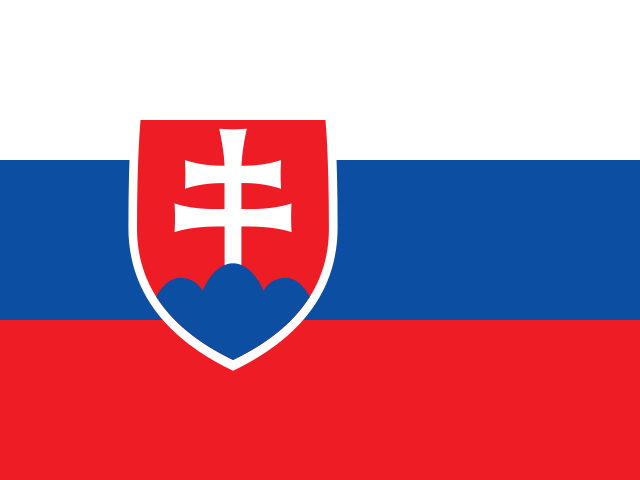
A Pan-Slavic tricolour of white, blue and red in three equal horizontal bands, with the national coat of arms on the hoist half of the flag: a silver double cross, which the law allows to be drawn white, rising from the middle and higher hill of a blue three-mount on a red early-Gothic shield. Article 8 of the constitution names four state symbols and Article 9 describes them without interpreting any of them, and the 1993 act on the state symbols, which prescribes the flag in detail, interprets nothing either. A government office rather than the constitution or the flag act reads the double cross as a Christian emblem and the three hills as the ranges of Tatra, Fatra and Matra.
Slovakia FACTS ◢
| Capital | Bratislava |
|---|---|
| Continent | Europe |
| Population | 5,413,813 (2025) |
| Area | 49,034 km² |
| Population density | 110/km² |
| Currency | Euro (EUR) |
| Official language | Slovak |
| Calling code | +421 |
| Internet TLD | .sk |
| Time zone | UTC+01:00 |
| Drives on the | Right |
| ISO codes | SK / SVK |
DID YOU KNOW? ◢
- Bratislava is the only national capital that borders two other countries, Austria and Hungary.
- It has one of the highest numbers of castles and chateaux per capita in the world.
- The High Tatras are the smallest high-mountain range in the world, yet still rise above 2,600 metres.
- It's home to some of the world's most striking ice caves and hundreds of natural mineral springs.
Slovakia QUICK ANSWERS ◢
What is the capital of Slovakia?
The capital of Slovakia is Bratislava.
What is the population of Slovakia?
Slovakia had a population of 5,413,813 in 2025.
What currency does Slovakia use?
Slovakia uses the Euro (EUR).
What languages are spoken in Slovakia?
The official language of Slovakia is Slovak.
Think you know your flags? Play Flag Daily → · Browse all countries →
MORE ON THE FLAG ◢
Ask what Slovakia's flag means and you get a confident answer about three mountain ranges and a Christian cross. Ask the constitution and the flag act and you get silence, spelled out at extraordinary length.
The Constitution of the Slovak Republic describes the flag in two sentences. The flag statute that fills in the rest runs, as it now stands, to twenty-two numbered sections with five annexes and a fining power. That statute goes down to a white border where the shield meets the blue and the red, one hundredth of the flag's length wide. Between them the two instruments never attach a meaning to any colour, hill or arm of the cross.
Somebody does. It is the Úrad vlády Slovenskej republiky, the Government Office, on its own public page about the state emblem. That distinction is the whole story, and it is worth knowing which half you are quoting.
Key Takeaways
- Slovakia's constitution names four state symbols in Article 8 and describes them in Article 9. Neither article interprets anything, and every consolidated version Slov-Lex publishes carries both word for word identically.
- The flag statute calls the double cross silver, then permits white in its place. White is the substitute, not the specification.
- The Tatra, Fatra and Mátra reading of Slovakia's three hills is published by the Government Office. It is not in the constitution, not in the statute, and not on the Presidency's own symbols page.
- Slovakia's official flag carried no shield at all between March 1990 and September 1992.
- A 2019 amendment created a colourless national symbol, the cross and hills with no tinctures, that any person may use so long as the use is dignified.
| Instrument | In force | What it fixes about the flag or the device | Meaning assigned |
|---|---|---|---|
| Ústavný zákon SNR č. 50/1990 Zb., Čl. 3 | 1 Mar 1990 to 30 Sep 1992 | Equal horizontal stripes of white, blue and red, one below another, at 2:3, with no shield | None |
| Zákon SNR č. 51/1990 Zb. | 1 Mar 1990 to 21 Mar 1993 | Nothing about the flag's design. Who may use it, and when | None |
| Ústava SR č. 460/1992 Zb., Čl. 9(2) | from 1 Oct 1992 | Longitudinal stripes of white, blue and red, plus the state emblem on the front half of the sheet | None |
| Zákon NR SR č. 63/1993 Z. z., § 7 | from 22 Mar 1993 | Equal stripe widths, the emblem's placement and height, the white border, no outline, 2:3 | None |
| Zákon č. 126/2019 Z. z. | from 15 May 2019 | Inserts § 6a and § 13b, two colourless versions of the device | None |
Slovakia's cross is silver in law and white by permission
One detail of this flag is reported wrong more or less everywhere, and it is a colour word. The statute corrects it in its own next breath.
Section 2(1) of zákon č. 63/1993 Z. z. blazons the emblem. On a red early-Gothic shield, it says, a double silver cross, raised on the middle and higher hill of a blue three-mount: "na červenom ranogotickom štíte dvojitý strieborný kríž, vztýčený na strednom vyvýšenom vŕšku modrého trojvršia". Article 9(1) of the constitution describes the emblem in the same terms.
The legal tincture is silver and not white, and the next provision hands the practical answer back. The silver of the double cross may be replaced by white in colour reproduction: "Striebornú farbu dvojitého kríža v štátnom znaku možno pri jeho farebnom vyobrazení nahradiť i bielou farbou."
So the Act's own annexes print a white cross while the Act's own text calls it silver. Both are correct, and only one of them is the specification. The Government Office's own downloadable drawing of the flag fills the cross with plain #ffffff, the shield with #ed1c24 and the hills with #254aa5 - and no Slovak instrument fixes any of those three values, so they are that office's file rather than the law's palette.
The statute is equally precise about the shape. Section 2(1) continues: "Driek a ramená kríža sú na koncoch rozšírené a vhĺbené, vrchy sú oblé." The shaft and the arms of the cross are widened and hollowed at their ends, and the hills are rounded. Annex 1 to the Act prints the emblem four ways: plain, outlined, in line only, and in heraldic hatching.
Where the Tatra, Fatra and Mátra reading actually comes from
It comes from the Government Office, and it says so in one sentence on a public page.
Under the heading Štátny znak, the Úrad vlády writes: "Trojvŕšie symbolizuje tri karpatské pohoria Tatry, Fatru a Mátru". The three-mount symbolises three Carpathian ranges, the Tatras, the Fatra and the Mátra - and the page adds, in a parenthesis of its own, that the Mátra now lies in Hungary. The same page gives the cross its reading: "Dvojkrížom sa Slovensko hlási ku kresťanstvu a zároveň k tradícii sv. Cyrila a Metoda, ktorí sem v období Veľkej Moravy (9. storočie) priniesli kresťanstvo." By the double cross Slovakia declares for Christianity and for the tradition of Saints Cyril and Methodius, who brought Christianity to Great Moravia in the ninth century.
That is a real state source saying a real thing, and it is worth quoting as what it is, which is the Government Office's account of the emblem.
Other arms of the Slovak state publish descriptions of the same emblem and give it no meaning at all. The Presidency's symbols page restates the statute's description and stops. The Ministry of Interior's state-symbols leaflet does the same, at three pages, and never reaches symbolism either. That leaflet is dated 31 December 2008 and has not kept up with the Act it summarises: it gives the fine ceiling as 6,638 euros where section 14(1) now says 7,000, sends you to the obvodný úrad where the Act now says okresný, and cites section 3(4) to (6) where the Act now says 3(3) to (6). It is its own argument for reading a statute rather than a summary of one.
So the honest form of the answer is that Slovakia's flag has an official description and a semi-official interpretation, and they live in different documents. If you want the ranges named, one government office will name them for you. If you want the law to name them, it does not.
For two and a half years, Slovakia's flag had no shield on it
This is the part that surprises people who assume the design arrived whole.
The Slovak National Council passed ústavný zákon č. 50/1990 Zb. on 1 March 1990, while Slovakia was still a federal republic inside Czechoslovakia. Article 1 renamed the Slovak Socialist Republic to the Slovak Republic. Article 3 defined its flag: "Štátna vlajka Slovenskej republiky sa skladá z troch rovnakých vodorovných pruhov bieleho, modrého a červeného, usporiadaných pod sebou. Jej rozmery sú 2:3." Equal horizontal stripes of white, blue and red, one below another, in the proportions 2:3, and no emblem of any kind on them.
Slov-Lex records that instrument as in force from 1 March 1990 to 30 September 1992, and never amended.
The shield arrives with the constitution. Article 9(2) of the 1992 text reads: "Štátna vlajka Slovenskej republiky sa skladá z troch pozdĺžnych pruhov - bieleho, modrého a červeného. Na prednej polovici listu štátnej vlajky Slovenskej republiky je štátny znak Slovenskej republiky." The state emblem is placed on the front half of the flag's sheet. The constitution was approved on 1 September 1992 and took effect on the day of its promulgation, 1 October 1992 - three months before Czechoslovakia dissolved.
None of the instruments gives a reason for adding the shield, and the Government Office does not offer one either. What it does say, on its flag page, is that a white, blue and red horizontal stripe is also found on the Russian or the Slovenian flag, and that these are known as the Pan-Slavic colours. Its word there is zástave rather than vlajka, a distinction Slovak law draws and one this page comes back to. It stops there. The obvious inference is available to any reader. It is simply not something either instrument has written down, and those two things are not the same claim.
The same page dates the flag itself far earlier: officially introduced on 1 January 1993, it says, but originating in 1848. The emblem page puts the device's first appearance as a symbol of Slovakia in 1848 and 1849.
The measurements section 7 fixes, and the one it leaves out
Zákon č. 63/1993 Z. z. was passed on 18 February 1993, promulgated on 22 March 1993, and took effect that day. Section 7(1) is where the flag becomes buildable.
It restores what the constitution left out - the stripes are "rovnakej šírky", of equal width - and then adds the geometry. The emblem is equidistant from the top, front and bottom edges of the flag, and its height equals half the flag's height. Where the shield meets any colour other than white there is a white border, "široký jednu stotinu dĺžky štátnej vlajky", one hundredth of the flag's length. On the flag the emblem is drawn with no outline at all, and the flag is the only place the Act requires that. The ratio is fixed: "Pomer strán štátnej vlajky je 2:3."
Annex 2 to the Act prints two drawings: the flag as flown, and a zostavovací nákres, a construction drawing marked up with the fractions - quarters down the hoist, thirds down the fly, and 1/100 for the border.
What it never prints is a colour standard. There is no Pantone value, no CMYK breakdown and no textile reference in the flag provisions or in the annexes that draw the flag and the emblem. Slovakia specifies its flag geometrically and leaves the three colours as the words white, blue and red.
The Act is also direct about conduct. It requires respect for the symbols in terms - "Každý je povinný zachovávať úctu k štátnym symbolom Slovenskej republiky" - forbids flying a damaged or dirty flag, forbids tying it into a rosette, and since 2019 extends the whole regime to electronic communication and digital reproduction. A district office may fine a legal person up to 7,000 euros for the breaches section 14(1) lists.
A flag, a zástava and a koruhva are three different objects
English collapses these into one word and Slovak law does not, so translated descriptions of this flag often disagree with each other for no visible reason.
The štátna vlajka is the flag proper, hoisted on a flagpole. The štátna zástava, under section 10, is formed from the flag but "je vždy pevne spojená so žrďou alebo priečnym rahnom" - always firmly attached to a staff or a crossbar - and its length may not exceed three times its width. It is a distinct legal object with its own annex. That three-to-one limit is older than the Act: the same sentence, word for word, is section 6(1) of the 1990 usage law the flag act repealed.
The koruhva is the vertical hanging form, and section 10(2) governs the one thing that would otherwise go wrong: "Na štátnej zástave použitej vo forme koruhvy sa štátny znak nachádza vo zvislej polohe." When the zástava is used as a koruhva the emblem stands upright, so the stripes turn ninety degrees and the shield does not turn with them.
Annex 3 prints the zástava, the koruhva and a stolová koruhva, the table version. If you are trying to place Slovakia from a flag hanging vertically outside a building - a routine problem in Flag Daily, where one flag arrives each day and you get three guesses - the upright shield is what section 10(2) prescribes for that form.
The cross without its colours is a separate legal thing
In May 2019 the National Council added two provisions that most descriptions of this flag miss entirely, and both concern the device rather than the flag.
Zákon č. 126/2019 Z. z. inserted section 6a, "Znamenie štátneho znaku", the charge of the state emblem: "Znamenie štátneho znaku tvorí dvojitý kríž vztýčený na strednom vyvýšenom vŕšku trojvršia." The same double cross on the same middle hill, with every tincture stripped out and neither the red shield nor the blue hills present.
The same Act inserted section 13b, "Národný symbol": "Národný symbol tvorí dvojitý kríž vztýčený na strednom vŕšku trojvršia." Both provisions describe the same device with the same run of words, "dvojitý kríž vztýčený na strednom" and then the hill, and section 13b drops "vyvýšenom", so its hill is simply the middle one rather than the middle and higher one. The subjects differ too, one naming the charge of the state emblem and the other the national symbol, and section 6a runs to a second sentence that section 13b does not have at all, the one about the widened and hollowed arm-ends and the rounded hills. The national symbol is the more loosely described of the two, and it comes with a different permission attached. Natural and legal persons may use the national symbol, provided the use is dignified.
So Slovak law now recognises three related things: a state emblem with fixed tinctures and a statutory list of official users, a colourless charge whose private use is limited exactly as the emblem's is, and a colourless national symbol anyone may use. The device on the flag is the first of the three. A private person putting the bare cross and hills on something is using the third, and section 13b is the provision that lets them.
What Article 8 of Slovakia's constitution does and does not do
Article 8 of the constitution is one sentence: "Štátnymi symbolmi Slovenskej republiky sú štátny znak, štátna vlajka, štátna pečať a štátna hymna." The state symbols of the Slovak Republic are the state emblem, the state flag, the state seal and the national anthem. Four of them, named, and nothing more.
The describing is done by Article 9, in five paragraphs - one each for the emblem, the flag, the seal and the anthem, and a fifth that hands the rest to Parliament: "Podrobnosti o štátnych symboloch Slovenskej republiky a ich používaní ustanoví zákon." Details are to be laid down by statute. That fifth paragraph is what zákon č. 63/1993 Z. z. exists to satisfy.
Both articles are worth checking against the current text rather than a summary, because the Slovak constitution has been amended repeatedly and the state-symbols articles have not moved with it. Slov-Lex publishes twenty-seven dated versions of the constitution besides the promulgated text and the one in force from 1 November 2025, and every one of them carries Article 8 and Article 9 word for word identically. This is not two endpoints agreeing with a gap in between. It is the whole series. The flag act has held just as still, and by the same test rather than a weaker one: Slov-Lex publishes eleven dated versions of it, and section 2(1), section 2(3), section 7(1), section 10(1) and section 10(2) read identically in every one of them. In more than thirty years of amendment to both instruments, nobody has added a meaning to either.
One boundary is worth stating plainly, because every negative claim on this page depends on it. What is being reported here is what four instruments say, read end to end: ústava č. 460/1992 Zb., zákon č. 63/1993 Z. z. with its five annexes, and the two laws of 1 March 1990 they replaced, ústavný zákon č. 50/1990 Zb. and zákon č. 51/1990 Zb. on the use of the symbols. The 2019 amendment is read inside the flag act's consolidated text rather than as a fifth instrument, so the table above lists it separately and this sentence does not. What none of it is is a claim about the parliamentary record. The explanatory memoranda and the debates behind all four were not opened for this article, and if a meaning was ever put on the record, that is where it would be.
The double cross and the three hills reach far back into the heraldry of the medieval Kingdom of Hungary, so the same cross appears on Hungary's arms and one of the three ranges the Government Office names sits on Hungarian soil today. Tracing that lineage is a question about heraldry rather than about Slovak law, and Slovak law is admirably clear that it is not answering it.
Frequently asked questions
What does the Slovak flag mean?
Officially, nothing. The Constitution of the Slovak Republic describes the flag in Article 9(2) and the flag statute, zákon č. 63/1993 Z. z., specifies it in detail, and neither assigns a meaning to the white, the blue, the red or any part of the shield. The Government Office publishes a reading - three Carpathian ranges for the hills, Christianity and the Cyril and Methodius tradition for the cross - but neither of those two instruments says it.
Is the double cross on Slovakia's flag white or silver?
Both, in a specific order. Article 9(1) of the constitution and section 2(1) of the flag statute both call it a silver cross. Section 2(3) of the statute then allows the silver to be replaced by white in colour reproduction, which is what happens in practice and what the Act's own annexes print.
Why is there a coat of arms on Slovakia's flag?
Because the 1992 constitution put it there. The previous instrument, ústavný zákon č. 50/1990 Zb., defined the Slovak flag as a bare white, blue and red tricolour with no emblem at all, and that version was in force from 1 March 1990 to 30 September 1992. Neither the constitution nor the flag statute gives a reason, and the state pages describing the flag do not either, though the Government Office does note that the same three horizontal stripes appear on the Russian or the Slovenian flag.
What do the three hills on the Slovak flag stand for?
The Government Office of the Slovak Republic names them as three Carpathian ranges, the Tatras, the Fatra and the Mátra, the last of which now lies in Hungary. That identification appears on its state-emblem page and nowhere in the constitution or the flag statute, both of which call the charge simply a blue three-mount with the cross raised on its middle and higher hill.
What is the difference between the Slovak štátna vlajka and štátna zástava?
The štátna vlajka is the flag hoisted on a flagpole. The štátna zástava is formed from the same design but is always fixed to a staff or a crossbar, and its length may not exceed three times its width. Section 10 of the flag statute treats them as separate objects and gives the zástava its own annex, including the koruhva, the vertical hanging form, in which the shield stays upright while the stripes run vertically.
Sources
- Národná rada Slovenskej republiky, Ústava Slovenskej republiky č. 460/1992 Zb., consolidated text effective 1 November 2025 and the promulgated text effective 1 October 1992, via Slov-Lex, the official statute book - retrieved 26 August 2026.
- Národná rada Slovenskej republiky, Zákon č. 63/1993 Z. z. o štátnych symboloch Slovenskej republiky a ich používaní, consolidated text effective 24 May 2019, with annexes 1 to 5, via Slov-Lex - retrieved 26 August 2026.
- Slovenská národná rada, Ústavný zákon č. 50/1990 Zb. o názve, štátnom znaku, štátnej vlajke, štátnej pečati a o štátnej hymne Slovenskej republiky, text effective 1 March 1990 to 30 September 1992, via Slov-Lex - retrieved 26 August 2026.
- Slovenská národná rada, Zákon č. 51/1990 Zb. o používaní štátneho znaku, štátnej vlajky, štátnej pečate a štátnej hymny Slovenskej republiky, consolidated text effective 1 January 1993, the second of that act's two time-versions; in force until 21 March 1993, the flag act having repealed it with effect from 22 March - retrieved 26 August 2026.
- Národná rada Slovenskej republiky, Zákon č. 126/2019 Z. z., amending the flag statute with effect from 15 May 2019, via Slov-Lex - retrieved 26 August 2026.
- Úrad vlády Slovenskej republiky, Štátny znak - retrieved 26 August 2026.
- Úrad vlády Slovenskej republiky, Štátna vlajka - retrieved 26 August 2026.
- Kancelária prezidenta Slovenskej republiky, Symboly - the live page refuses automated requests, so it was read from the Internet Archive capture of 7 July 2026 - retrieved 26 August 2026.
- Ministerstvo vnútra Slovenskej republiky, Štátne symboly, leaflet dated Bratislava, 31 December 2008 - retrieved 26 August 2026.
PLAY ANOTHER →
Five questions a day. Everyone gets the same five.
FIVE QUESTIONSDAILYGuess the CountryThree clues, three guesses. Work out where in the world it is.
THREE CLUESDAILYDaily CryptogramOne quote, one scrambled alphabet. Crack it before tomorrow.
CRACK THE QUOTEDAILYOn This DayOne thing that happened today in history. Every day, a new one.
TODAY IN HISTORY