
Slovenia
A pocket-sized slice of Europe where the Alps, the Adriatic and karst caves all fit in a country smaller than New Jersey. Slovenia is so leafy that more than half of it is forest.
WHAT THE FLAG MEANS ◢
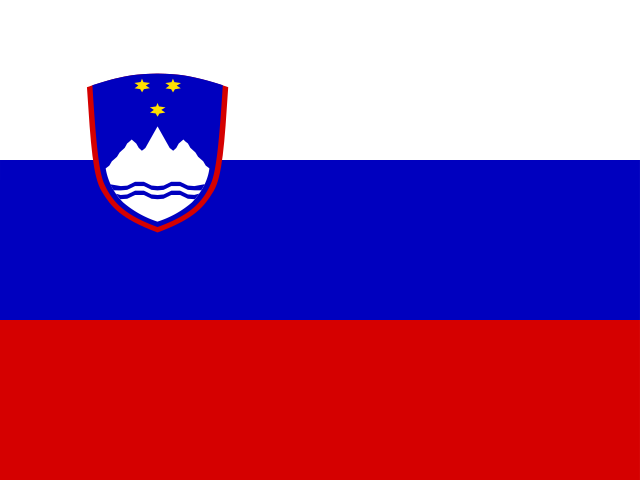
The Slovene national flag with the coat of arms added, which is how article 6 of the constitution defines it: a horizontal tricolour of white, blue and red in the ratio one to two, each band a third of the flag, with the arms in the upper hoist so that half of them lie in the white band and half in the blue. The same article blazons the arms and interprets one element of them itself: Mount Triglav in white on blue, beneath it two undulating blue lines symbolising the sea and rivers, and above it three golden six-pointed stars forming a downward-pointing triangle, the shield bordered in red. The three stars are conventionally traced to the arms of the Counts of Celje.
Slovenia FACTS ◢
| Capital | Ljubljana |
|---|---|
| Continent | Europe |
| Population | 2,130,986 (2025) |
| Area | 20,271 km² |
| Population density | 105/km² |
| Currency | Euro (EUR) |
| Official language | Slovene |
| Calling code | +386 |
| Internet TLD | .si |
| Time zone | UTC+01:00 |
| Drives on the | Right |
| ISO codes | SI / SVN |
DID YOU KNOW? ◢
- Around 60% of the country is covered in forest, making it one of the greenest nations in Europe.
- The word 'karst' comes from Slovenia's limestone Kras region, giving geologists everywhere a name for cave-riddled landscapes.
- Lake Bled has a tiny island with a church, reached by traditional hand-rowed 'pletna' boats.
- Ljubljana's name conveniently contains the word 'love', which the city leans into hard.
- The Postojna Cave is home to the olm, a blind, cave-dwelling salamander that can live for decades without eating.
Slovenia QUICK ANSWERS ◢
What is the capital of Slovenia?
The capital of Slovenia is Ljubljana.
What is the population of Slovenia?
Slovenia had a population of 2,130,986 in 2025.
What currency does Slovenia use?
Slovenia uses the Euro (EUR).
What languages are spoken in Slovenia?
The official language of Slovenia is Slovene.
Think you know your flags? Play Flag Daily → · Browse all countries →
MORE ON THE FLAG ◢
One clause of the Slovenian constitution says what a piece of the flag means. It is about the water.
Nine of the other ten sentences are drawing instructions or designations. Colours, counts, positions, a ratio, a fraction of the field for each band, the name of the anthem. The eleventh sends the whole question of using them off to a statute. None of it is given a reading.
Article 6 runs to eleven sentences across four paragraphs, and exactly one clause in the whole of it says what something means. The pattern repeats everywhere Slovenia writes about its symbols. There are two flags rather than one. The colours are pinned twice, in two different notations. The statute that governs all of it carries one gazette reference and, on the register's own record, no amendments. And the government page that publishes the lot will tell you what the European Union's stars mean while saying nothing about Slovenia's own.
Key Takeaways
- Article 6 runs to eleven sentences across four paragraphs and contains exactly one interpretive clause, five words long, about the two wavy blue lines beneath Triglav.
- Slovenia has two legally defined flags. The constitution defines the state flag as the Slovene national flag with the coat of arms added, and the 1994 Act gives the plain tricolour a different thing to signify: belonging to the Slovene nation, where the arms-bearing flag marks belonging to the Republic.
- The three golden six-pointed stars are unexplained in the constitution, in the 1994 Act and on the government's own symbols page.
- The government's own page of national symbols does explain the twelve stars on the European Union flag, and its Slovene and English versions give different meanings for them.
- The register records no amendment to the Act between 1994 and the May 2023 capture read for this article, and its fines are still written in tolars.
Article 6, in the language it was written in
The Slovenian constitution was published in the Uradni list on 28 December 1991, and its sixth article deals with the arms, the flag and the anthem together. The blazon runs:
"Grb Slovenije ima obliko ščita. V sredini ščita je na modri podlagi lik Triglava v beli barvi, pod njim sta dve valoviti modri črti, ki ponazarjata morje in reke, nad njim pa so v obliki navzdol obrnjenega trikotnika razporejene tri zlate šesterokrake zvezde. Ščit je ob stranicah rdeče obrobljen. Grb se oblikuje po določenem geometrijskem in barvnem pravilu."
Rendered into English, that reads: the arms of Slovenia have the form of a shield. In the middle of the shield, on a blue ground, is the figure of Triglav in white. Below it are two wavy blue lines, which represent the sea and rivers. Above it, arranged in the shape of a downward-turned triangle, are three golden six-pointed stars. The shield is edged in red along its sides. The arms are formed according to a determined geometric and colour rule.
The operative words for our purposes are five: "ki ponazarjata morje in reke". They attach to the two lines and to nothing else in the sentence. The verb, ponazarjati, is the ordinary Slovene word for to illustrate or represent, and the constitution uses it once.
Take away those five words and the rest of the paragraph is pure specification. In the Slovene, the second sentence gives a white figure on a blue ground, two wavy blue lines below it, and gold stars with six points each above, arranged point-down. The third gives the red edging along the sides. The fourth sends you to a determined geometric and colour rule. Every adjective in them is a drawing instruction. No adjective is a reading.
The next paragraph does the flag, and it opens with something worth stopping on:
"Zastava Slovenije je belo-modro-rdeča slovenska narodna zastava z grbom Slovenije. Razmerje med širino in dolžino zastave je ena proti dve. Barve zastave gredo po vrstnem redu: bela, modra, rdeča. Vsaka barva zavzema po širini tretjino prostora zastave. Grb je v levem gornjem delu zastave tako, da sega z eno polovico v belo polje, z drugo pa v modro."
The flag of Slovenia is the white, blue and red Slovene national flag with the coat of arms of Slovenia. The ratio of width to length is one to two. The colours run in the order white, blue, red, each taking a third of the flag across its width, and the arms are placed in the upper left part so that one half of them falls in the white field and the other in the blue.
Everything after the first sentence is a specification. The first sentence is the interesting one: the constitution defines the state flag by pointing at another flag.
Slovenia has two flags, and only one of them is the state's
The other flag is real, and it has its own law. The Act Regulating the Coat-of-Arms, Flag and Anthem of the Republic of Slovenia and the Flag of the Slovenian Nation was adopted on 20 October 1994, published in the Uradni list a week later, and came into force on 11 November 1994.
Its second and third articles set the two flags against each other, one article apart, with a second paragraph of article 2 in between. Article 2 says that the arms, flag and anthem "označujejo pripadnost Republiki Sloveniji", they mark belonging to the Republic of Slovenia. Article 3 opens: "Slovenska narodna zastava označuje pripadnost slovenskemu narodu", the Slovene national flag marks belonging to the Slovene nation.
Same three colours, same order, same proportions. One shield between them, and two different things being belonged to.
Article 3 of the Act then measures the national flag, picking up mid-paragraph after a first sentence that names it as the white, blue and red flag. The measurements are the ones you have already read:
"Razmerje med širino in dolžino zastave je ena proti dve. Barve zastave se vrste po temle vrstnem redu: bela, modra, rdeča. Vsaka barva zavzema po širini tretjino prostora zastave."
The ratio of width to length is one to two. The colours run in the order white, blue, red. Each colour takes a third of the flag across its width.
That is article 6 of the constitution again, almost verbatim. The Act swaps the verb, "gredo" in the constitution against "se vrste" in the Act, and inserts one demonstrative, "temle", so that the colours run in this following order rather than simply in order. Two instruments, the same one to two, the same thirds, and one shield deciding which of them you are flying.
| Where it comes from | What it fixes | What it interprets |
|---|---|---|
| Constitution art. 6, first paragraph | The blazon of the arms: Triglav, wavy lines, three stars, red edging | The two wavy lines, as the sea and rivers |
| Constitution art. 6, second paragraph | The state flag is the Slovene national flag plus the arms, one to two, colours in thirds | Nothing |
| 1994 Act art. 2 | Nothing about appearance | The arms, flag and anthem mark belonging to the Republic |
| 1994 Act art. 3 | The national flag: one to two, white, blue, red, each a third | The national flag marks belonging to the Slovene nation |
| 1994 Act art. 4 | Geometric, artistic and colour rules, declared part of the Act | Nothing |
What Article 6 does not say about the three stars
The stars are the most distinctive thing on the shield and the least explained. The constitution gives their number, their colour, their point count and their arrangement, and stops.
The reading in circulation is that they come from the arms of the Counts of Celje, the late medieval dynasty whose shield is said to have carried three golden six-pointed stars on blue. It is a plausible reading and it is repeated almost everywhere. It is also not in the constitution, not in the 1994 Act, and not on the government's own page of national symbols, all three of which were read for this article.
That is worth saying plainly rather than hedging around, because the alternative is to attribute a meaning to a state that has declined to give one. The honest position is that Slovenia's constitution names three stars and lets the reader wonder.
Slovenia is not alone in this among the countries that use the same three colours. The Croatian flag is the neighbouring one to read beside it.
Slovenia's shapes are inside the statute and its colours are fixed twice
The constitution had already said, in the last sentence of its blazon, that the arms are formed according to a determined geometric and colour rule. What article 4 of the 1994 Act adds is where that rule is kept.
"Geometrijska, likovna ter barvna pravila za oblikovanje grba, zastave in slovenske narodne zastave ter besedilo in notni zapis melodije himne so sestavni del tega zakona."
The geometric, artistic and colour rules for forming the arms, the flag and the Slovene national flag, together with the words and the musical notation of the anthem, are an integral part of this Act. The constitution points at a rule. The Act swallows it. Nowhere does either instrument give the shapes in words to the precision the drawings carry: the geometry is drawn, and the drawing is inside the statute.
The government publishes those rules, and it publishes the colours twice over in two different systems. In process ink the blue is C100 M60 Y0 K10, the red is C0 M100 Y100 K0, the yellow is C0 M10 Y100 K0. Then, under the heading SCOTDIC CODE 777, it gives the same colours again in a second notation: blue N46 N722509, red N23 N074014, yellow N6 N197512, white N1 N95.
The page adds nothing to that second set beyond its own heading, which reads "SCOTDIC CODE 777" and then names the scheme an international colour codification system, with a bracketed number after it. So a state that never says what its colours mean has been careful enough to fix them twice over, once in the four process inks and once against an international codification identified by number.
The English version adds a number the Slovene does not
The government's symbols page exists in Slovene and in English, and the two do not quite agree about the shield.
The Slovene, quoting the constitution, says the shield is edged in red "ob stranicah", along the sides, with no count. The English page renders the same clause as: "The shield features a red border on two of its sides."
Two may well be right as a description of the drawing the government publishes. It is not in the instrument. This is the ordinary way a detail enters circulation: a translation makes a sentence more helpful than its original, the helpful version travels, and a reader who never sees the Slovene ends up believing the constitution counted the sides.
The same page gives the EU's stars two different meanings
The government does the same thing in the other direction with the European Union's flag, and there the two languages disagree with each other rather than with a source. The Slovene says the number of the EU's twelve stars "pomeni popolnost, celovitost in enotnost", means perfection, completeness and unity. The English says "The number of stars symbolises harmony, unity and solidarity". One word overlaps.
Which leaves the page in a curious position. It gives a meaning for the European Union's twelve stars, twice, in two different wordings, and gives none at all for the three stars Slovenia has carried since 1991.
A flag law still written in a currency that is gone
The 1994 Act has never been amended, on the register's own record. Its official citation there is one gazette reference and one only, Uradni list RS number 67/94. The register also shows what did not happen: three amending Acts are listed against it as planned interventions, two of them under the reserved short title ZGZH-A, and not one of the three has a gazette number against it. In the register as it stood when it was captured in May 2023, the only instrument recorded as affecting the Act was a Constitutional Court decision published in Uradni list 14/99, on the conformity of three of its provisions with the constitution.
One consequence is visible on the face of the text. Its penalty articles are denominated in tolars: a legal person faces a fine of at least 150,000 tolars for using the arms or a flag in a form or with a content contrary to the constitution or the Act, and at least 150,000 tolars for registering the arms, the flag, or their component parts as a trademark, a model or a design. Slovenia's currency is the euro, and the Act still says tolars.
That trademark prohibition is the Act's article 8, and it is broader than it first sounds in two directions. On the objects: it covers the arms and the state flag, and their component parts, "njunih sestavnih delov", the dual form attaching to those two, and then, listed separately, the Slovene national flag and the words and the musical notation of the anthem. On the acts: it prohibits not only registering them as a mark, model or design but using them for marking goods or services at all. The only carve-out is for collective marks whose holders are ministries or the Government.
Enforcement is odder still. The Act's article 25 assigns supervision of the trademark ban, and of the ban on performing the anthem for advertising, to the market inspectorate. In Slovenia, misusing the national flag commercially is a trading-standards matter.
Its article 7 covers the physical object: it is not permitted to use the arms or either flag if they are damaged or outwardly unfit for use, or in a way contrary to public order or such that the reputation of the Republic is diminished. None of which tells you what any of it means. If you would rather find out how many of these you can recognise without being told, Flag Daily shows you one a day and gives you three guesses at the country.
Frequently asked questions
What do the colours on the Slovenian flag mean?
Slovenian law does not say. Article 6 of the constitution fixes the order as white, blue and red, each occupying a third of the flag by width, and the 1994 Act repeats the same specification for the Slovene national flag. Neither assigns the three colours a meaning.
The Pan-Slavic reading, which several neighbours share and which this page's own summary of the flag uses, is conventional rather than official. No Slovenian instrument read for this article states it.
What do the three stars on the Slovenian coat of arms represent?
The constitution does not say. Article 6 gives the stars as three, golden, six-pointed and arranged in a downward-pointing triangle, and assigns them no meaning; the usual attribution, to the arms of the Counts of Celje, appears in no Slovenian instrument read for this article.
Those three sources are the constitution, the 1994 Act on the arms, flag and anthem, and the government's own page of national symbols. None of the three mentions Celje, and none offers any other account of where the stars came from.
Does the Slovenian constitution explain any part of the flag?
One part. Article 6 describes the two wavy blue lines beneath Mount Triglav as lines "ki ponazarjata morje in reke", which represent the sea and rivers. That is the only interpretive clause in the article.
The rest of the article's eleven sentences is specification and designation, the mountain, the stars, the red edging, the colours, the flag's proportions and the name of the anthem, and it closes with one sentence sending the use of all three to a statute.
What is the difference between the flag of Slovenia and the Slovene national flag?
The coat of arms. The constitution defines the state flag as the white, blue and red Slovene national flag with the arms of Slovenia added, and the national flag is the same tricolour without them.
The 1994 Act keeps them apart by what they signify. The arms, flag and anthem mark belonging to the Republic of Slovenia. The Slovene national flag marks belonging to the Slovene nation.
What are the official colours of the Slovenian flag?
The 1994 Act makes the colour rule an integral part of the Act and the government publishes it in two systems. In CMYK the blue is C100 M60 Y0 K10, the red C0 M100 Y100 K0 and the yellow C0 M10 Y100 K0, with white at zero across all four channels.
The same colours are given a second time under the heading SCOTDIC CODE 777, which the page names as an international colour codification system: blue N46 N722509, red N23 N074014, yellow N6 N197512 and white N1 N95.
Sources
- Ustava Republike Slovenije, article 6 - Uradni list Republike Slovenije, number 33/1991, 28 December 1991. Retrieved 30 August 2026.
- Zakon o grbu, zastavi in himni Republike Slovenije ter o slovenski narodni zastavi - Uradni list Republike Slovenije, number 67/1994, 27 October 1994. Retrieved 30 August 2026.
- Register entry for that Act, with its citation history - Pravno-informacijski sistem Republike Slovenije. The current site is a single-page application that returns no text to a plain request, so the register entry was read from the Internet Archive capture of 10 May 2023, which records the adoption, publication and commencement dates, the official English title, and a citation of one gazette reference only. Retrieved 30 August 2026.
- Državni simboli - Government of the Republic of Slovenia, Slovene version, carrying the CMYK and SCOTDIC colour rules and the downloadable geometric rule. Retrieved 30 August 2026.
- National symbols - Government of the Republic of Slovenia, English version of the same page. Retrieved 30 August 2026.
- Geometrijsko pravilo za oblikovanje grba Republike Slovenije - Government of the Republic of Slovenia, the drawing that article 4 of the 1994 Act makes part of the Act. Retrieved 30 August 2026.
PLAY ANOTHER →
One quote, one scrambled alphabet. Crack it before tomorrow.
CRACK THE QUOTEDAILYOn This DayOne thing that happened today in history. Every day, a new one.
TODAY IN HISTORYDAILYGuess the CountryThree clues, three guesses. Work out where in the world it is.
THREE CLUESDAILYDaily CodeA short message, hidden in a different cipher every day.
ONE CIPHER A DAY