
Qatar
Qatar is a small desert peninsula jutting into the Persian Gulf that turned vast natural-gas reserves into gleaming skylines, and became the first Arab nation to host the FIFA World Cup.
WHAT THE FLAG MEANS ◢
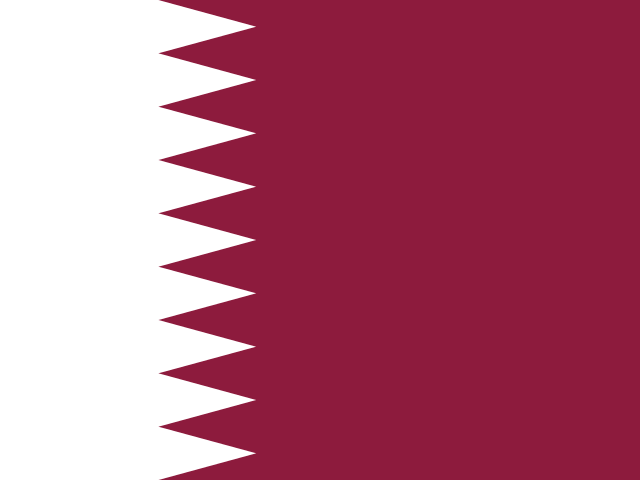
A maroon field with a broad white band at the hoist, the two divided by a nine-point serrated line. Qatar National Library reads the nine points as marking Qatar as the ninth member of the Trucial Coast Convention of 1916. It gives the maroon a practical origin rather than a symbolic one: Qatari flags were coloured red for centuries with a dye from Bin Ghannam Island near Al Khor, prolonged sun faded that red to a purplish maroon, and when the British Navy proposed plain red in 1932 Qatar kept the faded colour for its connection to its own heritage. The Ministry of Foreign Affairs publishes the maroon as Pantone 1955 C; Law No. 14 of 2012 governs the flag and assigns the colours no meaning.
Qatar FACTS ◢
| Capital | Doha |
|---|---|
| Continent | Asia |
| Population | 2,972,215 (2025) |
| Area | 11,437 km² |
| Population density | 260/km² |
| Currency | Qatari riyal (QAR) |
| Official language | Arabic |
| Calling code | +974 |
| Internet TLD | .qa |
| Time zone | UTC+03:00 |
| Drives on the | Right |
| ISO codes | QA / QAT |
DID YOU KNOW? ◢
- It hosted the 2022 FIFA World Cup, the first ever held in the Arab world.
- It holds some of the world's largest natural gas reserves, shared in a single giant offshore field.
- Its capital, Doha, has transformed from a pearling and fishing town into a modern skyline in just decades.
- Nearly the entire country is flat desert, with almost no permanent rivers or lakes.
- Before oil and gas, its economy relied heavily on pearl diving in the Gulf.
Qatar QUICK ANSWERS ◢
What is the capital of Qatar?
The capital of Qatar is Doha.
What is the population of Qatar?
Qatar had a population of 2,972,215 in 2025.
What currency does Qatar use?
Qatar uses the Qatari riyal (QAR).
What languages are spoken in Qatar?
The official language of Qatar is Arabic.
Think you know your flags? Play Flag Daily → · Browse all countries →
MORE ON THE FLAG ◢
The Qatar flag is maroon because the dye faded. Qataris coloured their flags red for centuries using a dye that came from Bin Ghannam Island near Al Khor, and under prolonged sun that red turned a purplish-red. When the British Navy suggested in 1932 that Qatar adopt an official flag and proposed red for it, Qatar declined and kept the faded colour instead.
That account is not a legend picked up from a flag hobbyist. It is Qatar National Library's, and the same page goes out of its way to knock down the explanation you will find almost everywhere else.
Key Takeaways
- Qatar National Library states that the maroon comes from a sun-faded dye, and that the colours do not represent peace and bloodshed.
- When Britain proposed red in 1932, Qatar chose maroon because of the colour's connection to its own heritage.
- The flag briefly carried the word "Qatar" and ten red diamonds. Sheikh Ali bin Abdulla Al Thani removed both in 1960.
- The nine points mark Qatar as the ninth member of the Trucial Coast Convention of 1916.
- Law No. 14 of 2012 governs the flag. Its dimensions live in annexes the Emir may amend, and deliberate insult carries up to three years' imprisonment, a fine of up to 200,000 riyals, or either penalty alone.
Why is the Qatar flag maroon and not red?
Because maroon is what red became, and Qatar decided it preferred the result.
Qatar National Library, which holds the archives this story is told from, puts the sequence plainly. Qatari ancestors had been colouring their flags red for centuries with a dye originating from Bin Ghannam Island near Al Khor. Left in the Gulf sun, that dye faded to a purplish-red. By the time an official flag was on the agenda, the faded colour was the familiar one.
So in 1932, when the British Navy suggested the government design an official flag and proposed red, Qatar said no and chose maroon, in the Library's words "due to its deep connection to the country's culture and heritage".
The colour now has a reference number. Qatar's Ministry of Foreign Affairs publishes the flag as two colours, white and Al Adam (maroon), and gives the maroon as Pantone 1955 C. The flag is commonly called Al Adaam after the colour, the transliteration varying between the two spellings.
What do the nine points on the Qatar flag mean?
They mark Qatar as the ninth signatory of a treaty system, not nine of anything on the ground.
Qatar National Library reads the nine points along the notched edge as marking Qatar as the ninth member of the Trucial Coast Convention of 1916, the agreement that formalised its relationship with Britain. The serration is a diplomatic tally.
The Ministry of Foreign Affairs describes the same feature geometrically rather than historically, and the wording is worth having exactly, because most descriptions get the direction wrong:
Between the two colours, there are nine isosceles triangles, so that the base of the triangles is in the white area facing the flag hoist, while their heads are located in the 'Al Adam' part towards the flag itself.
In other words the white does not have nine points sticking out of it in the way it is usually drawn in the mind. Those triangles sit on the white, at the mast end, and their apexes push into the maroon. The Ministry also fixes which way round the flag hangs: raised from outside, the maroon flies free and the white is the side next to the mast.
What the Qatar flag's colours do not mean
This is where the usual account tells you something Qatar does not.
That account holds that the maroon stands for the blood shed in Qatar's wars and the white for peace. Qatar National Library addresses that claim directly and rejects it: "Contrary to popular belief, the white and maroon colours of the Qatari flag do not represent peace and bloodshed during times of war."
Officially, the specification is silent in the same direction. The Ministry of Foreign Affairs sets out the design, the layout, the two colours and the Pantone reference, and assigns no meaning to either colour. The country's Permanent Constitution does not fill the gap either. Article 3 says only that "The law stipulates the State flag, its emblem, its decorations, its badges, and its national anthem", delegating the whole question and describing nothing.
So on the colours themselves there are two official positions and they agree: one institution says what the colours are not, and the specification simply declines to say what they are. A meaning attached to the maroon anywhere else is somebody's reading, not Qatar's.
When did the Qatar flag stop changing?
1960, on the country's own account, which is earlier than the date usually given.
Qatar was already flying something close to today's flag by 1932. Shortly after that, the word "Qatar" in Arabic was added to it, along with ten red diamonds running down the serrated edge. According to the Library, citing official government records, Sheikh Ali bin Abdulla Al Thani reversed that in 1960: he kept the white, the purplish-red and the serrated points, and removed the diamonds and the word. By the Library's summary, Qatar has been flying its flag since 1960.
Elsewhere the flag is usually dated to 1971, the year of independence. Treat 1960 as the date Qatar itself gives for the design settling, and 1971 as a date about the country rather than about the cloth.
Qatar National Library points to the archival trail behind that whole sequence: a file of British correspondence and drawings in the Qatar Digital Library, called "Flags Flown by the Sheikh of Qatar", with material going back to August 1929 and taken from the British Library's India Office Records. The design arguments of the 1930s were being had in writing, and the paperwork survives.
How long is the Qatar flag?
An unusually long rectangle, and the exact proportion is harder to source than you would expect.
Law No. 14 of 2012 is the instrument in force. It states that the national flag "shall be, in terms of shape, design, colours, size, materials, configuration and performance requirements, according to the specifications set forth in" annexes attached to the law. Those annexes may be amended by a decision of the Emir. The dimensions are therefore delegated twice over: from the Constitution to the law, and from the law to a schedule that can be changed without new legislation.
Neither the law's published text on Qatar's legal portal nor the Ministry of Foreign Affairs' public flag page reproduces the annex figures, and the Arabic text of the law refers to its two annexes without setting them out either. The ratio widely quoted elsewhere is 11 to 28, which would make the flag more than two and a half times as long as it is tall.
That figure is not one this article can trace to either published official text, so it is offered as the circulating number rather than a verified one. What the specification does establish is the shape: a horizontal rectangle. What is conspicuous, next to the flags most people can picture, is how long it is. Set it beside the other country factsheets and it is the odd rectangle out.
What the law does to protect it
Law No. 14 of 2012 was issued on 16 December 2012 and published the following April. It is unusually specific about disrespect.
A flag that is damaged, torn, worn out or whose colours have faded may not be flown, displayed or circulated. That is a striking rule for a flag whose colour is itself the product of fading. The maroon on a modern flag is a fixed reference now, not a process left to run.
Using the flag for purposes contrary to its original use is prohibited, as is adding any words, pictures or designs to it, or using it commercially, as a brand or part of one, or for advertising. Manufacture, import and sale all require licences issued to the law's specifications.
Deliberately insulting the flag, by damaging it, removing it from where it is raised, or expressing contempt for it by any act or omission, carries imprisonment of up to three years, a fine of up to 200,000 riyals, or either penalty alone. Lesser violations, including trading in flags that do not meet the specifications, carry up to six months, up to 100,000 riyals, or either alone. Both provisions open with the same formula, "without prejudice to any more severe penalty" available elsewhere in Qatari law, so these are floors on the response rather than ceilings. Enforcement falls to an administrative unit named by the Emiri Diwan.
If you want to see how well you can pick the Gulf flags apart, Flag Daily runs one a day, and Bahrain is the nearest comparison.
Frequently asked questions
Why is the Qatar flag maroon instead of red?
Qatar National Library's account is that Qataris dyed their flags red for centuries with a dye from Bin Ghannam Island near Al Khor, and that prolonged sun turned the colour a purplish-red. When the British Navy proposed red for an official flag in 1932, Qatar chose maroon instead because of the colour's connection to its heritage.
What do the nine points on the Qatar flag represent?
Qatar's ninth place among the signatories of the Trucial Coast Convention of 1916. The Ministry of Foreign Affairs describes the feature as nine isosceles triangles whose bases sit in the white at the hoist and whose apexes point into the maroon.
Does the maroon on the Qatar flag stand for blood?
No, and Qatar National Library says so explicitly: contrary to popular belief, the white and maroon do not represent peace and bloodshed in war. The Ministry of Foreign Affairs specification assigns no meaning to either colour, and the Constitution delegates the flag to legislation without describing it.
What colour is the Qatar flag officially?
White and Al Adam, the maroon the flag is named for. The flag name is commonly transliterated Al Adaam. Qatar's Ministry of Foreign Affairs publishes the maroon as Pantone 1955 C, and the law requires that a flag whose colours have faded is not flown.
What is the penalty for disrespecting the Qatar flag?
Under Law No. 14 of 2012, deliberately insulting the flag carries imprisonment of up to three years, a fine of up to 200,000 riyals, or either penalty alone. Lesser breaches, such as selling flags that do not meet the official specifications, carry up to six months, up to 100,000 riyals, or either alone. Both provisions apply without prejudice to any more severe penalty available elsewhere in Qatari law.
Sources
- Al Meezan, Qatar's legal portal, Law No. 14 of 2012 Concerning the Qatari Flag (issued 16 December 2012, published 1 April 2013) - the delegation of the specifications to annexes, the amendment power, the prohibitions on additions and commercial use, the rule against flying a faded flag, the licensing of manufacture and sale, and both penalty provisions. Retrieved 10 August 2026.
- Ministry of Foreign Affairs, State of Qatar, National Flag - the two colours, Pantone 1955 C, the nine isosceles triangles and their orientation, and which side hangs at the mast. Retrieved 10 August 2026.
- Qatar National Library, The Qatari Flag: A Symbol of Pride and Dignity - the Bin Ghannam Island dye and its fading, the 1932 British proposal, the diamonds and the word "Qatar", their removal in 1960, the nine points and the 1916 convention, the rejection of the peace-and-bloodshed reading, and the Qatar Digital Library archive. Retrieved 10 August 2026.
- Comparative Constitutions Project, Permanent Constitution of the State of Qatar - article 3, which delegates the flag to legislation and describes nothing. Retrieved 10 August 2026.
PLAY ANOTHER →
One quote, one scrambled alphabet. Crack it before tomorrow.
CRACK THE QUOTEDAILYDaily CodeA short message, hidden in a different cipher every day.
ONE CIPHER A DAYDAILYGuess the CountryThree clues, three guesses. Work out where in the world it is.
THREE CLUESDAILYOn This DayOne thing that happened today in history. Every day, a new one.
TODAY IN HISTORY