
Bahrain
A small archipelago in the Persian Gulf whose name means 'two seas'. Bahrain was pearling in these warm waters long before oil ever entered the picture.
WHAT THE FLAG MEANS ◢
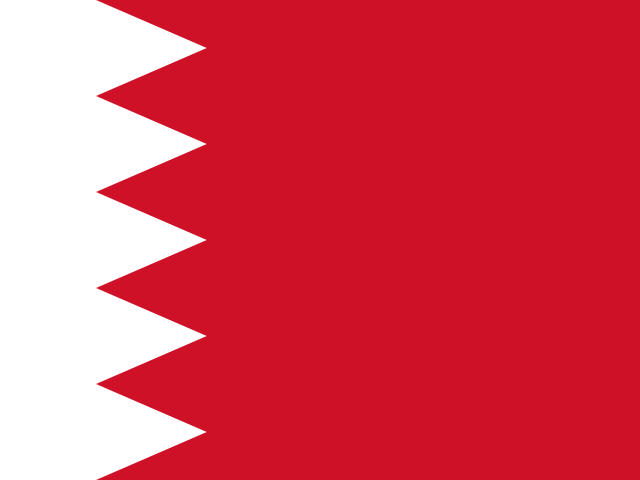
A white band at the hoist and a red field, divided by a serrated line of five white triangles. Decree-Law No. 4 of 2002 gives the white a quarter of the flag's length and says the five sections represent the five pillars of Islam; it assigns the two colours themselves no meaning. White beside red goes back to the General Treaty of 1820, which Bahrain's rulers signed.
Source: legalaffairs.gov.bh
Bahrain FACTS ◢
| Capital | Manama |
|---|---|
| Continent | Asia |
| Population | 1,600,366 (2025) |
| Area | 786 km² |
| Population density | 2,036/km² |
| Currency | Bahraini dinar (BHD) |
| Official language | Arabic |
| Calling code | +973 |
| Internet TLD | .bh |
| Time zone | UTC+03:00 |
| Drives on the | Right |
| ISO codes | BH / BHR |
DID YOU KNOW? ◢
- Its name means 'two seas' in Arabic.
- It was one of the first places in the Persian Gulf to discover oil, back in 1932.
- The Tree of Life, a lone mesquite tree, has survived for centuries in the middle of its desert.
- The King Fahd Causeway connects the island nation to Saudi Arabia by road across the Gulf.
Bahrain QUICK ANSWERS ◢
What is the capital of Bahrain?
The capital of Bahrain is Manama.
What is the population of Bahrain?
Bahrain had a population of 1,600,366 in 2025.
What currency does Bahrain use?
Bahrain uses the Bahraini dinar (BHD).
What languages are spoken in Bahrain?
The official language of Bahrain is Arabic.
Think you know your flags? Play Flag Daily → · Browse all countries →
MORE ON THE FLAG ◢
Most national flag laws are exercises in geometry: fractions, colours and hoisting rules, with the symbolism left to historians.
Bahrain's does not. Decree-Law No. 4 of 2002 sets out the design in a single article, and halfway through the measurements it stops to say that the serrated line is divided into five sections representing the five pillars of Islam. Then it carries on measuring, and never mentions the colours again.
That split is the whole story of this flag. One element has a meaning fixed in statute. The other two have a documented origin and no assigned meaning at all.
Key Takeaways
- Article 1 of Decree-Law No. 4 of 2002 states that the serrated line between the colours is divided into five sections representing the five pillars of Islam.
- The same article gives the red and the white no meaning, and neither did the law it replaced. The Constitution leaves the flag entirely to legislation.
- Under Decree-Law No. 16 of 1972 the dividing line could be "straight or serrated", and eight points were required only if serrated.
- The white takes a quarter of the flag's length under the 2002 law, up from a fifth in 1972.
- White beside red traces to the General Treaty of 1820, whose Article 4 says the flag "shall be a symbol of this only and of nothing further".
Why does the Bahrain flag have five triangles?
Because the law requires exactly five, and, unusually, tells you why.
Article 1 of Decree-Law No. 4 of 2002 describes a horizontal rectangle whose width is three fifths of its length. The length divides in two: deep red for three quarters of it, white for the remaining quarter, at the hoist. The statute is in Arabic; translations here are this section's own.
Then it turns to the join. The line separating the white from the red is to be serrated and divided into five sections representing the five pillars of Islam. Each section forms the base of a white isosceles triangle, its sides running a fifth of the way into the red. A model is annexed to the law.
So the Five Pillars reading is not a guidebook gloss here. It is the operative text of the statute, sitting between two fractions.
Those fractions also settle a figure that circulates about this flag. The white band is only a quarter of the length, but the five triangles bite a fifth of the way into the red, which adds another 7.5 per cent of the area. That is where 32.5 per cent white comes from.
What did Bahrain's flag look like before 2002?
Looser, and with more points.
Decree-Law No. 16 of 1972, signed by Isa bin Salman Al Khalifa on 19 August 1972, is titled "the flag of the State of Bahrain". Its Article 1 gives the white a fifth of the flag's length at the hoist and the red the other four fifths. Then comes the clause the 2002 law deleted: the dividing line "shall be straight or serrated", and only if serrated must it be divided into eight sections, each the base of a white isosceles triangle.
For thirty years, then, a plain-edged Bahraini flag was lawful: the teeth were an option, and eight of them if chosen.
That law assigns nothing a meaning either, not the eight points and not the colours. Its Article 9 repealed Declaration No. 12 of 1959 on flag regulations, which is not published on the Legislation and Legal Opinion Commission's site, so this section will not guess at it.
Set the two texts side by side:
| Provision | 1972 law | 2002 law |
|---|---|---|
| White band | a fifth of the length | a quarter of the length |
| Serrated edge | optional | required |
| Sections | eight, if serrated | five |
| Depth into the red | not stated | a fifth of the red part |
| Meaning assigned | none | the five pillars of Islam |
The last row is the point. For the first time, a Bahraini flag law explained something.
The rewrite came with a change of title, too. The 1972 statute is the flag of the State of Bahrain, signed "Amir of the State of Bahrain". The 2002 statute is the flag of the Kingdom of Bahrain, signed "King of the Kingdom of Bahrain".
The Constitution had already stepped back from the question. Article 3 says only that the State flag, emblem, logos, honours and national anthem "are laid down by law", which puts the design and its official meaning inside Decree-Law No. 4.
Where do the red and the white come from?
From a treaty signed after a British naval expedition, two centuries before either statute.
The General Treaty with the Arab Tribes of the Persian Gulf was issued at Ras al-Khaimah on 8 January 1820, after a British force took the town. Article 3 prescribes a flag, and leaves no room to choose another:
"The friendly (literally the pacificated) Arabs shall carry by land and sea a red flag, with or without letters in it, at their option, and this shall be in a border of white, the breadth of the white in the border being equal to the breadth of the red ... this shall be the flag of the friendly Arabs, and they shall use it and no other."
Bahrain is on the signature page. An agent for Shaikhs Sulaiman bin Ahmad and Abdulla bin Ahmad, who then ruled Bahrain jointly, signed at Sharjah on 5 February 1820, and both rulers signed and accepted at Bahrain itself on 23 February. The spellings are the collection's own.
Read one article further and the flag stops meaning anything. Article 4 keeps the signatories in their former relations except that they shall be at peace with the British, "and the flag shall be a symbol of this only and of nothing further".
That is about as close to an explicit denial of symbolism as a founding document gets. The white was an identifier, marking the ships that had signed.
One detail usually gets lost. The treaty asks for a white border, all the way round, of the same breadth as the red centre, a shape its own text glosses as "the flag known in the British Navy by the title of white pierced red". Nobody flies that today. What survived is white at the hoist only, on Bahrain's flag and on those of the shaikhdoms that became the United Arab Emirates. Neither Qatar nor Kuwait is on the 1820 signature page.
Does any Bahraini law say what red and white mean?
No. Two flag statutes thirty years apart describe the colours only as colours with fractions attached, and the Constitution hands the question to those statutes. Explanations circulate anyway: peace, purity, the blood spilled in the region's wars. Those are readings by other people. Bahrain has been explicit about exactly one element of its flag, and that element is the five triangles.
Everything else is conduct, down to the 2002 law's Article 4: a foreign ship in Bahraini waters must fly the Bahraini flag until it leaves.
Count the teeth and you have identified this flag, which is a habit worth carrying into Flag Daily.
Frequently asked questions
What do the five triangles on the Bahrain flag mean?
The five pillars of Islam, and this is the rare case where a flag law says so itself. Article 1 of Decree-Law No. 4 of 2002 requires the serrated line between the white and the red to be divided into five sections representing the five pillars.
What do the colours of the Bahrain flag mean?
Officially, nothing. Neither Decree-Law No. 4 of 2002 nor the 1972 law it replaced assigns the red or the white any meaning, and the Constitution leaves the flag to legislation. Meanings you see attached to them are readings by others, not statements by Bahrain.
How many points did the Bahrain flag have before 2002?
Eight, when it had any. Decree-Law No. 16 of 1972 said the dividing line "shall be straight or serrated" and required eight sections only if serrated, so a plain-edged flag was lawful too. The 2002 law made serration compulsory and fixed the count at five.
When was the current Bahrain flag adopted?
Decree-Law No. 4 of 2002 was issued at Rifa'a Palace on 14 February 2002 and takes effect, under its Article 11, from publication in the Official Gazette. That is the instrument fixing the present five-point design.
Why does Bahrain's flag have white next to red like its neighbours?
The General Treaty with the Arab Tribes of the Persian Gulf, issued in January 1820, required the signatory rulers to fly a red flag inside a white border and no other. Bahrain's two rulers signed that February, as had the shaikhdoms that later formed the United Arab Emirates. Modern flags kept white beside red and dropped the border.
Sources
- Legislation and Legal Opinion Commission, Kingdom of Bahrain, Decree-Law No. 4 of 2002 on the flag of the Kingdom of Bahrain, Articles 1 to 11, Arabic - retrieved 12 August 2026.
- Legislation and Legal Opinion Commission, Kingdom of Bahrain, Decree-Law No. 16 of 1972 on the flag of the State of Bahrain, Articles 1 and 9, Arabic - retrieved 12 August 2026.
- C. U. Aitchison, A Collection of Treaties, Engagements and Sanads, Vol. XII, Persian Gulf No. XXXVIII, General Treaty with the Arab Tribes of the Persian Gulf, 1820, Articles 3 and 4 and the signatures, pp. 172 to 176, with Bahrain at p. 145 - retrieved 12 August 2026.
- Constitution of the Kingdom of Bahrain, Article 3 - retrieved 12 August 2026.
PLAY ANOTHER →
One thing that happened today in history. Every day, a new one.
TODAY IN HISTORYDAILYGuess the CountryThree clues, three guesses. Work out where in the world it is.
THREE CLUESDAILYDaily TriviaFive questions a day. Everyone gets the same five.
FIVE QUESTIONSDAILYDaily CryptogramOne quote, one scrambled alphabet. Crack it before tomorrow.
CRACK THE QUOTE