
United Arab Emirates
Seven desert emirates that federated in 1971 and then built skylines into the clouds. The UAE turned sand and oil into the home of the world's tallest building.
WHAT THE FLAG MEANS ◢
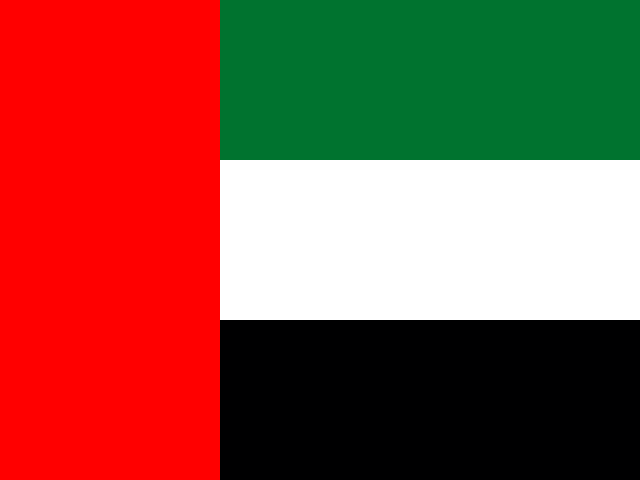
A red vertical band at the hoist beside three horizontal bands of green, white and black. Federal Law No. 2 of 1971 fixes the shape, the proportions and the four colours and assigns none of them a meaning. Two federal publications supply readings of their own and the two do not match: the government portal gives red for bravery and black for strength of mind, while the flag guideline issued to government entities gives red for the sacrifices of an earlier generation and black for courage. Dubai's protocol department instead traces the palette to a classical Arabic couplet pairing white with deeds, green with plains, black with battles and red with swords.
United Arab Emirates FACTS ◢
| Capital | Abu Dhabi |
|---|---|
| Continent | Asia |
| Population | 11,513,149 (2025) |
| Area | 83,600 km² |
| Population density | 138/km² |
| Currency | United Arab Emirates dirham (AED) |
| Official language | Arabic |
| Calling code | +971 |
| Internet TLD | .ae |
| Time zone | UTC+04:00 |
| Drives on the | Right |
| ISO codes | AE / ARE |
DID YOU KNOW? ◢
- It's a federation of seven emirates, with Abu Dhabi as capital and Dubai as its largest city.
- Dubai's Burj Khalifa is the tallest building on Earth, soaring over 828 metres.
- The country only formed in 1971, uniting the emirates that had been the Trucial States.
- Much of its land is the Rub' al Khali, or 'Empty Quarter', one of the largest sand deserts anywhere.
United Arab Emirates QUICK ANSWERS ◢
What is the capital of the United Arab Emirates?
The capital of the United Arab Emirates is Abu Dhabi.
What is the population of the United Arab Emirates?
The United Arab Emirates had a population of 11,513,149 in 2025.
What currency does the United Arab Emirates use?
The United Arab Emirates uses the United Arab Emirates dirham (AED).
What languages are spoken in the United Arab Emirates?
The official language of the United Arab Emirates is Arabic.
Think you know your flags? Play Flag Daily → · Browse all countries →
MORE ON THE FLAG ◢
Ask what the four colours of the United Arab Emirates flag mean and the UAE government will hand you more than one answer.
The federal government's own platform, u.ae, reads the red for "hardiness, bravery, strength and courage". The printed flag guideline issued to government entities and embassies reads the same red for "The sacrifices made by the previous generation of Emiratis to protect the motherland". Dubai's Protocol Department declines the colour-by-colour approach altogether and says the designer took his palette from two lines of classical Arabic verse.
None of those readings is in the law. Federal Law No. 2 of 1971 concerning the Union Flag names the four colours, fixes where each one sits, and stops.
Key Takeaways
- Article 1 of the 1971 flag law describes the flag entirely by geometry and colour names. It interprets nothing.
- Article 5 of the constitution is a referral: the flag "shall be specified by Law", with no description and no meaning attached.
- u.ae and the printed flag guideline both assign the four colours meanings, and the two sets do not match. Courage moves from the red to the black between them.
- The designer, Abdullah Mohammed Al Maainah, was 19. He entered a newspaper competition and learned he had won by going to look at a flagpole.
- The Pantone values come from the flag guidelines rather than from any instrument on the state's legislation platform.
The United Arab Emirates flag law describes a rectangle and stops
The operative text is short enough to read in full. Article 1 of Federal Law No. 2 of 1971 says the flag shall take "the following form, size and colours", and then gives them: a rectangle whose length is double its width, divided into four rectangular sections, the first of them red and forming the edge of the flag nearest the pole, with the other three horizontal, equal and parallel, and the upper one green, the middle white and the lower black.
The official English on the state's legislation platform garbles that last clause. It reads "the higher one is green; the medium is until and the lower is black", where "until" is plainly a slip for white, and the same page prints the platform's standing disclaimer that "In case of conflict, the Arabic text will prevail". The Arabic is unambiguous: the middle band is بيضاء, white.
What the flag law's Article 1 does not do is explain anything. There is no clause of the kind that turns up in the flag laws of other states, no sentence telling you what any colour signifies or represents. The colours are named the way the measurements are named, as facts about a rectangle.
The constitution is no more forthcoming. Article 5 provides that the Union "shall have its flag, an emblem and a national anthem", that "The flag and the emblem shall be specified by Law", and that each emirate keeps its own flag for use inside its territory. It describes nothing and interprets nothing. Read the consolidated text end to end and Article 5 is the only one of its 152 articles that mentions the flag at all.
The law it points at had not been passed when the constitution took effect, and there was something else in the gap. The flag law's own preamble reviews "the Federal Resolution No. (4) of 1971 on the flag", an earlier instrument that the state's legislation platform does not return under any search tried here.
The law itself was signed at the Presidential Palace in Abu Dhabi on 4 Dhu al-Qi'dah 1391, corresponding to 21 December 1971, nineteen days after the flag was first raised. The platform records it as published in issue 1 of the official gazette and dates that issue 1 December 1971, three weeks before the signature, which is more likely an artefact of how the platform dates issue 1 than a fact about the gazette.
The government's own pages do not agree about the colours
If the law is silent, the state's publishing is not. It is just not consistent.
| Colour | u.ae, the federal government platform | The printed flag guideline for government entities |
|---|---|---|
| Red | "hardiness, bravery, strength and courage", and a band that binds the other meanings into unity | "The sacrifices made by the previous generation of Emiratis to protect the motherland, its accomplishments and its values" |
| Green | "hope, joy, optimism and love", and possibly prosperity | "Growth, prosperity and flourishing vibrancy" |
| White | "peace and honesty", read by some for cleanliness | "Good deeds, generosity, and bountifulness that distinguishes Emiratis" |
| Black | "the defeat of enemies and also strength of mind" | "Strength, resilience and courage" |
The printed guideline is the United Arab Emirates Flag and Official Portraits Guidelines, a federal document whose specifications chapter opens by saying that "All government entities must apply the standards set in this chapter whenever handling the UAE flag." Its sibling matters later: the UAE Government Media Office publishes a web guideline of the same name and structure, with no colour meanings in it at all.
Notice where courage goes. On u.ae it belongs to the red; in the printed guideline it belongs to the black, and the red stands for sacrifice instead.
Then notice the register. u.ae hedges almost every line, with "can also symbolise", "is interpreted by some to symbolise" and "can also be interpreted as". The printed guideline hedges nothing. It sets the four meanings in the same column as the Pantone references, one page after the flag's stitching and its fabric.
Dubai's Protocol Department, which publishes its own flag page for diplomatic use, gives a third kind of answer. Under the heading "Meaning and significance of the Flag" it does not list the colours at all. It says only this: "The designer was inspired by verses from a poem written by the poet Safi-u-ddin Al Hali describing our acts as white, plains as green, battles as dark, and swords as red."
Dubai's protocol department traces the palette to a poem
The verse the Dubai page is pointing at is a well-known one. Al Ittihad, the Abu Dhabi newspaper that carried the design competition's advertisement in 1971, printed the couplet in 2017 while calling the flag an aesthetic translation of it, and called the two lines Safi al-Din al-Hilli's famous ones.
Its two lines pair a colour with a noun, four times over. The Dubai Protocol Department renders those pairs as white for our acts, green for our plains, dark for our battles and red for our swords. In the Arabic those colour words are بيض for white, خضر for green, سود for black and حمر for red.
Four colours, in a line of poetry, arranged as a boast.
That matters for a claim which circulates widely about this flag: that its palette is the pan-Arab colours of the Arab Revolt of 1916. The reading is easy to find in the press. It was not found on any UAE state page opened for this article. u.ae does not say it, neither version of the flag guideline says it, the Dubai Protocol Department does not say it, and the Cabinet's own Flag Day page does not say it.
Al Maainah's own account runs somewhere else again. The National reports him describing the colours as standing for successive eras of Islamic and regional history, from the early caliphates through the Fatimid and Ottoman periods, and has him saying that the black reflected the oil that was about to transform the country and the green its fertile land, while the red and white echoed colours already flying on the flags of the individual emirates. The same four colours turn up, differently arranged, on the flags of Jordan and Kuwait.
He has also given the plain symbolic version. Speaking to Khaleej Times before Flag Day in 2021, he said the colours were not chosen randomly and that every colour has an innate meaning: "White symbolises peace, goodness and purity, black represents solidarity, green stands for hope, prosperity and development while red denotes bravery and courage".
That lands close to u.ae on three of the four colours, and nearly word for word on the red. Where it parts company is the black, which he gives as solidarity where the portal gives the defeat of enemies. It sits much further from the printed guideline, which puts sacrifice on the red and courage on the black. It does not agree with his own account of the oil and the emirate flags either.
The nineteen-year-old who found out by watching a flagpole
The competition was run by the Amiri Diwan in Abu Dhabi and advertised in Al Ittihad. Dubai's Protocol Department puts the advertisement two months before the declaration of the federation, records about 1,030 designs entered, and says six were shortlisted, from which the present flag was chosen.
Al Maainah told Khaleej Times that he found the advertisement three days before the deadline. "It was a race against time, as I didn't have any drawing tools or colouring pencils. I rushed out to get them and worked all night to come up with the design." Six of those 1,030 designs were his own.
Nobody told him he had won. The shortlist was published in the newspapers in black and white, which was no help at all for judging a design whose entire content is colour. On the morning of 2 December 1971 he went to Mushrif Palace in Abu Dhabi and waited by the fence for enough wind to unfurl the flag on the pole. "There was no wind that day, so I waited until there was a draft to make sure that the flag up there at the pole was mine," he told The National.
Only two flags went up that day, one in Abu Dhabi and one at Union House in Dubai. The prize was 4,000 riyals. The dirham had not been introduced yet. Al Maainah went on to a diplomatic career and served as ambassador in several countries.
The federation those two flags were raised for had six members, not seven. The state's legislation platform still keeps the superseded text of Article 1 of the constitution beside the current one, and it lists Abu Dhabi, Dubai, Sharjah, Ajman, Umm Al Quwain and Fujairah. Ras Al Khaimah was written in the following year, by Constitutional Amendment Declaration No. 1 of 1972.
If you want to test how much of a flag you actually keep in your head, Flag Daily puts one up and gives you three guesses at the country. The UAE flag is a useful case, because the red band runs vertically at the hoist while the other three colours run horizontally, so a mirrored version of it is still four correct colours in the wrong arrangement.
The United Arab Emirates colour standard comes from a guideline
Article 2 of the flag law, as it now stands, says that the approved specifications for the flag, its pole, the rules for raising it and the conditions of its printing, distribution and use "shall be determined pursuant to a Cabinet Resolution".
Search the state's legislation platform for that resolution and one instrument comes back: Cabinet Resolution No. 5 of 1996 on the regulation of the rules for raising the state flag. Its eleven articles cover which buildings fly it and when, how it is treated at sea, its precedence beside other flags, half-masting, and a rule that it may never touch the ground or the water. Not one of them describes the flag or fixes a colour.
The values everyone quotes come from somewhere else. Both flag guidelines, the printed one and the Government Media Office's web guideline, give the colours as Pantone 186 C for the red, Pantone 348 C for the green, Pantone White and Pantone Black C, each with RGB and CMYK equivalents. They also specify polyester or heavy polyamide thread, an office flag of 170 by 90 centimetres, and a flag height of one third of the pole. That is a published standard by any practical measure. It is not a Cabinet Resolution.
Those two versions are not identical, and the difference is the one this article turns on. The printed guideline sets a meaning beside each colour. The Government Media Office's web guideline gives the Pantone, RGB and CMYK references in that same slot and no meanings at all.
There is a trap here too, though not a defect. The statute and the guideline use the axis words in opposite directions. The Government Media Office's web guideline calls the flag's vertical dimension طول and the horizontal one عرض, which is the reverse of the statute. So where the statute says the flag's length is ضعف its width, double, the guideline says the dimension it calls طول is نصف, half, of the other one. Both sentences describe the same rectangle, twice as wide as it is tall, with the red band taking a quarter of the long side.
The guideline's own English confirms that reading, calling the dimension in question the height and putting the red band at "a quarter of the flag width".
The penalty for insulting the flag was rewritten in 2019
The 1971 law's original Article 3 punished dropping, damaging or insulting the flag with imprisonment of up to six months, or a fine of up to one thousand Qatar and Dubai riyals, given in the alternative as one hundred Bahraini dinars. Those were the currencies the Trucial States were using in 1971.
It also required a state of mind. The 1971 text reached the act only where it was done out of hatred or contempt for the authority of the Union, of the emirates, or of the other state whose flag was involved.
Federal Decree-Law No. 13 of 2019, signed on 29 August 2019, replaced Articles 2 and 3 of the flag law outright, and that clause went with them. The penalty is now imprisonment of not less than ten years and not more than twenty-five, together with a fine of not less than 500,000 dirhams, for anyone who publicly, or in a public place, drops, damages or in any way insults the Union flag. The same article extends the protection to the flag of any member emirate, to the flag of the Gulf Cooperation Council, and to the flag of any other state.
Article 3's closing sentence is the one that changes the character of the offence: insulting the Union flag "shall be considered as a crime against the State's security".
That 2019 decree is also where the flag law's Article 2 acquired its reference to approved specifications. Before it, Article 2 said only that the rules for raising the flag would be set by a regulation issued by the Cabinet.
Why Flag Day is 3 November and not 2 December
The UAE marks Flag Day on 3 November, which is not the anniversary of anything that happened to the flag.
The Ministry of Cabinet Affairs records that Sheikh Mohammed bin Rashid Al Maktoum called for the day in a speech in November 2013, as a national campaign marking the anniversary of Sheikh Khalifa bin Zayed Al Nahyan's accession as President of the UAE. Nowhere on that page is the year of the accession given, but Khaleej Times puts it in 2004, and Al Ittihad's Flag Day feature of 1 November 2017 calls that year's occasion the thirteenth anniversary, which comes to the same thing.
The flag's own anniversary is 2 December, the day the federation was declared and the day the design was first flown.
The same Cabinet page notes that a procedural and guidance manual on the uses of the state flag was issued to mark the occasion. A manual is not what the flag law's Article 2 asks for, and manuals are what stand in place of the Cabinet Resolution Article 2 does ask for.
Frequently asked questions
What do the colours of the UAE flag mean?
Federal Law No. 2 of 1971 assigns them no meaning, and neither does the constitution. The federal platform u.ae reads green for hope, joy, optimism and love, white for peace and honesty, black for the defeat of enemies and strength of mind, and red for hardiness, bravery, strength and courage. The printed flag guideline issued to government entities gives a different set, in which red stands for the sacrifices of an earlier generation of Emiratis and it is black that stands for courage.
Who designed the UAE flag?
Abdullah Mohammed Al Maainah, who was 19 when he entered the 1971 design competition. It was run by the Amiri Diwan in Abu Dhabi and advertised in the Al Ittihad newspaper before the federation was declared. Dubai's Protocol Department records about 1,030 entries and a shortlist of six. Al Maainah later served as a UAE ambassador.
Does the UAE constitution describe the flag?
It does not. Article 5 says the Union shall have a flag, an emblem and a national anthem, that the flag and emblem shall be specified by law, and that each emirate keeps its own flag for use within its territory. The description was left to Federal Law No. 2 of 1971, which gives the shape, the proportions and the four colours and interprets none of them.
What are the official colours of the UAE flag?
Both flag guidelines, the printed one issued to government entities and the Government Media Office's web guideline, give Pantone 186 C for the red, Pantone 348 C for the green, Pantone White and Pantone Black C, with RGB and CMYK values for each. Those figures come from government guidelines rather than from any instrument published on the state's legislation platform, where the only flag-related Cabinet Resolution covers the rules for raising the flag.
Why is UAE Flag Day on 3 November?
UAE Flag Day marks the anniversary of Sheikh Khalifa bin Zayed Al Nahyan's accession as President, which Khaleej Times dates to 2004, rather than anything in the flag's own history. The Ministry of Cabinet Affairs records that Sheikh Mohammed bin Rashid Al Maktoum called for the day in a speech in November 2013. The flag was first raised on 2 December 1971.
Sources
- Ministry of Cabinet Affairs, UAE Legislation platform, Federal Law No. (2) of 1971 Concerning the Union Flag, consolidated Arabic and English texts and the superseded 1971 wording of Articles 2 and 3 - retrieved 27 August 2026.
- Ministry of Cabinet Affairs, UAE Legislation platform, Federal Decree-Law No. (13) of 2019 amending Federal Law No. (2) of 1971 concerning the Union Flag (PDF) - retrieved 27 August 2026.
- Ministry of Cabinet Affairs, UAE Legislation platform, Cabinet Resolution on the regulation of the rules for raising the state flag, No. 5 of 1996 - retrieved 27 August 2026.
- Ministry of Cabinet Affairs, UAE Legislation platform, Constitution of the United Arab Emirates, Article 5, and the superseded texts of Article 1 - retrieved 27 August 2026.
- The Official Platform of the UAE Government, Fact sheet, Flag section - retrieved 27 August 2026.
- UAE Government Media Office, Visual Identity Guidelines: The UAE Flag - read from the Internet Archive captures of 26 September 2025 (English) and 19 January 2026 (Arabic), the live site being unreachable from outside the UAE.
- Ministry of Higher Education and Scientific Research, United Arab Emirates Flag and Official Portraits Guidelines for Federal Entities and Embassies (PDF, 2021) - retrieved 27 August 2026.
- Protocol Department, Government of Dubai, The United Arab Emirates Flag - retrieved 27 August 2026.
- Ministry of Cabinet Affairs, UAE Flag Day - retrieved 27 August 2026.
- Al Ittihad (Abu Dhabi), flag feature published 1 November 2017, headline beginning العَلَم and rendering as The Flag, a Coloured Love Poem for the Homeland - retrieved 27 August 2026.
- The National, Who designed the UAE flag?, 10 April 2026, quoting Al Maainah's 2011 interview - retrieved 27 August 2026.
- Khaleej Times, Meet the Emirati diplomat who designed UAE's flag as a teenager, 28 October 2021 - retrieved 27 August 2026.
PLAY ANOTHER →
A short message, hidden in a different cipher every day.
ONE CIPHER A DAYDAILYOn This DayOne thing that happened today in history. Every day, a new one.
TODAY IN HISTORYDAILYDaily CryptogramOne quote, one scrambled alphabet. Crack it before tomorrow.
CRACK THE QUOTEDAILYDaily TriviaFive questions a day. Everyone gets the same five.
FIVE QUESTIONS