
Rwanda
Nicknamed the 'land of a thousand hills', Rwanda is a compact, mountainous country where mountain gorillas roam volcanic forests and the capital, Kigali, is famed for being remarkably clean.
WHAT THE FLAG MEANS ◢
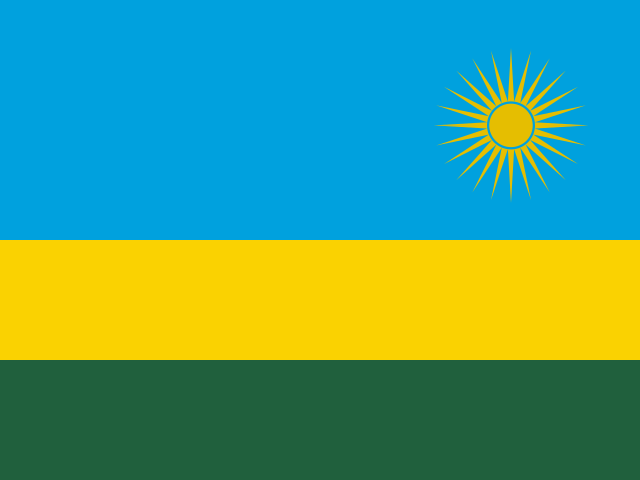
Three horizontal bands of blue, yellow and green, the blue covering the upper half, with a golden sun and rays in the upper fly separated from the disc by a blue ring. The constitution describes it in those terms and assigns no meanings, leaving the details to specific laws, and the law it defers to does assign them. Article 5 of the 2008 flag law gives green for the hope of prosperity through the effective use of Rwandan strength and resources, yellow for economic development, blue for happiness and peace, and the golden sun and its rays for the light that progressively enlightens all people, referring to unity, transparency and the fight against ignorance. The same readings were first enacted in the constitutional revision of 31 December 2001, which replaced the flag flown at the time of the genocide.
Source: amategeko.gov.rw · gov.rw · checked 2026-08-27
Rwanda FACTS ◢
| Capital | Kigali |
|---|---|
| Continent | Africa |
| Population | 14,569,341 (2025) |
| Area | 26,338 km² |
| Population density | 553/km² |
| Currency | Rwandan franc (RWF) |
| Official languages | English, French, Kinyarwanda, Kiswahili |
| Calling code | +250 |
| Internet TLD | .rw |
| Time zone | UTC+02:00 |
| Drives on the | Right |
| ISO codes | RW / RWA |
DID YOU KNOW? ◢
- It's one of the best places on Earth to see endangered mountain gorillas in the wild, in Volcanoes National Park.
- Plastic bags have been banned since 2008, part of a national push for cleanliness.
- Once a month, citizens take part in Umuganda, a morning of community service where even the capital's traffic pauses.
- It's one of only a handful of countries where women hold a majority of seats in the national parliament.
Rwanda QUICK ANSWERS ◢
What is the capital of Rwanda?
The capital of Rwanda is Kigali.
What is the population of Rwanda?
Rwanda had a population of 14,569,341 in 2025.
What currency does Rwanda use?
Rwanda uses the Rwandan franc (RWF).
What languages are spoken in Rwanda?
The official languages of Rwanda are English, French, Kinyarwanda and Kiswahili.
Think you know your flags? Play Flag Daily → · Browse all countries →
MORE ON THE FLAG ◢
Rwanda's flag colours were given an official interpretation on 31 December 2001, in the text of the Fundamental Law then in force, and that interpretation was re-enacted as an article of statute seven years later. It is still in the statute book today.
What Rwanda's flag means is not a tradition or a popular reading, then. It is a legal text, and it is longer than the one-line summary usually attached to it.
One thing no Rwandan instrument ever puts into words is the detail everyone quotes: the number of rays on the sun. Twenty-four is right, and it is drawn twenty-four times both on the sheet annexed to the flag law and on the artwork the government publishes. No article of any instrument says so. The count was a decision the artist made alone, after trying seven and then twelve.
Key Takeaways
- The colour meanings come from the revision of 31 December 2001 to Rwanda's Fundamental Law, and were re-enacted as article 5 of Law n 34/2008.
- The sun stands for four things in the law, not one: light, unity, transparency and the fight against ignorance.
- No Rwandan instrument states the number of rays in words. The annexed drawing shows twenty-four, and the designer settled on that after rejecting seven and twelve.
- The old red, yellow and green flag with a black R carried no legal meaning at all, in either the 1962 or the 1991 constitution.
- From 2008 until 2013 the flag law said no individual had the right to own the national flag, while allowing anyone to use its colours arranged to depict it.
| What | Where it is fixed | What that instrument actually gives |
|---|---|---|
| Layout of the colours | Revision of 31/12/2001, art. 1(a), and Law n 34/2008 art. 2 | Green then yellow from the bottom, together half the flag; blue upper half; sun on the right, separated from its rays by a blue ring |
| Meaning of each colour | Revision of 31/12/2001, art. 1(a), and Law n 34/2008 art. 5 | An interpretation for green, yellow, blue and the sun; three of the four run to two sentences |
| Colour references | Law n 34/2008 art. 6 | Four codes: one Pantone reference and three RAL numbers. No hex, no RGB |
| Sizes and geometry | Ministerial Order n 004/07.01/13 of 19/12/2013 | Three flag sizes, the two large ones in centimetres and the small one in millimetres, plus the sun's diameter, its ray span and its margins |
| Number of rays | Drawn in the Law n 34/2008 annex, stated nowhere | Twenty-four rays at fifteen degree spacing on the sheet; no article of any instrument gives a figure |
The sun is the part of Rwanda's flag the law describes least
Article 2 of Law n 34/2008 puts the sun on the flag in one clause. The flag's "upper half is blue and bears on its right hand side the image of the sun with its rays of golden yellow. The sun and its rays are separated by a blue ring."
That is the whole description. A disc, rays, golden yellow, a blue ring between them, on the right.
The 2013 ministerial order adds measurements but no count. On the ordinary large flag the sun's disc is thirteen centimetres across, its rays span forty-two centimetres, there are thirteen centimetres from the rays to the top edge and fourteen to the fly edge. Repeat for the ceremonial size and the small size. Still no number of rays in the text.
Rwanda's own seal is the opposite case. The same article of the 2001 revision blazons the seal two items later, and there it counts: "Le soleil avec ses vingt quatre rayons lumineux", the sun with its twenty-four luminous rays. The count is fixed for the seal and left open for the flag.
The figure does get repeated as though it were specified. The New Times, describing the national symbols in 2011, gives the flag "a golden-yellow 24-pointed sun" and adds that "The diameter of the sun is listed as 0.125 of the width of the flag", which no Rwandan instrument says and which turns out to be a misreading of the flag law's own construction sheet. Twenty-four is a fact about the drawings rather than about the words, and its author explained where the number came from.
The Rwandan news site IGIHE interviewed the designer, Alphonse Kilimobenecyo, in 2019, and heads that part of its account "Gushyiramo izuba ni ibitekerezo bye bwite": putting in the sun was his own idea. Its report of his death in 2025 puts it in English, that the sun "had not been among the required design elements". He spent a week trying elements that kept turning out to mean nothing, and the sun is what came out of that. Then he had to choose a ray count.
"Nabanje gutekereza utuntu twihariye tugomba kuba mu ibendera. Izuba naravuze nti ‘ese ndariha imirasire ingahe’, ndavuga nti ‘irindwi ariko nsanga bidasa neza’. Natangiye ngira 12, ndenzaho mike nabwo mbona ari bibi nyuma nza kuvuga nti reka ngire 24."
He first thought about what elements the flag had to have. Of the sun, he asked himself how many rays to give it, said seven and found it did not look right, started with twelve, went a little over that and still thought it bad, and finally said let it be twenty-four. IGIHE's own narrative around the quotation says he began at twelve rather than seven, so take the seven from his words and not from the report.
IGIHE reports that he then gave those twenty-four rays a meaning of his own: good politics, which must never fall asleep and must shine on the country at all times. He also put the sun toward the fly, where a sun rises, rather than toward the hoist, where it would read as setting, which he took to mean that the good politics had gone to sleep.
None of that reasoning is in any instrument. It is the designer's account of his own work, given in what IGIHE calls his only interview, and it is the only first-hand account of the ray count on the record.
The law's wording is longer than the summary you usually see
Article 5 of Law n 34/2008 is headed, in the French column, "Description des couleurs du drapeau national", and opens: "The colours of the national flag are described as follows". Then it takes the elements one at a time.
Green. "It symbolises the hope for prosperity through effective use of the strength of Rwandans and resources of Rwanda." The Kinyarwanda is "Gisobanura icyizere cy’uburumbuke hakoreshejwe neza imbaraga z’Abanyarwanda n’ibiri mu Rwanda." A compression to green for prosperity loses two things at once, because the law does not say the colour is prosperity. It says the colour is the hope of prosperity, and it attaches a condition to that hope: the effective use of Rwandan strength and Rwandan resources.
Yellow. "It symbolises economical development. Rwandans must work hard in order to achieve sustainable economical development."
Blue. "It symbolises happiness and peace. Rwandans must fight for peace which will lead them to sustainable economical development and happiness."
The sun. The article's fourth item is headed "Golden sun and rays" and reads: "They symbolise the light which progressively enlightens all people. These refer to unity, transparency and fight against ignorance."
Three of the four entries carry a second sentence, and two of those are instructions rather than symbols. Rwandans must work. Rwandans must fight for peace. A summary that keeps only the first sentence of each keeps the symbolism and drops the demand.
The sun's entry is the one a short summary damages most. Unity is only one of three things the law attaches to it, alongside transparency and the fight against ignorance, and all three sit after a first clause about light that spreads progressively over everyone.
The meanings arrived in a constitutional revision, not in a flag law
Two instruments were promulgated on the same day, 31 December 2001, and they divide the work in a way that is easy to get backwards.
The revision of the Fundamental Law is where the design and the meanings sit. It builds the flag from the bottom up, a green stripe then a yellow stripe together covering half of it and a blue upper half carrying the sun, and it replaced paragraphs one, two and three of article 3 of the Constitution of 10 June 1991, which is to say the flag, the motto and the seal at once. Its preamble states the reason: "Realising that the national flag, motto and emblem should reflect the unity of all Rwandans".
Law n 57/2001 of the same date is the flag law proper, and it contains no meanings whatever. Read end to end it runs to seven chapters and twenty-seven articles about material, formats, hoisting, half-mast, oaths, funerals, cost and penalties. Its article 4 fixes the geometry in centimetres, down to the sun's disc, the span of its rays and its distance from the top and right edges, in the figures the 2008 law and the 2013 order still carry. What it never states is which colour goes where, that the rays are golden yellow, or that a blue ring separates them. It has no chapter of description in the sense the 2008 title adds, and leans on the constitutional text for those.
Law n 34/2008 brought the two strands together. Its long title adds a word the 2001 law did not have, "ibisobanuro", description, and its chapter III lifts the constitutional interpretations into the statute book.
The Kinyarwanda survived that move intact, down to the wording of every item. The English and the French were both re-translated. That is worth knowing, because it is why English accounts of this flag disagree with each other, and the divergence starts inside the 2001 text itself: for yellow, its French column reads "Symbolise le développement économique" while its English column reads "Stands for wealth". The 2008 English brings the two back into line at "It symbolises economical development". The Kinyarwanda never moved: "Usobanura ubukungu" in both.
One link in that chain could not be checked. The Fundamental Law was replaced by the Constitution of 4 June 2003, and the text of that constitution as originally enacted is not in Rwanda's own legal database, which holds only the version revised in 2015. In that current text the flag is at article 9, described in the same words as in the statute and given no meaning at all: the article closes by providing that "Specific laws determine details relating to national symbols." So whether any interpretation was in force between June 2003 and August 2008 is a question this article cannot answer.
Two amendments have followed and neither touched the meanings. Law n 06/2013 rewrote twelve articles, on material, formats, possession, hoisting, oaths, funerals, safekeeping, cost and penalties, and added a definitions article. Law n 42/2018 replaced the penalties chapter. Articles 5 and 6 of the 2008 law stand as enacted.
A useful cross-check: Rwanda's own government portal reproduces the article 2 description of the flag on its About page, then stops: "The characteristics, description, ceremonial and respect of the National Flag are determined by the law." It does not publish the gloss. The gloss is in the instrument, which is where a reader has to go.
The flag Rwanda replaced was described twice and explained never
Rwanda's previous flag was a vertical tricolour of red, yellow and green with a black letter R on the yellow band, and it was the country's flag until the last day of 2001.
The Constitution of 24 November 1962 set it out in article 4: "L’emblème national est le drapeau tricolore : rouge, jaune et vert portant au milieu de la bande jaune la lettre R de couleur noire." The Constitution of 10 June 1991 restated it in article 3, adding that the colours run "à partir de la hampe", from the staff, which is what makes the bands vertical.
Neither article interprets anything. Not the red, not the yellow, not the green, not the letter. The old flag was described and never explained. Set against Rwanda's own constitutional history, that makes the 2001 revision the departure: neither of the two texts that carried the old flag stops to say what a colour is for, and this one does.
The R was a disambiguator. IGIHE's account of the 2001 competition says entrants were told to avoid the mistake made in 1959, when Rwanda's flag was made to resemble Guinea's, and the letter was written into it two years later to tell the two apart. The earliest Rwandan instrument that can be opened carrying the R is the 1962 constitution, so treat the 1959 and 1961 dates as the newspaper's, not the gazette's.
What replaced it was chosen by competition. IGIHE reports that the ministry then responsible for local government put out a notice seeking the Republic's emblems, more than 400 people entered, ten were shortlisted for a panel, and Kilimobenecyo came first. The colours were handed to the entrants and the rest was theirs. "Usibye kuba we na bagenzi be bari bahawe amabara bagomba kugenderaho, ibindi byose bigize ibendera ry'igihugu byaturutse mu bwenge bwe nk'umuhanzi", the article says: apart from him and his fellow entrants being handed the colours to work from, everything else in the flag came out of his own mind as an artist.
On the brief itself he was direct. "Hari ibyo twagombaga kugenderaho nk’icyerekezo cy’igihugu. Niba irya kera ryarimo umutuku uvuga impinduramatwara n’amaraso yamenetse, twagombaga gukoresha irigaragaza icyizere cyo kwiyubaka." There were things they had to work from, such as the country's direction. If the old flag had red in it standing for revolution and blood that was shed, they had to use one that showed the hope of rebuilding.
Kilimobenecyo failed the secondary entrance exam three times, trained at the Nyundo school of art, and studied graphic arts at the fine arts institute in Kyiv on an opportunity IGIHE says Russia offered. He designed the coat of arms and several banknotes as well, and died on 19 April 2025, aged 66. IGIHE spells his name Kilimobenecyo. Most sources outside Rwanda spell it Kirimobenecyo.
The construction sheet in the law disagrees with the law's own measurements
Law n 34/2008 carries an annex, a scale drawing labelled with eight letters and a short list of equations. X is the hoist and Y the fly; Z, W and U are the three bands; C is the sun's disc, D the sun including its rays, A the gap from the top edge to the rays and B the gap from the rays to the fly edge.
The sheet states: A = 0.1 X, B = 1/3 D, C = A, D = 0.125 Y, Y = 1.5 X, Z = X/2 and W = U = Z/2.
Checked against the centimetre figures given in article 4 of the same law and in the 2013 ministerial order, across all three flag sizes, fifteen of those eighteen tests hold, thirteen of them exactly and two to within a third of a unit. The flag is one and a half times as long as it is deep. The blue band is half the depth and the other two a quarter each. The disc equals the top margin, and both are a tenth of the hoist. The fly margin is a third of the sun's overall width, so forty-two centimetres of rays stand fourteen centimetres from the edge.
The three failures are the same equation at each size. D = 0.125 Y predicts a sun 24.4 centimetres wide on the large flag where the text says forty-two, 28.1 where the ceremonial flag says 48.5, and 37.5 millimetres where the small flag says sixty-five. The coefficient the stated figures actually imply is about 0.215 in every case.
So the annex is right about the proportion, the bands, the disc and both margins, and wrong about the one figure that sets how big the sun looks. It is also where the newspaper's stray 0.125 came from: read Y as the width rather than the length, and D as the disc rather than the sun with its rays, and the annex coefficient becomes the sentence The New Times printed.
The sheet also draws the sun, and the rays can be counted. Off a 500 dpi render of the gazette page they come to twenty-four, at fifteen degree spacing, which is what the government's artwork carries too.
That is not decoration. Article 4 of the 2008 law provides that "All flag samples shall be made in the manner provided for in annex of this Law", and Law n 06/2013 re-enacted the direction as "Each Flag shall be made in the manner provided for in the appendix to this law". Rwandan law therefore prescribes manufacture by a drawing that shows twenty-four rays, while no article has ever reduced that number to words. The position has held since 2001, when Law n 57/2001 fixed the same sun measurements and referred manufacture to a second annex of its own. That annex is not reproduced in the gazette scan, so what it drew cannot be checked here.
There is a second small gap, this time between the law and the artwork. Rwanda's government publishes the official flag as an EPS and a JPEG. Both are about 1.573 units long to one deep. Every dimension pair in the ministerial order is exactly 1.5 to one. The published master is a little longer than the flag the order describes.
Everything else the flag law regulates, and how much of it has moved
Article 6 gives four colour references and nothing else: "Blue: Pantene 299 C 2x", "Green: RAL 6029", "Yellow: RAL 1023", "Golden Yellow: RAL 1003".
The law does distinguish the sun's golden yellow from the yellow of the band, giving them separate RAL numbers, and the artwork the government publishes does use two different yellows. No screen value appears anywhere in it. There is no hex, no RGB triple and no CMYK breakdown. The government does publish artwork, so a digital reference exists; what does not exist is a screen colour fixed by law.
The law also spells the Pantone reference three different ways in its three official language columns, and none of them is the trademark: Panthène in Kinyarwanda, Pantene in English, Pantène in French. What the trailing "2x" denotes is not explained.
The rules around the flag have moved more than the flag has. As enacted in 2008, article 7 read: "No individual shall have the right to own the national flag. However he/she shall have the right to own and use the blended colours in a way that describes the national flag." Law n 06/2013 replaced it. The flag remains government property, and the replacement text then reads: "Any natural person, whether a Rwandan or foreigner, non-government organizations, companies and cooperatives having legal personality, shall have the right to possess and use the National Flag in compliance with laws."
The same 2013 law took the fabric out of the statute. The 2008 text required polyester at one hundred percent. The replacement says only that the flag is made of a fabric, and lets a ministerial order name others.
The penalties moved in the other direction, and they were not new in 2018. The 2008 law already had a "CHAPTER VII: PENALTIES", whose article 29 punished deliberate misuse with one month to one year and "a fine of fifty thousand Rwandan Francs (50.000 Rwf) to two hundred thousand Rwandan Francs (200.000 Rwf)", or one of the two.
The same chapter's article 30 already punished any person who "deliberately disrespects, denigrates or damages the national flag" with six to twelve months and "a fine of fifty thousand Rwandan Francs (50.000 Rwf) to one hundred thousand Rwandan Francs (100.000 Rwf)", and its second paragraph already covered passing another flag off as the national one.
Law n 42/2018 re-enacted the chapter as "OFFENCES AND PENALTIES" and raised the money penalties by an order of magnitude. It renamed disrespect as contempt, widened it to removal and desecration and to the official emblems of sovereignty, moved it from article 30 to article 29, added a rider for theft, and took it to one to two years and one to two million Rwandan francs, or one of the two. Unlawful use now carries one to six months and half a million to a million francs, where the 2008 text allowed up to a year but stopped at two hundred thousand. The money went one way and the prison terms did not: passing another flag off as the national one drew one to three years in 2008 and draws one to two now, on a fine that rose from a hundred thousand to half a million at the floor.
That law also carries a drafting slip only the instrument shows. Its article 4 inserts a provision headed "Article 31: Use of another flag presenting it as being the national flag", and the Kinyarwanda and French columns both introduce it as article 31. The English column says "Article 30 is inserted to read as follows", which is the number it had used one article earlier.
For all of that documentation, a flag is still recognised at a glance. In Flag Daily, which shows one flag a day and allows three guesses at the country, what identifies Rwanda's is the sun in the upper fly rather than the tricolour under it, and nothing in the statute book helps with the guess.
Frequently asked questions
What do the colours of the Rwandan flag mean?
Article 5 of Law n 34/2008 gives green as the hope for prosperity through effective use of the strength of Rwandans and the resources of Rwanda, yellow as economic development, blue as happiness and peace, and the golden sun and its rays as light that progressively enlightens all people, referring to unity, transparency and the fight against ignorance. The same assignments first appeared in the constitutional revision of 31 December 2001, although the English and French wordings were re-translated for the 2008 law.
How many rays does the sun on Rwanda's flag have?
Twenty-four. That is what the drawing annexed to Law n 34/2008 shows, and what the artwork the Rwandan government publishes shows. No article of any Rwandan instrument states the figure in words: the flag law, its 2001 predecessor and the 2013 ministerial order all fix the sun's diameter, the span of its rays and its distance from the edges, and stop there. The designer, Alphonse Kilimobenecyo, has said he chose twenty-four after rejecting seven and twelve.
When did Rwanda change its flag and why?
The revision of the Fundamental Law promulgated on 31 December 2001 replaced the flag, and came into force the day it was promulgated. Its preamble states the reason: the national flag, motto and emblem should reflect the unity of all Rwandans. The design it replaced was a vertical red, yellow and green tricolour with a black letter R on the yellow band.
What did the old Rwandan flag mean?
Neither of the two constitutions that carried it says. Article 4 of the 1962 constitution and article 3 of the 1991 constitution both describe the red, yellow and green bands and the black R without interpreting any of them. Those are the two texts opened for this article; earlier republican constitutions were not.
Are the colours of Rwanda's flag officially specified?
Yes, but only as print standards. Article 6 of Law n 34/2008 sets the blue as "Blue: Pantene 299 C 2x", spelling the trademark its own way, and gives RAL 6029, RAL 1023 and RAL 1003 for the green, the yellow and the sun's golden yellow. No hex or RGB value appears in the flag law, its two amendments, the dimensions order or the constitution, so no screen colour for this flag is fixed by law.
Sources
- Republic of Rwanda, Law n 34/2008 of 08/08/2008 on characteristics, description, ceremonial and respect of the national flag, Official Gazette n 16 of 20/04/2009, pp. 19 to 43, Kinyarwanda, English and French columns plus the annexed construction sheet - retrieved 27 August 2026.
- Republic of Rwanda, Revision of 31/12/2001 of the Fundamental Law of the Republic of Rwanda, Journal Officiel n special du 31/12/2001, pp. 3 to 10 - retrieved 27 August 2026. Image-only scan, so the passages quoted here are transcribed beside the draft.
- Republic of Rwanda, Law n 57/2001 of 31/12/2001 on characteristics, ceremonial and respect of the national flag, Journal Officiel n special du 31/12/2001 bis, pp. 10 to 14 - retrieved 27 August 2026.
- Republic of Rwanda, Law n 06/2013 of 27/02/2013 modifying and complementing Law n 34/2008, Official Gazette n 10 of 11 March 2013 - retrieved 27 August 2026.
- Republic of Rwanda, Law n 42/2018 of 13/08/2018 modifying Law n 34/2008, Official Gazette n Special of 20/09/2018 - retrieved 27 August 2026.
- Republic of Rwanda, Ministerial Order n 004/07.01/13 of 19/12/2013 determining the dimensions of the national flag, Official Gazette n 02 of 13/01/2014 - retrieved 27 August 2026.
- Republic of Rwanda, Constitution de la République Rwandaise du 24 novembre 1962, Journal Officiel, 1ère année n 22 bis, 1er décembre 1962, article 4 - retrieved 27 August 2026.
- Republic of Rwanda, Constitution de la République Rwandaise du 10 juin 1991, article 3 - retrieved 27 August 2026.
- Government of Rwanda, About the Government of Rwanda and National Symbols, including the official flag artwork in EPS and JPEG - retrieved 27 August 2026.
- Philbert Girinema, Inganzo ifutse ya Kilimobenecyo wahanze ibendera ry'igihugu, ikirangantego n'inote zirimo iya 5000 Frw, IGIHE, 12 February 2019 - read from the Internet Archive capture of 6 April 2019, retrieved 27 August 2026.
- IGIHE, Man behind the design of Rwanda National Flag, Coat of Arms and banknotes dies at 66, 19 April 2025 - read from the Internet Archive capture of 13 May 2025, retrieved 27 August 2026.
- Times Reporter, Rwanda's National symbols, The New Times, 28 January 2011 - retrieved 27 August 2026.
PLAY ANOTHER →
One thing that happened today in history. Every day, a new one.
TODAY IN HISTORYDAILYDaily CodeA short message, hidden in a different cipher every day.
ONE CIPHER A DAYDAILYDaily CryptogramOne quote, one scrambled alphabet. Crack it before tomorrow.
CRACK THE QUOTEDAILYDaily TriviaFive questions a day. Everyone gets the same five.
FIVE QUESTIONS