
Samoa
A Polynesian nation in the South Pacific, Samoa jumped across the International Date Line in 2011, skipping a whole day to better align its calendar with trading partners like Australia and New Zealand.
WHAT THE FLAG MEANS ◢
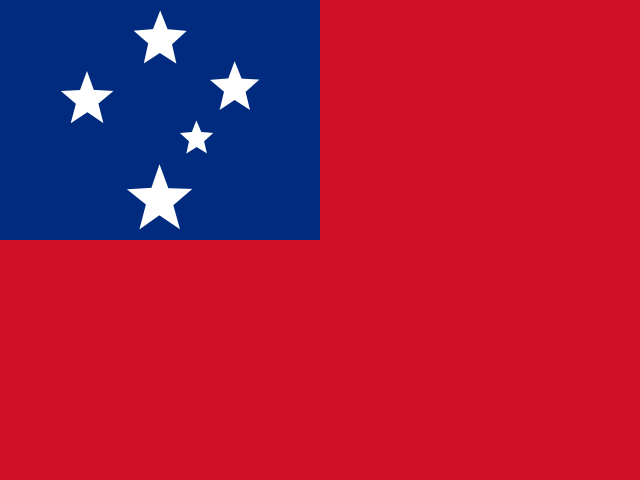
A red field with a blue canton bearing five white stars. The Schedule to the Official Flag and National Anthem of Samoa Act 1994 prescribes the flag in geometric detail, down to the vertical and horizontal units fixing the size and position of every star, and the one thing it interprets is the stars, which it names as representing the Southern Cross. It assigns the colours no meaning, and neither does the constitution. The government's own account of the country reads the red as courage and as a traditional Samoan colour, says the blue is taken to represent freedom, and gives the white no meaning of its own.
Samoa FACTS ◢
| Capital | Apia |
|---|---|
| Continent | Oceania |
| Population | 219,306 (2025) |
| Area | 2,842 km² |
| Population density | 77/km² |
| Currency | Samoan tālā (WST) |
| Official languages | English, Samoan |
| Calling code | +685 |
| Internet TLD | .ws |
| Time zone | UTC+13:00 |
| Drives on the | Left |
| ISO codes | WS / WSM |
DID YOU KNOW? ◢
- In 2011 it skipped December 30 entirely, hopping over the International Date Line to change which side of the calendar it lived on.
- Author Robert Louis Stevenson, of 'Treasure Island' fame, spent his final years in Samoa and is buried there.
- It's considered a cradle of Polynesian culture, with traditions like the elaborate 'fa'a Samoa' way of life still central to daily living.
- The traditional Samoan tattoo, or pe'a, is applied by hand using tools made from bone and tusk.
Samoa QUICK ANSWERS ◢
What is the capital of Samoa?
The capital of Samoa is Apia.
What is the population of Samoa?
Samoa had a population of 219,306 in 2025.
What currency does Samoa use?
Samoa uses the Samoan tālā (WST).
What languages are spoken in Samoa?
The official languages of Samoa are English and Samoan.
Think you know your flags? Play Flag Daily → · Browse all countries →
MORE ON THE FLAG ◢
Ask what Samoa's flag means and you will nearly always be handed the same three words: courage, freedom, purity. It is a tidy answer, one colour each, and it is worth knowing where it comes from, because the two Samoan texts that could settle it do not say it.
The flag law says nothing about the colours at all, and the constitution does not mention the flag in any form. What the Government of Samoa does publish is a shorter and stranger reading, one that keeps two of the three words, hedges one of them, and adds something the popular version drops.
The Samoan text that does explain what the stars stand for is not a law at all. It is the national anthem, and the man who wrote it went back and changed those words.
Key Takeaways
- The Schedule to the Official Flag and National Anthem of Samoa Act 1994 fixes the position and size of all five stars in numbered units and assigns the red, blue and white no meaning.
- Samoa's constitution never mentions the flag. A full-text search of the current consolidated text returns no occurrence of the word.
- The Government of Samoa's own account of the country reads the red as courage and as a traditional Samoan colour, hedges the blue as said to represent freedom, and gives the white no meaning of its own.
- The legal wording of the flag is a New Zealand formula from February 1949, reported at the time almost word for word as it still reads in the Act.
- The flag was raised at Mulinu'u in June 1948, fourteen years before independence. Samoa's sixtieth-anniversary independence celebration in 2022 fell on 1 June and opened with an official flag-raising ceremony, though no source opened here says the June date was chosen for the 1948 raising.
| The reading in circulation | Does a Samoan source say it? | What the source actually says |
|---|---|---|
| Red means courage | Partly | The government's country page calls red "representative of courage, as well as being a traditional Samoan color" |
| Blue means freedom | Partly | The same page says the blue "is said to represent freedom" |
| White means purity | No Samoan source found here says it | Neither the Act, the constitution nor the government's country page gives the white any meaning of its own |
| Stars for the Southern Cross | Yes, in the statute and on the government's page | The 1994 Schedule calls them "5 white regular five-rayed stars representing the Southern Cross" |
Who says Samoa's flag means courage, freedom and purity?
Not the flag law, and not the constitution. The Government of Samoa says two of the three on its own website, and the sentence it uses is more careful than the version in circulation.
Under the heading "Flag" on the government's page about the country, three sentences do the whole of the state's explaining. One dates the flag. One says that "The symbolic flag display the white stars of the Southern Cross." And the third is the only place any Samoan state text reads the colours at all: "The blue is said to represent freedom; red is representative of courage, as well as being a traditional Samoan color."
That third sentence hedges the blue rather than asserting it. It gives the red a second reading, and that second reading is the more Samoan of the two: red as a colour Samoa already used. And it says nothing about the white.
The missing white matters, because purity is the third of the three words the version in circulation repeats. The government's page names the stars white and stops there, and a search of every reachable Samoan government site for the word turns up that page and nothing else. Neither it, nor the flag Act, nor the constitution gives the colour itself any meaning.
The complete triad is easy to find in one place that is not Samoan. The CIA World Factbook's 2024 Samoa entry gave the flag's colours as "red stands for courage, blue represents freedom, and white signifies purity", and the version in circulation uses the same three words in the same order. The same three words turn up in reporting too: covering Samoan flags in 2024, Radio New Zealand wrote that the 1948 design "symbolised courage, freedom, and purity". The Factbook itself has since gone. CIA's farewell notice, dated February 4, 2026, says the publication "has sunset", and the Samoa entry's own URL now answers a 302 to that notice, so its sentence has to be read from a mirror of the 2024 edition rather than at source.
The government's page also gives the flag an adoption date: "The flag of Samoa was officially adopted on January 1, 1962." Yet the design was flying, and legally described in words, well before that.
Samoa's flag law measures the flag and refuses to explain it
The instrument is the Official Flag and National Anthem of Samoa Act 1994, and section 3 does almost nothing on its own: "There shall be an official Flag of Samoa which is the Flag more particularly described in the Schedule."
The Schedule holds the detail, and it is unusually exacting. It opens "Red, the first quarter blue and bearing thereon 5 white regular five-rayed stars representing the Southern Cross", then sets up a grid: "In this prescription the hoist of the flag from top to bottom is regarded as 144 vertical units, and its breadth from side to side as 288 horizontal units."
Every star is then placed by measurement. Two of them have their centres on a vertical line bisecting the blue quarter, the upper star's top point and the lower star's bottom points each three vertical units clear of the blue quarter's upper and lower edges. The star nearest the staff has its top point 21 units from the top of the flag and its nearest point 42 units in from the hoist. The star nearest the fly has its top point 18 units down from the same edge and its nearest point 42 units in from the fly edge of the blue quarter. The fifth star has its bottom points 26 vertical units up from the foot of the blue quarter and its nearest point 56 horizontal units in from the fly edge of it.
Even the sizes are numbered. The star nearest the fly measures 15 units, the topmost star and the star nearest the staff 16 each, the lowest star 20, and the fifth star 10, all "measured from the point of any ray to the point of the next ray but one".
For a document that counts in units of one hundred and forty-fourths, the silence on colour is loud. The Schedule names red, blue and white and never says which red, which blue, or what any of them stands for.
The only thing the Act interprets is the stars
One phrase in the Schedule does interpretive work, and it is four words long: the stars are described as "representing the Southern Cross".
That is the whole of the statutory symbolism. Not islands, not districts, not virtues. A constellation, named.
The sizes point the same way. The Act never names the individual stars, and never explains why the smallest is half the largest, but five identical stars in a ring is plainly not what it is describing.
The contrast with the country that approved the wording is sharper still. New Zealand's Flags, Emblems, and Names Protection Act 1981 does not describe its own flag in words at all: section 5(1) declares the flag "depicted in Schedule 1" to be the New Zealand Flag, and Schedule 1 carries no text, only a picture. Dimensions are left to a Minister, who may fix "the standard sizes, dimensions, proportions, and colours of the New Zealand Flag" by notice. The one Southern Cross the Act itself spells out belongs to the New Zealand Red Ensign, defined there as carrying "the Southern Cross as represented by four 5-pointed white stars". Four, where Samoa's Schedule prescribes five.
That shared constellation is why the flags of Samoa, New Zealand and Australia get mixed up, and the star count is the fastest way to separate them. It is the sort of detail that decides a round of Flag Daily, which shows one flag a day and gives you three guesses at the country.
The wording was approved in Wellington in February 1949
The Schedule is older than the Act it sits in, and older than the country it describes.
Pacific Islands Monthly, reporting from the region in its issue of 1 March 1949, carried a short item headed "W. Samoa’s Flag Approved In NZ". It reports that the design "was approved by the New Zealand government at the end of February". And then it describes what was approved: "The new flag is red, with the first quarter blue, bearing five white, regular, five-pointed stars representing the Southern Cross."
Set that beside the Schedule now on the Samoan statute book, which opens "Red, the first quarter blue and bearing thereon 5 white regular five-rayed stars representing the Southern Cross". The nouns, their order and the closing clause are the same in both. The Act writes 5 for five and five-rayed for five-pointed, adds thereon, and drops the commas. The legal description of an independent Pacific state's flag is a New Zealand trusteeship-era formula, still running.
The same 1949 item records that this was the second approval: "Some months ago a slightly different design was approved, but the Samoans have since decided to alter it." The change came from the Samoan side, not the administering one.
The reports of the day disagree about the star count
What changed between the two approvals is generally given as the fifth star. Radio New Zealand's 2024 account of Samoan flags puts it plainly: the 1948 flag had four stars, and "In 1949, a fifth star was added." The reporting of the time does not settle it.
Pacific Islands Monthly for May 1948 had already described the design agreed by the Fono of Faipule, which the same issue glosses as "an advisory body representing the common people of Samoa", as "a red field with a blue square in the left hand upper corner, with five white stars in the blue square". Five, from the Samoan end, in May 1948.
A week after that issue's date, an A.A.P.-Reuters dispatch out of Wellington, printed in The West Australian of 28 May 1948, reported New Zealand's consent and described something else: "It is red, with one blue quarter bearing four white stars representing the Southern Cross." Four, from the New Zealand end, in the same month.
So the four-star story rests on the administering power's description and the five-star story on the Samoans' own, and the version approved at the end of February 1949 is the one the Act still prescribes. No Samoan government source reachable for this article discusses the change at all.
The flag was raised before there was a country to raise it for
Samoa was a United Nations trust territory administered by New Zealand, and the flag arrived as part of a step towards self-government rather than at the end of one.
Pacific Islands Monthly covered the ceremony at Mulinu'u, near Apia, in mid-1948, where the new Samoan flag went up beside the New Zealand ensign and a new Legislative Assembly was opened. The magazine's own reports disagree by a day, one placing the raising on 1 June and another on 2 June. The anniversary kept the following year was 1 June.
The High Commissioner, Colonel F. W. Voelcker, told the crowd: "It is right and proper that these flags should fly together". Hon. E. F. Paul, speaking for the European citizens, put the moment in a longer line: "This is the fourth occasion that a Samoan flag has been raised at Mulinu’u." He counted back to 1873, 1875 and 1879, and added that "the previous flags were raised during time of strife and turmoil, whereas this flag unfurled to-day is to fly on the winds of peace."
High Chief Malietoa Tanumafili, whom Article 17 of the constitution would later name as Malietoa Tanumafili II and appoint, jointly with Tupua Tamasese Mea'ole, to hold the office of Head of State from Independence Day, said of it: "The crown of this day is the flag you now see waving over us".
That word, crown, is the one the national anthem uses too.
Reporting the 1949 celebrations, the magazine reported that the "first anniversary of the raising of the Samoan flag was celebrated as a public holiday on June 1". Samoa gained its independence from New Zealand in 1962, on the government's own account, and marks the occasion in June. On 1 June 2022 Prime Minister Fiame Naomi Mataafa closed what the government's own transcript calls "the official flag raising ceremony", speaking as chair of the "Independence Preparation Committee" and congratulating the country on "the celebration of our 60 years of Independence". Whether the June date was chosen for the 1948 raising is not something any source opened here says.
Samoa's constitution never mentions the flag
Searched end to end, the Constitution of the Independent State of Samoa contains no occurrence of the word "flag". Not in the preamble, not in the articles on the Head of State, not in the transitional provisions. The check was run against the current consolidated text and repeated against an older copy of the pre-1997 text, when the country was still called Western Samoa. Neither contains it.
Nor did the New Zealand statute that governed the territory for four decades. The Samoa Act 1921 runs to hundreds of sections covering the executive, the public service, the treasury, health, prisons and land, and never legislates a flag.
A Samoan flag statute existed by 1973, and the 1994 Act ends by disposing of it in one sentence: "The Flag of Samoa Act 1973 is repealed." That 1973 Act does not appear in any online collection reachable for this article, so what it said is not something this piece can report.
The national anthem reads the stars, and its author rewrote that line
Section 4 of the same 1994 Act names the national anthem: "Samoa Tula’i". Nothing in the Act prints its words, and the words are where Samoa's own reading of the flag turns out to live. The anthem is about the flag from its first line, telling Samoa to rise and raise its banner, which is its crown.
Then it points at the stars.
The Samoa Observer reported in October 2024 on the work of Rita Seumanutafa-Palala, then completing a PhD in ethnomusicology, who showed the paper a photograph of the original sheet music. The line as Sauni Iiga Kuresa first wrote it in 1948 ran "Va'ai i na fetu, o lo'o agiagia ai, o le faailoga lea, o Samoa ua mafai, ona tautai", which the paper renders "Oh see and behold the stars on the waving banner; They are a sign that Samoa is able to lead".
Kuresa later revised it himself, and the revision is the version most people know: "Va'ai i na fetu o lo'o agiagia ai, O le faailoga lea o Iesu na maliu mo Samoa", rendered "Look at those stars that are waving on it: This is the symbol of Jesus, who died on it for Samoa."
So the stars have held two Samoan meanings inside the same song. In 1948, on the paper's reading, they were a sign that Samoa could lead itself. After the revision they were a sign of Christ. The paper gives the reason for the change, and its wording is the paper's own: "the changes arose due to criticism regarding the original version's religious undertones. Many believed it needed a stronger Christian emphasis, prompting revisions by Kuresa." A 1986 arrangement by Ueta Solomona then restored Kuresa's first phrasing, "Samoa ua mafai ona tautai," the paper reports, "omitting the reference to Christ". Its second paragraph records that "There is growing controversy on which version of the anthem should be used."
Neither reading is the Southern Cross that the statute names, and neither is courage, freedom or purity.
Standing still, stopping the car, and the donkey clause
The 1994 Act spends far more words on conduct than on meaning, and it is oddly specific about traffic.
Anyone in a public place where the flag is being raised or lowered must stand still until it is done. Drivers must stop, and the Act defines a driver to include the rider of a bicycle, of a motor cycle, of a horse and, in its own words, "the rider of a donkey". Defacing the flag, or wilfully offering it an insult "by act, word or conduct", carries a fine of up to ten penalty units "or to imprisonment for a term not exceeding 6 months, or both".
Samoa learned early why such a provision might be wanted. In April 1949, less than a year after the first raising, Pacific Islands Monthly's Apia correspondent reported that two members of the Returned Servicemen's Association, playing darts in the club hall, "inadvertently threw some darts at the new Samoan flag, suspended on the wall of the hall".
The Council of State convened. "It was argued that the action of the two Europeans constituted a deliberate insult to the new Samoan flag." Apologies were made and accepted, the High Commissioner broadcast an explanation over the Apia station, the two men's apologies went out in English and Samoan, and the police shut the hall and its bar as a precaution.
Frequently asked questions
What do the colours of the Samoa flag mean?
Samoa's flag Act and its constitution both assign the colours no meaning at all. The Government of Samoa's own website reads the red as courage and as a traditional Samoan colour, hedges the blue as said to represent freedom, and gives the white no meaning of its own. The widely repeated triad of courage, freedom and purity has no Samoan legal source, and no Samoan state source at all for its third term.
What do the five stars on Samoa's flag mean?
The Schedule to the Official Flag and National Anthem of Samoa Act 1994 calls them "5 white regular five-rayed stars representing the Southern Cross", and adds nothing further. That is the only interpretation anywhere in the Act. Samoa's national anthem gives the stars a separate reading, and has given them two different ones over time.
Why does Samoa's flag look like New Zealand's and Australia's?
All three carry the Southern Cross, and Samoa's legal description of it descends from a New Zealand approval of February 1949, made while Samoa was a trust territory administered from Wellington. The star count separates them fastest. Samoa's flag Act prescribes five stars, and the only Southern Cross New Zealand's flags Act spells out in words, the one on the New Zealand Red Ensign, has four.
When was the Samoa flag adopted?
The design was raised at Mulinu'u in June 1948 and the version flown today was approved by the New Zealand government at the end of February 1949, while Samoa was a United Nations trust territory. The Government of Samoa's own country page dates official adoption to 1 January 1962.
Is it illegal to disrespect the Samoan flag?
Yes. Under section 7 of the Official Flag and National Anthem of Samoa Act 1994, defacing the flag, or wilfully offering it an insult by act, word or conduct, carries a fine of up to ten penalty units or imprisonment of up to six months, or both. The Act also requires people to stand still while the flag is raised or lowered, and drivers to stop.
Sources
- Government of Samoa, Samoa, samoagovt.ws - retrieved 27 August 2026.
- Official Flag and National Anthem of Samoa Act 1994 (Samoa), sections 2 to 8 and Schedule, official version as at 31 December 2018, Consolidated Acts of Samoa 2018 on PacLII, read from the Internet Archive capture of 15 May 2023 because the live site is unreachable from here - retrieved 27 August 2026.
- Constitute Project, Constitution of Samoa 1962 (rev. 2017) - retrieved 27 August 2026.
- New Zealand Parliamentary Counsel Office, Samoa Act 1921 - retrieved 27 August 2026.
- New Zealand Parliamentary Counsel Office, Flags, Emblems, and Names Protection Act 1981, sections 2, 5 and 10 and Schedule 1 - retrieved 27 August 2026.
- Constitution of the Independent State of Western Samoa, Articles 17, 54 and 112, PacLII copy of the pre-1997 text, Consolidated Acts of Samoa - read from the Internet Archive capture of 9 June 2007 - retrieved 27 August 2026.
- Pacific Islands Monthly, vol. XIX no. 8, 1 March 1949, W. Samoa’s Flag Approved In NZ, digitised by Trove at the National Library of Australia - retrieved 27 August 2026.
- Pacific Islands Monthly, 20 May 1948, W. Samoa's New Assembly Now Taking Shape, via Trove - retrieved 27 August 2026.
- Pacific Islands Monthly, 18 June 1948, New Assembly In Samoa, via Trove - retrieved 27 August 2026.
- The West Australian (Perth), 28 May 1948, page 3, Western Samoa's New Flag, via Trove - retrieved 27 August 2026.
- Pacific Islands Monthly, 1 August 1948, Western Samoa Becomes Of Age, via Trove - retrieved 27 August 2026.
- Pacific Islands Monthly, 1 May 1949, Apia Has A Flag Incident, via Trove - retrieved 27 August 2026.
- Pacific Islands Monthly, 1 July 1949, Western Samoa En Fete On June 1 And 2, via Trove - retrieved 27 August 2026.
- Government of Samoa, Vote of thanks by the Honourable Prime Minister Fiame Naomi Mataafa: conclusion of the official flag raising ceremony, 1st June 2022 - retrieved 27 August 2026.
- Sialai Sarafina Sanerivi, The evolution of Samoa's anthem, Samoa Observer, 30 October 2024 - retrieved 27 August 2026.
- A brief history of Samoan flags, RNZ Pacific, 2024 - retrieved 27 August 2026.
- CIA World Factbook, Samoa, government section, read from the theodora.com mirror of the 2024 edition, which names the Factbook as its source. The Factbook itself was retired and cia.gov/the-world-factbook/countries/samoa/ now redirects to a farewell notice, so the wording cannot be checked at source. Cited as a publication that printed the circulating triad, never as an authority - retrieved 27 August 2026.
PLAY ANOTHER →
One quote, one scrambled alphabet. Crack it before tomorrow.
CRACK THE QUOTEDAILYGuess the CountryThree clues, three guesses. Work out where in the world it is.
THREE CLUESDAILYDaily TriviaFive questions a day. Everyone gets the same five.
FIVE QUESTIONSDAILYOn This DayOne thing that happened today in history. Every day, a new one.
TODAY IN HISTORY