
San Marino
Wrapped entirely inside Italy and perched atop Monte Titano, San Marino claims to be the world's oldest surviving republic, founded by a stonemason back in the year 301.
WHAT THE FLAG MEANS ◢
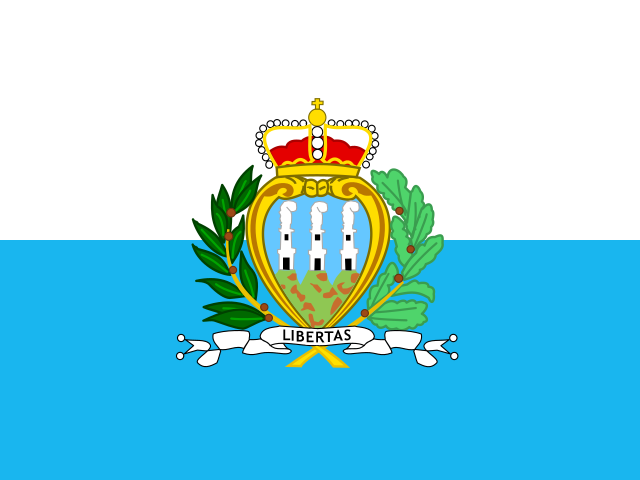
Two horizontal bands of white over light blue, with the official coat of arms in the centre: three silver towers on three green mountains, crested with silver ostrich plumes, beneath a closed crown, between crossed branches of laurel and oak, and above a silver ribbon reading LIBERTAS. Constitutional Law 22 July 2011 no. 1 sets all of that out, fixes the flag at three by four, with two by three permitted for international use, and gives a Pantone value for every colour, and assigns a meaning to exactly one element: the closed crown, which it calls the symbol of sovereignty. It says nothing about the white or the blue, and it does not name Monte Titano. The readings of white for snow and peace and blue for sky and liberty are not the law's.
San Marino FACTS ◢
| Capital | San Marino |
|---|---|
| Continent | Europe |
| Population | 34,109 (2025) |
| Area | 61 km² |
| Population density | 559/km² |
| Currency | Euro (EUR) |
| Official language | Italian |
| Calling code | +378 |
| Internet TLD | .sm |
| Time zone | UTC+01:00 |
| Drives on the | Right |
| ISO codes | SM / SMR |
DID YOU KNOW? ◢
- It claims to be the world's oldest surviving sovereign republic, traditionally dating its founding to 301 AD.
- It's one of only three countries completely surrounded by a single other country.
- Its historic centre and Monte Titano are a UNESCO World Heritage Site, crowned by three medieval towers.
- It's among the smallest countries in the world, both in area and population.
San Marino QUICK ANSWERS ◢
What is the capital of San Marino?
The capital of San Marino is San Marino.
What is the population of San Marino?
San Marino had a population of 34,109 in 2025.
What currency does San Marino use?
San Marino uses the Euro (EUR).
What languages are spoken in San Marino?
The official language of San Marino is Italian.
Think you know your flags? Play Flag Daily → · Browse all countries →
MORE ON THE FLAG ◢
San Marino's flag is defined by a constitutional law, and that law explains one thing about it.
Constitutional Law 22 July 2011 no. 1, Legge Costituzionale 22 luglio 2011 n.1, blazons the flag and its coat of arms in full heraldic Italian. It fixes the flag's proportions, the size of the arms on it, the position of the arms to a fraction of the flag's height, and a Pantone value for every colour in both. It runs to five articles and two annexes.
In all of that it assigns a meaning to one element. The arms are "sormontato da corona chiusa, simbolo di sovranità": surmounted by a closed crown, symbol of sovereignty. Nothing else in the law is given a meaning at all. Not the white, not the blue, not the three towers, not the three mountains, not the ostrich plumes, not the laurel and the oak, and not the word LIBERTAS.
Key Takeaways
- The flag is set out in Constitutional Law 22 July 2011 no. 1, which inserted an article into San Marino's 1974 Declaration of the Rights of Citizens.
- The only meaning that law assigns to any element is the closed crown, which it calls the symbol of sovereignty.
- The law fixes the flag's official proportions at 3:4, and permits 2:3 only for international use or where specifically provided.
- It gives Pantone values for every colour, and the flag's blue and the shield's blue are two different blues.
- Neither the law nor the annexes name Monte Titano.
San Marino's flag law explains one thing, and it is the crown
Article 1 inserts a new article 2 bis into an earlier law and sets out what the arms are. The clause is: "Lo stemma ufficiale della Repubblica è sormontato da corona chiusa, simbolo di sovranità." The official coat of arms of the Republic is surmounted by a closed crown, symbol of sovereignty.
That is it. Everything after it is description. The shield has an azure field, three green mountains, silver towers, "finestrate, merlate e distinte in nero", windowed, embattled and outlined in black, "cimate di penne di struzzo d'argento", crested with silver ostrich plumes. The shield is ornamented by two green branches crossed below its point, one of laurel and one of oak, "fruttati d'oro", fruited in gold. On a silver ribbon the motto LIBERTAS in black capitals.
Every one of those is a statement of what is there. None of them says what it is for.
The asymmetry repays a second look. A drafter uninterested in meanings would not have written "simbolo di sovranità" at all, so the gloss is deliberate on its face. What cannot be read off the text is why it was thought needed for the crown and for nothing else.
There is a second thing about that choice, and it comes from the document the article was inserted into.
The crown is a symbol of sovereignty in a law that puts sovereignty in the people
The 2011 law is not free-standing. Its article 1 begins "Alla Legge 8 luglio 1974 n. 59 è aggiunto il seguente articolo", to Law 59 of 8 July 1974 the following article is added, and what follows is article 2 bis.
Law 59 of 1974 is the Dichiarazione dei diritti dei cittadini e dei principi fondamentali dell'ordinamento sammarinese, the Declaration of the Rights of Citizens and of the fundamental principles of the Sammarinese legal order. San Marino has no codified constitution in one document, and this Declaration is the nearest thing to one. The Council's archive serves the 1974 text as originally enacted, so the insertion is cited here to the 2011 law that made it rather than to a consolidated copy.
Its article 2 opens: "La sovranità della Repubblica risiede nel popolo". The sovereignty of the Republic resides in the people.
So since 2011 those two sentences have sat in the same instrument, one article apart. Article 2 says sovereignty resides in the people. Article 2 bis says the closed crown is the symbol of sovereignty. Neither refers to the other and nothing in either resolves the tension for a reader who notices it.
The Declaration's own preamble is worth having beside them, because it establishes what kind of document the flag was put into. The Great and General Council adopts it "nel fermo proposito di ripudiare il Fascismo ed ogni concezione totalitaria dello Stato", in the firm intention of repudiating Fascism and every totalitarian conception of the State.
That preamble matters for this flag for a reason that has nothing to do with the crown, and it takes a second law to see it.
The days San Marino flies the flag, in 1936 and in 2012
Article 4 of the 2011 law delegates the regulation of the flag's use to a decreto delegato, and the decree that answered it is Decreto Delegato 1 agosto 2012 n.103. It does the job a law of 1936 had done, and its repealing article does not name that law: article 5 says only "Sono abrogate le norme in contrasto con il presente decreto delegato", the norms in conflict with this decree are repealed.
Both instruments do the same job: they list the days on which the flag is flown. Set the two lists side by side and the country's twentieth century is in the difference.
The 1936 law is Legge 25 agosto 1936 n.10, and its article 1 lists the state holidays. Among them: "10 agosto: anniversario della fondazione dei Fasci Sammarinesi, 1922". The tenth of August, the anniversary of the founding of the Sammarinese Fascist organisations in 1922.
The 2012 decree lists the days again. That one is gone, and in its place, among the days on which the flag is flown, is "28 luglio: Caduta del Fascismo e festa della Libertà". The twenty-eighth of July, the Fall of Fascism and the feast of Liberty.
| Day | 1936 | 2012 |
|---|---|---|
| 5 February, Sant'Agata and the recovery of liberty after the Alberoni occupation of 1740 | yes | yes |
| 25 March, the Arengo Generale of the heads of household in 1906 and the feast of the Militia | no | yes |
| 1 April, the entry of the Captains Regent | yes | yes |
| 1 May, workers | no | yes |
| Corpus Domini | yes | yes |
| 4 June, San Quirino and the foiling of Fabiano da Monte's attempt in 1543 | yes | yes |
| 14 June, the discovery of an attempt against the Republic's internal security in 1933 | yes | no |
| 28 July, the Fall of Fascism and the feast of Liberty | no | yes |
| 10 August, the founding of the Sammarinese Fascist organisations in 1922 | yes | no |
| 3 September, the patron saint and the Republic's founding in 301 (1936: the patron saint and Founder, and the Republic's Natale) | yes | yes |
| 1 October, the entry of the Captains Regent | yes | yes |
Six days survive both lists. Five of the six keep their wording almost exactly; the sixth is recast, 3 September going from the patron saint and Founder and the Republic's Natale in 1936 to the patron saint and the Founding of the Republic in 2012. Two go: the Fascist anniversary, and 14 June. Three arrive: 25 March, 1 May and 28 July.
Both instruments are dated twice. The 1936 law is "addì 25 Agosto 1936 (1635 d.F.R.)" and the 2012 decree "addì 1 agosto 2012/1711 d.F.R", the second figure counting from the foundation of the Republic. The flag laws of San Marino are dated in two eras at once, and the shorter era is the one that changed its mind about which anniversaries to fly for.
The proportions are 3:4, and 2:3 is the exception
Annex A to the 2011 law holds the drawing, and it is precise in a way article 2 bis is not.
"Proporzioni della bandiera 3:4". The flag's proportions are three to four.
The other figure people give for this flag is 2:3, and the law itself provides for it: "La bandiera ufficiale potrà assumere la proporzione 2:3 per usi internazionali e/o quando specificamente previsto." The official flag may take the 2:3 proportion for international uses and where specifically provided.
So both flags are official and one of them is the exception. San Marino flies a 3:4 flag at home and permits a 2:3 flag abroad, and the law writes out the geometry for both.
The rest of the annex is equally exact. On the flag, the base of the arms is 3/2 L. The arms are centred horizontally on the flag's base, and vertically "l'intersezione dei bracci della croce sulla corona è a 1/2 L dal bordo superiore", the intersection of the arms of the cross on the crown is half an L from the top edge. In the 2:3 version the arms take the central third of the base and that same intersection moves to a sixth of the height from the top.
A flag positioned by the crossing point of a cross on top of a crown is an unusual specification, and it is the second time in this law that the crown is treated as the reference point for everything else.
The arms have their own geometry in Annex B: "base 10 u x altezza 12 u", ten units wide by twelve tall.
Italy is the country San Marino sits inside, and its tricolour is the flag a visitor arriving in San Marino will have been looking at all the way there.
Two blues, in one law
The colour tables in the annexes are the part of this law that article 2 bis does not have at all, and they contain a distinction its prose loses.
Article 2 bis calls the flag's lower field "azzurro", and it calls the shield's field "azzurro" as well. The same word, twice, for two different things.
The annexes do not agree that they are the same. Annex A, the flag, gives two official colours: "Celeste", Pantone 2915 C and 2915 U, CMYK 55/10/5/0, Pantone textile 15-4323 TPX; and "Bianco bandiera", flag white, which it specifies as white paper, 0/0/0/0, white fabric.
Annex B, the arms, gives ten. Among them "Azzurro cielo", Pantone 291 C and 291 U, CMYK 47/8/7/0, textile 14-4318 TPX.
So the two blues in this law are not the same blue:
| Where | Name in the annex | Pantone Coated | Pantone Uncoated | CMYK | Pantone TPX |
|---|---|---|---|---|---|
| The flag's lower field, Annex A | Celeste | 2915 C | 2915 U | 55/10/5/0 | 15-4323 TPX |
| The shield's field, Annex B | Azzurro cielo | 291 C | 291 U | 47/8/7/0 | 14-4318 TPX |
Different names, different numbers, one instrument. Whatever the blazon's single word suggests, the specification that governs printing and weaving treats them as two colours.
The other nine in Annex B show how far this law goes:
- Giallo sole and Giallo oro, sun yellow and gold yellow
- Marrone rami, branch brown
- Verde luce, Verde foglia and Verde ombra, light green, leaf green and shadow green
- Blu ombra, shadow blue
- Grigio ombra, shadow grey
- Nero, black
Two of them, Verde ombra and Blu ombra, are specified as mixtures of two Pantones with an alternative single Pantone given for each.
This is a coat of arms specified as a shaded illustration rather than as a flat blazon, and a constitutional law is an unusual place to find that.
San Marino's flag law never names Monte Titano
The list of things absent from the instrument is longer than the list of things in it.
It does not name Monte Titano. The three mountains are "tre monti di verde", three green mountains, and the towers are silver, windowed, embattled and outlined in black. The mountain the towers stand on is not identified anywhere in the law or its annexes.
It does not say what LIBERTAS means or why it is there. The motto is given as a fact about a silver ribbon.
It does not read the white for snow or peace, or the blue for sky or liberty. Those are the readings in general circulation and the law assigns neither.
It does not explain the ostrich plumes, the laurel, the oak, or why the shield's branches are fruited in gold.
And it does not say why there are three of anything: three mountains, three towers.
What it does instead is delegate. Article 4 splits the follow-up in two. "L'utilizzo dello stemma ufficiale è disciplinato da legge ordinaria": the use of the arms is governed by ordinary law. "La regolamentazione dell'utilizzo della bandiera è demandata a decreto delegato": the regulation of the flag's use is delegated to a decreto delegato. Meanings are delegated to nobody.
The decree that says how to fly it
The 2012 decree is where the detail went, and none of it is about meaning either.
The flag is flown outside the institutions, the Militia Quarter, the schools and San Marino's diplomatic missions abroad on the listed days. It goes up on the Tower of the Public Palace when the Great and General Council sits. It is flown outside polling stations from morning until the count closes.
Then the conduct rules. Flags must be flown in good condition and correctly unfurled, and neither on them nor on the staff that carries them may figures, writing or letters of any kind be applied. One flag per staff. In mourning, half-mast, with one or two strips of black veil permitted at the top of the hoist. No other flag, standard, gonfalon or pennant may be placed above the flag of the Republic. It may be applied only to cars carrying the Captains Regent.
And it may not be used as decoration: "La bandiera della Repubblica di San Marino non può essere usata per alcun tipo di decorazione, drappo o festone." For draping stages or decorating generally, white and azure ribbons or fabrics may be used instead.
That last rule is the neatest summary of how San Marino treats this flag. The colours are available to anybody who wants to make a place look Sammarinese. The flag itself is not decoration.
Any citizen may fly it outside their home on national holidays.
Andorra also carries its coat of arms at the centre of its flag, and its own instruments are worth setting beside these.
Frequently asked questions
What do the colours of the San Marino flag mean?
None of the four San Marino instruments opened for this article says, and the 2011 constitutional law is the one that would. It describes the flag as two horizontal fields, white above and azure below, with the official coat of arms at the centre, and assigns neither colour a meaning. The readings of white for the snow of the peak or for peace, and blue for the sky or for liberty, are in general circulation and are not the law's. The only meaning the law assigns to anything is the closed crown, which it calls the symbol of sovereignty.
What are the three towers on the San Marino flag?
The law calls them silver towers on three green mountains, windowed, embattled, outlined in black and crested with silver ostrich plumes. It does not name Monte Titano, it does not identify the towers, and it does not say why there are three. The towers and the mountain are named in general description rather than in the instrument.
What does LIBERTAS mean on the San Marino flag?
The law gives the motto as a fact and not as a meaning: on a silver ribbon, LIBERTAS in black capitals. Nothing in the instrument says why it is there or what it refers to. It sits on a coat of arms whose only glossed element is a crown described as the symbol of sovereignty, in a Declaration whose article 2 places sovereignty in the people.
What are the proportions of the San Marino flag?
Three to four, under Annex A to the 2011 constitutional law. The same annex permits the 2:3 proportion for international use or where specifically provided, and sets out where the arms go in each version. Both are official and 3:4 is the default.
What law defines the flag of San Marino?
Constitutional Law 22 July 2011 no. 1, which inserted article 2 bis into Law 59 of 8 July 1974, the Declaration of the Rights of Citizens. Its annexes fix the graphic model, the proportions and the Pantone colours. The use of the flag is regulated separately by Delegated Decree 1 August 2012 no. 103, which does the job of a law of 25 August 1936 and repeals whatever conflicts with it without naming that law.
Sources
- Consiglio Grande e Generale, Repubblica di San Marino, Legge Costituzionale 22 luglio 2011 n.1, Bandiera e stemma ufficiale della Repubblica di San Marino, with Annex A (the flag) and Annex B (the arms). Approved by the Great and General Council on 20 July 2011 by 45 votes to 2 with 1 abstention. Retrieved from the Council's own law archive, 26 August 2026.
- Consiglio Grande e Generale, Legge 8 luglio 1974 n.59, Dichiarazione dei diritti dei cittadini e dei principi fondamentali dell'ordinamento sammarinese, cited for its preamble and its article 2. The copy the archive serves is the law as originally enacted and does not show the 2011 insertion. That insertion is recorded in the constitutional law above. Retrieved 26 August 2026.
- Consiglio Grande e Generale, Decreto Delegato 1 agosto 2012 n.103, Disciplina dell'esposizione della bandiera della Repubblica di San Marino, made under article 4 of the 2011 constitutional law. Retrieved 26 August 2026.
- Consiglio Grande e Generale, Legge 25 agosto 1936 n.10, Legge che regola l'uso della Bandiera nazionale e di quelle estere, the earlier instrument on the same subject, cited for its list of state holidays. Retrieved 26 August 2026.
- Consiglio Grande e Generale, Archivio Leggi, Decreti e Regolamenti, the Council's searchable law archive, used to establish that these are the instruments the archive holds on the flag. Retrieved 26 August 2026.
PLAY ANOTHER →
One quote, one scrambled alphabet. Crack it before tomorrow.
CRACK THE QUOTEDAILYOn This DayOne thing that happened today in history. Every day, a new one.
TODAY IN HISTORYDAILYDaily TriviaFive questions a day. Everyone gets the same five.
FIVE QUESTIONSDAILYGuess the CountryThree clues, three guesses. Work out where in the world it is.
THREE CLUES