
Andorra
A tiny mountain principality wedged high in the Pyrenees between France and Spain, ruled jointly by a French president and a Spanish bishop. Andorra runs on its own quirky rules.
WHAT THE FLAG MEANS ◢
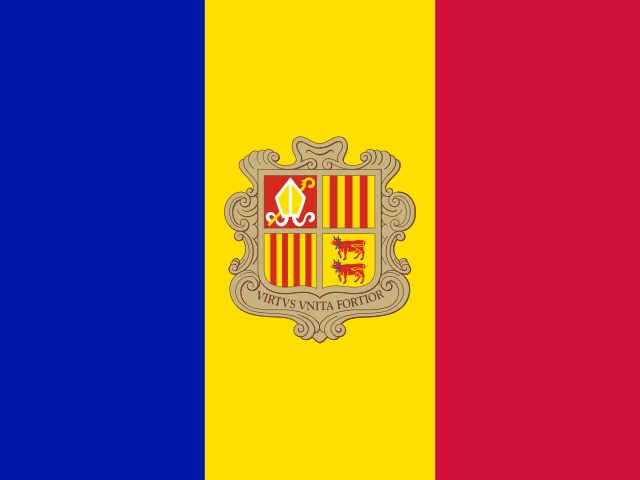
Three vertical bands of blue, yellow and red, the arms on the wider yellow band. No Andorran law gives the colours a meaning: the Paris press of December 1866 reported blue for France, red for Spain and yellow for Andorra itself, but no official document records the reasoning. The quartered arms give two houses to each co-prince - Urgell's mitre and crozier and Catalonia's four pales, against Foix's three and Bearn's two cows - under the motto 'Virtus Unita Fortior', 'strength united is stronger'.
Source: govern.ad
Andorra FACTS ◢
| Capital | Andorra la Vella |
|---|---|
| Continent | Europe |
| Population | 82,904 (2025) |
| Area | 468 km² |
| Population density | 177/km² |
| Currency | Euro (EUR) |
| Official language | Catalan |
| Calling code | +376 |
| Internet TLD | .ad |
| Time zone | UTC+01:00 |
| Drives on the | Right |
| ISO codes | AD / AND |
DID YOU KNOW? ◢
- It's a co-principality, with two heads of state: the President of France and a Spanish bishop.
- It has no army and no airport, sitting entirely within the Pyrenees mountains.
- Catalan is its official language, making it the only country where Catalan holds that status.
- Its people enjoy one of the longest life expectancies in the world.
Andorra QUICK ANSWERS ◢
What is the capital of Andorra?
The capital of Andorra is Andorra la Vella.
What is the population of Andorra?
Andorra had a population of 82,904 in 2025.
What currency does Andorra use?
Andorra uses the Euro (EUR).
What languages are spoken in Andorra?
The official language of Andorra is Catalan.
Think you know your flags? Play Flag Daily → · Browse all countries →
MORE ON THE FLAG ◢
Andorra's constitution spends one sentence on the flag and does not describe it. Article 2.2 says that the national anthem, the flag and the coat of arms "són els tradicionals" - are the traditional ones. That is the whole provision.
So if you want to know what the blue, the yellow and the red on the Andorran flag stand for, there is no official answer waiting to be found. What the flag does spell out, quarter by quarter, is who rules the place.
Key Takeaways
- The 1993 Constitution never describes the flag. Article 2.2 says the anthem, flag and arms are "the traditional ones" and stops.
- No Andorran law gives the colours a meaning. Paris newspapers reported in December 1866 that blue stood for France, red for Spain and yellow for Andorra itself, and the Arxiu Nacional d'Andorra says no official document records the reasoning.
- The shield is quartered, two houses to each co-prince: the mitre and crozier of the Bishopric and the four red pales of Catalonia, against the three pales of Foix and the two cows of Béarn.
- The stripes are not equal. The government's own standards set the yellow band at 0.36 of the flag's length and the blue and red at 0.32 each.
- The flag was proposed in 1866 and only declared official on 22 December 1942, six weeks after German troops reached Andorra's frontier with France.
What do the colours on the Andorran flag mean?
Officially, nothing. The law that defines the flag describes it and assigns it no symbolism.
That law is the Llei sobre la utilització dels signes d'Estat of 20 June 1996, whose annex fills the gap left by the constitution's word "traditional". Its second section sets out "tres franges similars verticals consecutives", blue at the hoist, then yellow, then red, and stops there.
The annex is careful to describe the traditional flag rather than the official one. Article 1.2 of the same law says the official form must be fixed by a law of its own, and a transitional provision holds that until such a law exists the annex's description applies instead. In the text consolidated to August 2022, it still does.
The nearest thing to an explanation is a newspaper report from the week the flag was proposed. On 13 December 1866 the Paris daily La Presse, describing an Andorran delegation received at the palace of Compiègne two days earlier, said a flag had been agreed: "bleu pour la France, rouge pour l'Espagne et jaune pour la république." Blue for France, red for Spain, and yellow for "the republic", which is what the French and Spanish press of the day called Andorra.
Read that pairing carefully, because the popular retelling scrambles it. Red is Spain's in the report and yellow is Andorra's own. Versions that hand yellow to Spain, or blue and red jointly to France, are not what the 1866 account says.
The Arxiu Nacional d'Andorra's monograph on the flag states that "no disposem de documents oficials en què se'ns parli dels motius d'aquesta elecció de colors" - there are no official documents discussing why these colours were chosen - and reads the press version as diplomatic wording meant to suit everyone. The archivist's own suggestion is heraldic rather than geographic: yellow and red already sit in the arms twice over, through Foix and through the Catalan pales. He labels it a hypothesis and leaves it there.
What is on Andorra's coat of arms?
Four quarters, and the statute names them one by one.
The same 1996 annex opens: "L'escut del Principat d'Andorra tradicionalment ha estat format per quatre cases, dues corresponents a cadascun dels dos Coprínceps." Four houses, two belonging to each of the two co-princes. It lists the Bishopric, represented by "una mitra i un bàcul daurats sobre fons vermell" - a gold mitre and crozier on a red ground - then Catalonia, Foix and Béarn, and adds that the shield may be accompanied by the device "Virtus Unita Fortior".
That listing order is not the order you read them in, which is one reason so many descriptions put the quarters in the wrong corners. The government's book of graphic standards, approved on 5 May 1999, letters them onto the drawing itself (sheet 1.1.1):
| Position | House | What is on it |
|---|---|---|
| Top left | Bishopric of Urgell | Gold mitre and crozier on red |
| Top right | Foix | Three red pales on gold |
| Bottom left | Catalonia | Four red pales on gold |
| Bottom right | Béarn | Two red cows on gold |
Two of those quarters look nearly identical, and the difference is arithmetic. Counted off the government's own artwork, Foix has three red pales and Catalonia four. Miscount, and you have swapped one for the other.
Béarn supplies the memorable ones: red cows with blue horns, hooves and collar bells. Below everything, on the scroll, sits VIRTVS VNITA FORTIOR.
Why does the shield give two quarters to each prince?
Because Andorra genuinely has two princes, and the constitution says so in the same breath as it declines to describe the flag.
Article 43.1 makes the co-princes "conjuntament i indivisa, el Cap de l'Estat" - jointly and indivisibly the head of state, singular. Article 43.2 names them as the Bishop of Urgell and the President of the French Republic, holding equal powers, an institution it traces to the Pareatges, the thirteenth-century settlements that split lordship of the valleys between a bishop and a count.
Line the quarters up against that and the shield stops being decorative. The mitre and crozier are the Bishop of Urgell, whose see lies in Catalonia. Foix is the county whose rights passed to Béarn, then to the kings of Navarre, then to the French crown, and finally to the French head of state. The statute allocates no quarter to a named prince, but Foix and Béarn were one inheritance and Urgell sits inside Catalonia, so the pairing is not hard to make. A constitutional arrangement, drawn as heraldry.
Who created the Andorran flag, and when did it become official?
It was proposed in December 1866, in the middle of a constitutional row, and took another seventy-six years to be made official.
Andorra was then partway through the Nova Reforma, a restructuring of its parliament decreed by the episcopal co-prince in April 1866 without French assent. A delegation led by the syndic general Guillem d'Areny-Plandolit went to Compiègne to seek that assent, and did not get it: Napoleon III's approval of the reform took until April 1868.
The flag came out of the same meeting, on 11 December 1866. No source names a designer, and that is worth stating plainly rather than leaving as a gap: the record credits a room, not a hand. The National Archives names the three Andorrans in it as Areny-Plandolit, Bonaventura Moles, consul major of Andorra la Vella, and Tomàs Palmitjavila, secretary of the Consell General, and calls the three of them the fathers of the tricolour.
It was shown at the Paris Exposition Universelle the following year, where L'Étendard of 18 June 1867 recorded "un trophée de drapeaux, aux couleurs bleue, rouge et jaune".
Decades of disagreement followed, not about the colours but about their arrangement. When a French schoolmaster wrote in 1902 asking how the Andorran flag was set out, the archived letter came back with three different pencil sketches in its margin, two of them horizontal.
The Consell General settled it on 22 December 1942, declaring the anthem, arms and flag official in one sitting and recording the flag as "de tres colors, sentit vertical: blau, groc i vermell". Six weeks earlier Germany had occupied Vichy France and, in the National Archives' words, reached "el Pas de la Casa, a la frontera d'Andorra amb França" for the first time. The archives read the timing as deliberate: declaring the three symbols official was a demonstration of national sovereignty in front of a foreign state.
That minute also shows what has since shifted: it puts the Béarn cows in gold on a green field, where the modern arms have them red on gold, and it calls the three stripes equal.
Is the Andorran flag three equal stripes?
No, and the government's own drawings are where you can see it.
Note that the 1996 statute never claims they are. Its word is "similars" - similar bands, not equal ones - and it puts no numbers on them at all.
The numbers arrive fifteen years later, in the institutional identity standards published in November 2011 (sheets 2.2 and 2.3). Those set the height at 0.70 of the length L, a ratio of 7 to 10, and divide the length like this:
| Band | Width |
|---|---|
| Blue, at the hoist | 0.32 L |
| Yellow, at the centre | 0.36 L |
| Red, at the fly | 0.32 L |
The middle stripe is exactly an eighth wider than each of its neighbours.
The same diagram suggests why, without saying so in words: the arms are 0.30 L wide, which leaves a comfortable margin inside a 0.36 L band and almost none inside a 0.32 L one. Colours are specified as Pantone Blue 072, Yellow C and Red 199.
One practical point to finish. The 1996 law allows the arms to be left off "sobretot quan la bandera es representa en certs formats reduïts o específics" - especially in reduced or specific formats, such as ribbons. A plain Andorran tricolour is not a mistake. It is the permitted short form, and it is the version that turns up in a flag quiz.
Frequently asked questions
Do the blue, yellow and red on Andorra's flag have official meanings?
No. No Andorran law assigns them one. The 1996 state-signs law describes the three bands without symbolism, and the Arxiu Nacional d'Andorra says no official document records why they were chosen. The one contemporaneous account is press reporting from December 1866, which gave blue to France, red to Spain and yellow to Andorra itself, and the National Archives treats that as a diplomatic gloss rather than a settled fact.
What are the four quarters of Andorra's coat of arms?
The Bishopric of Urgell, a gold mitre and crozier on red, top left. Foix, three red pales on gold, top right. Catalonia, four red pales on gold, bottom left. Béarn, two red cows on gold, bottom right. The 1996 law calls them four houses, two for each of Andorra's two co-princes.
What does Virtus Unita Fortior mean?
It is Latin, usually rendered "united virtue is stronger". Latin virtus covers strength and courage as well as moral virtue, so "strength united is stronger" reads the same three words just as fairly. Andorran law quotes the motto and never translates it.
When did the Andorran flag become official?
On 22 December 1942, by resolution of the Consell General, which declared the anthem, coat of arms and flag official in one sitting and set the flag as three vertical colours with blue at the hoist. The tricolour had been in use, in varying arrangements, since 1866.
Why is Andorra's flag so easy to confuse with Moldova's, Romania's and Chad's?
All four are vertical tricolours in blue, yellow and red, and Andorra's clearest marker is optional: the 1996 law expressly allows the coat of arms to be dropped in reduced formats. With the arms present the shield settles it, because a quartered mitre, two sets of red pales and a pair of cows belong to Andorra alone. Without them there is little left to go on, because what the Andorran standard specifies beyond the arms is proportion, and reproductions routinely normalise proportion away.
Moldova's is the closest of the three, because it also carries arms on the yellow band. Romania's and Chad's carry none at all.
Sources
- Consell General d'Andorra, Constitució del Principat d'Andorra, articles 2.2 and 43 - retrieved 12 August 2026.
- Govern d'Andorra, Llei sobre la utilització dels signes d'Estat, 20 June 1996, consolidated August 2022, article 1.2 and the annex sections on the traditional arms and flag - retrieved 12 August 2026.
- Govern d'Andorra, Llibre de normes gràfiques, approved 5 May 1999, sheet 1.1.1 - retrieved 12 August 2026.
- Govern d'Andorra, Normes gràfiques de la identitat institucional: Bandera, November 2011, sheets 2.2 and 2.3 - retrieved 12 August 2026.
- Pau Chica Fernàndez, Arxiu Nacional d'Andorra, La bandera andorrana - retrieved 12 August 2026.
PLAY ANOTHER →
One thing that happened today in history. Every day, a new one.
TODAY IN HISTORYDAILYDaily TriviaFive questions a day. Everyone gets the same five.
FIVE QUESTIONSDAILYDaily CodeA short message, hidden in a different cipher every day.
ONE CIPHER A DAYDAILYDaily CryptogramOne quote, one scrambled alphabet. Crack it before tomorrow.
CRACK THE QUOTE