
Chad
A vast landlocked expanse where the Sahara meets the savanna, Chad is named after a shrinking lake that was once one of the largest bodies of water in Africa.
WHAT THE FLAG MEANS ◢
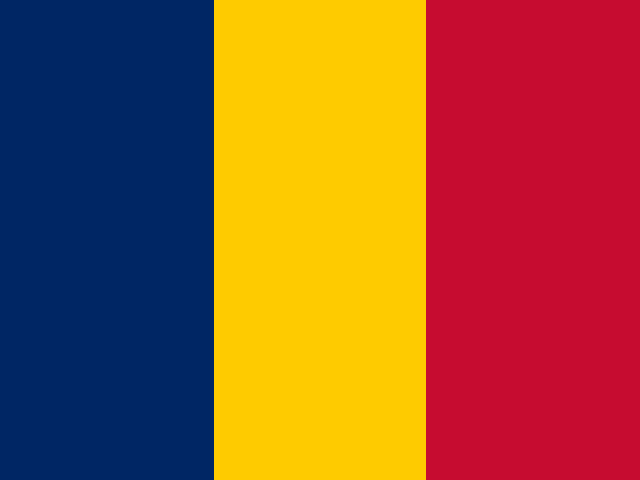
A vertical tricolour of blue, gold and red, the blue at the hoist. The constitution names the colours and their order but fixes no meaning; the familiar sky, sun and sacrifice readings come from flag reference works rather than Chadian law.
Chad FACTS ◢
| Capital | N'Djamena |
|---|---|
| Continent | Africa |
| Population | 21,003,705 (2025) |
| Area | 1,284,000 km² |
| Population density | 16/km² |
| Currency | Central African CFA franc (XAF) |
| Official languages | Arabic, French |
| Calling code | +235 |
| Internet TLD | .td |
| Time zone | UTC+01:00 |
| Drives on the | Right |
| ISO codes | TD / TCD |
DID YOU KNOW? ◢
- Lake Chad has shrunk dramatically since the 1960s, and is shared with Niger, Nigeria and Cameroon.
- The Emi Koussi volcano in its Tibesti Mountains is the highest peak in the Sahara.
- The Ennedi Plateau, a UNESCO site, is filled with dramatic sandstone arches and ancient rock art.
- It's one of the largest landlocked countries in the world by area.
Chad QUICK ANSWERS ◢
What is the capital of Chad?
The capital of Chad is N'Djamena.
What is the population of Chad?
Chad had a population of 21,003,705 in 2025.
What currency does Chad use?
Chad uses the Central African CFA franc (XAF).
What languages are spoken in Chad?
The official languages of Chad are Arabic and French.
Think you know your flags? Play Flag Daily → · Browse all countries →
MORE ON THE FLAG ◢
Two countries fly a vertical tricolour of blue, gold and red with nothing on it to tell them apart. Chad's version was approved in 1959. Romania's became identical to it in December 1989, when the incoming government cut the communist-era insignia out of the middle of its own tricolour.
Neither country copied the other. Two sets of colours arrived from different directions and met by accident, which is why the pair has no villain and no fix.
Most accounts go on to say that Chad took the clash to the United Nations in 2004 and got nowhere. That version is thinner than it reads. What is actually on the record is a Romanian president refusing to budge, and Romania's foreign ministry saying it had never been notified of any complaint at all.
Chad's own law is quieter still. Article 8 of the constitution names three colours, fixes their order, says which end the blue goes on, and stops.
Key Takeaways
- Chad's flag was approved on 6 November 1959, nine months before independence, replacing a green-yellow-red design a legislative commission had recommended that June.
- Article 8 of the constitution approved by referendum on 17 December 2023 calls the flag "bleu, or, rouge" in equal vertical bands, "le bleu étant du côté de la hampe" (the blue being on the staff side).
- Constitutionally the middle band is "or", gold, and that identical sentence sits at Article 8 of the 1996, 2018 and 2023 texts.
- None of those three texts gives the colours a meaning, and no separate Chadian flag law could be found. Sky-and-sun readings come from flag reference works instead.
- Southern-lands, northern-desert and blood readings inside the popular version were written for the design Chad rejected, and the reference work that records the blue's reading hedges it as "said to".
| The claim | What the source says | Where |
|---|---|---|
| The flag is blue, yellow and red | "bleu, or, rouge", gold rather than yellow | Constitution of Chad, Article 8 |
| Blue means sky and hope, yellow the sun | no colour is given any meaning | Constitution of Chad, Articles 8 to 11 |
| Blue replaced green to avoid Mali's flag | the Mali Federation "had already adopted the tricolour flag it proposed" | Britannica, Whitney Smith |
| The colours mean south, desert and blood | that was the reading of the rejected green-yellow-red design | Britannica, Whitney Smith |
| Chad took the clash to the UN in 2004 | the reports were "unconfirmed" and Romania had "no official notification" | BBC News, 14 April 2004 |
Why do Chad and Romania have the same flag?
Because two unrelated histories arrived at the same three colours, and one of them lost an emblem.
Chad's tricolour is a blend. Flags of the World reads it as the blue, white and red of France, the colonial power, crossed with the green, yellow and red flown across newly independent Africa. Blue comes from the first set, gold and red from the second, and the white and the green drop out.
Romania's tricolour is older than Chad as a state. The same reference traces its vertical arrangement, blue at the hoist, to a decree of the revolutionary provisional government in Bucharest in 1848, and Article 12 of the Romanian constitution still specifies "three vertical stripes: blue, yellow, and red, in this order, from the mast".
Only in December 1989 did the two designs become indistinguishable. Romania's flag had carried the communist-era insignia in its centre. When Nicolae Ceausescu was overthrown, the incoming government dropped it, and the plain tricolour left behind was Chad's flag. So the collision has a precise date, and it is not 1959.
What does Chad's constitution actually say about the flag?
One sentence, and it is a description rather than an explanation.
The text now in force was approved by referendum on 17 December 2023 and is published by the Chadian presidency. Article 8 sits in Title I, on the state and sovereignty:
l'emblème national est le drapeau tricolore : bleu, or, rouge à bandes verticales et à dimensions égales, le bleu étant du côté de la hampe.
In English: the national emblem is the tricolour flag, blue, gold, red, in vertical bands of equal dimensions, the blue being on the staff side. From there Article 8 moves on to the motto, "Unité - Travail - Progrès", the anthem "La Tchadienne" and the capital.
Three things are worth noticing about that sentence. It names the middle colour "or", gold, not "jaune", yellow. It fixes the orientation, so a mirrored Chadian flag with the red at the hoist is wrong rather than merely unusual. And it says nothing whatever about what the colours stand for.
That wording is not new either. Chad's 1996 and 2018 constitutions carry it word for word, under the same article number. Three texts across nearly three decades, and the description has never gained a single adjective of meaning.
What the next article adds is a penalty rather than a meaning. Under Article 9 the attributes of the Republic are reserved to the use of the public authorities, and "tout usage illégal à des fins privées, toute profanation de ces attributs sont punis par la loi": any illegal private use, and any profanation of them, is punished by law.
So what do the three colours mean?
Nothing that the constitution says, in any of its three versions. Every reading in circulation comes from outside the country.
Popular accounts all give some version of blue for the sky and hope and the southern waters, gold for the sun and the northern desert, red for unity and sacrifice. Those glosses are consistent, confident, and attached to no Chadian law or decree that could be found. Flags of the World, the long-running volunteer-compiled vexillological reference, introduces them as the "official symbolics of the colours" on the very page where it quotes a constitutional article that assigns none.
That trail leads back to a reference work rather than a statute. Britannica's flag entry, written by Whitney Smith, the vexillologist who coined the word, records that the dark blue stripe "is said to stand for hope and the sky, yellow is for the sun, and red is for the unity of the nation". The hedge is Smith's own, and the most cited source for the meanings does not claim them as official.
A flag can be entrenched in law down to which end the blue goes and still have no legal symbolism at all. Chad is one of those cases, as is Romania, whose Article 12 is just as silent on what its blue, yellow and red are for.
Was Chad's blue chosen to avoid Mali's flag?
That is the standard account, and it has one real source behind it rather than the several it appears to have.
Smith's Britannica entry sets out the sequence. The Republic of Chad was proclaimed on 28 November 1958 with no flag of its own, a date the constitution's preamble still records, and the French Tricolour still flew. A legislative commission recommended a design on 30 June 1959, and it was a vertical green-yellow-red tricolour. What the commission "failed to take into consideration was that the same three pan-African colours were being used by other French territories and that the Mali Federation had already adopted the tricolour flag it proposed". A new design went in that November and was approved by acclamation on the 6th, with dark blue in place of the green.
Chronology backs the story. That federation, the short-lived union of Senegal and French Sudan that gave Mali its name, adopted its flag on 4 April 1959 by the account in Flags of the World: the same three colours, vertically, with a black kanaga figure added at the centre. It had the arrangement nearly three months before Chad's commission proposed it.
What is missing is a Chadian record of the reasoning. The claim about the motive rests on one signed reference-work account, repeated since without anybody adding a gazette, a debate transcript or a commission minute to it. Treat it as the best available account rather than as a documented decision.
What survived the redesign is the commission's own symbolism. Green stood for the fertile lands of the south, yellow for the desert of the north, red for the readiness of citizens to shed their blood in defence of the nation. Those are the meanings that still circulate, attached to a flag whose first band is not green.
Did Chad complain to the United Nations in 2004?
Nobody has produced the complaint. What exists is a report of one, and a refusal aimed at it.
BBC News covered the episode on 14 April 2004. Romanian president Ion Iliescu said his country would not give up its flag, noting that Chad had only been independent since 1960: "The tricolour belongs to us. We will not give up the tricolour."
Read the sentence before the quote, though. Iliescu's comments followed "unconfirmed reports in the Romanian media that Chad has called on the UN to examine the issue". Romania's foreign ministry then said it had received no official notification from Chad about any move to raise the matter at the UN, and that it was investigating the press reports.
One substantive point did come back from the ministry. Romania had registered its flag in 1997 under the Paris Convention for the Protection of Industrial Property, whose register of state emblems is administered by the World Intellectual Property Organization. No claim had been lodged against that registration inside the twelve-month window.
So the widely repeated version, in which Chad formally petitioned the UN and was turned down, is a hardening of a story that was labelled unconfirmed on the day. The refusal is quotable. The complaint it refused is not.
The only difference is one shade of blue
Not the proportions, and not anything on the cloth. Flags of the World puts both at 2:3, both are three equal vertical bands, and neither carries a device.
Chad's blue is the darker of the two, an indigo against Romania's cobalt. The same reference, reporting the French navy's flag album, puts Chad's blue at Pantone 281 and Romania's at 280, a single step apart on the same swatch card.
Neither constitution mentions the shade. Romania's Article 12 gives the order and nothing else, and Chad's Article 8 says only "bleu". Romania does have a separate flag law, dated 1994, which the same reference says fixes the model and the intensity of the colours in an annex; that annex is where cobalt blue, chrome yellow and vermilion red come from. No Chadian law or decree doing the same job could be found, so the darker blue is a habit of manufacture rather than a rule.
Two other countries fly the same three colours vertically, and both solved the problem the obvious way. Moldova adds its coat of arms to the yellow band, and Andorra adds its own. Chad and Romania are the pair that added nothing.
If you want to find out whether you can pick either one out of a line-up, a daily flag round is the honest test. Nothing else will help: between them, the two governments have produced one contested newspaper report and no rule at all.
Frequently asked questions
Is Chad's flag exactly the same as Romania's?
Not exactly, but the only difference is the shade of blue, and no Chadian text specifies a shade. Chad's blue is an indigo and Romania's a cobalt, recorded by Flags of the World as Pantone 281 against 280. Both flags are 2:3 with three equal vertical bands and no emblem, and both constitutions describe blue, yellow or gold, and red with the blue at the hoist, so the two constitutional descriptions are indistinguishable. Only Romania's separate 1994 flag law fixes a shade.
Does Chad's constitution say what the flag's colours mean?
No. Article 8 of the text approved by referendum on 17 December 2023 names the colours, sets them in equal vertical bands and puts the blue on the staff side, and it assigns no meaning to any of them. Chad's 1996 and 2018 constitutions carry the same sentence and are just as silent, and no separate Chadian flag law could be located. The familiar sky, sun and sacrifice readings come from flag reference works, chiefly Whitney Smith's Britannica entry and Flags of the World.
Is the middle band of Chad's flag yellow or gold?
The constitution says gold. Article 8 spells the three colours "bleu, or, rouge", and the 1996 and 2018 texts use the same word at the same article number. Yellow is the everyday description and turns up in colour standards for manufacturers, but the legal term has been "or" through every rewrite.
When was the flag of Chad adopted?
It was approved by acclamation on 6 November 1959, while Chad was an autonomous republic within the French Community, and independence followed on 11 August 1960. A legislative commission had recommended a green-yellow-red design on 30 June that year, which was dropped once it became clear other French territories and the Mali Federation were using those colours.
Why does the blue band have to be at the hoist?
Because Article 8 says so, in the clause "le bleu étant du côté de la hampe": the blue being on the staff side. That makes a reversed Chadian flag an error rather than a variant, and it is one of the few things about the design the constitution is willing to be specific about.
Sources
- Présidence de la République du Tchad, Constitution approuvée par le référendum le 17 décembre 2023, Articles 8 to 11 - retrieved 12 August 2026.
- Digithèque de matériaux juridiques et politiques, Université de Perpignan, Tchad, Constitution de 1996 and Constitution de 2018, Article 8 in both - retrieved 12 August 2026.
- Whitney Smith, Flag of Chad, Encyclopaedia Britannica, archived copy - retrieved 12 August 2026.
- BBC News, 'Identical flag' causes flap in Romania, 14 April 2004 - retrieved 12 August 2026.
- Constitution of Romania, Article 12, national symbols, via the Constitute Project - retrieved 12 August 2026.
- Flags of the World, Chad, Romania and Mali, colour specifications, quoted constitutional texts and the Mali Federation flag date - retrieved 12 August 2026.
PLAY ANOTHER →
A short message, hidden in a different cipher every day.
ONE CIPHER A DAYDAILYDaily CryptogramOne quote, one scrambled alphabet. Crack it before tomorrow.
CRACK THE QUOTEDAILYOn This DayOne thing that happened today in history. Every day, a new one.
TODAY IN HISTORYDAILYGuess the CountryThree clues, three guesses. Work out where in the world it is.
THREE CLUES