
Romania
Romania wraps around the Carpathian Mountains in southeastern Europe, home to medieval Transylvania, Dracula's castle legend, and the Danube's vast wildlife-rich delta on the Black Sea.
WHAT THE FLAG MEANS ◢
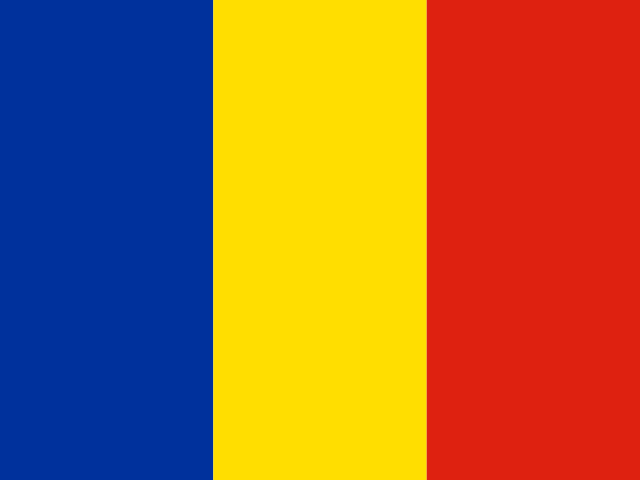
A vertical tricolour of blue, yellow and red, blue at the hoist. Article 12(1) of the constitution gives the three colours and their order from the lance and nothing more, and the flag law adds the proportions and, since 2023, an exact colour specification. Neither instrument assigns the colours a meaning. The colours are conventionally traced to those of the Romanian principalities, and several readings of them circulate, the liberty, justice and fraternity one among them.
Romania FACTS ◢
| Capital | Bucharest |
|---|---|
| Continent | Europe |
| Population | 19,020,271 (2025) |
| Area | 238,397 km² |
| Population density | 80/km² |
| Currency | Romanian leu (RON) |
| Official language | Romanian |
| Calling code | +40 |
| Internet TLD | .ro |
| Time zone | UTC+02:00 |
| Drives on the | Right |
| ISO codes | RO / ROU |
DID YOU KNOW? ◢
- Bran Castle in Transylvania is popularly linked to the Dracula legend inspired by Vlad the Impaler.
- The Danube Delta, where Europe's second-longest river meets the Black Sea, is one of the continent's richest wildlife havens.
- The Carpathian Mountains shelter some of Europe's largest populations of brown bears, wolves and lynx.
- The Palace of the Parliament in Bucharest is one of the largest and heaviest administrative buildings on Earth.
- Romanian is a Romance language, closely related to Italian and Spanish, surrounded by Slavic-speaking neighbours.
Romania QUICK ANSWERS ◢
What is the capital of Romania?
The capital of Romania is Bucharest.
What is the population of Romania?
Romania had a population of 19,020,271 in 2025.
What currency does Romania use?
Romania uses the Romanian leu (RON).
What languages are spoken in Romania?
The official language of Romania is Romanian.
Think you know your flags? Play Flag Daily → · Browse all countries →
MORE ON THE FLAG ◢
Ask what Romania's blue, yellow and red stand for and you will be handed liberty, justice and fraternity, or blood and cornfields and sky. Ask Romanian law the same question and you get nothing, across seven constitutions and every flag statute since.
Article 12(1) of the Constitution names the three colours and the order they run in from the flagpole, and that is the whole of it: "Drapelul României este tricolor; culorile sunt așezate vertical, în ordinea următoare începând de la lance: albastru, galben, roșu." The flag statute, Law 75/1994, stops in the same place. So do the Norms the Government made under it, and so did every earlier Romanian constitution back to 1866.
What those instruments do specify, and lately in some detail, is something else: how blue the blue is. Romania's flag law spent twenty-nine years answering that by pointing at a picture printed in a gazette. Since June 2023 it answers with Pantone 280c.
Key Takeaways
- Article 12(1) of the Constitution gives the tricolour and the order from the lance, and assigns the colours no meaning.
- Law 75/1994 fixed the flag's proportions and referred its model and colour intensity to Annex 1, which was a drawing printed in the gazette.
- Law 176/2023 replaced that annex with one that keeps the drawing and adds a table: Pantone 280c, 116c and 186c, plus CMYK and RGB values.
- Flying the flag with the wrong colour intensity has been a fineable offence since 2001, twenty-two years before the flag law stated a number to measure it against.
- The 1848 decree that prescribed the tricolour prescribed a motto too, and the Defence Ministry quotes it as two words, justice and brotherhood, with no liberty among them.
The flag law fixed the shade, until 2023, by pointing at a picture
Law 75/1994 is the operative flag statute, published in Monitorul Oficial no. 237 of 26 August 1994. Article 1 of it opens with a delegation and follows with geometry.
The delegation: "Modelul drapelului României și intensitatea culorilor acestuia sunt cele prevăzute în anexa nr. 1." The model of the flag and the intensity of its colours are those set out in Annex 1.
The geometry: the flag is rectangular, and "Lățimea drapelului este egală cu 2/3 din lungimea acestuia, iar dimensiunile fâșiilor culorilor sunt egale." The width is two-thirds of the length, and the colour bands are equal. That is the 2:3 ratio and the three equal stripes, and it is the whole of what article 1 of Law 75/1994 says about how the flag is built.
Everything else was in Annex 1. And Annex 1 was a drawing. The Chamber of Deputies' electronic edition of the 1994 text prints, where the annex should be, the line "Drapelul României se găseşte în Monitorul Oficial nr. 237 din 26 august 1994": the flag is to be found in the gazette. The replacement annex enacted in 2023 keeps that drawing and attaches a footnote to it in the statute itself, saying "Imaginea drapelului României este reprodusă în facsimil."
So for twenty-nine years the flag law's account of Romania's colours was a picture. Article 1 said the intensity of the colours was whatever Annex 1 provided, and Annex 1 showed rather than said. Neither the statute nor the Norms made under it gave a value anyone could measure.
What Law 176/2023 actually settled
Law 176/2023, published in Monitorul Oficial no. 550 of 20 June 2023 and in force from 23 June, made four changes to Law 75/1994. The fourth replaced Annex 1 outright.
The new annex keeps the drawing, which still shows the staff at the hoist and marks the length, the width and the width of one band. Beside it, for the first time in the flag law, is a table.
| Colour system | Albastru (blue) | Galben (yellow) | Roșu (red) |
|---|---|---|---|
| Pantone | 280c | 116c | 186c |
| CMYK | 100-70-0-10 | 0-10-95-0 | 0-90-80-5 |
| RGB | 0-43-127 | 252-209-22 | 206-17-38 |
The annex also restates the geometry in symbols, in rows of its own: L is the length, l the width at "2/3 L", and c, headed "Lățimea fiecărei culori", the width of each colour at "1/3 L". The row of three colour names is labelled "Spațiu culori".
The other three changes are worth knowing because they show what Parliament was worried about. A new third paragraph of Law 75/1994's article 1 says "Pe drapelul României nu pot fi adăugate alte inscripții și simboluri în afara celor aprobate prin lege sau prin regulamentele militare": nothing may be added to the flag beyond what a law or a military regulation approves. Article 7 of the same law was changed so that the European Union and NATO flags may be flown alongside the Romanian one, in place of the Council of Europe flag named in 1994. And article 21 of it gained a sentence requiring people present to sing the anthem or keep silent.
Getting the shade wrong was already an offence
One detail makes the 1994 arrangement odd rather than merely quaint.
The Norms approved by Government Decision 1157/2001 open by making the flag compulsory for every public authority and institution based in Romania, and they do it in the flag law's own vocabulary: "Arborarea drapelului României, în forma, cu dimensiunile, modelul și intensitatea culorilor stabilite potrivit legii, este obligatorie pentru toate autoritățile și instituțiile publice cu sediul în România."
Article 24 of those Norms then lists the contraventions, and its first item, in the text as those Norms were first published in 2001, covers flying the flag in another shape, at other dimensions, to another model, or "cu altă intensitate a culorilor decât cele stabilite potrivit legii": with a colour intensity other than the one established by law. It carries a fine, and the Norms still state the amounts in millions of lei.
For twenty-two years, then, a mayor could be fined for the shade of a flag whose shade the flag law expressed only as ink on a 1994 gazette page.
Law 176/2023 gave the Government thirty days to bring the Norms into line, in its article II: "În termen de 30 de zile de la data intrării în vigoare a prezentei legi, Guvernul modifică și completează Normele". The Government took until Decision 1204 of 29 November 2023, published on 8 December, a little over five months. That amendment carried the inscriptions ban and the EU and NATO wording across into the Norms, and it edited article 24 of them, but only at letter (d), on the sash a mayor or county council president wears. The colour-intensity contravention at letter (a) is untouched and still measures against whatever the law establishes.
The 1848 decree prescribed a two-word motto, and liberty is not in it
The gloss that circulates most in English attaches liberty, justice and fraternity to the three colours. The nearest thing to an ancestor for it in the record is an 1848 decree, and that decree says something different.
In June 1848 the provisional government of Wallachia issued a decree on the appearance of the country's flag. The Ministry of National Defence, in its own published account of the national symbols, quotes it as saying "steagul naţional va avea trei culori: albastru, galben şi roşu", and then prescribing a motto to be written on the flags and on public monuments and decrees, which "se va compune din două cuvinte": it shall be made of two words.
DREPTATE and FRĂŢIE, justice and brotherhood, are what the ministry gives as the two, and liberty is not among them. The decree also puts the words on the cloth as lettering rather than distributing them across the bands, which means that even in 1848 nobody was assigning one virtue to one colour.
That decree is also the likeliest reason Romania keeps Flag Day on 26 June, and the link is arithmetic rather than declared. Dates in nineteenth-century Romania were routinely written twice, twelve days apart. The Defence Ministry's document does it for the Blaj assembly, "3/15 mai 1848", and again for a flag ceremony of "1/13 septembrie 1863". The decree's bare 14 June is the old-style half of such a pair, and adding the same twelve days gives 26 June. What no instrument does is say so. Law 96/1998 gives only "Se proclamă ziua de 26 iunie Ziua drapelului naţional", and then goes on to cultural programmes, military ceremonies and public flag-raisings. It never explains the date, and no source opened for this article states the connection on the state's behalf.
The Defence Ministry does publish a reading: blood, sun and sky
The colour reading the Defence Ministry itself publishes is a different one. Its account of the national symbols closes its historical narrative with a section headed SEMNIFICAŢIA CULORILOR, the meaning of the colours, and gives red as "sângele înaintaşilor noştri care a botezat pământul românesc de-a lungul veacurilor", the blood of our forebears that baptised Romanian soil down the centuries; yellow as "strălucirea aurie a mândrului soare", the golden brilliance of the proud sun, tied to the country's harvests; and blue as "seninul cerului care ne binecuvântează ţara", the clear sky that blesses our country.
That is a ministry's reading, published by a ministry. It is not in any instrument, and it is not the reading most non-Romanian sources print.
Are these really the old colours of the principalities?
Partly, and the specific version is more interesting than the general one.
Romania's first constitution, of 1866, does carry a provision, and it is easy to miss because it uses the older spelling Colorile rather than Culorile. Article 124 of that constitution reads: "Colorile Principatelor-Unite urmeza a fi Albastru, Galben si Rosu." The colours of the United Principalities shall be blue, yellow and red.
Note what it does not say. It does not say flag, it does not say vertical, and it does not put blue at the hoist. It names three colours as belonging to the union of two principalities, and leaves the arrangement to whoever is sewing.
The Defence Ministry's account offers a source for those three: it says the Organic Regulations fixed a flag for each of the two principalities, Moldavia's red and blue, Wallachia's yellow and azure. The ministry stops short of saying the tricolour was assembled out of that pair, and the arithmetic is suggestive rather than conclusive, since between them the two lists hold red, blue, yellow and azure and nothing else. The document also quotes the leaders of 1848 defending the choice as ancestral, saying "culorile eşarfelor tricolore au fost de demult, străbunii noştri le purtau pe pavilioanele şi pe steagul lor".
The ministry's document is blunter than the popular version about the deeper past. It says that in the feudal era Wallachia, Moldavia and Transylvania were each distinguished by flags whose colours were red, yellow and white, with insignia combining red, yellow and blue arriving only over time. So calling these the historic colours of the principalities is defensible for the era of the Organic Regulations and gets shakier the further back it is pushed.
The state has pushed it back as far as antiquity. The Presidency's own English page on the flag, archived in 2001, told readers the three colours are found in banners from the time of Michael the Brave and Stephen the Great and that "recent research indicates that they existed even on the Dacian standard" carried on Trajan's Column in Rome. That claim is the Presidency's, offered without a citation, and it is the sort of thing worth flagging rather than repeating.
The arms in the middle of the Romanian flag, and when they went
Between 1948 and 1989 the Romanian flag was not bare.
A coat of arms sat at the centre under the constitutions of 1948, 1952 and 1965, and each of them described the flag slightly differently. The 1948 constitution's article 101 says the flag "se compune din culorile: albastru, galben si rosu, asezate vertical", then adds "In mijloc este asezata stema tarii": in the middle is placed the country's arms.
The 1952 constitution's article 103 and the 1965 constitution's article 118 both name the colours in the opposite order, as red, yellow and blue, and then correct themselves with a positional clause: "poarta culorile rosu, galben si albastru, asezate vertical cu albastrul langa lancie" in 1952, and the same with "cu albastrul linga lance" in 1965. Named backwards, flown the same way round. The same naming order turns up long after those constitutions were gone: the Presidency page archived in 2001 opens by calling the flag "a tricolour: red, yellow and blue" and only puts blue at the hoist much further down.
In December 1989 the arms went, and they went before the law did. The Defence Ministry's account puts it as an act of the crowds: when the masses rose against totalitarianism, the heraldic emblem was removed from the tricolour as an expression of their condemnation of the old regime. The National Salvation Front then wrote the bare flag into law with Decree-Law 2 of 27 December 1989, whose article 1 declares the country's flag to be "tricolorul tradiţional al României" with the colours "pornind de la lance: albastru, galben, roşu". Traditional, from the lance, blue first. No emblem appears anywhere in the decree.
Read as a run, the constitutional wording was rewritten six times between 1866 and 2003 and never once explained itself.
| Instrument | Article | What it fixes |
|---|---|---|
| Constitution of 1866 | art. 124 | The colours of the United Principalities, with no flag and no arrangement |
| Constitution of 1923 | art. 124 | Blue, yellow and red, arranged vertically |
| Constitution of 1938 | art. 92 | The same three, arranged vertically |
| Constitution of 1948 | art. 101 | Blue, yellow, red, vertical, with the arms in the middle |
| Constitution of 1952 | art. 103 | Colours named red, yellow, blue, with blue at the lance, arms in the middle |
| Constitution of 1965 | art. 118 | As 1952, for the Socialist Republic |
| Constitution of 1991, republished 2003 | art. 12(1) | Tricolour, vertical, blue, yellow, red from the lance |
Romania is not the only vertical blue, yellow and red tricolour
Romania's is one of several flags built from a vertical blue, yellow and red field, which is what makes it easy to misread at a glance. Chad flies one. So, with a coat of arms added at the centre, does Moldova. Andorra's is the same three colours with its own arms.
That is exactly the kind of near-collision that makes flags hard to tell apart at speed, which is the whole premise of a game like Flag Daily, where you see the flag and get three guesses at the country.
It is also the reason the 2023 annex matters more than it looks. Until a state writes its shade down as a number, there is nothing to settle an argument about whose blue a given flag is flying. Romania has now written its own down. What it still has not written down in any instrument is what the blue is for.
Frequently asked questions
What do the colours of the Romanian flag mean?
No Romanian instrument read for this article assigns them a meaning. Article 12(1) of the Constitution, Law 75/1994 and the Norms under it prescribe the design and stop, and so did the constitutions of 1866, 1923, 1938, 1948, 1952 and 1965. The readings in circulation belong to whoever is offering them: the Ministry of National Defence publishes red for the blood of forebears, yellow for the sun and the harvest and blue for the sky, while the nearest thing in the record to an ancestor for the liberty-justice-fraternity version is an 1848 motto that had two words in it and did not include liberty.
What shade of blue is on the Romanian flag?
Since June 2023 the flag statute answers directly. Annex 1 to Law 75/1994, as replaced by Law 176/2023, gives the blue as Pantone 280c, CMYK 100-70-0-10 and RGB 0-43-127, with the yellow at 116c and the red at 186c. Before that amendment the law fixed the colour intensity only by reference to a drawing printed in the 1994 gazette, and a Presidency page archived in 2001 described the shades in pigment names instead, calling the blue cobalt.
What are the proportions of the Romanian flag?
Article 1 of Law 75/1994 sets the width at two-thirds of the length, which is a ratio of 2:3, and requires the three colour bands to be equal. Annex 1 restates it in symbols, with the width of each colour given as one third of the length. Blue goes at the lance, per article 12(1) of the Constitution.
Why does Romania celebrate Flag Day on 26 June?
Law 96/1998 proclaims 26 June as National Flag Day and does not say why that date. The connection is arithmetic: the Wallachian provisional government's decree prescribing the tricolour is dated 14 June 1848, and the twelve-day offset the Defence Ministry's own dual datings show puts that on 26 June. No Romanian instrument states the link, so it is an inference from two dates rather than a declared commemoration.
When was the coat of arms removed from the Romanian flag?
In December 1989, during the revolution, and the Ministry of National Defence describes the removal as an act of the crowds rather than of the state. The arms had been on the flag under the constitutions of 1948, 1952 and 1965. Decree-Law 2 of 27 December 1989 then declared the country's flag to be the traditional tricolour with blue at the lance, and mentions no emblem on it at all.
Sources
- Parliament of Romania, Constitution of Romania, republished 2003, article 12, on the Ministry of Justice's Portal Legislativ. The portal is unreachable from outside Romania at present; read from the Wayback Machine capture of 16 March 2024, retrieved 26 August 2026.
- Parliament of Romania, Law 75/1994 on flying the flag of Romania, consolidated text with Annex 1, Portal Legislativ, read from the Wayback Machine capture of 15 November 2025, retrieved 26 August 2026.
- Chamber of Deputies of Romania, Law 75/1994 as published in Monitorul Oficial no. 237 of 26 August 1994, read from the Wayback Machine, retrieved 26 August 2026. The Chamber's edition notes that its texts are not official.
- Parliament of Romania, Law 176/2023 amending Law 75/1994, Portal Legislativ, read from the Wayback Machine capture of 15 November 2025, retrieved 26 August 2026.
- Government of Romania, Norms on flying the flag, the anthem and the seals, approved by Decision 1157/2001, consolidated to 8 December 2023, Portal Legislativ, read from the Wayback Machine capture of 6 April 2025, retrieved 26 August 2026. The text as first published in Monitorul Oficial no. 776 of 5 December 2001 is on the Chamber of Deputies site.
- National Salvation Front, Decree-Law 2 of 27 December 1989, article 1, Portal Legislativ, read from the Wayback Machine capture of 28 October 2025, retrieved 26 August 2026.
- Parliament of Romania, Law 96/1998 proclaiming National Flag Day, Chamber of Deputies, read from the Wayback Machine, retrieved 26 August 2026.
- Senate of Romania, the constitutions of 1866, 1923, 1938, 1948, 1952 and 1965, retrieved 26 August 2026. The Senate sets these six transcriptions without Romanian diacritics, and they are quoted here exactly as it prints them; quotations from the Ministry of Justice portal use the modern comma-below forms, and those from the Chamber of Deputies and the Ministry of National Defence use the cedilla forms their files carry.
- Ministry of National Defence of Romania, Simbolurile naţionale, published at mapn.ro and linked here to the Wayback Machine capture of 5 September 2023, because the live document now returns HTTP 410. Retrieved 26 August 2026.
- Presidency of Romania, The National Flag, English page at presidency.ro, linked here to the Wayback Machine capture of 21 July 2001 because presidency.ro does not respond from outside Romania at present. Retrieved 26 August 2026.
PLAY ANOTHER →
One thing that happened today in history. Every day, a new one.
TODAY IN HISTORYDAILYGuess the CountryThree clues, three guesses. Work out where in the world it is.
THREE CLUESDAILYDaily CodeA short message, hidden in a different cipher every day.
ONE CIPHER A DAYDAILYDaily CryptogramOne quote, one scrambled alphabet. Crack it before tomorrow.
CRACK THE QUOTE