
Moldova
A landlocked country tucked between Romania and Ukraine, Moldova is wine country to its core - it holds the largest underground wine cellars on Earth.
WHAT THE FLAG MEANS ◢
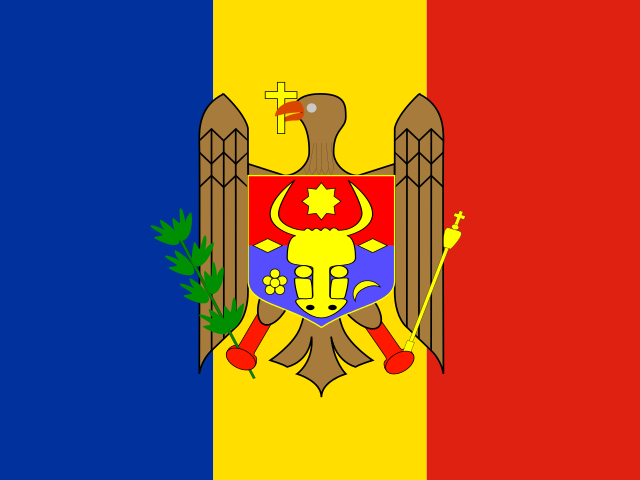
A vertical tricolour of blue, yellow and red with the national coat of arms on the central yellow stripe. Article 12 blazons the arms in full: an eagle holding a golden cross in its beak, a green olive branch in its right claw and a golden sceptre in its left, with a shield on its breast divided red over blue and charged with an aurochs head, an eight-pointed star between its horns, a five-petalled rose to the right and a crescent to the left, all of it in gold. It assigns none of it a meaning. The tricolour is conventionally read as reflecting the shared heritage of Moldova and Romania.
Moldova FACTS ◢
| Capital | Chișinău |
|---|---|
| Continent | Europe |
| Population | 2,360,527 (2025) |
| Area | 33,844 km² |
| Population density | 70/km² |
| Currency | Moldovan leu (MDL) |
| Official language | Romanian |
| Calling code | +373 |
| Internet TLD | .md |
| Time zone | UTC+02:00 |
| Drives on the | Right |
| ISO codes | MD / MDA |
DID YOU KNOW? ◢
- The Mileștii Mici cellars hold the world's largest wine collection, with tunnels stretching for kilometres.
- Wine-making here dates back thousands of years, and vineyards are woven into daily life.
- It's one of the least mountainous countries in Europe, with gentle hills and fertile farmland.
- Its national symbol, the aurochs head, appears on the country's coat of arms.
Moldova QUICK ANSWERS ◢
What is the capital of Moldova?
The capital of Moldova is Chișinău.
What is the population of Moldova?
Moldova had a population of 2,360,527 in 2025.
What currency does Moldova use?
Moldova uses the Moldovan leu (MDL).
What languages are spoken in Moldova?
The official language of Moldova is Romanian.
Think you know your flags? Play Flag Daily → · Browse all countries →
MORE ON THE FLAG ◢
Moldova's constitution does not just name its flag. It draws it, charge by charge, down to the number of petals on the rose, and then it stops.
It counts the rays on the star too, and it uses a heraldic term of art to say which way the crescent faces.
And having spent all that precision on drawing the thing, it says nothing whatever about what any of it stands for.
Key Takeaways
- Article 12 of Moldova's constitution blazons the flag and the arms in full and assigns no meaning to any element, including the three colours.
- Moldova's blazon counts what it describes: five petals on the rose, eight rays on the star, and a crescent described with the heraldic term conturnată, turned to face the other way.
- The proportions are not in Moldova's constitution. They come from Law No. 217 of 17 September 2010, which fixes the flag at one to two and the arms at a fifth of the flag's length in width.
- Law No. 217 does give the flag a meaning, in the provisions the Presidency reproduces: a major official symbol of the sovereignty and independence of the Republic of Moldova. Not a colour, not a charge, the flag entire.
- The Ministry of Justice records that the 2010 law replaced outdated norms on the State Flag contained in a regulation adopted for the Moldovan Soviet Socialist Republic in May 1990. The 1990 regulation itself was not among the texts read here.
Moldova's Article 12 counts the petals and stops
The Constitution of the Republic of Moldova gives its state symbols one article, headed Simbolurile statului. Its opening clause is a bare list: the Republic of Moldova has a flag, arms and anthem.
The second clause does the flag:
"Drapelul de Stat al Republicii Moldova este tricolor. Culorile sunt dispuse vertical, în ordinea următoare, începând de la lance: albastru, galben, roșu. În centru, pe fâșia de culoare galbenă, este imprimată Stema de Stat a Republicii Moldova."
The State Flag of the Republic of Moldova is a tricolour whose colours are arranged vertically, in the following order, beginning from the staff: blue, yellow, red. In the centre, on the yellow stripe, is printed the State Arms of the Republic of Moldova.
The third clause does the arms, and the drafting goes to work:
"Stema de Stat a Republicii Moldova reprezintă un scut tăiat pe orizontală având în partea superioară cromatică roșie, în cea inferioară - albastră, încărcat cu capul de bour având între coarne o stea cu opt raze."
A shield divided horizontally, red above and blue below, charged with an aurochs head having between its horns a star with eight rays. It continues:
"Capul de bour este flancat în dreapta de o roză cu cinci petale, iar în stânga de o semilună conturnată. Toate elementele reprezentate în scut sunt de aur (galbene)."
The aurochs head is flanked on the right by a rose with five petals, and on the left by a crescent conturnată. Read as a blazon, right and left are the bearer's, which are the viewer's left and right, and the same frame governs the eagle's claws below. All the elements on the shield are of gold. And then the eagle: the shield is placed on the breast of a natural eagle, meaning one in its own colours, carrying a gold cross in the beak, and holding a green olive branch in the right claw and a gold sceptre in the left. The constitution gives that bird a name in passing, in brackets: acvila cruciată, the crossed eagle.
That word conturnată is worth a moment. In heraldry a charge is conturned when it is turned to face the sinister, the reverse of the direction a charge normally faces. The constitution is precise enough to specify which way a crescent points, and never precise enough to say why there is a crescent.
Two clauses remain, and neither adds a meaning. Clause (4) sends the anthem to organic law. Clause (5) declares that the flag, the arms and the anthem are the state symbols of the Republic of Moldova and:
"sunt ocrotite de lege"
Are protected by law. The clause is passive: it names no protector and imposes no duty on anyone in particular. It is the closest the constitution comes to saying anything about the flag beyond how to draw it, and it still says nothing about what it stands for.
What Article 12 leaves out is the whole of the meaning
Set the blazon against the readings you will find everywhere and the gap is total.
| What people say it means | What Article 12 says |
|---|---|
| Blue for the sky, yellow for the fields, red for sacrifice | Nothing. The colours are given as an order, from the staff |
| The aurochs head is the historic arms of the Principality of Moldavia | Nothing. It is described and not sourced |
| The eight-rayed star, the rose and the crescent are the sun, the flower and the moon | Nothing. Numbers, positions and one heraldic orientation |
| The eagle with the cross is the Wallachian eagle, and the arms are a union of two heraldries | Nothing. The eagle is "natural" and named (acvila cruciată), never attributed |
| The tricolour reflects a shared heritage with Romania | Nothing. Romania is not named anywhere in the article |
Every one of those readings may be historically sound. None of them is in the instrument. A reader who wanted to know what the flag means, and read only the article of the constitution that is about the flag, would come away able to draw every charge on it and unable to say a word about it.
Two other flags are worth reading beside this one, for different reasons. The Andorran flag is another vertical blue, yellow and red tricolour with arms in the middle. The Chadian flag has the harder version of Moldova's problem: a plain tricolour with nothing on it to tell it apart from Romania's.
Moldova's measurements are in a law from 2010, not in the constitution
Article 12 fixes no proportion. It does not say how tall the flag is relative to its length, or how big the arms are on the yellow.
Those numbers come from Law No. 217 of 17 September 2010 on the State Flag of the Republic of Moldova, and the Presidency reproduces its operative description:
"Drapelul de Stat reprezintă o pânză dreptunghiulară, cu proporţia dintre înălţimea şi lungimea pânzei de 1:2, tripartită vertical egal, începând de la lance în culorile albastru, galben şi roşu, şi având în mijlocul câmpului galben imaginea Stemei de Stat a Republicii Moldova, a cărei lăţime constituie 1/5 din lungimea drapelului."
A rectangular cloth, the proportion between height and length being one to two, divided vertically into three equal parts beginning from the staff in blue, yellow and red, and having in the middle of the yellow field the image of the State Arms, whose width is one fifth of the length of the flag.
One fifth of the length, in width. That is a real constraint and it is nowhere in the constitution, which is the split that keeps opening up around flags: the instrument everyone cites is not the instrument that tells a maker what to cut.
The same law does assign a meaning, and nothing in the constitution or in the provisions the Presidency reproduces assigns another. It is not to a colour or a charge. It is to the flag entire:
"Drapelul de Stat al Republicii Moldova este un simbol oficial major al suveranităţii şi independenţei Republicii Moldova."
The State Flag is a major official symbol of the sovereignty and independence of the Republic of Moldova.
The Presidency's page for the state symbols as a set gives the arms an almost identical formula with one addition, sovereignty and independence plus the unity and indivisibility of the Republic, but that page cites no instrument at all and Law No. 217 is on its face a law about the State Flag. So the arms formula is the Presidency's, and the page does not say what stands behind it.
Moldova's flag law is specific about respect and specific about profanation
The provisions reproduced from that law interpret no element of the flag. They do not decline to instruct. The protection it provides is the protection Article 12(5) declares the symbols to have.
Citizens of Moldova and foreigners in Moldova are alike obliged to show respect towards the State Flag and to commit no act that would offend it. At ceremonies of hoisting on solemn occasions, those present stand, men honour it with their heads uncovered, and military personnel of every rank salute in accordance with military regulations.
Then the law itemises what profanation looks like, and the list runs to: soiling, staining, writing on, drawing on, applying objects to, burning, trampling underfoot, or using as a tablecloth, a chair cover, a curtain and so on. The Romanian ends that run with etc., so the enumeration is expressly open. Liability, contraventional or criminal, attaches to any of it, and to any use of the flag that breaches the flag law.
The constitution will not tell you why the crescent faces the wrong way. The flag law will tell you not to use the flag as a chair cover.
A Soviet republic's flag regulation outlived the constitution it was made under
The 2010 law replaced something, and what it replaced is the most surprising fact about Moldova's flag.
According to the Ministry of Justice, which drafted the bill and announced the vote while the text was still at first reading and still to face a second, the new law came "să substituie normele învechite cu privire la Drapelul de Stat care se conţin în Regulamentul cu privire la Drapelul de Stat al Republicii Sovietice Socialiste Moldoveneşti adoptat în mai 1990", to replace the outdated norms on the State Flag contained in the Regulation on the State Flag of the Moldovan Soviet Socialist Republic adopted in May 1990.
Put a date beside that. The constitution's own final provisions say it came into force on 27 August 1994, and that on the same day the Constitution of 15 April 1978 was repealed in its entirety. The next article of those provisions is what let the old flag rules survive: laws and other normative acts, it says, remain in force to the extent they do not contradict the constitution. Nothing in the new constitution touches how a flag is flown; Article 12 describes the flag and stops. Whether the 1990 regulation did anything else is not something this article can say, because that regulation is not among the texts read here. So the Soviet-era constitution was gone in 1994, and the Soviet-era flag regulation was still governing how the flag was flown sixteen years later.
Law No. 217 also fixes the Day of the State Flag as 27 April. The reproduced text does not say why that date. The tricolour is generally said to have been adopted on 27 April 1990, which would place it days or weeks before the regulation the 2010 law replaced, but neither the Presidency's pages nor the Ministry's states it.
The Ministry also records what the drafters did instead of inventing: they studied the legislation of other European states whose symbols are regulated by law in the same way. The drafters, on their own account, worked comparatively.
None of which brings anybody closer to what the colours mean, because the operative provisions the Presidency reproduces do not say either. If you would rather find out how many of these tricolours you can actually tell apart, Flag Daily shows you one a day and gives you three guesses at the country.
Frequently asked questions
What do the colours of the Moldovan flag mean?
Article 12 of the constitution gives the colours as an order, blue, yellow and red beginning from the staff, and assigns them no meaning. The operative text of the 2010 flag law published by the Presidency calls the whole flag a major official symbol of the sovereignty and independence of the Republic, and interprets no element of it.
The readings in circulation, blue for the sky, yellow for the fields, red for sacrifice, are conventional rather than official.
What is the animal on the flag of Moldova?
Two, in fact: an eagle, and on the shield across its breast an aurochs, the extinct wild ox of Europe. Article 12 of the constitution places the aurochs head on a shield divided horizontally, red above and blue below, with a star of eight rays between the horns. A five-petalled rose stands on the right and a crescent on the left, right and left being the bearer's rather than the viewer's.
The constitution says nothing about where the aurochs comes from or what it stands for. The usual account, that it is the historic arms of the Principality of Moldavia, is not in the constitutional text.
Why is the Moldovan flag so similar to Romania's?
The constitution does not address it. Article 12 gives the tricolour's colours and their order, and never mentions Romania.
The shared-heritage reading is the conventional one, and neither the constitution nor the operative text of the 2010 law published by the Presidency states it. The instruments provide a distinguishing feature instead: the State Arms in the middle of the yellow stripe, which is Article 12(2) of the constitution, at a width of one fifth of the flag's length, which is Law No. 217 of 2010 and is nowhere in the constitution.
What are the official proportions of the flag of Moldova?
One to two, height to length, with the three vertical bands equal and the arms a fifth of the flag's length in width. Those figures come from Law No. 217 of 17 September 2010 on the State Flag.
The constitution states no proportion at all. It fixes the order of the colours and the position of the arms and stops there.
When is Moldova's Flag Day?
27 April, fixed by Law No. 217 of 17 September 2010. The Presidency's reproduction of the law names the date without explaining it, and neither the constitution nor the Presidency's pages say why 27 April.
The date is generally given as the day the tricolour was adopted in 1990. What the Ministry of Justice records is that the rules for flying it were still those of a Moldovan SSR regulation of May 1990. The constitution's own final provisions supply the other half: it came into force on 27 August 1994, and repealed the Soviet-era constitution of 1978 outright on the same day.
Sources
- Constituția Republicii Moldova, Articolul 12 - Presidency of the Republic of Moldova, Romanian text, 2024 edition. Retrieved 30 August 2026.
- Drapelul de Stat al Republicii Moldova - Presidency of the Republic of Moldova, reproducing the operative provisions of Law No. 217 of 17 September 2010 on the State Flag, which the page cites at its foot. Retrieved 30 August 2026.
- Simbolurile statului - Presidency of the Republic of Moldova, the same descriptions for the arms, the flag and the anthem together. Retrieved 30 August 2026.
- Lege nouă pentru Drapelul de stat - Ministry of Justice of the Republic of Moldova, announcing the unanimous first-reading vote on the State Flag bill the Ministry drafted, and the Moldovan SSR regulation of May 1990 it was to replace. The page carries no date; this article identifies that bill with Law No. 217 of 2010 on subject matter. Retrieved 30 August 2026.
- What could not be opened: the numbered text of Law No. 217 of 17 September 2010 in the State Register of Legal Acts. That register answers a security challenge to every method tried here, including a headless browser, so the law is quoted from the Presidency's reproduction of it rather than from the register. Checked 30 August 2026.
PLAY ANOTHER →
Three clues, three guesses. Work out where in the world it is.
THREE CLUESDAILYDaily TriviaFive questions a day. Everyone gets the same five.
FIVE QUESTIONSDAILYOn This DayOne thing that happened today in history. Every day, a new one.
TODAY IN HISTORYDAILYDaily CodeA short message, hidden in a different cipher every day.
ONE CIPHER A DAY