
São Tomé and Príncipe
Two tiny volcanic islands straddling the Equator in the Gulf of Guinea, São Tomé and Príncipe is Africa's second-smallest country and once ran on cocoa grown on jungle-clad plantations.
WHAT THE FLAG MEANS ◢
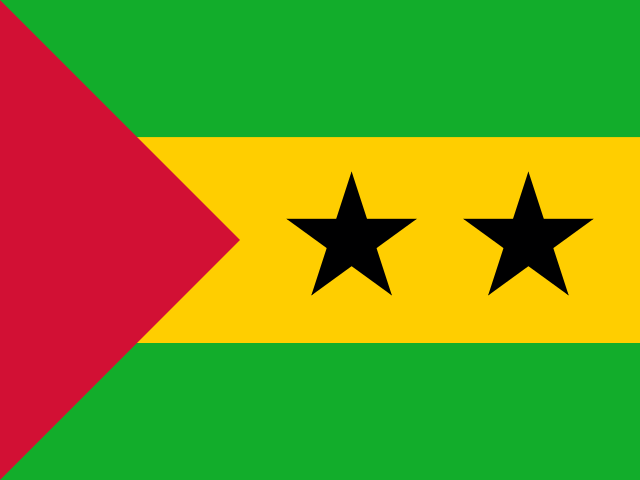
Three horizontal bands of green, yellow and green with a red triangle at the hoist and two black stars on the central yellow band, which Article 14 of the constitution makes one and a half times the width of each of the others. That article prescribes the design and assigns none of it a meaning. The presidency's own national symbols page does: it reads the triangle's shape as equality and its red as the struggle for independence, the two stars as the islands of the archipelago, and yellow, green and red as the colours of the liberation movement, which it calls the Pan-African colours. It gives the black nothing.
São Tomé and Príncipe FACTS ◢
| Capital | São Tomé |
|---|---|
| Continent | Africa |
| Population | 240,254 (2025) |
| Area | 964 km² |
| Population density | 249/km² |
| Currency | São Tomé and Príncipe dobra (STN) |
| Official language | Portuguese |
| Calling code | +239 |
| Internet TLD | .st |
| Time zone | UTC±00:00 |
| Drives on the | Right |
| ISO codes | ST / STP |
DID YOU KNOW? ◢
- It's the second-smallest country in Africa by both area and population.
- The islands sit right on the Equator in the Atlantic's Gulf of Guinea.
- It was once one of the world's leading cocoa producers, and chocolate is still tied to its identity.
- Portuguese is the official language, a legacy of its history as a Portuguese colony.
- The islands are volcanic, with dramatic peaks like the needle-shaped Pico Cão Grande rising straight from the forest.
São Tomé and Príncipe QUICK ANSWERS ◢
What is the capital of São Tomé and Príncipe?
The capital of São Tomé and Príncipe is São Tomé.
What is the population of São Tomé and Príncipe?
São Tomé and Príncipe had a population of 240,254 in 2025.
What currency does São Tomé and Príncipe use?
São Tomé and Príncipe uses the São Tomé and Príncipe dobra (STN).
What languages are spoken in São Tomé and Príncipe?
The official language of São Tomé and Príncipe is Portuguese.
Think you know your flags? Play Flag Daily → · Browse all countries →
MORE ON THE FLAG ◢
Ask what São Tomé and Príncipe's flag means and two São Tomé sources answer, and they are not answering the same question.
The constitution describes the flag. Article 14 gives the number of bars, their colours, their relative widths, the number of points on the stars and the height of the triangle against its base, and then it stops. Nothing in it says what any of that stands for.
The Presidency of the Republic does say. Its national symbols pages carry a short list under the heading "O significado de cada um dos elementos que compõem a bandeira", the meaning of each of the elements that make up the flag, and it begins with the triangle. Before the stars are given the islands and before the colours are given the liberation movement, the Presidency assigns the triangle a meaning that has nothing to do with its colour. The triangle expresses equality.
Key Takeaways
- Article 14 of the constitution describes the flag in geometric detail and assigns no element of it any meaning at all.
- The Presidency of the Republic publishes a reading that does assign meanings, and it gives the triangle two: the shape expresses equality, and the red symbolises the struggle for independence.
- The equality reading appears in none of the five constitutional texts, and it is the one item in the state's list that could not be guessed from looking at other flags.
- The same description appears in five constitutional texts between 1975 and 2003, differing only in typing. The colour word all five use for the triangle is encarnado, and the Presidency's own page uses two others.
- Neither the constitution nor the Presidency's page gives the black a meaning. The Presidency's list of what the colours mean names three of them, and the flag has four.
The Presidency gives the triangle a meaning that is not about its colour
The Presidency's flag page sets out its list in three lines. Two stars, "simbolizando as ilhas do arquipélago", symbolising the islands of the archipelago. Then the triangle. Then the colours.
The triangle line rewards slowing down. It opens with a triangle "exprimindo a igualdade", expressing equality, then names the colour, then gives that colour "a luta pela independência", the struggle for independence.
Read the grammar and the sentence is doing two jobs at once. The triangle expresses equality: that is a claim about the shape rather than the fill. The red symbolises the struggle for independence: that is a claim about the colour. The Presidency has separated the form from the fill and given each of them something different.
The equality reading is emblematic and not a measurement. Article 14 puts the triangle's base on the hoist and makes its height half that base, and those two figures rule an equilateral triangle out: an equilateral triangle stands about 0.87 times its base tall, and this one is fixed at exactly half. What the figures do not do is settle the shape, because the article never says where the apex sits, so the two remaining sides are not determined at all. The triangle stands for equality on the Presidency's reading. Nothing in the instrument makes it equal-sided.
That reading is also the one item on the list that could not be guessed from looking at other flags. Stars for islands, colours for a liberation movement and red for an independence struggle are all readings this flag shares with its neighbours. Equality is particular to this account, and a summary written by working outwards from what other flags mean would not produce it.
The page cites nothing for any of it. It is dated 5 December 2018 and it does not say where the readings come from, whether they were adopted by anyone, or whether the state considers them binding. What it establishes is that the office of the head of state publishes them.
The same office does the same thing on the companion symbol, which suggests a habit rather than a one-off. Its coat of arms page reproduces the constitution's description of the insígnia and then adds two clauses the constitution does not have: the falcon and the parrot are "aves existentes no território nacional", birds found in the national territory, and the palm tree is "planta esta, muito abundante nas duas ilhas", a plant very abundant on the two islands.
Neither addition is in article 14. Both arrive in the Presidency's voice, in a paragraph that otherwise tracks the constitutional wording closely. These pages are the instrument plus a gloss, with no line drawn between them.
Article 14 describes São Tomé and Príncipe's flag and explains nothing
The constitutional text is the other half of the answer, and reading it in full shows what is absent from it.
Article 14 is headed Símbolos Nacionais. Its first paragraph runs to two sentences, the first of them very long: "A Bandeira Nacional é constituída por três barras dispostas horizontalmente, sendo verdes e de igual largura as dos extremos, e a mediana, na qual estão apostas duas estrelas negras de cinco pontas, amarela, e uma vez e meia mais larga que cada uma das outras e por um triângulo encarnado, cuja base se situa do lado esquerdo da Bandeira. A altura do triângulo é metade da base."
The National Flag consists of three bars arranged horizontally, of which those at the extremes are green and of equal width, and the middle one, on which two black five-pointed stars are affixed, is yellow and one and a half times wider than each of the others, and of a triangle in encarnado whose base is on the left side of the Flag. The height of the triangle is half the base.
That is a precise specification. It fixes a ratio between the bands, it counts the stars, it counts the points on the stars, it puts the triangle's base on the hoist, and it fixes the triangle's proportions against itself.
It also does something slightly awkward that survives translation. The word amarela, yellow, arrives after the clause about the stars rather than before it, so the sentence tells you what is fastened to the middle band before it tells you what colour the band is.
The remaining two paragraphs of the article are shorter. The National Anthem is "INDEPENDÊNCIA TOTAL". The insígnia is a falcon on the left and a parrot on the right, either side of an oval shield with a palm tree along its vertical axis.
Not one of the three paragraphs contains a word about what any of it means. In a country where the head of state's own website is willing to say, the silence in the constitution is a choice rather than an oversight.
The same sentence has been in five constitutional texts since 1975
The description is old, and it has barely moved.
The National Assembly's own copies of five constitutional texts all carry it. The Constituição Política approved by acclamation on 5 November 1975, under four months after independence, has it at Article 2, alongside the capital, the anthem and a national motto of unity, discipline and work. The revision enacted as Lei n.º 1/80, promulgated on 30 January 1980, moves it to Article 3 and keeps the motto. Lei n.º 2/82, promulgated on 31 December 1982, holds it at Article 3. The 1990 constitution enacted as Lei n.º 7/90 moves it to Article 13, drops the motto and puts the falcon and the parrot beside it. The text in force after the revision promulgated on 25 January 2003 carries it at Article 14.
| Instrument | Article | What it says the flag means |
|---|---|---|
| Constituição Política, 5 November 1975 | Article 2(2) | Nothing |
| Lei n.º 1/80, promulgated 30 January 1980 | Article 3(2) | Nothing |
| Lei n.º 2/82, promulgated 31 December 1982 | Article 3(2) | Nothing |
| Constitution enacted by Lei n.º 7/90 | Article 13(1) | Nothing |
| Constitution as revised, promulgated 25 January 2003 | Article 14(1) | Nothing |
The five copies are the same description and they are not identical files. The 1975 text doubles a word, writes "iguais" where the others write "igual", and gives "as do extremo" for the later "as dos extremos". The 1980 and 1982 texts both write "às do extremo". The 1982 text also puts "sendo verde" in the singular where the rest have "verdes", drops the accent from triangulo, and slips an extra article into "cuja a base". Every one of those is a spelling or agreement difference, and not one of them changes a colour, a count, a proportion or a placement.
So the article number moves, the neighbours in the article change, the motto comes and goes, and the sentence about the flag stays where it is. Whatever else was being argued about across nearly thirty years of constitutional redrafting, this was not.
A description that does not change is not evidence that a meaning was ever debated and rejected. It is evidence that no drafter, across five texts, put one in.
The constitution and the Presidency do not use the same word for red
There is a small discrepancy on the Presidency's own page, and it is easy to miss because every version of it is a word for red.
All five constitutional texts call the triangle encarnado. The Presidency's description, which otherwise follows the constitution closely enough to be a paraphrase of it, calls the triangle escarlate, scarlet. Then, three lines further down its own page, its list of meanings calls the triangle vermelho, the ordinary Portuguese word for red.
So the office of the head of state names the colour twice, in two different words, neither of which is the word in the instrument it is paraphrasing.
None of this is a contradiction about what colour the flag is. Encarnado, escarlate and vermelho all describe the same triangle, and anyone flying the flag would fly the same one. But the constitutional word is the one with legal force, and it is the one that gets lost first. The English text of the constitution published by the Comparative Constitutions Project renders encarnado as "scarlet", which is closer to the Presidency's paraphrase than to the constitution.
The decree that established Portugal's flag in June 1911 reaches for a similar pair. It divides the flag into "duas cores fundamentaes, verde escuro e escarlate", dark green and scarlet, rather than the everyday verde and vermelho.
The Presidency's list of colours names three, and the flag has four
There is one element of this flag that no source opened for this article assigns a meaning to, and it is the one a reader is most likely to ask about.
The stars are black. The constitution says so in every version: "duas estrelas negras de cinco pontas". The Presidency repeats it in its description. Then the Presidency's list of meanings gives the stars the islands of the archipelago, which is a reading of the number, and moves on to the colours.
And the colour line reads "As cores amarelo, verde e vermelho, relativas ao movimento de libertação (as cores pan-africanas)". The colours yellow, green and red, relating to the liberation movement, the Pan-African colours. That is three colours, and the flag has four.
Black is on the flag, it is named in the constitution, and it is absent from the Presidency's account of what the colours mean. Whether that is deliberate, or whether black is simply being treated as the colour a star gets drawn in rather than as one of the flag's colours, the page does not say.
That settles what the readings giving black a meaning of its own are doing. Neither the constitution nor the Presidency says any such thing, so those readings fill a gap the state's own account leaves open.
São Tomé and Príncipe's constitution fixes the bands and the triangle, but not the flag's shape
Article 14 is unusually specific about proportion for a flag provision, and it stops two steps short of the specification you would need to draw the flag.
Take what it gives. The two green bands are of equal width. The yellow band is one and a half times wider than each of them. That makes the three bands 2:3:2, and it settles a question a plain list of colours leaves open, which is that the middle band is not the same size as the others.
The first gap is the triangle's base. The article says only that the base "se situa do lado esquerdo da Bandeira", is located on the left side of the flag. It does not say the base spans the whole of that side, though every drawn version of the flag has it do so. Take that as given and the base is the flag's full height, and since the triangle's height is half its base, the triangle reaches half the flag's height inward.
The second gap is the flag itself. There is no ratio of height to length anywhere in article 14, in any of the five constitutional texts. The 1:2 figure that reference works quote for this flag is not in the instrument.
Together those two gaps decide something visible. Because the triangle's dimensions are fixed against itself rather than against the flag, how far the triangle reaches across the flag depends entirely on a ratio the constitution declines to state. Fix the flag at 1:2 and the triangle covers a quarter of its length. Fix it at 2:3 and it covers a third.
For a nearby flag built the same way, out of horizontal bands and a hoist triangle, there is Equatorial Guinea, which shares the Gulf of Guinea with São Tomé and Príncipe.
The liberation movement comes first and Pan-African is in brackets
The Pan-African claim is the one most often made about this flag. What the Presidency says and what gets said on its behalf come apart.
The Presidency says that yellow, green and red relate to the liberation movement, and then, in brackets, that these are the Pan-African colours. The primary attribution is to the Movimento de Libertação de São Tomé e Príncipe, whose own colours these were before they were the state's, and the Pan-African label is a gloss on that, offered second and in parentheses.
What is often said instead is that the flag uses the Pan-African colours to signal solidarity with other African states, or that they are the colours of Ethiopia. Neither of those is on the Presidency's page and neither is in the constitution.
The difference is not pedantry. One account says the colours came from the movement that won the country's independence and belong to its own history. The other says they were adopted to look like the flags of other countries. The state's own page says the first.
If flags of this shape interest you, Flag Daily works through one a day. Hoist triangles are one of the harder families to tell apart at a glance.
Frequently asked questions
What do the colours of the São Tomé and Príncipe flag mean?
The constitution assigns them nothing. The Presidency of the Republic publishes a reading in which yellow, green and red relate to the liberation movement and are described as the Pan-African colours, and in which the red of the triangle symbolises the struggle for independence. The black of the stars is not given a meaning by either source.
What do the two black stars on the São Tomé and Príncipe flag mean?
The Presidency of the Republic says they symbolise the islands of the archipelago. That reading is the state's own, published on its national symbols pages, but it is not in the constitution, which says only that two black five-pointed stars are affixed to the middle band.
Does São Tomé and Príncipe's constitution say what the flag means?
No. Article 14 describes the flag in detail, down to the number of points on the stars and the height of the triangle against its base, and assigns no element of it any meaning. The same is true of the description in all five constitutional texts between 1975 and 2003.
Why is there a red triangle on the São Tomé and Príncipe flag?
The Presidency of the Republic gives the triangle two readings at once: the shape expresses equality, and the red symbolises the struggle for independence. That equality reading appears in none of the constitutional texts, and it is the only item in the state's list that could not be guessed from other flags. The constitution places the triangle's base on the hoist side and says nothing about why it is there.
What are the proportions of the São Tomé and Príncipe flag?
The constitution fixes the bands at 2:3:2, the middle one being one and a half times the width of each of the others, and makes the triangle's height half its base. It does not fix the flag's own ratio of height to length in any version, so the widely quoted 1:2 figure comes from reference works rather than from the instrument.
Sources
- Assembleia Nacional de São Tomé e Príncipe, Constituição da República Democrática de São Tomé e Príncipe, Portuguese text as revised and promulgated 25 January 2003, article 14. Read from the National Assembly's own file, retrieved from the Internet Archive capture of 30 September 2009 because parlamento.st now returns HTTP 410. Retrieved 26 August 2026.
- Presidência da República de São Tomé e Príncipe, Bandeira Nacional, the Presidency's national symbols page carrying its description of the flag and its list of meanings, dated 5 December 2018. Retrieved live, 26 August 2026.
- Presidência da República de São Tomé e Príncipe, Brasão de Armas, the companion page for the insígnia, carrying the two clauses about the birds and the palm that the constitution does not have. Retrieved live, 26 August 2026.
- Assembleia Nacional de São Tomé e Príncipe, Constituição Política, approved by acclamation 5 November 1975, with the Lei Fundamental of 17 July 1975, article 2. Read from the Internet Archive capture of 5 February 2007. Retrieved 26 August 2026.
- Assembleia Nacional de São Tomé e Príncipe, Lei n.º 1/80, the law revising the constitution of 1975, article 3, adopted 25 January 1980 and promulgated 30 January 1980. Read from the Internet Archive capture of 5 February 2007. Retrieved 26 August 2026.
- Assembleia Nacional de São Tomé e Príncipe, Lei n.º 2/82, article 3, adopted 15 December 1982 and promulgated 31 December 1982. Read from the Internet Archive capture of 5 February 2007. Retrieved 26 August 2026.
- Assembleia Nacional de São Tomé e Príncipe, Constituição de 1990, Lei n.º 7/90, article 13. Read from the Internet Archive capture of 5 February 2007. Retrieved 26 August 2026.
- Assembleia Nacional de São Tomé e Príncipe, Leis Aprovadas, the Assembly's index of every law passed from the Constituent Assembly to the VIII Legislature, used to establish that no separate statute on the national flag, symbols, anthem or arms appears in that record. Read from the Internet Archive capture of 9 June 2007. Retrieved 26 August 2026.
- Comparative Constitutions Project, Sao Tome and Principe's Constitution of 1975 with Amendments through 2003, English text distributed by constituteproject.org, Oxford University Press, cited here only for its rendering of encarnado as "scarlet" at article 14. Retrieved 26 August 2026.
- Assembleia da República de Portugal, Diário da Assembleia Nacional Constituinte, sessão de 19 de junho de 1911, page 4, carrying the decree establishing the Portuguese national flag and its colour words verde escuro e escarlate. Retrieved 25 August 2026.
PLAY ANOTHER →
One quote, one scrambled alphabet. Crack it before tomorrow.
CRACK THE QUOTEDAILYDaily TriviaFive questions a day. Everyone gets the same five.
FIVE QUESTIONSDAILYOn This DayOne thing that happened today in history. Every day, a new one.
TODAY IN HISTORYDAILYGuess the CountryThree clues, three guesses. Work out where in the world it is.
THREE CLUES