
Portugal
Portugal occupies the western edge of Europe, facing the Atlantic that its explorers once sailed into the unknown. Today it pairs that seafaring past with port wine, azulejo tiles and endless coastline.
WHAT THE FLAG MEANS ◢
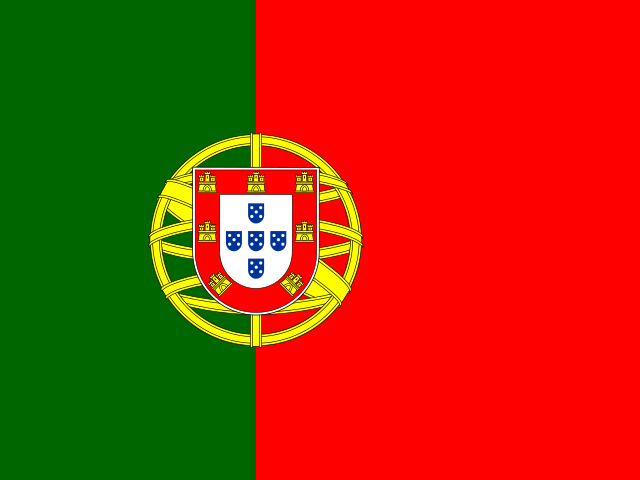
Two vertical fields, dark green at the hoist and a wider scarlet at the fly, with the shield of the national arms resting on a Manueline armillary sphere over the join. Article 11 of the constitution makes the flag the symbol of the sovereignty of the Republic and of Portugal's independence, unity and integrity, but it does not describe the flag: it identifies it as the one adopted by the Republic established by the revolution of 5 October 1910. The decree that adopted it, of 19 June 1911, names the two colours, assigns them nothing, and leaves the dimensions to a commission's report. The readings of green as hope and red as the revolution are unofficial.
Portugal FACTS ◢
| Capital | Lisbon |
|---|---|
| Continent | Europe |
| Population | 10,804,871 (2025) |
| Area | 92,225 km² |
| Population density | 117/km² |
| Currency | Euro (EUR) |
| Official language | Portuguese |
| Calling code | +351 |
| Internet TLD | .pt |
| Time zones | UTC-01:00, UTC±00:00 |
| Drives on the | Right |
| ISO codes | PT / PRT |
DID YOU KNOW? ◢
- Portuguese explorers pioneered the Age of Discovery, with Vasco da Gama opening the sea route to India.
- It's the world's leading producer of cork, harvested from the bark of cork oak trees.
- Port wine takes its name from the city of Porto, from where it was historically shipped.
- Lisbon is one of the oldest cities in Western Europe, predating cities like London and Paris.
- The University of Coimbra, founded in 1290, is one of the oldest universities in continuous operation.
Portugal QUICK ANSWERS ◢
What is the capital of Portugal?
The capital of Portugal is Lisbon.
What is the population of Portugal?
Portugal had a population of 10,804,871 in 2025.
What currency does Portugal use?
Portugal uses the Euro (EUR).
What languages are spoken in Portugal?
The official language of Portugal is Portuguese.
Think you know your flags? Play Flag Daily → · Browse all countries →
MORE ON THE FLAG ◢
Portugal's constitution says what its flag means, and it says nothing at all about what its colours mean. Those are two different things, and they are easy to run together.
Article 11 gives the flag a meaning entire: it is the "símbolo da soberania da República, da independência, unidade e integridade de Portugal". Then it identifies the flag not by describing it but by pointing: it is "a adotada pela República instaurada pela Revolução de 5 de Outubro de 1910", the one adopted by the Republic established by the revolution of 5 October 1910.
Which raises the obvious question. Adopted how, and where does it say what the flag looks like?
Key Takeaways
- Article 11 of Portugal's constitution attaches a meaning to the flag as a whole and describes nothing. It identifies the flag by reference to what the 1910 Republic adopted.
- The flag article 11 points at was established by a decree read out to the Constituent Assembly on 19 June 1911, at the sitting that proclaimed the Republic.
- That 1911 decree calls Portugal's colours "verde escuro e escarlate", dark green and scarlet, and assigns neither of them any meaning.
- The 1911 decree does not fix the flag's proportions. It hands the dimensions and drawing details to the report of a commission appointed ten days after the revolution.
- Green for hope and red for the revolution appear in neither the Portuguese constitution nor the 1911 decree. They are popular readings rather than official ones.
Portugal's constitution attaches a meaning, but not to the colours
Article 11 is headed Símbolos nacionais e língua oficial and its first paragraph is a single sentence: "A Bandeira Nacional, símbolo da soberania da República, da independência, unidade e integridade de Portugal, é a adotada pela República instaurada pela Revolução de 5 de Outubro de 1910."
So there is a constitutional meaning, and it is real. The flag is the symbol of the sovereignty of the Republic and of the independence, unity and integrity of Portugal. Very few flag provisions say that much.
But read what it attaches that meaning to. The flag. Not the green, not the red, not the armillary sphere. And it defines which flag by pointing backwards at an adoption rather than by describing a design, so the constitution could be read from end to end without learning that the flag has two colours.
The other two paragraphs of the article are equally short. The national anthem is A Portuguesa. The official language is Portuguese.
Portugal's flag was established on one afternoon in June 1911
The pointer resolves to a specific afternoon.
On 19 June 1911 the Assembleia Nacional Constituinte met and proclaimed the Republic. The Diário of that sitting records the President reading a decree abolishing the monarchy, then calling for silence because he had another reading to make, and reading a second decree. The second one is the flag. Its first two sentences are short enough to give whole:
"A Bandeira Nacional é bipartida verticalmente em duas cores fundamentaes, verde escuro e escarlate, ficando o verde do lado da tralha. Ao centro, e sobreposto á união das duas cores, terá o escudo das Armas Nacionaes, orlado de branco e assentando sobre a esfera armilar manuelina, em amarello e avivada de negro."
The National Flag is divided vertically into two fundamental colours, dark green and scarlet, with the green on the hoist side. At the centre, over the join of the two colours, the flag has the shield of the National Arms, bordered in white and resting on the Manueline armillary sphere, which is in yellow and outlined in black.
That is the whole description, and what it leaves out is the point. It assigns the dark green nothing and the scarlet nothing. It says the sphere is Manueline, which dates it, and does not say what it stands for.
The record of what happened next is worth having, because official texts rarely preserve this sort of thing. "Repetidos vivas á Republica Portuguesa, á Pátria e á Bandeira Nacional, são soltados por todos os Deputados. O Sr. Primeiro Secretario faz ondular por sobre a mesa da Presidencia a bandeira nacional." Repeated cheers from every deputy, and the First Secretary waving the flag over the Assembly's Table. Then the President asked for silence again and read the second article: "O Hymno Nacional é A Portuguesa."
One page earlier the same sitting had done something the flag decree never gets. For the decree abolishing the monarchy the President stopped and took a division: "Antes de se votar por acclamação, temos de votar pôr de pé e por sentados. Os Srs. Deputados que approvam o decreto que acaba de ler-se tenham a bondade de se levantar." Every deputy stood, and he declared it "approvada por unanimidade" before moving to acclamation.
Nothing of the kind is recorded for the flag. It is read, it is cheered, and the sitting moves on. The summary at the head of the same day's Diário says the decree was read and voted, "Lê-se e vota se outro decreto estabelecendo a Bandeira Nacional", so the document disagrees with itself about whether a vote was taken. What the verbatim record shows is a reading and an ovation.
Dark green and scarlet, not green and red
The colour words in the instrument are more specific than the ones in general use, and the difference is worth keeping.
The decree says verde escuro and escarlate. Dark green and scarlet. Not verde and vermelho, the ordinary Portuguese words for green and red, and those are the words a description of this flag usually reaches for.
Scarlet, in ordinary usage, names a red at the orange end rather than the blue. Dark green is a stated depth rather than a hue. Whoever wrote that sentence in 1911 was choosing words carefully. Green and red is what the flag looks like from across a square, and it is the easier thing to write.
The proportions of Portugal's flag are not in the decree
Here is the part that gets left out, and it is an unusual piece of legal drafting.
The decree's first article ends: "As dimensões e mais pormenores de desenho, especialização e decoração da bandeira, são os do parecer da commissão nomeada por decreto de 15 de outubro de 1910, que serão immediatamente publicados no Diário do Governo."
The dimensions and further details of the drawing, specification and decoration of the flag are those of the report of the commission appointed by the decree of 15 October 1910, to be published immediately in the Diário do Governo.
So Portugal's flag is described by a decree that borrows a committee's report by reference. The 2:3 split between the green and the red that everyone quotes, the exact placement of the sphere, the geometry of the shield: none of that is in the instrument the constitution points at. It is in a parecer, a report, drawn up by a commission appointed by a decree of 15 October 1910, ten days after the revolution.
That report could not be obtained here, and the reason is worth stating. Portugal's official legal gazette site returns a JavaScript shell to every request, including direct requests for document PDFs, so nothing published in the Diário do Governo could be read. What could be established is where the parecer is not. Searching the whole First Republic catalogue of the parliamentary archive for the decree's own three words, esfera armilar bandeira, returns exactly one hit, which is the decree itself. That is an and-search over a machine-read text layer the archive itself disclaims, so it is not proof of absence; it does mean the report does not appear in the parliamentary record under the decree's own wording.
| Where to look | What it gives you | What it says the colours mean |
|---|---|---|
| Constitution, article 11 | a meaning for the flag as a whole, and a pointer to 1910 | nothing |
| Decree of 19 June 1911 | the two colours, their order, and the charge at the centre | nothing |
| The commission's parecer of 1910 | the dimensions and the drawing details | not obtainable for this article |
Green for hope and red for the revolution are in neither instrument
This is the reading everyone has heard, and it is in neither instrument.
The decree names two colours and stops. The constitution names none. Neither says green is hope, neither says red is the blood of those who died for the Republic, and neither says the red replaced the blue and white of the monarchy as an act of rupture.
None of that makes the readings false or even unlikely. The 1910 revolution did replace a blue and white monarchical flag with a green and red republican one, and the choice was argued about at the time. What it means is that the readings are somebody's, not the state's, and the difference matters most where it is least visible: a reader who meets green for hope in a schoolbook has no way of knowing whether they are reading a law or a convention.
The armillary sphere is dated, not explained
The decree calls it the esfera armilar manuelina, the Manueline armillary sphere, and that phrase is doing less work than it looks.
Manueline is a period label, after Manuel I. The armillary sphere was his personal device and it is all over Portuguese architecture of that period. So the decree is telling a flagmaker which sphere to draw, in the way an architect might say a Corinthian capital.
What it is not doing is saying why the sphere is there. The reading in general circulation, that it recalls the age of Portuguese navigation, is not in the decree and not in the constitution.
What the decree puts at the centre of Portugal's flag
One small precision worth keeping.
The decree never speaks of the arms as a whole. It names two things and puts them in a relation: "o escudo das Armas Nacionaes", the shield of the National Arms, bordered in white, and beneath it the Manueline armillary sphere that the shield rests on. What is yellow and outlined in black is the sphere, not the shield; the Portuguese agrees the adjectives with esfera, which is feminine.
What the National Arms consist of, as against the shield alone, is not something any instrument opened here says, so this article does not draw that line. It reports the words the decree uses.
The decree does not blazon the shield either. The castles and the blue escutcheons that everyone can see on the flag are not described anywhere in the instrument that adopted it; they arrive with the shield, which was already the shield of Portugal and did not need introducing in 1911.
If you have ever tried to redraw this flag from memory, the shield is where it defeats you, and it is why Portugal is a harder flag than it looks in Flag Daily, where you get one flag a day and three guesses at the country.
Portugal's chain is the longest, and it ends outside the statute book
Constitutions vary in how much of the flag they are willing to carry, and where they stop is where you have to start looking.
As this site's explainer on Russia's constitution sets out, article 70 describes nothing at all and hands the description and the rules of use to a federal constitutional law, which is a pointer of the same kind as Portugal's. The explainer on Morocco's constitution sets out the other shape: that constitution does describe its flag, in one line, and a later instrument does the specifying.
Portugal sits at the far end. Its constitution describes nothing, the decree the constitution points at describes the colours but not the dimensions, and the dimensions are in a committee's report. Three links, and the last one is not a law.
Frequently asked questions
What do the colours of the Portuguese flag mean?
Officially, nothing. The decree of 19 June 1911 that describes the flag calls the colours dark green and scarlet and assigns neither of them any meaning, and article 11 of the constitution attaches its meaning to the flag as a whole rather than to any colour. Green for hope and red for the revolution are popular readings with no instrument behind them.
What does the Portuguese constitution say about the flag?
Article 11 says the National Flag is the symbol of the sovereignty of the Republic and of the independence, unity and integrity of Portugal, and that it is the flag adopted by the Republic established by the revolution of 5 October 1910. It does not describe the flag, so the constitution alone does not tell you that it has two colours.
When was the Portuguese flag adopted?
It was established by a decree read out to the Assembleia Nacional Constituinte on 19 June 1911, at the sitting that proclaimed the Republic. The commission whose report fixes the flag's dimensions had been appointed by a decree of 15 October 1910, ten days after the revolution.
What are the proportions of the Portuguese flag?
The figure in universal circulation is 2:3, green to red. The 1911 decree does not fix it: it says the dimensions and the further details of the drawing are those of the report of the commission appointed in October 1910, which it borrows by reference, and that report could not be obtained here.
What does the armillary sphere on the Portuguese flag mean?
The decree calls it the Manueline armillary sphere, which dates it to the reign of Manuel I rather than explaining it. The device was his personal emblem. The common reading that it recalls the age of Portuguese navigation is not in the decree, not in the constitution, and neither instrument says it.
Sources
- Assembleia da República, Constituição da República Portuguesa, artigo 11.º, Portuguese original. Retrieved 25 August 2026.
- Assembleia da República, Diário da Assembleia Nacional Constituinte, sessão de 19 de junho de 1911, page 4, carrying the decree establishing the National Flag as read out to the Assembly. The standing division on the preceding decree is on page 3 of the same sitting, and the day's summary is on page 1. Retrieved 25 August 2026.
- Assembleia da República, Diário da Assembleia Nacional Constituinte, 19 de junho de 1911, page 3, carrying the standing division on the decree abolishing the monarchy, and page 1, carrying the sitting's summary. Retrieved 25 August 2026.
- Assembleia da República, Debates Parlamentares full-text search, used to establish that the commission's report does not appear in the First Republic parliamentary record under the decree's own wording. Retrieved 25 August 2026.
PLAY ANOTHER →
Three clues, three guesses. Work out where in the world it is.
THREE CLUESDAILYOn This DayOne thing that happened today in history. Every day, a new one.
TODAY IN HISTORYDAILYDaily CodeA short message, hidden in a different cipher every day.
ONE CIPHER A DAYDAILYDaily TriviaFive questions a day. Everyone gets the same five.
FIVE QUESTIONS