
Russia
The largest country on Earth by a wide margin, Russia sprawls across two continents and eleven time zones - when the sun rises in Kaliningrad, it's already setting in Kamchatka.
WHAT THE FLAG MEANS ◢
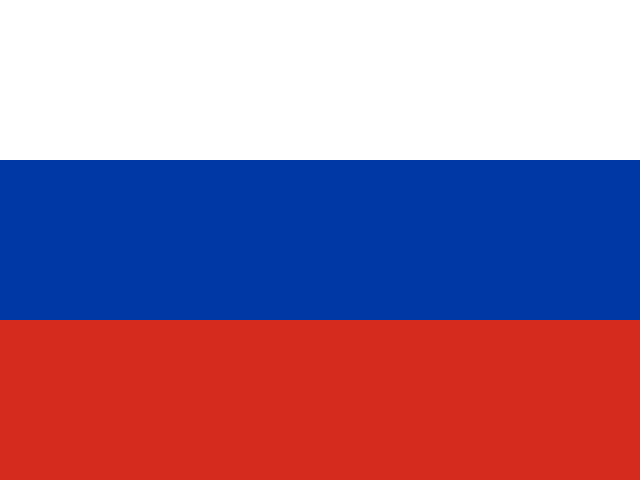
A horizontal tricolour of white, blue and red, in the proportions two to three. Article 70 of the Russian constitution does not describe the flag at all. It delegates the description to a federal constitutional law, and that law, of 25 December 2000, sets out the three bands and assigns the colours no meaning. It fixes no shade either, and the Presidential Executive Office says as much in terms. The colour readings that circulate are popular tradition, and none of them is the state's.
Russia FACTS ◢
| Capital | Moscow |
|---|---|
| Continent | Europe, Asia, Eurasia |
| Population | 143,513,328 (2025) |
| Area | 17,075,400 km² |
| Population density | 8/km² |
| Currency | Russian ruble (RUB) |
| Official language | Russian |
| Calling code | +7 |
| Internet TLD | .ru |
| Time zones | UTC+02:00, UTC+03:00, UTC+04:00, UTC+05:00, UTC+06:00, UTC+07:00, UTC+08:00, UTC+09:00, UTC+10:00, UTC+11:00, UTC+12:00 |
| Drives on the | Right |
| ISO codes | RU / RUS |
DID YOU KNOW? ◢
- It's the largest country in the world, roughly the size of the entire surface of the dwarf planet Pluto.
- It spans eleven time zones across one continuous stretch of land, more than any other country's mainland.
- Lake Baikal, in Siberia, is the world's deepest and oldest freshwater lake, holding roughly a fifth of all unfrozen fresh water on the planet.
- The Trans-Siberian Railway is the longest railway line in the world, running about 9,289 kilometres from Moscow to Vladivostok.
Russia QUICK ANSWERS ◢
What is the capital of Russia?
The capital of Russia is Moscow.
What is the population of Russia?
Russia had a population of 143,513,328 in 2025.
What currency does Russia use?
Russia uses the Russian ruble (RUB).
What languages are spoken in Russia?
The official language of Russia is Russian.
Think you know your flags? Play Flag Daily → · Browse all countries →
MORE ON THE FLAG ◢
Russia's flag is three horizontal bands, white over blue over red, and Russian law has been unusually careful about it. There is a federal constitutional law devoted to the flag, in force since 2000, amended thirteen times, and most recently on 26 June 2026.
Nowhere in its twelve articles does it say what the colours mean. The closest it comes is calling the flag itself a state symbol.
Nor does the constitution, which does not describe the flag at all. Article 70 hands the whole job to that law in one sentence. And the shades of the blue and the red are not fixed anywhere, a point the Presidential Executive Office makes on its own website.
Key Takeaways
- Article 70 of the Russian constitution does not describe the flag. It delegates the description and the rules of use to a federal constitutional law.
- That law, of 25 December 2000, describes the flag in two sentences and assigns the colours no meaning. Nor did the 1993 decree it replaced.
- From 1 November 1991 the same flag was defined in the RSFSR constitution with different colour words, azure and scarlet, and different proportions, 1:2 rather than 2:3. A presidential decree set out the present description on 11 December 1993, and the azure and scarlet article lapsed with that constitution later the same month.
- The state says in terms that the shades are not regulated. The Pantone numbers in circulation can be traced to a government procurement document, not to law.
- The nobility and loyalty and courage reading traces to a page on a political consultancy's website, now a parked domain, which called it official and did not name an instrument.
Russia's constitution does not describe the flag. It delegates.
Most countries put the flag in the constitution and describe it there. Russia does not, and article 70 is worth reading for how completely it passes the question on.
Its first paragraph is one sentence: "Государственные флаг, герб и гимн Российской Федерации, их описание и порядок официального использования устанавливаются федеральным конституционным законом." The state flag, coat of arms and anthem of the Russian Federation, their description and the procedure for their official use, are established by federal constitutional law.
It gives no colours, no proportions and no design, and it interprets nothing. The second paragraph of the same article is about Moscow being the capital.
So anyone answering this question from the constitution has nothing to work with, and the answer has to come from the law article 70 points at.
The law article 70 points at describes the flag in two sentences
That law is Federal Constitutional Law No. 1-FKZ of 25 December 2000, "О Государственном флаге Российской Федерации", signed by Vladimir Putin, passed by the State Duma on 8 December and approved by the Federation Council on 20 December 2000.
Its article 1 opens by saying what the flag is for constitutional purposes: "Государственный флаг Российской Федерации является официальным государственным символом Российской Федерации." The state flag of the Russian Federation is an official state symbol of the Russian Federation.
Then the description, and this is the whole of it: "Государственный флаг Российской Федерации представляет собой прямоугольное полотнище из трех равновеликих горизонтальных полос: верхней - белого, средней - синего и нижней - красного цвета. Отношение ширины флага к его длине 2:3."
A rectangular cloth of three equal horizontal bands, the upper white, the middle blue and the lower red, with the width to the length as two to three. A third sentence adds that a multicoloured drawing is annexed to the law.
The remaining articles are about where the flag is flown, when it is raised, how it sits beside regional flags, and what happens to people who abuse it. Searched end to end for every stem that could introduce one, символ-, означ-, обознач- and олицетвор-, the law returns nothing but its own description of itself as a state symbol.
The blue is worth a note of its own. Russian distinguishes two blues, and the law picks синий, the darker one, rather than голубой. English translations flatten that, which is how "light blue" occasionally appears in accounts of this flag.
For two years Russia's flag was azure and scarlet in law
This is the part that gets left out, and it is the reason a flat description of the tricolour is not quite the whole truth.
The white, blue and red flag came back on 22 August 1991, as the coup collapsed, by a resolution of the RSFSR Supreme Soviet. Its operative sentence calls the tricolour the historic flag of Russia and adopts it until new state symbols are established by a special law, in the words "До установления специальным законом новой государственной символики Российской Федерации". The colours it names are not the ones in the law today: "полотнище из равновеликих горизонтальный белой, лазоревой, алой полос". White, azure, scarlet. The masculine ending on "горизонтальный", where the plural is called for, is in the official text as published.
Ten weeks later that wording went into the constitution. The Law of the RSFSR of 1 November 1991 rewrote article 181 of the 1978 constitution to read: "Государственный флаг РСФСР представляет собой прямоугольное полотнище с равновеликими горизонтальными полосами: верхняя полоса белого цвета, средняя - лазоревого цвета и нижняя - алого цвета. Отношение ширины флага к его длине - 1:2".
Azure and scarlet again, and a flag twice as long as it is tall.
The description changed on 11 December 1993, when presidential decree No. 2126 set out the one still in force: white, синий and красный, at 2:3. The colour words became ordinary ones and the flag got shorter: at 1:2 it had been two widths long, at 2:3 it is one and a half, so the old flag had been a third longer than the new one.
Strictly, the decree did not repeal article 181, and it could not have: a presidential decree cannot amend a constitution. It does repeal something, though. The third of its three operative items opens "Признать утратившим силу" and strikes out the RSFSR flag Regulation approved in December 1953. What it does not touch, because it cannot, is the constitutional text, and the azure and scarlet article lapsed later that month with the whole 1978 constitution, on the day its successor was officially published. That successor provides that "Одновременно прекращается действие Конституции (Основного Закона) Российской Федерации - России, принятой 12 апреля 1978 года". The decree itself is written as a stopgap, its Положение to run "до вступления в силу соответствующего закона", until the corresponding law comes into force. That law arrived seven years later.
The original 1993 wording was checked against the decree's own later amendments, and the 1994 revision did not touch that sentence.
So for a little over two years Russian law described its flag in heraldic colour names, and at proportions the law has not used since. The colours on the cloth did not change, but the shape did, and the decree says so itself, in the second of its three operative items: flags "ранее установленных пропорций", of the previously established proportions, were allowed until 1 January 1995. A thirteen-month grace period is a state conceding that flags have to be remade.
| Instrument | Date | The colours it names | Proportions |
|---|---|---|---|
| Resolution of the RSFSR Supreme Soviet No. 1627/1-I | 22 August 1991 | white, azure, scarlet | not stated |
| Law of the RSFSR No. 1827-I, rewriting article 181 | 1 November 1991 | white, azure, scarlet | 1:2 |
| Presidential decree No. 2126 | 11 December 1993 | white, blue, red | 2:3 |
| Federal Constitutional Law No. 1-FKZ | 25 December 2000 | white, blue, red | 2:3 |
Nobody has ever fixed the shades, and the state says so
The law names three colours as words. It does not say which white, which blue, which red, and it attaches no standard, coordinate or reference.
That is not an oversight anyone is embarrassed about. flag.kremlin.ru, the Presidential Executive Office's own State Insignia site, says it outright, in the caption printed beside its picture of the flag: "Оттенки синего и красного цвета законом не регламентируются". Its English edition puts it as "The law does not stipulate the precise shades of blue and red that may be used."
Which raises an obvious question, because Russian state flags are visibly consistent. If the law does not say, who does?
Procurement. A Federal Protective Service request for quotation of 14 December 2011 specifies the flags it wanted made down to the fabric, and gives the colours as "средней - синего (PANTONE 286 C-«SolidCoated»), нижней - красного (PANTONE 485 С-«SolidCoated») цветов". Pantone 286 C and Pantone 485 C are the numbers that circulate as the official Russian colours, and that is the document they can be traced to here. Being in a tender is not the same as being in a law.
If you have ever drawn a flag from memory and got the blue almost right, that gap is why. It is also the sort of thing that decides a round of Flag Daily, which shows you one flag a day and gives you three guesses at the country.
The nobility and loyalty reading is in no Russian instrument
The reading that circulates in English is that white stands for nobility, blue for loyalty and honesty, and red for courage and love. It is not in the 2000 law, not in the 1993 decree, not in the constitution and not on the Kremlin's own flag page.
It has a source, and the source is worth seeing. The English Wikipedia article states it in its own voice, prefaced "At the times of Alexander III of Russia the official interpretation was as follows", and hangs one citation on it: a page belonging to a Russian political consultancy, the Политический Консультативный Центр.
That page still existed when Wikipedia cited it. It does not now. Fetched on 25 August 2026, the domain serves a parking page whose title is four words: "Данный домен возможно продается". This domain may be for sale.
The Internet Archive has it. In a capture from 3 November 2011 the passage reads: "Символика его цветов официально расшифровывалось следующим образом: белый цвет - благородство и откровенность, синий цвет - верность, честность, безупречность и целомудрие, красный цвет" and then the four words for red, courage, boldness, magnanimity and love.
It says the symbolism was decoded "официально", officially, and it does not name an instrument, a date or an author for the decoding. It attaches the reading not to Alexander III but to the flag as it was in 1693, under Peter, which is where Wikipedia's attribution came from and it did not come from here. And the sentence disagrees with itself grammatically, a feminine subject against a neuter verb, which reads as unedited web prose rather than as a quoted document.
The reading that reaches most English readers is shorter still, and the shortening does not happen at Wikipedia. Wikipedia renders the page almost in full and loses only смелость, boldness. The triad that travels onward from there, nobility and loyalty and honesty and courage and love, keeps five of the source's ten attributes: white loses откровенность, frankness, blue loses безупречность and целомудрие, and red loses смелость and великодушие. Half the gloss, presented as the meaning of the flag.
None of this makes the reading worthless. Nineteenth-century Russia did argue about its national colours, and the same archived page sets out the tricolour's long competition with the black, yellow and white imperial flag; but that page is admitted here only as the object of a claim, so it is offered as background and not as proof. What is established is narrower and firmer. Anyone repeating the triad is repeating a parked website, and no Russian instrument has ever said it.
Worth noting what the Factbook did get right, since this article has been hard on it. Its Russia entry says "despite many popular interpretations, there is no official meaning assigned to the colors of the Russian flag", which is exactly the finding every Russian instrument opened for this page supports.
The Pan-Slavic claim is about other countries' flags
The other thing said about these colours is that they are the root of the Pan-Slavic colours, the white, blue and red that Serbia, Slovakia, Slovenia and the Czech lands use in various orders.
Notice what kind of claim that is. It is not about what Russia's flag means. It is a historical claim about where several other countries got their colour schemes, conventionally dated to the Slavic Congress held in Prague in 1848, which is background rather than something established here.
No Russian instrument says it. The Kremlin's own account of the flag, which is happy to trace the tricolour to Peter's boats and to a landing on Sakhalin in 1806, does not mention Pan-Slavism at all. Two places it does appear are worth noting for what they have behind them, which is nothing. The English Wikipedia article asserts it in its own voice, saying the Russian colours would later inspire the choice of the Pan-Slavic ones "by the Prague Slavic Congress, 1848", and hangs no citation on that sentence at all. The CIA World Factbook asserted it separately, its Russia entry reading "this flag inspired several other Slav countries to adopt horizontal tricolors of the same colors but in different arrangements, and so red, blue, and white became the Pan-Slav colors". Neither cites anything, and neither cites the other. That is as far as the files go: no citation link between them, which is not the same as proof that they arose independently. Every Factbook URL probed on 25 August 2026 returned a 302 to a CIA notice dated 4 February 2026 which opens "One of CIA's oldest and most recognizable intelligence publications, The World Factbook, has sunset."
The claim may well be right. It is simply not something Russian law or the Russian state asserts, and it belongs in a history of Serbia's or Slovakia's flags at least as much as in an account of Russia's.
Thirteen amendments, and not one of them about meaning
The flag law is not a museum piece. It has been amended thirteen times since 2000, the amendments counted from the consolidated text's own header rather than from any secondary account.
Federal Constitutional Law No. 2-FKZ of 26 June 2026 has two numbered items and they do three things. It adds "объектах спорта, находящихся в государственной (муниципальной) собственности" to the list of places where the flag flies permanently, sports facilities in state or municipal ownership. Then it strikes a parenthetical from another article and adds words covering official physical-culture events and official sporting competitions.
That is a fair sample of the whole run. The amendments add buildings, add occasions, add categories of ceremony. Twenty-six years of active legislative attention to this flag has produced a great deal of law about where it goes and none at all about what it stands for.
What the Russian state does say about its flag
There is an official account of the flag. It is about origin rather than meaning, and it is on flag.kremlin.ru.
The Kremlin's telling starts at sea. The flag "was created when Russia built its first naval vessels, and was used mostly as a naval ensign until the nineteenth century", and it dates a detachment of small vessels sailing for the Solovetsky Islands under a white, blue and red flag to 1693, under Peter the Great. It gives 1806, and an expedition to southern Sakhalin, as the moment the tricolour began to be flown ashore as a marker of territory. It records the interruption of 1858, when the Heraldry Department proposed changing the national flag, and says that "Over the next 150 years Russia's flag changed numerous times".
Then it describes the commission of November 1990 that recommended bringing the tricolour back, and the law of 2000 that fixed it. Origin, interruption, restoration, statute. Nowhere in it does the state say what the white, the blue or the red is for.
One thing that account leaves out is the other story people have heard, that the colours came from the Dutch flag. The Factbook offered it as a maybe, "the colors may have been based on those of the Dutch flag", and Peter the Great's shipbuilding apprenticeship in the Dutch Republic is the background that makes it plausible, though that is background rather than something established here. The Kremlin's telling runs through Peter's vessels in detail and does not mention the Dutch at all. Neither does any instrument.
That silence is consistent across every source opened for this page, and it is the answer to the question people actually type. Russia's flag does not officially mean anything. The readings are real, old and widely held, and they are somebody's, not the state's.
Frequently asked questions
What do the colours of the Russian flag mean?
Officially, nothing. Federal Constitutional Law No. 1-FKZ of 25 December 2000 describes the flag in two sentences and assigns the white, the blue and the red no meaning across all twelve of its articles, the 1993 decree it replaced did the same, and article 70 of the constitution does not describe the flag at all. The popular reading of nobility, loyalty and courage is not in any Russian instrument.
Is the blue on the Russian flag dark blue or light blue?
The law says синий, which is the darker of the two blues Russian distinguishes, rather than голубой. Between 1991 and 1993 the legal word was лазоревый, azure, appearing as лазоревой in the 1991 resolution and лазоревого in article 181, and before 2000 there was a decree rather than a law. No instrument has ever fixed a shade.
What are the official Pantone colours of the Russian flag?
There are none in law. The Presidential Executive Office states on its own State Insignia site that the shades of the blue and the red are not regulated. Pantone 286 C and Pantone 485 C circulate as the official values and can be traced to a government procurement document, a Federal Protective Service request for quotation of 14 December 2011, which is procurement rather than legislation.
What are the proportions of the Russian flag?
Two to three, width to length, set by presidential decree on 11 December 1993 and carried into the 2000 law unchanged. From 1 November 1991 the proportions written into the RSFSR constitution were 1:2, so the flag defined in Russian law was noticeably longer for those two years, and that decree gave flags of the older proportions until 1 January 1995.
Who designed the Russian flag?
No Russian instrument records a designer. The Kremlin's own account traces the white, blue and red tricolour to the building of Russia's first naval vessels and to a voyage to the Solovetsky Islands in 1693 under Peter the Great, and describes it as a naval ensign that came ashore later. The flag was restored in 1991 on the recommendation of a government commission on state symbols rather than created.
Sources
- Russian Federation, Constitution of the Russian Federation, article 70, as amended in 2020, from the official state legal information portal. Retrieved 25 August 2026.
- Russian Federation, Federal Constitutional Law No. 1-FKZ of 25 December 2000, "О Государственном флаге Российской Федерации", consolidated text including all thirteen amendments. Retrieved 25 August 2026.
- Russian Federation, Federal Constitutional Law No. 2-FKZ of 26 June 2026, the most recent amendment to the flag law. Retrieved 25 August 2026.
- Russian Federation, Presidential Decree No. 2126 of 11 December 1993, "О Государственном флаге Российской Федерации", with its Положение, read in both the original and the consolidated wording. Retrieved 25 August 2026.
- RSFSR, Law of the RSFSR No. 1827-I of 1 November 1991, "Об изменениях и дополнениях Конституции (Основного Закона) РСФСР", item 14 of which rewrites article 181. Retrieved 25 August 2026.
- RSFSR, Resolution of the Supreme Soviet of the RSFSR No. 1627/1-I of 22 August 1991, "Об официальном признании и использовании Национального флага РСФСР". Retrieved 25 August 2026.
- Presidential Executive Office of Russia, State Insignia: the Flag, and its English edition. Retrieved 25 August 2026.
- Federal Protective Service of the Russian Federation, request for quotation of 14 December 2011, read from a capture of zakupki.gov.ru in the Internet Archive taken on 1 February 2014, and cited for the Pantone values it specifies. Retrieved 25 August 2026.
- Политический Консультативный Центр, Государственный флаг России, read from the Internet Archive capture of 3 November 2011 and cited as the object of a provenance claim rather than as an authority. The live domain is now offered for sale. Retrieved 25 August 2026.
- English Wikipedia, Flag of Russia, cited as the object of a claim about what it says and what it cites, not as an authority. Retrieved 25 August 2026.
- Central Intelligence Agency, The World Factbook, Russia flag description, read from the capture of 24 January 2021. The Factbook's URLs now return a 302 to a CIA notice dated 4 February 2026. Retrieved 25 August 2026.
PLAY ANOTHER →
Five questions a day. Everyone gets the same five.
FIVE QUESTIONSDAILYDaily CryptogramOne quote, one scrambled alphabet. Crack it before tomorrow.
CRACK THE QUOTEDAILYGuess the CountryThree clues, three guesses. Work out where in the world it is.
THREE CLUESDAILYDaily CodeA short message, hidden in a different cipher every day.
ONE CIPHER A DAY