
Morocco
A northwest-African kingdom where the Sahara, the Atlas Mountains and two coastlines meet, and where you can order a mint tea in a maze-like medina old enough to get lost in for real.
WHAT THE FLAG MEANS ◢
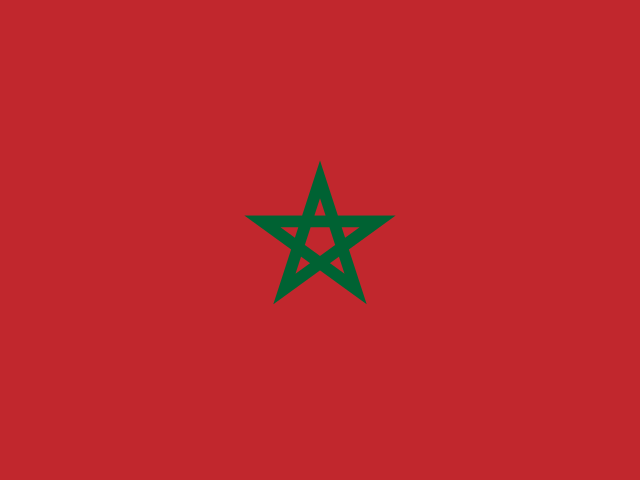
A red field bearing an open, interlaced green star of five points. Dahir 1-05-99 of 23 November 2005 fixes the cloth, the colours by name, the proportions and the star's geometry, and repealed the 1915 dahir that had added the star and called it the Seal of Solomon. Neither that dahir nor article 4 of the constitution, which names the flag as the emblem of the Kingdom, assigns the colour or the star any meaning. The red is conventionally linked to the Alaouite dynasty and the sharifs.
Morocco FACTS ◢
| Capital | Rabat |
|---|---|
| Continent | Africa |
| Population | 38,430,770 (2025) |
| Area | 446,550 km² |
| Population density | 86/km² |
| Currency | Moroccan dirham (MAD) |
| Official languages | Arabic, Tamazight |
| Calling code | +212 |
| Internet TLD | .ma |
| Time zone | UTC+01:00 |
| Drives on the | Right |
| ISO codes | MA / MAR |
DID YOU KNOW? ◢
- The medina of Fez is one of the world's largest car-free urban areas, a warren of thousands of narrow lanes.
- It sits just across the Strait of Gibraltar from Spain, with only about 13 kilometres of water between the two continents.
- The University of al-Qarawiyyin in Fez, founded in 859 AD, is often cited as the world's oldest continuously operating university.
- The blue-painted mountain town of Chefchaouen is famous for streets and buildings washed almost entirely in shades of blue.
Morocco QUICK ANSWERS ◢
What is the capital of Morocco?
The capital of Morocco is Rabat.
What is the population of Morocco?
Morocco had a population of 38,430,770 in 2025.
What currency does Morocco use?
Morocco uses the Moroccan dirham (MAD).
What languages are spoken in Morocco?
The official languages of Morocco are Arabic and Tamazight.
Think you know your flags? Play Flag Daily → · Browse all countries →
MORE ON THE FLAG ◢
Morocco's flag is red with a green five-pointed star, and the reason the star is there is written down. A dahir of Sultan Moulay Youssef, dated 17 November 1915, gives it in the preamble: the older flag could be confused with other flags, "en particulier avec ceux qui sont usités comme signaux dans la Marine".
That is a reason for the star. It is not a meaning for it, and no Moroccan instrument supplies one.
The flag today is not governed by the 1915 dahir at all. It is governed by a second dahir, number 1-05-99 of 23 November 2005, whose first article fixes the cloth, the colour, the proportions and the geometry of the star in six short paragraphs, and whose third article repeals the 1915 text outright. It assigns the flag no meaning either.
Key Takeaways
- Morocco's dahir of 17 November 1915 states its reason for adding the star: the older flag could be mistaken for other flags, and for naval signal flags in particular.
- The 1915 dahir called the charge the Seal of Solomon. It was repealed and replaced on 23 November 2005, and the replacement does not use the name.
- Dahir n° 1-05-99 of 2005 fixes the flag as bright red cloth carrying an open star of palm green, with a hoist two thirds of the fly and the star inside an invisible circle one sixth of the fly in radius.
- The sentence describing Morocco's flag is identical in its constitutions of 1970, 1996 and 2011. Only its article number moves, from 7 to 4.
- Morocco's own instruments never mention the five pillars of Islam. The two citations traceable behind the reading are a CIA World Factbook entry retired in February 2026, which in the same passage dates the design to 1912, and a commercial reference site. Neither is Moroccan.
Why is there a green star on Morocco's flag?
Because a plain red flag is hard to tell apart from other things flown at sea, and in 1915 the sultan's government said so in writing.
The instrument is a dahir of 9 moharrem 1334, 17 November 1915, published in the Bulletin Officiel of the French protectorate on 29 November under the heading "portant description du nouveau drapeau de l'Empire". Its preamble gives three grounds: the progress of the empire, the renown it had acquired, and the need to give it an emblem distinguishing it from other nations. Then it names the problem with the flag already in use.
The flag the sultan's ancestors had adopted could be confused with other flags, "en particulier avec ceux qui sont usités comme signaux dans la Marine". Signal flags at sea, specifically.
The operative part is one sentence long. "Nous avons décrété de distinguer Notre drapeau en l'ornant au centre du Sceau de Salomon à cinq branches, de couleur verte." We have decreed to distinguish Our flag by adorning it at the centre with the Seal of Solomon of five points, green in colour.
That sentence names the charge the Seal of Solomon, in the statute book, which no later Moroccan instrument does. And it explains why the star is there without once saying what it stands for.
The dahir was promulgated under the protectorate, and the countersignature at the foot of it is not a Moroccan one. "Vu pour promulgation et mise à exécution", Rabat, 25 November 1915, signed by the Ministre Plénipotentiaire delegated to the Résidence Générale, Saint-Aulaire. The design is the sultan's. The machinery that published it was French.
The law that describes Morocco's flag today was written in 2005
Almost every account of this flag stops at the constitution, quotes its one line, and concludes that Moroccan law says nothing further. That has been wrong for twenty years.
Dahir n° 1-05-99 of 20 chaoual 1426, 23 November 2005, is titled in Arabic for the خصوصيات علم المملكة, the characteristics of the flag of the Kingdom, and of the national anthem. It was published in the Bulletin officiel of 15 December 2005, in the Arabic édition générale at page 3379 and in the Kingdom's own French translation at page 834 of the same issue number.
Its first article restates the constitutional sentence and then adds five paragraphs of specification.
The cloth: "Le drapeau est en toile dite « grand teint », de couleur rouge vif, opaque et de forme rectangulaire."
The star: "L'étoile est ouverte, de couleur vert palmier, formée de cinq branches à tracé continu et tissée dans la matière." Open, palm green, five branches drawn in one continuous line, and woven into the material rather than printed on it, so that it reads from both sides of the flag.
The shape: "Le guindant du drapeau représente les deux tiers (2/3) de la longueur de son battant." The hoist is two thirds of the fly, which is the 3:2 rectangle.
The placement: the star sits inside an invisible circle whose radius is one sixth of the fly, centred on "le point d'intersection des lignes diagonales non apparentes du rectangle du drapeau". And each branch is one twentieth as wide as it is long.
That is a real specification, and it settles several things that otherwise circulate as guesswork. The star is open rather than solid because the law says so. Its five points interlace because the law says the branches are drawn "à tracé continu", in one unbroken line. It shows through the cloth because the law requires it to be woven in.
The 2005 dahir took the Seal of Solomon out of Moroccan law
Article 3 of the 2005 dahir is one sentence, and it is the sentence that changes what is true of this flag today.
The dahir "abroge et remplace le dahir du 9 moharrem 1334 (17 novembre 1915)". The Arabic is blunter: وينسخ ويعوض.
So the only Moroccan instrument that ever called the charge the Seal of Solomon was struck off the statute book in 2005, and its replacement does not use the name. The 2005 text calls it النجم, the star, and describes it by colour, form and geometry alone. The constitution calls it نجمة خضراء خماسية الفروع, a green five-branched star, and does the same.
The name has not stopped being true of the design. The 1915 dahir's own phrase is "du Sceau de Salomon à cinq branches", so the name it used is the five-pointed form of a figure with a long prior history under that name. What has stopped being true is that Moroccan law gives it that name. Anyone writing that the constitution calls the star the Seal of Solomon is citing the wrong instrument, and anyone citing the 1915 dahir for it is citing a repealed one.
The five pillars reading has no Moroccan state source
The most repeated sentence about this flag in English is that the five points stand for the five pillars of Islam. It is in neither dahir and in none of the three constitutions read for this page.
Its trail is short, and it runs out of Morocco quickly. The English Wikipedia article states the reading in its own voice and hangs two citations on it. The first is a dead link to the CIA World Factbook, whose archived capture of 15 January 2021 says of Morocco: "the pentacle represents the five pillars of Islam and signifies the association between God and the nation; design dates to 1912". The second is a commercial reference site, World Atlas, which served this machine a Cloudflare bot challenge rather than the page, so it could not be read here.
Neither is Moroccan, and the Factbook is gone. The Morocco entry's own URL now returns a 302 to a CIA notice dated 4 February 2026 that opens "One of CIA's oldest and most recognizable intelligence publications, The World Factbook, has sunset."
The dead citation also misdates the design. That same short passage puts the design at 1912, three years before the dahir that created it. Nineteen twelve is the year the protectorate began, not the year the star was added.
One more thing about that Wikipedia sentence. It says the red stands for "the blood of the ancestors and unity", and the Factbook capture does not contain that phrase. Which of its two citations carries it cannot be settled from here, because the other one never served its page.
None of this makes the five pillars reading false. Five points and five pillars is an old and obvious association. It makes it a popular reading with no Moroccan state source behind it, which is a different claim from the one usually printed. On a flag whose governing law is unusually detailed about everything else, the silence about meaning is worth reporting as a finding rather than filling in.
| Instrument | Date | What it does | What it says the flag means |
|---|---|---|---|
| Dahir portant description du nouveau drapeau de l'Empire | 17 November 1915 | Adds a green five-pointed Seal of Solomon at the centre of the flag, and gives its reason as confusion with other flags | Nothing |
| Constitution, article 7 | 1970 and 1996 | Names the red flag with a green five-pointed star as the emblem of the Kingdom | Nothing |
| Constitution, article 4 | 2011 | The same sentence, renumbered | Nothing |
| Dahir n° 1-05-99 | 23 November 2005 | Fixes cloth, colour, proportions and star geometry, and repeals and replaces the 1915 dahir | Nothing |
The Arabic original and the official French translation diverge
Moroccan law is made in Arabic and published in French translation, and both are official. Reading the pair is worth the trouble here, because the French adds in small ways.
The Arabic calls the flag علم, the ordinary word for a flag. The French renders it "emblème". The constitution does the same: article 4 opens علم المملكة, the flag of the Kingdom, and its official French opens "L'emblème du Royaume". Both official texts say Kingdom, and both describe a flag. An English version that turns this into the emblem of the State has departed from each of them, in two places at once.
The cloth clause diverges too. The Arabic gives three qualities of the cloth, opening ثوب أحمر قان, a deep red cloth, then adding that it is not transparent and rectangular in shape. The French gives four, adding "en toile dite « grand teint »", a French textile term for fast-dyed cloth that has no counterpart word on the Arabic line.
The French has one typographical slip that would matter if anyone drew from it alone: one of the star's points "dirigée vert le haut", green towards the top, where vers le haut is meant. The Arabic is unambiguous.
Neither text assigns the red, the green or the star any meaning. On that they agree exactly.
The colour is fixed by name, and by nothing else
The 2005 dahir gives the field as "rouge vif", bright red, and the star as "vert palmier", palm green. The Arabic gives the star's colour as أخضر كسعف النخيل, green like palm fronds.
Those are the whole of it. There is no Pantone reference, no textile standard, no coordinate and no annexed colour plate. Nor is there a construction sheet. The annex to the 2005 dahir is the national anthem, its Arabic words and then its score across several pages of the gazette, and there is no drawing of the flag anywhere in the instrument. The geometry sits entirely in the words of article 1.
So the hex values that circulate for this flag, the ones in the state's own published file included, are renderings of two colour names rather than a specification. Worth knowing before redrawing a flag from a colour chip, which is the sort of thing that catches people out in Flag Daily, where you get one flag a day and three guesses at the country.
The flag file the state publishes does not match the law the state wrote
The Moroccan national portal publishes the flag for download, as JPG, PNG, PDF and SVG. The SVG is a clean vector drawing: field #C1272D, star #006233.
It does not follow the dahir.
The file draws the field 2000 units wide and 1300 high. That is a hoist 0.650 of the fly, where article 1 of the 2005 dahir requires two thirds, 0.6667. To satisfy the dahir at that width the height would have to be 1333.33, so the published file falls 33.33 units short, about 2.5 per cent.
The star inside it is a regular pentagram, and its size does follow the law. Its five tips fit one circle to within 0.04 units, and that circle's radius is 332.39 against the 333.33 that the one sixth rule requires, a match to 0.28 per cent.
What does not follow is where that circle sits. The dahir puts its centre where the rectangle's diagonals cross, which on a 2000 by 1300 field is 650 units down. The file puts it at 676.9, about 27 units low. The two departures are related rather than independent: measured against the height the dahir requires, 1333.33, the same offset is 10 units rather than 27. The star misses that centre too, so a taller field would have reduced the error and not removed it.
None of that is visible to a reader at flag size, and none of it makes the file wrong as a picture of the flag. It does mean the file the Kingdom hands out is not a drawing of the flag the Kingdom's law describes, so anyone treating it as a construction sheet inherits both departures. The branch width rule, one twentieth of the branch length, was not tested here. Reading a branch width off an interlaced outline needs a judgement about which edges bound a branch, so it is left alone.
Three constitutions, one sentence, two article numbers
The constitutional wording has been stable, and reading three of them end to end is how you can say so.
The 1970 constitution, annexed to dahir n° 1-70-177 of 31 July 1970, gives it at article 7: "L'emblème du Royaume est le drapeau rouge frappé en son centre d'une étoile verte à cinq branches." The 1996 constitution gives the identical sentence, also at article 7. The 2011 constitution gives it again, word for word, at article 4.
Each of the three follows it immediately with the motto, DIEU, LA PATRIE, LE ROI, and none of the three adds a syllable of interpretation.
The 2005 dahir was made under the 1996 text and says so. It is issued "Vu la Constitution, notamment ses articles 7 et 19", and its first article opens "Conformément à l'article 7 de la Constitution". Since 2011 that cross-reference points at an article number the flag no longer occupies, which is untidiness rather than a defect: the sentence it points to is the same sentence.
One earlier link in the chain could not be checked. The 1962 constitution is usually said to have the same wording, and the 1970 promulgating dahir does abrogate "la constitution promulguée le 17 rejeb 1382 (14 décembre 1962)". But the 1962 gazette itself was not obtainable: both archived captures of it return 404, and the Secrétariat Général du Gouvernement's own site is unreachable from here. So the run of identical wording is established from 1970, not from 1962.
The 1915 dahir does not describe the flag it replaced
Less is documented here than gets written, and the 1915 dahir is careful in a way that later accounts are not.
The dahir refers to "le drapeau adopté par Nos ancêtres" and says it could be confused with other flags. It does not describe it. A plain red field is the reading that fits both the surviving depictions and the dahir's own complaint, since a plain red flag is exactly what would be lost among naval signals, but the instrument itself does not say the word.
The same goes for the red. That the red is the colour of the Alaouite dynasty, ruling since the seventeenth century, and of the sharifian descent it claims, is the standard account and it is very likely right. It is not in the 1915 dahir, not in the 2005 dahir, not in any of the three constitutions, and not on the national portal's own page for the flag, which carries the images and no text about them in any of its language versions. It is a convention with a long history and no Moroccan legal source, and it deserves to be written that way.
Plenty of flags are like this. Morocco's neighbour Algeria and its counterpart at the other end of the Mediterranean, Turkey, both have colour readings that circulate confidently and appear in no instrument either. What makes Morocco distinctive is the contrast inside its own law: a state that will legislate the weave of the cloth and the radius of an invisible circle, and will not say what the star is for.
Frequently asked questions
Why does Morocco's flag have a green star?
A dahir of Sultan Moulay Youssef dated 17 November 1915 added it, and gives its reasons in the preamble: the standing of the empire, the need for an emblem distinguishing it from other nations, and the risk that the older flag could be confused with other flags, signal flags at sea especially. The dahir explains why the star was added and never says what it represents.
Is the star on the Moroccan flag the Seal of Solomon?
The 1915 dahir called it that, in those words. That dahir was repealed and replaced by dahir n° 1-05-99 of 23 November 2005, which calls the charge simply the star and describes it by colour, form and geometry. So the design is the figure known as the Seal of Solomon, but no Moroccan instrument in force gives it that name.
Does the five pillars of Islam meaning come from Moroccan law?
No. It appears neither in the dahir of 17 November 1915 nor in dahir 1-05-99 of 2005, and in none of the three Moroccan constitutions read for this page. Its oldest traceable citation in English is the CIA World Factbook, which the CIA announced had sunset in a notice dated 4 February 2026, and whose archived Morocco entry dates the design to 1912 in the same sentence, three years before the dahir that created it.
What are the official colours of the Moroccan flag?
Dahir n° 1-05-99 gives them by name only. The field is "rouge vif", bright red, and the star is "vert palmier", palm green, given in the Arabic original as green like palm fronds. No colour standard, coordinate or reference is attached anywhere in the instrument, so any hex or Pantone value in circulation is an interpretation of two colour names.
What are the correct proportions of the Moroccan flag?
The hoist is two thirds of the fly, giving a 3:2 rectangle, and the star sits inside an invisible circle whose radius is one sixth of the fly, centred where the rectangle's diagonals cross. Each branch of the star is one twentieth as wide as it is long. All four rules are in article 1 of the 2005 dahir.
Sources
- Royaume du Maroc, Secrétariat Général du Gouvernement, Bulletin Officiel de l'Empire chérifien n° 162, 29 novembre 1915, page 838, "Dahir du 17 novembre 1915 (9 Moharrem 1334) portant description du nouveau drapeau de l'Empire". Read from a capture of 17 December 2025 in the Internet Archive, the live site being unreachable from here. The right margin of page 838 is clipped in the only scan that exists, and two of the runs quoted above end in characters reconstructed from it: the final s of "usités" and the final n of "Salomon". Retrieved 25 August 2026.
- Royaume du Maroc, Bulletin officiel n° 5378, 13 kaada 1426 (15 décembre 2005), édition de traduction officielle, page 834, "Dahir n° 1-05-99 du 20 chaoual 1426 (23 novembre 2005) relatif aux caractéristiques de l'emblème du Royaume et à l'hymne national". Read from a capture of 30 September 2022. Retrieved 25 August 2026.
- Royaume du Maroc, Bulletin officiel n° 5378 of 15 December 2005, Arabic édition générale, page 3379, the Arabic original of the same dahir and the authoritative text of it. Read from a capture of 8 February 2026. Retrieved 25 August 2026.
- Royaume du Maroc, Bulletin officiel n° 5964 bis, 28 chaabane 1432 (30 juillet 2011), page 1904, Constitution article 4, with the Arabic original at page 3602 of the same issue. Read from captures of 6 December 2022 and 20 May 2024. Retrieved 25 August 2026.
- Royaume du Maroc, Bulletin officiel n° 4420 bis, 26 joumada I 1417 (10 octobre 1996), page 644, Constitution article 7. Read from a capture of 19 August 2019. Retrieved 25 August 2026.
- Royaume du Maroc, Bulletin officiel n° 3013 bis, 31 juillet 1970, Constitution article 7, annexed to dahir n° 1-70-177. Read from a capture of 19 August 2019. Retrieved 25 August 2026.
- Royaume du Maroc, Emblèmes du Royaume du Maroc, the national portal's flag page and the SVG, PDF, PNG and JPG files it publishes. Retrieved 25 August 2026.
- Central Intelligence Agency, The World Factbook, Morocco flag description, cited only as the oldest traceable citation for the five pillars reading. Read from the capture of 15 January 2021 that the English Wikipedia article links; the live URL now redirects. Retrieved 25 August 2026.
- Central Intelligence Agency, Spotlighting The World Factbook as We Bid a Fond Farewell, 4 February 2026, the notice the Morocco flag entry's URL now returns a 302 to. Retrieved 25 August 2026.
- World Atlas, Flags, Symbols and Currencies of Morocco, the second of the two citations Wikipedia hangs on the five pillars sentence, cited as the object of a claim about whether it could be read. It served this machine a Cloudflare bot challenge rather than the page. Retrieved 25 August 2026.
- English Wikipedia, Flag of Morocco, revision 1367137326 of 1 August 2026, cited as the object of a claim about what it says and what it cites, not as an authority. Retrieved 25 August 2026.
PLAY ANOTHER →
Five questions a day. Everyone gets the same five.
FIVE QUESTIONSDAILYDaily CryptogramOne quote, one scrambled alphabet. Crack it before tomorrow.
CRACK THE QUOTEDAILYDaily CodeA short message, hidden in a different cipher every day.
ONE CIPHER A DAYDAILYGuess the CountryThree clues, three guesses. Work out where in the world it is.
THREE CLUES