
Equatorial Guinea
The only sovereign African nation with Spanish as an official language, split between a mainland chunk and a scatter of islands, with its capital sitting offshore rather than on the continent. Equatorial Guinea is a geographic oddity.
WHAT THE FLAG MEANS ◢
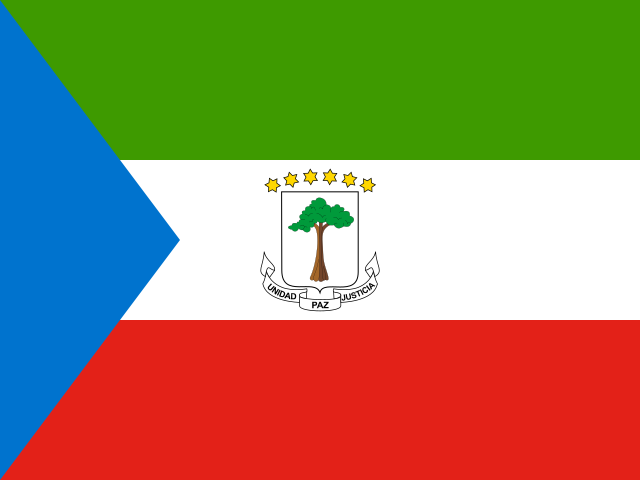
Green, white and red horizontal bands with a blue triangle at the hoist and the national coat of arms centred on the white band, its silk-cotton tree beneath six stars for the mainland and the islands of Bioko, Annobón, Corisco, Elobey Grande and Elobey Chico. Article 4 of the constitution describes the flag and assigns the colours nothing; the government's own information page reads green as the country's forest, white as peace, red as the blood of those who fought for independence, and blue as the sea that joins the mainland to the islands.
Source: guineaecuatorialpress.com
Equatorial Guinea FACTS ◢
| Capital | Ciudad de la Paz |
|---|---|
| Continent | Africa |
| Population | 1,938,431 (2025) |
| Area | 28,051 km² |
| Population density | 69/km² |
| Currency | Central African CFA franc (XAF) |
| Official languages | French, Portuguese, Spanish |
| Calling code | +240 |
| Internet TLD | .gq |
| Time zone | UTC+01:00 |
| Drives on the | Right |
| ISO codes | GQ / GNQ |
DID YOU KNOW? ◢
- It's the only African country where Spanish is an official language.
- Its historic capital, Malabo, sits on an island rather than the mainland.
- Despite the name, the equator doesn't actually pass through any of its territory.
- It's made up of a mainland region plus several islands in the Gulf of Guinea.
Equatorial Guinea QUICK ANSWERS ◢
What is the capital of Equatorial Guinea?
The capital of Equatorial Guinea is Ciudad de la Paz.
What is the population of Equatorial Guinea?
Equatorial Guinea had a population of 1,938,431 in 2025.
What currency does Equatorial Guinea use?
Equatorial Guinea uses the Central African CFA franc (XAF).
What languages are spoken in Equatorial Guinea?
The official languages of Equatorial Guinea are French, Portuguese and Spanish.
Think you know your flags? Play Flag Daily → · Browse all countries →
MORE ON THE FLAG ◢
Equatorial Guinea's flag is a horizontal tricolour, green over white over red, with a blue triangle at the hoist and the national coat of arms in the middle of the white band. Article 4.2 of the Ley Fundamental says that much, and then stops.
No green for the forest, no red for blood, no blue for the sea. The article gives the design, the next paragraph hands the shield to an ordinary law, and the one after that gives the motto. Nothing is explained.
So the meanings quoted for the Equatorial Guinea flag come from elsewhere: the government's own information pages, and a flag archive. Put the two official pages side by side and they tell the blue differently.
Key Takeaways
- Article 4.2 of the Ley Fundamental describes the flag in two sentences and assigns no meaning to any colour. The only other place the text touches it is Article 18, which requires everyone living in the Republic to respect the national ensigns.
- The government's institutional website says blue is the sea joining the mainland to the islands. The embassy in Venezuela says blue is the country's territorial waters.
- The embassy in Venezuela names the six territories the stars stand for, down to the adjacent islets. The government's own page says only "the six territories of the Republic" and names none of them.
- The constitution's own definition of national territory names four more islands than the arms have stars for, and three of those four were before the International Court of Justice into this century.
- Neither the 1973 draft constitution nor the Ley Fundamental of 2012 describes the coat of arms. Both leave it to ordinary law, and Flags of the World reports that the emblem was changed under Francisco Macías Nguema and the 1968 arms restored in 1979.
What do the colours on the Equatorial Guinea flag mean?
In law, nothing. Article 4.2 reads: "la bandera nacional es verde, blanca y roja, en tres franjas horizontales de iguales dimensiones y un triángulo azul en el extremo más próximo al mástil. En el centro de la bandera está grabado el Escudo de la República." The national flag is green, white and red, in three horizontal stripes of equal size, with a blue triangle at the end nearest the mast and the shield of the Republic engraved at the centre.
That is the whole legal definition, and it is a description. Across the text promulgated on 16 February 2012, which is the 1991 constitution as reformed in the referendum of 13 November 2011, the words bandera and escudo appear only in that article, and emblema, estrella and ceiba appear nowhere in it. The flag turns up once more, obliquely: Article 18 requires everyone living in the Republic to respect Equatorial Guinea, "sus enseñas nacionales", its national ensigns, the head of state, the government and the other lawfully constituted institutions. It says nothing about what those ensigns mean either.
Two official sources go further, and this is where the familiar readings come from. Both are translated here from the Spanish.
| Colour | Government institutional website | Embassy of Equatorial Guinea in Venezuela |
|---|---|---|
| Green | The country's rich forest | Vegetation and the country's forest wealth |
| White | Peace | The peace desired by the people |
| Red | The blood of those who fought for independence | The blood of the martyrs who gave their lives for independence |
| Blue | The sea joining the continental and island zones | The country's immense, rich territorial waters |
Three rows agree. Blue does not. One reading makes the triangle a statement about the shape of the country, a strip of sea holding a mainland and a scatter of islands together in the same gulf as São Tomé and Príncipe. The other makes it a claim over water. Neither page says why it chose its wording, and neither mentions hydrocarbons, though Article 3.2 of the same constitution reserves to the state the exclusive exploitation of the country's mineral wealth and its hydrocarbons.
Two cautions about that second column. The embassy's flag paragraph matches, word for word, a piece published on 16 November 2018 by CPDS, a party that describes both post-independence governments as dictatorships, so the two are not independent witnesses; their paragraphs on the shield, by contrast, are not identical, and the CPDS version names five things for six stars.
A third reading differs from the government's on two of the four colours and from the embassy's on three. Flags of the World carries a note by Željko Heimer of 14 December 1995 giving green as the natural resources and the flora and fauna of the country, and red as "the struggle for independence" rather than as anyone's blood; his blue and white match the government's, and his blue does not match the embassy's. That note is a flag hobbyist's summary written in 1995, not an Equatoguinean statement, and neither of the two official Equatoguinean pages gives green or red that way.
Why does the Equatorial Guinea flag have six stars?
Because the country was defined as six pieces. The embassy's page names them: the Continental Region, Bioko, Annobón, Corisco, Elobey Grande and the islet of Elobey Chico, with the adjacent islets. One star each for a mainland and five islands. The government's own page says only that the six six-pointed stars represent "los seis territorios de la República de Guinea Ecuatorial y las islas adyacentes", the six territories of the Republic and the adjacent islands, and names none of them.
That count is old, and it is still the count on the flag. A draft constitution written under Macías Nguema, headed Proyecto de una nueva Constitución and dated Bata, 10 July 1973, defines the territory at its Article 5 as Río Muni plus Fernando Poo, Annobón, Corisco, Elobey Grande, Elobey Chico and adjacent islets. Six units, six stars. Bioko was still called Fernando Poo, and the text provides for the repeal of the constitution of 22 June 1968.
That draft is quoted here from a printing in the Bata paper La Libertad, reproduced in Spain by the Revista de Política Internacional in its issue for November and December 1973. Its own final provisions make it conditional on approval in a popular referendum, and no promulgated copy could be reached, so the article numbering may differ from the enacted text.
The Ley Fundamental in force does not match. Its Article 3.1 adds Mbañe, Conga, Leva and Cocotero: four more names than the arms have stars for, and three of the four were argued over into this century. The International Court of Justice heard Gabon and Equatorial Guinea on the three the constitution calls Mbañe, Cocotero and Conga, which the Court calls Mbanié, Cocotiers and Conga, and delivered judgment on 19 May 2025.
The Court publishes that judgment only as a PDF, which could not be retrieved for this article. The holding here is therefore taken from a commentary by Andreas Giorgallis, published by EJIL: Talk! on 17 July 2025. He reports that a 1974 document said to have been signed at Bata was declined as a treaty, so the case turned on the 1900 Franco-Spanish convention. On the sovereignty question, the Court treated the three islands as a single unit because of their proximity to Corisco, and found that Spain's title over them, resting on a continuous and uncontested display of authority that France and later Gabon accepted, passed to Equatorial Guinea at independence.
Which pulls one of the six stars into the case. Corisco is one of the six territories the stars stand for, and the islands whose sovereignty the Court decided are its neighbours.
What is the tree on the Equatorial Guinea flag?
A ceiba, also called the silk-cotton tree or kapok, Ceiba pentandra. Spain's national research council, the CSIC, describes it in its Equatorial Guinea flora pages as a tree of 30 to 40 metres with a trunk braced by buttresses, spiny when young, its seeds wrapped in the silky fibre called kapok. It records the local names, dum in Fang and búbá in Bubi, and says the tree is held sacred and appears as a symbol on the flag of Equatorial Guinea.
Where the species comes from is not settled between the sources here. The CSIC page says it originated in tropical America and is now one of the commonest trees of secondary forest in Río Muni, on Bioko and on Annobón. Ivan Sache, writing on Flags of the World on 10 October 2010, gives its native range as Mexico, Central America and the Caribbean and West Africa as well, which would make it native where it flies. Sache's note adds that the kapok is the national tree of Guatemala and of Puerto Rico, so whichever way its origins run, it is a national symbol on both sides of the Atlantic.
The tree's place on the arms is told two ways on that one page, by two contributors. Heimer's note says the tree marks where the first treaty was signed between Spain and a local ruler. Sache's says the arms are based on those granted by the King of Spain to the town of Bata, and that the kapok was nicknamed the "Tree of the Gods" in the nineteenth century because the Bonkoro swore loyalty to the Spanish Crown under such a tree.
Sache credits that second account to the Equatoguinean government's own website. The page the government served on 14 August 2026 carries none of it, and no archived capture carrying it could be found, so an account Sache read on the government's own site survives only as a flag archive's summary of it. No law setting out the arms is published anywhere reachable for this article either, although Article 4.3 delegates the shield to exactly such a law.
One more oddity. The government's own summary of the flag and shield describes a silver field, six six-pointed stars and the motto on a scroll, and never mentions the tree at all.
Did the flag change under Macías Nguema?
The shield did. Neither the 1973 draft nor the Ley Fundamental draws the coat of arms; both say only that the shield is the one the law establishes.
That 1973 text kept the flag adopted at independence on 12 October 1968 without describing it either. Its Article 1 says only that the national ensign is the flag adopted on the day independence was proclaimed. Flags of the World reports that under Macías Nguema the emblem on the flag was changed, and dates the dictatorship 1972 to 1979; which instrument did it, and under which constitution, is not something the sources used for this article can settle.
What stood in its place is the gap in the record. The same archive says only that the original 1968 arms were restored after Macías Nguema was deposed in August 1979, and dates the restored arms, and the flag, to 21 August 1979. No Equatoguinean source reachable for this article publishes the design that came between.
The official Equatoguinean account skips the interruption entirely. The government's institutional page says the coat of arms was approved on 12 October 1968 and stops there. The CPDS article, which is not an official source, gives the same date. Neither mentions a replacement, a restoration or 1979.
Even the motto is punctuated three ways. Article 4.4 of the Ley Fundamental gives it as "Unidad, Paz y Justicia", and the 1973 draft used the conjunction too; the government's page and the embassy both print it without the conjunction, as "Unidad, Paz, Justicia"; Flags of the World sets the three words apart with dashes.
Is there an official specification for the flag?
None that anyone has found. Christopher Southworth, writing on Flags of the World on 20 February 2015, said that as far as he could discover there are no official specifications for Equatorial Guinea, and that the flag books he had seen mostly differ on the length of the triangle and the position of the arms. Read against Article 4.2, that is unsurprising: the article fixes three equal horizontal bands and puts a blue triangle at the mast end, and it does not say how far the triangle reaches, how large the shield is, what proportions the flag has, or what shade any of the colours should be.
The gap fills up with third-party numbers instead, and they disagree. Flags of the World reports the Album des pavillons of 2000 giving a blue approximating Pantone 312c, other references a navy blue, and the London 2012 Olympic protocol manual a different blue again. None of them is a government standard.
The plain tricolour with no shield has the same problem, and Flags of the World's contributors do not agree about what it is. The 2000 Album des pavillons is reported there as listing it as an unofficial variant for a civil flag and ensign; Zoltan Horvath, writing there on 28 May 2024, argues instead that it is a historical flag used between 1968 and 1973, and that the French naval books illustrating it as a variant are mistaken. What is documented either way is that the design was settled late. Jos Poels records that parliament agreed the design on 8 October 1968, four days before independence, that newspaper descriptions from those days give the flag without the coat of arms, and that photographs from the independence ceremonies in Santa Isabel, now Malabo, show flags flying with no shield on them.
Frequently asked questions
Does Equatorial Guinea's constitution say what the flag colours mean?
No. Article 4.2 of the Ley Fundamental describes green, white and red stripes, a blue triangle at the hoist and the shield of the Republic at the centre, and assigns no meaning to any colour. The readings in circulation come from government information pages and from the flag archive Flags of the World, not from the constitutional text.
Article 4.3 sends the shield itself to an ordinary law, and no such law could be found published online for this article.
What do the six stars on the coat of arms represent?
Six territories. The embassy in Venezuela names them as the Continental Region and the islands of Bioko, Annobón, Corisco, Elobey Grande and Elobey Chico. The government's own site says only "the six territories of the Republic and the adjacent islands", naming none.
What kind of tree is on Equatorial Guinea's flag?
A ceiba, or silk-cotton tree, Ceiba pentandra, whose seed fibre is kapok. The CSIC's flora pages record it as a sacred tree and a symbol on the flag. Its native range is given differently by the sources used here: the CSIC says tropical America, while a Flags of the World contributor includes West Africa.
When was the flag adopted?
At independence on 12 October 1968. Flags of the World reports that the arms at its centre were replaced during the Macías Nguema years and restored afterwards, and dates the current flag and arms to 21 August 1979. The government's own page dates the arms to 12 October 1968 and does not mention the interruption.
Is there an Equatorial Guinea flag without the coat of arms?
Photographs from the 1968 independence ceremonies show flags without the coat of arms, and one newspaper photograph from those days shows plain stripes with no triangle either. Neither form is what Article 4.2 defines: the constitutional flag carries the shield.
Sources
- Government of Equatorial Guinea, Oficina de Información y Prensa, Ley Fundamental de Guinea Ecuatorial, promulgated 16 February 2012 - retrieved 14 August 2026.
- Government of Equatorial Guinea, Himno, Bandera y Escudo - retrieved 14 August 2026.
- Embassy of the Republic of Equatorial Guinea in Venezuela, Símbolos Patrios - retrieved 14 August 2026.
- Constitute Project, Equatorial Guinea 1991 (rev. 2012), English text, used to check the translations from the Spanish above and for the 1991 base date - retrieved 14 August 2026.
- Centro de Estudios Políticos y Constitucionales, La nueva Constitución de la Guinea Ecuatorial, Revista de Política Internacional no. 130, November to December 1973, reproducing a draft text dated Bata, 10 July 1973 - retrieved 14 August 2026.
- CSIC, Museo Virtual de la Ciencia, Biodiversidad en Guinea Ecuatorial: Ceiba pentandra - retrieved 14 August 2026.
- Flags of the World, Equatorial Guinea, page last modified 16 August 2025 - retrieved 14 August 2026.
- CPDS, Los Símbolos de la República de Guinea Ecuatorial, La Verdad, 16 November 2018 - retrieved 14 August 2026.
- International Court of Justice, Land and Maritime Delimitation and Sovereignty over Islands (Gabon/Equatorial Guinea), case 179 - retrieved 14 August 2026.
- EJIL: Talk!, A Commentary on the Land and Maritime Delimitation and Sovereignty over Islands (Gabon/Equatorial Guinea) (2025) - retrieved 14 August 2026.
PLAY ANOTHER →
One quote, one scrambled alphabet. Crack it before tomorrow.
CRACK THE QUOTEDAILYDaily TriviaFive questions a day. Everyone gets the same five.
FIVE QUESTIONSDAILYOn This DayOne thing that happened today in history. Every day, a new one.
TODAY IN HISTORYDAILYDaily CodeA short message, hidden in a different cipher every day.
ONE CIPHER A DAY